
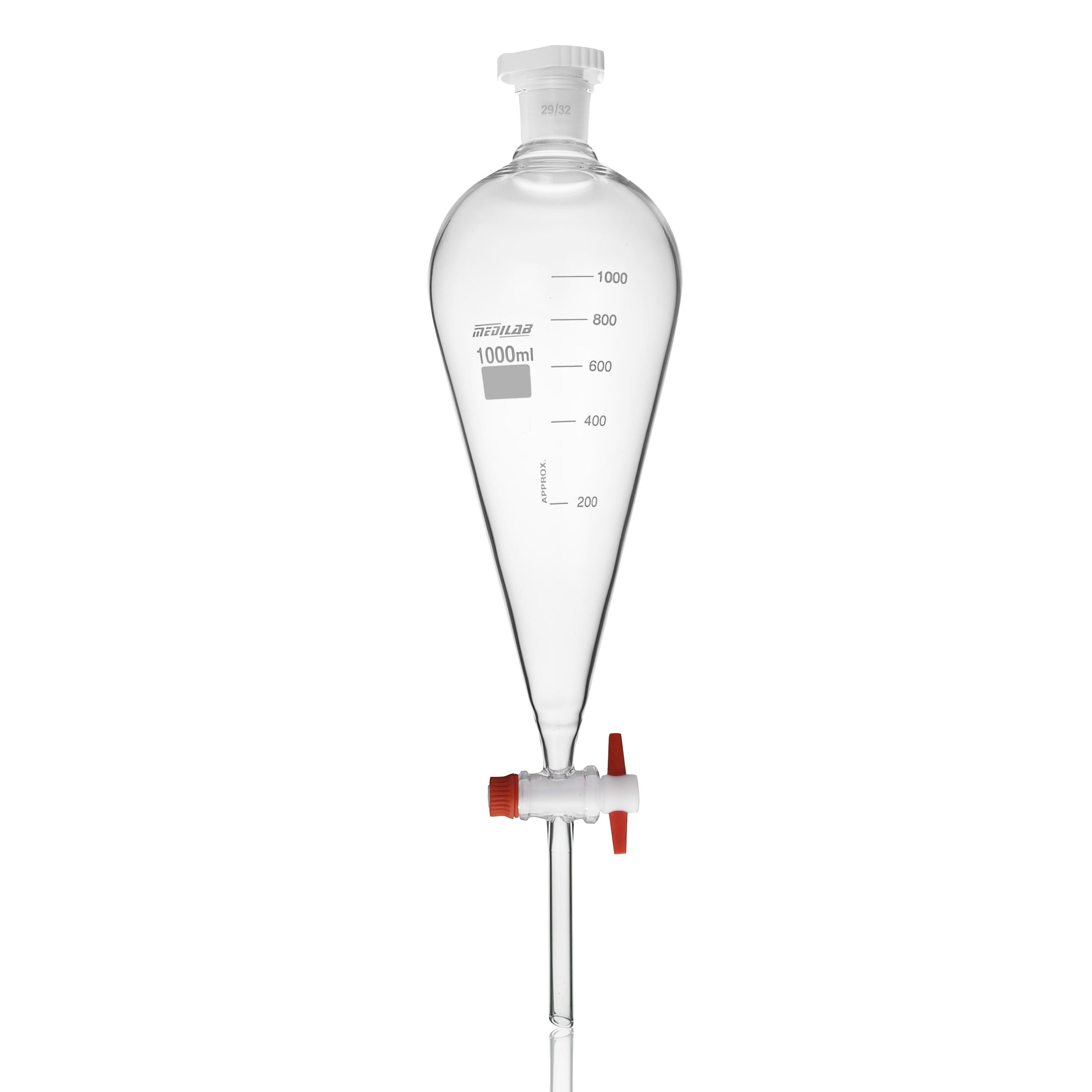
Description
| Catalog No. | Capacity ml | N/S | Bore (mm) | Stopcock Type |
| 11302/1 | 50 | 19/26 | 2.5 | PTFE |
| 11302/2 | 100 | 19/26 | 2.5 | PTFE |
| 11302/3 | 250 | 29/32 | 4 | PTFE |
| 11302/4 | 500 | 29/32 | 4 | PTFE |
| 11302/5 | 1000 | 29/32 | 6 | PTFE |
| 11302/6 | 2000 | 29/32 | 6 | PTFE |
The MEDILAB Separating Funnel, Squibb Shape, PTFE Key Stopcock is a precision glassware tool designed for efficient liquid–liquid separation. Its Squibb (conical) shape ensures clear phase separation, while the PTFE key stopcock allows smooth, leak-free flow control. This funnel is essential in chemical, pharmaceutical, and analytical laboratories where accuracy, safety, and reliability are critical.
Key Features
- Squibb (conical) shape for faster and clearer phase separation
- PTFE key stopcock for precise, chemical-resistant flow control
- Leak-proof design with smooth operation
- Clear graduation for approximate volume reference
- High resistance to chemical attack and thermal stress
- Suitable for routine and advanced laboratory applications
Material Specifications
- Material Type: Premium borosilicate laboratory glass
- Thermal Properties: Excellent resistance to heat and thermal shock
- Chemical Resistance: Highly resistant to acids, alkalis, and organic solvents
- Mechanical Strength: Uniform wall thickness for safe handling
- Standards Compliance: Manufactured in accordance with ISO 4800 laboratory standards
Technical Specifications
- Available Capacities: As per the standard size table
- Shape: Squibb (conical) separating funnel
- Stopcock: PTFE key stopcock
- Stopper: Supplied with polyethylene (PE) stopper
- Graduation: Clearly marked, non-calibrated scale
- Accuracy Class: Not for volumetric measurement
Handling & Precautions
- Ensure the stopcock is properly closed before filling
- Avoid overtightening the PTFE key to prevent wear
- Clean with suitable laboratory detergents after use
- Autoclavable under standard laboratory conditions
- Avoid sudden temperature changes
- Store vertically in a secure stand or rack
Applications
- Liquid–liquid extraction and phase separation
- Organic and analytical chemistry workflows
- Pharmaceutical research and formulation labs
- Biotechnology and chemical processing laboratories
- Academic teaching and research institutions
- Quality control (QC) and quality assurance (QA) testing