

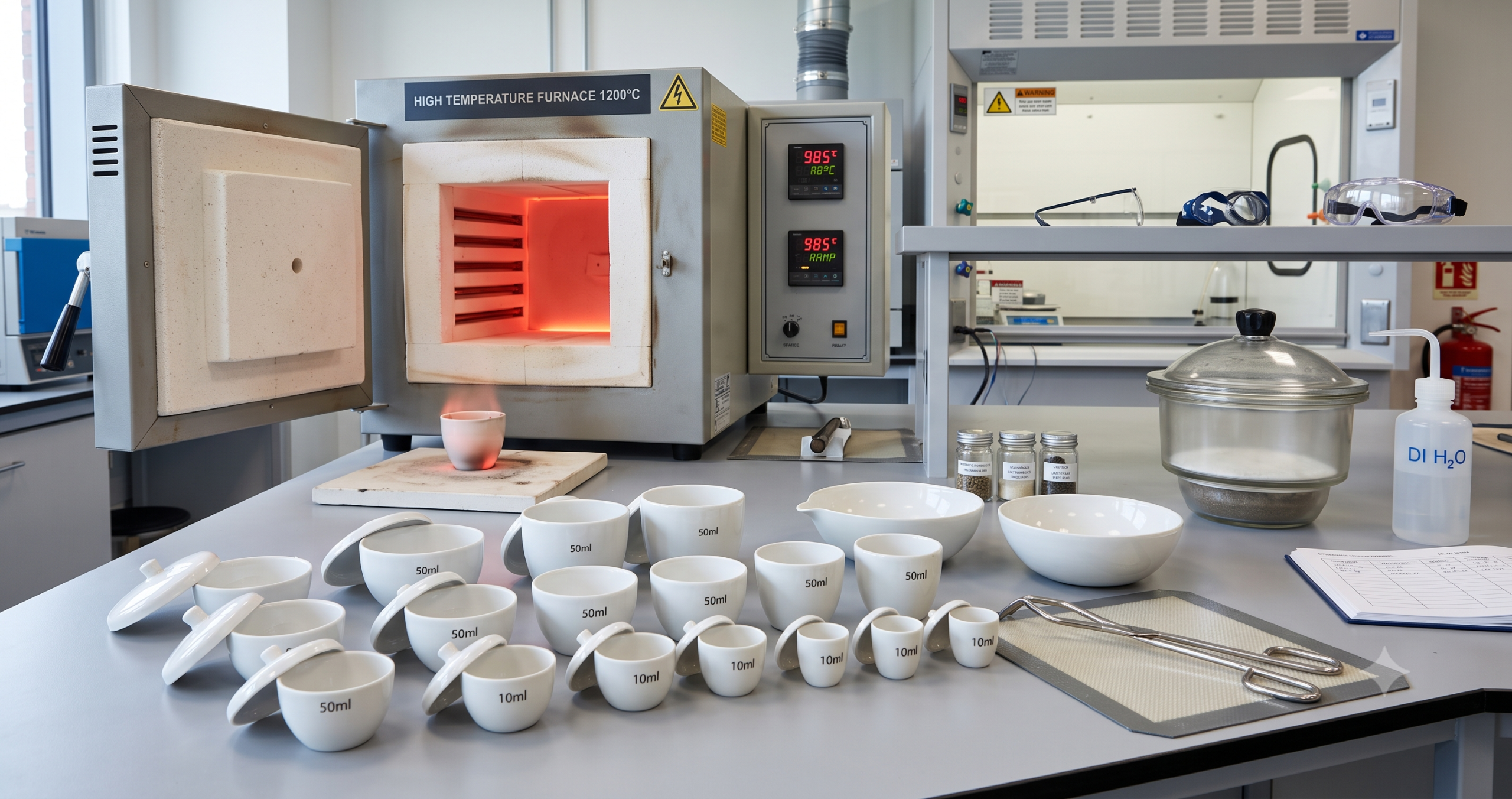
Porcelain labware gets overlooked in most material selection conversations, which default straight to a choice between borosilicate glass and plastic. That default is a mistake for a specific but common set of laboratory operations: anything involving sustained high temperature, direct flame, or chemical fusion, where both glass and plastic reach a hard physical limit that porcelain does not.
This guide covers eight applications where porcelain labware is the correct material choice, not a substitute or a budget alternative: crucibles for gravimetric ignition, evaporating dishes, spot test plates, combustion boats, high-temperature filter funnels, mortars and pestles, muffle furnace trays, and fusion dishes. For each application, we compare porcelain directly against glass and plastic on the properties that actually determine performance, maximum working temperature, thermal shock tolerance, chemical resistance, and mechanical hardness, so the choice is based on the physics of the application rather than habit.
Medilab Exports Consortium manufactures laboratory glassware and porcelain ware as part of our broader institutional supply range, and we regularly help procurement teams and lab managers work through exactly this material selection question. This guide reflects the same evaluation criteria we walk customers through when a specification calls for high-temperature or chemically aggressive conditions that fall outside what glass or plastic can reliably handle.
Why Porcelain Labware Exists as a Separate Material Category
Porcelain labware is a fired ceramic, typically an alumina-silicate composition, manufactured at kiln temperatures far above what any glass-forming or plastic-molding process reaches. This gives porcelain a maximum continuous use temperature well above borosilicate glass, and a chemical inertness to molten flux and fusion conditions that would soften or attack glass and destroy plastic outright. Where glass and plastic are chosen for precision, transparency, and general chemical compatibility, porcelain is chosen specifically for what happens at the temperature and chemical extremes neither material can survive.
The trade-off is real and worth stating plainly: porcelain is opaque, so you cannot observe a reaction in progress the way you can in glass, and it has lower thermal shock resistance than borosilicate, meaning rapid temperature changes can crack it even though its maximum temperature ceiling is much higher. Choosing porcelain labware correctly means matching these specific trade-offs to an application where they do not matter, and where the alternative materials would simply fail.
Application 1: Crucibles for Gravimetric Ignition
Gravimetric analysis frequently requires igniting a precipitate to a constant weight at temperatures between 800 and 1200 degrees C, conditions that would soften borosilicate glass and destroy any plastic. Porcelain labware crucibles are the standard choice for this application precisely because porcelain maintains its structural integrity and chemical stability at these temperatures, allowing repeated heating and cooling cycles over the course of an ignition-to-constant-weight procedure without degrading the sample or the vessel.
Glass crucibles simply cannot reach the temperatures gravimetric ignition requires, and plastic crucibles do not exist for this application because no common laboratory plastic survives anywhere near the required temperature range. This is one of the clearest cases where material choice is not a preference but a hard physical requirement.
Application 2: Evaporating Dishes
Evaporating dishes are used to evaporate solvents from a solution, often over a direct flame or hot plate at temperatures that can approach or exceed the safe working limit of borosilicate glass, particularly when a solution is evaporated to near-dryness and the dish briefly reaches a higher temperature than the liquid itself. Porcelain evaporating dishes tolerate this end-stage heating without the risk of thermal failure that pushing a glass dish to the same temperature carries.
Plastic evaporating dishes are impractical for nearly any application involving heat, since most laboratory plastics deform or melt at a small fraction of the temperatures reached during solvent evaporation, particularly the final drying stage where porcelain labware reliably outperforms both alternatives.
Application 3: Spot Test Plates
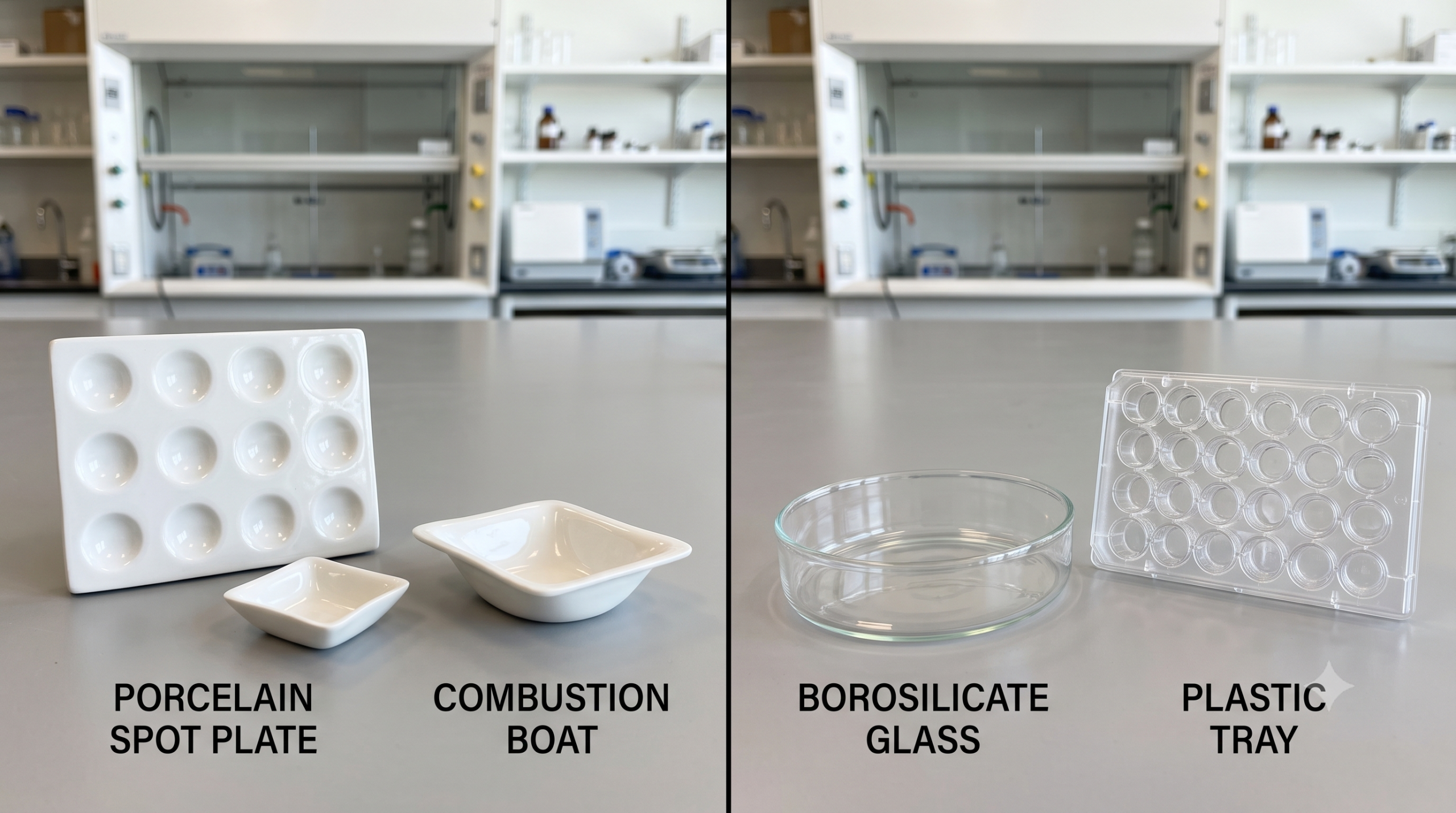
Spot plates are used for qualitative spot tests, small-scale reactions performed directly on the plate surface to observe a color change or precipitate formation. Porcelain spot plates, particularly in white or black glaze, provide strong visual contrast against colored precipitates and reaction products, an advantage that clear glass does not offer and that plastic, prone to staining and chemical attack from repeated reagent contact, does not maintain over repeated use.
Porcelain’s chemical inertness also means the plate does not absorb or react with the small reagent volumes used in spot testing, preserving accuracy across repeated tests in a way that a stained or chemically degraded plastic spot plate cannot match over its service life.
Application 4: Combustion Boats
Combustion boats hold solid samples during combustion analysis, elemental analysis, or thermogravimetric procedures where the sample is heated to high temperatures inside a furnace tube. Porcelain labware combustion boats withstand the sustained high heat of these procedures directly, a requirement that immediately rules out both glass, which cannot survive furnace-tube temperatures, and plastic, which would combust or melt well before the sample reaches analytical temperature.
Alumina and other advanced ceramics are sometimes used for even higher-temperature combustion work, but porcelain remains the standard, cost-effective choice for the majority of routine combustion analysis procedures conducted at temperatures within its stated working range.
Application 5: High-Temperature Filter Funnels
Porcelain Buchner-style filter funnels are used for vacuum filtration involving hot solutions or aggressive chemical conditions where a plastic funnel would soften, deform, or chemically degrade. Where a standard glass Buchner funnel handles most routine vacuum filtration adequately, a porcelain equivalent is preferred when the filtrate is hot enough to stress glass repeatedly over the funnel’s service life, or when the sample involves fusion residues or strongly alkaline slurries that porcelain tolerates more reliably over time.
Porcelain labware funnels are also naturally resistant to the staining and gradual surface degradation that some aggressive filtrates cause in plastic funnels over repeated use, preserving consistent filtration performance across a longer service life.
Application 6: Mortars and Pestles
Grinding and homogenizing solid samples requires a hard, abrasion-resistant surface, a property porcelain has in clear abundance and plastic entirely lacks. A plastic mortar and pestle wears down quickly under any serious grinding load and can contaminate the sample with abraded plastic particles, while porcelain’s hardness allows repeated, vigorous grinding without significant wear or sample contamination.
Glass mortars and pestles exist for very light-duty grinding of soft materials, but porcelain is the standard choice whenever the sample requires genuine mechanical grinding force, since porcelain’s hardness withstands this mechanical stress far better than glass, which is prone to chipping and fracture under repeated grinding pressure.
Application 7: Muffle Furnace Trays
Muffle furnaces operate at sustained temperatures from several hundred to over a thousand degrees C for ashing, calcination, and heat treatment procedures. Any tray or dish placed inside a muffle furnace must tolerate the furnace’s operating temperature directly, which eliminates both glass and plastic as viable options for the majority of muffle furnace operating ranges. Porcelain labware trays are manufactured specifically to tolerate this sustained high-temperature environment across repeated use cycles.
Because muffle furnace heating and cooling cycles are typically gradual rather than rapid, porcelain’s relatively lower thermal shock resistance compared to borosilicate glass is not a practical limitation in this application, since the furnace itself is not usually programmed to change temperature quickly enough to stress the porcelain tray.
Application 8: Fusion Dishes
Fusion analysis, dissolving a solid sample in a molten flux at very high temperature to prepare it for subsequent analysis, requires a vessel that survives direct contact with molten flux material at temperatures that would immediately destroy glass and plastic alike. Porcelain fusion dishes are formulated to withstand this specific chemical and thermal combination, though for the most aggressive flux chemistries, platinum or specialized ceramic crucibles are sometimes required instead of standard porcelain.
For the majority of routine fusion procedures within standard temperature and flux chemistry ranges, porcelain labware fusion dishes remain the standard, cost-effective option, reserving platinum or specialized ceramics for the specific fusion chemistries that would otherwise attack a standard porcelain glaze.
Porcelain vs Glass vs Plastic: A Property Comparison
The table below summarizes the core material properties that should drive a porcelain labware selection decision against borosilicate glass and common laboratory plastics. Use it as a quick reference whenever a specification or procedure calls for conditions near the edge of what glass or plastic can reliably tolerate.
| Property | Porcelain | Borosilicate Glass | Common Laboratory Plastic |
|---|---|---|---|
| Maximum Continuous Temperature | Approx. 1200-1400 degrees C | Approx. 500 degrees C | Approx. 120-260 degrees C (varies by polymer) |
| Thermal Shock Resistance | Moderate to low (gradual heating/cooling required) | Excellent | Good, but limited by low maximum temperature |
| Chemical Resistance (Fusion/Molten Flux) | Good for standard flux chemistries | Not suitable | Not suitable |
| Chemical Resistance (Strong Acids) | Excellent | Excellent (except HF) | Excellent for PTFE; variable for other polymers |
| Mechanical Hardness / Abrasion Resistance | High | Moderate | Low |
| Transparency | Opaque | Transparent | Variable (often translucent or opaque) |
| Relative Cost | Low to moderate | Moderate | Low |
How to Choose the Right Material for Your Application
Selecting porcelain labware over glass or plastic comes down to three questions applied in sequence. First, does the procedure require sustained temperatures above roughly 500 degrees C, or direct flame contact, or molten flux conditions? If yes, porcelain or a specialized ceramic is required, since glass and plastic are eliminated by the temperature requirement alone. Second, is rapid heating or cooling part of the procedure? If yes and the temperature also exceeds borosilicate’s range, a gradual-heating protocol or a more thermal-shock-tolerant ceramic than standard porcelain may be needed. Third, does the application involve mechanical grinding or abrasion? If yes, porcelain’s hardness makes it the clear choice over both plastic and glass.
For applications that fall within glass’s temperature and thermal shock tolerance, our guide on laboratory glassware quality standards remains the right reference for selecting and specifying the correct glassware. If your procurement decision spans both glassware and porcelain ware across a full laboratory setup, our overview of lab supplier consolidation covers how sourcing multiple material categories from one qualified supplier simplifies documentation and quality verification across your full equipment list. For guidance on vetting a new porcelain or ceramic ware supplier specifically, our framework to evaluate a lab supplier remotely applies the same certificate verification and sample testing principles regardless of material category.
Frequently Asked Questions
For gravimetric ignition at temperatures above roughly 500 degrees C, yes, porcelain is not just better but necessary, since borosilicate glass cannot survive the temperatures gravimetric ignition typically requires. Porcelain labware crucibles are the standard choice for this application because there is no glass alternative capable of reaching the same temperature range without failing.
Not as well as borosilicate glass. Porcelain has a higher maximum working temperature than glass, but lower thermal shock resistance, meaning it should be heated and cooled gradually rather than subjected to sudden temperature swings. This is an important distinction: porcelain’s advantage is its temperature ceiling, not its tolerance for rapid change, and procedures using porcelain labware should account for this by allowing gradual heating and cooling cycles.
Plastic is genuinely the better and more cost-effective choice for a wide range of laboratory applications that do not involve high heat, direct flame, or fusion chemistry. The applications covered in this guide are specifically the ones where plastic’s low maximum temperature and low mechanical hardness make it unsuitable, which is exactly why porcelain labware exists as a distinct category rather than a redundant alternative to plastic.
Porcelain is chemically inert to most laboratory acids and to standard fusion flux chemistries, which is why it is the standard material for crucibles and fusion dishes. It is not suitable for hydrofluoric acid, which attacks the silicate structure of porcelain in the same way it attacks glass, and highly aggressive flux chemistries may still require platinum or specialized ceramic vessels instead of standard porcelain labware.
Opacity is the most significant practical disadvantage: porcelain does not allow visual observation of a reaction or sample in progress, which glass provides by default. Porcelain also has lower thermal shock resistance than borosilicate glass and is more brittle under mechanical impact, meaning porcelain labware should be handled with the same care given to preventing sudden drops or impacts that would be less consequential for a comparably sized plastic item.
For most routine teaching lab exercises, glass and plastic remain the practical default, but any experiment involving direct flame ignition, evaporation to dryness, or qualitative spot testing benefits from having porcelain labware available specifically for those steps. Equipping a teaching lab with a modest set of porcelain crucibles, evaporating dishes, and spot plates alongside standard glassware covers the applications where porcelain is the correct rather than optional choice.
Yes. Medilab Exports Consortium supplies porcelain crucibles, evaporating dishes, spot plates, and related high-temperature laboratory ware alongside our core borosilicate 3.3 glassware range, allowing institutional buyers to source both material categories from a single qualified supplier. Contact us to request a catalog covering our full porcelain labware and glassware range.
Source Porcelain Labware and Glassware from One Supplier
Medilab Exports Consortium supplies porcelain labware, including crucibles, evaporating dishes, spot plates, and combustion boats, alongside our ISO-certified borosilicate 3.3 glassware range. Request a catalog covering both material categories for your next high-temperature application.
