
Lab supplier consolidation rarely shows up as a line item on a procurement budget, which is exactly why most laboratories underestimate what fragmented sourcing actually costs them. A hospital central store ordering glassware from one vendor, plasticware from another, instruments from a third, and PPE from a fourth is not comparing four invoices. It is absorbing four sets of coordinator hours, four documentation formats, four freight bills, and four different quality baselines, none of which appear on the purchase order.
This guide breaks down the real cost structure of multi-vendor lab sourcing against a consolidated single-supplier model: coordinator and administrative time, documentation variation across vendors, freight and logistics inefficiency, and QC inconsistency between suppliers. We use actual cost categories that procurement teams can apply to their own vendor list, not abstract efficiency claims. Understanding where lab supplier consolidation saves money, and where it does not, lets a procurement manager make the case with numbers instead of intuition.
Medilab Exports Consortium built its business on borosilicate 3.3 laboratory glassware for 60+ years and has since expanded into an 8-category laboratory supply range covering plasticware, diagnostic consumables, measuring instruments, sterilization equipment, lab furniture, and PPE. We work with institutional buyers across 40+ countries who are actively evaluating lab supplier consolidation as a cost-reduction strategy, and this guide reflects the cost breakdowns we walk procurement teams through during that evaluation.

Why Multi-Vendor Lab Sourcing Costs More Than the Invoice Shows
Procurement teams compare vendors on unit price because unit price is visible and easy to benchmark. The costs that lab supplier consolidation addresses are almost all invisible on a per-order basis: they accumulate in staff hours, delayed shipments, rejected batches, and audit gaps that only become obvious when someone adds them up across a full budget year. A lab running six or seven active vendors for glassware, plasticware, instruments, consumables, PPE, and furniture is running six or seven parallel administrative processes, each with its own order cycle, invoice format, and quality standard.
None of this is a criticism of any individual vendor. A specialist plasticware supplier may offer excellent pricing on plasticware, and a specialist instrument distributor may offer strong service on instruments. The cost is structural, not vendor-specific: it is the overhead of managing the seams between vendors rather than the vendors themselves. Lab supplier consolidation does not eliminate the need for quality vendors; it eliminates the seams.
The next four sections quantify those seams in the categories that show up most consistently when we review a procurement team’s full vendor list: coordinator time, documentation, freight, and QC variance. A fifth section brings them together into a total cost of ownership comparison that procurement managers can adapt to their own volumes.
Cost 1: Coordinator and Administrative Time
Every additional active vendor adds a fixed administrative load regardless of order size: a separate purchase order workflow, a separate approval chain, separate vendor master data in the ERP system, separate invoice reconciliation, and separate relationship management for quotes, follow-ups, and dispute resolution. A procurement coordinator managing one supplier across 8 product categories processes one PO cycle. The same coordinator managing 8 specialist vendors, one per category, processes eight PO cycles, eight sets of approvals, and eight invoice reconciliations for the same total spend.
Where the Hours Actually Go
Institutional procurement teams that track coordinator time by task, rather than by vendor, typically find that quotation requests, purchase order generation, and invoice matching consume 60-70% of a coordinator’s active hours on routine restocking, work that does not scale with order value but does scale with vendor count. A single quarterly restock order split across five vendors requires five quotation cycles, five negotiations, and five sets of terms to track, even when the combined order value is identical to what one consolidated order would represent. Lab supplier consolidation collapses this into one cycle, and the time saved is redeployable to higher-value procurement work such as supplier qualification, contract negotiation, and inventory planning.
This overhead compounds during the exception cases that consume disproportionate coordinator time: a delayed shipment, a pricing discrepancy, a damaged consignment. Chasing resolution across five separate vendor relationships, each with different account managers and different escalation paths, takes materially longer than resolving the same volume of exceptions with a single accountable supplier who owns the full order.
Cost 2: Documentation Variation Across Vendors
Institutional buyers, particularly hospitals, pharmaceutical labs, and NABL-accredited facilities, depend on consistent documentation for every incoming shipment: certificates of conformance, materials certificates, batch compliance records, and country-of-origin documentation. When these documents arrive in different formats from different vendors, someone on the procurement or QA team has to normalize them before they are usable for internal audit or accreditation review.
The Audit Trail Problem
A laboratory sourcing from a single ISO-certified supplier receives documentation in one consistent format across every product category, which means the audit trail for an NABL or ISO 15189 assessment is uniform and easy to compile. A laboratory sourcing the same product range from multiple vendors is compiling an audit trail from five or six different documentation templates, some of which may not meet the certification standard the buyer’s own accreditation requires. Lab supplier consolidation converts documentation from a per-vendor variable into a single standardized process, which materially reduces the labor of accreditation preparation.
This matters most acutely at the moment an accreditation assessor asks for equipment and consumable traceability records. Reconstructing documentation gaps under audit pressure, because one vendor’s certificate format did not capture the field the assessor is asking about, is a common and entirely avoidable source of non-conformity findings that consolidated, standardized documentation prevents by design.
Cost 3: Freight and Logistics Costs of Fragmented Ordering
Freight cost scales with the number of shipments far more than it scales with total order volume. Five separate vendors shipping five separate consignments for a single quarterly restock generate five freight invoices, five sets of customs documentation for cross-border orders, and five delivery windows to coordinate with the receiving dock. Consolidating the same order volume with one supplier collapses this into a single consignment, a single freight invoice, and a single delivery window.
Minimum Order Quantities and Partial Shipments
Multi-vendor sourcing also creates a secondary freight cost that is easy to overlook: minimum order quantity mismatches. A lab that needs a modest quantity of glassware and a modest quantity of PPE from two separate vendors, each with its own MOQ threshold, often ends up either over-ordering to meet a vendor’s minimum or paying a premium for a below-minimum order. A single supplier covering both categories under one consolidated order can frequently meet a combined MOQ threshold that neither category would meet independently, which is a direct freight and pricing benefit of lab supplier consolidation that does not show up in a simple per-unit price comparison.
For institutional buyers importing across borders, consolidated shipments also reduce customs clearance overhead. One shipment means one bill of lading, one customs declaration, and one clearance process, rather than five separate clearance events each carrying its own risk of delay, inspection hold, or documentation query.
Cost 4: QC Inconsistency Across Suppliers
Quality control standards vary meaningfully between vendors, even within the same product category, and this variance compounds when a lab sources across multiple categories from multiple suppliers. A lab may qualify one glassware vendor to a Class A ISO 4787 standard, a plasticware vendor to a different internal specification, and an instrument vendor to a third standard entirely, because no single QC framework was ever applied consistently across the full supply chain.
Why Variance Compounds Across Categories
This inconsistency creates two separate cost exposures. First, batch-to-batch and vendor-to-vendor variance increases the rate of receiving rejections and rework, because staff cannot rely on a single incoming inspection protocol that applies uniformly across every product category. Second, it weakens the lab’s own quality management system, because the QMS has to accommodate multiple external quality baselines rather than auditing against one. Lab supplier consolidation with a single ISO 9001 and ISO 17025 certified supplier applies one QC framework across the full product range, which simplifies incoming inspection and strengthens the audit position of the receiving laboratory.
The precision requirements that apply to laboratory glassware quality standards illustrate the point directly: a lab that qualifies its glassware supplier to ISO 4787 Class A tolerances but sources plasticware and consumables from an unqualified vendor has a QC gap at exactly the seam between categories, the seam that consolidated sourcing removes.
Cost 5: Total Cost of Ownership Comparison
Bringing coordinator time, documentation, freight, and QC variance together produces a total cost of ownership picture that a unit-price comparison alone never captures. The table below summarizes the structural difference between multi-vendor sourcing and lab supplier consolidation across the cost categories covered in this guide.
| Cost Category | Multi-Vendor Sourcing | Consolidated Single Supplier | Primary Saving |
|---|---|---|---|
| Coordinator Time | One PO cycle per vendor per order | One PO cycle for full order | Fewer quotation and approval cycles |
| Documentation | Multiple formats to normalize | One standardized certificate format | Faster accreditation audit prep |
| Freight and Logistics | Multiple consignments and customs events | Single consolidated shipment | Lower per-order freight and customs cost |
| MOQ Thresholds | Independent thresholds per vendor | Combined order meets thresholds | Reduced over-ordering and premiums |
| QC Standard | Variable baseline per vendor | Single ISO-certified QC framework | Fewer receiving rejections |
| Vendor Relationship | Multiple account managers | Single accountable point of contact | Faster exception resolution |
None of these savings require a price concession from any individual category. Lab supplier consolidation produces savings from the structure of the transaction, not from squeezing margin out of any one product line, which is why it holds up even when a specialist vendor’s per-unit price is nominally competitive in isolation.
What a True Single-Source Lab Supplier Must Cover
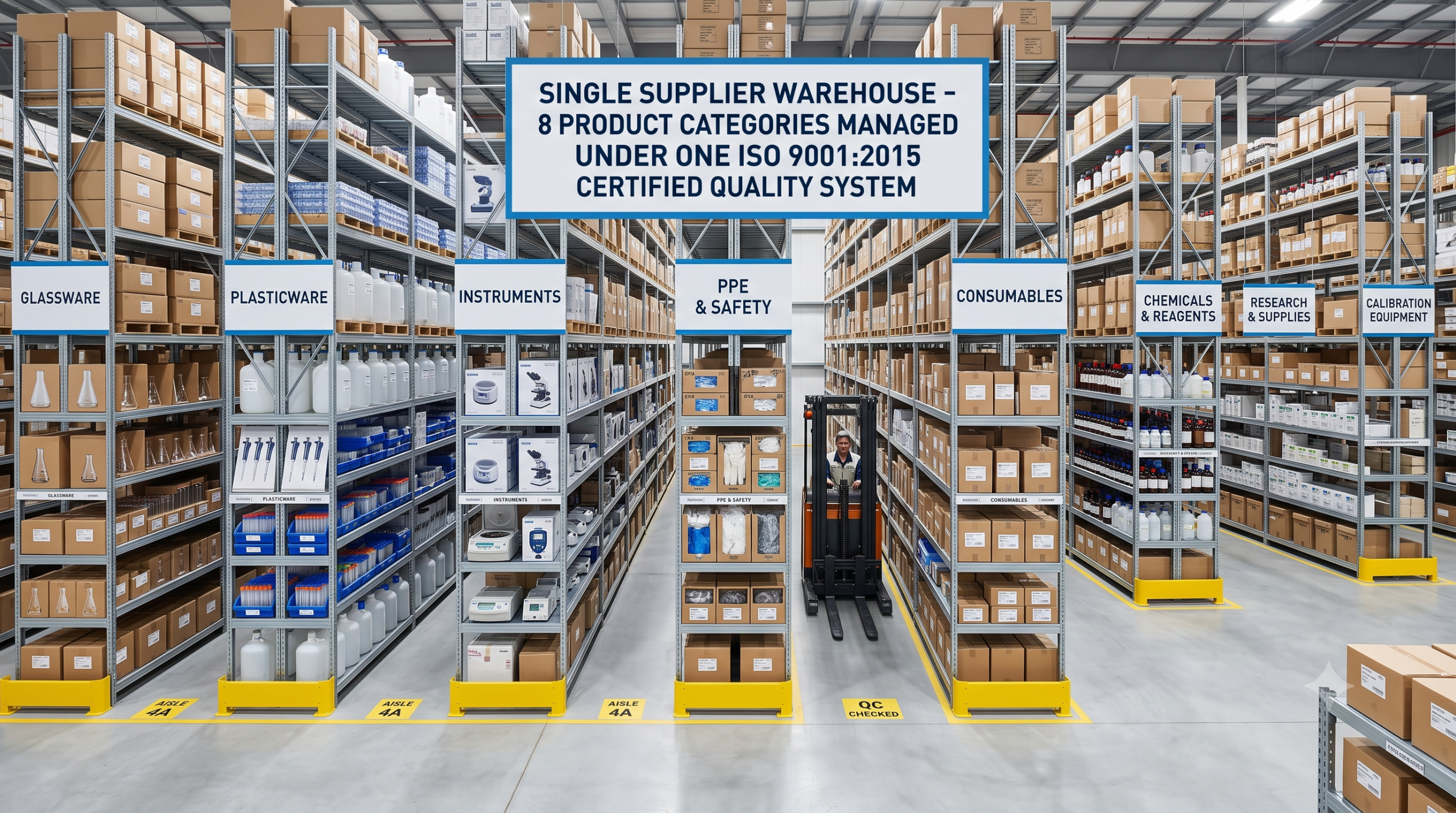
Consolidation only delivers the savings above if the single supplier genuinely covers the lab’s full category range, rather than forcing the buyer to retain a second or third vendor for whatever the primary supplier does not stock. Medilab Exports Consortium’s 8-category range was built specifically around this requirement, expanding from our original borosilicate glassware manufacturing base into a full institutional supply portfolio:
- Laboratory glassware – Class A and Class B borosilicate 3.3 volumetric flasks, beakers, pipettes, burettes, and reagent bottles
- Plasticware and consumables – centrifuge tubes, sample containers, petri dishes, and general disposable labware
- Diagnostic and sample collection supplies – collection tubes, swabs, and pre-analytical materials for clinical laboratories
- Measuring and analytical instruments – balances, pH meters, and general-purpose bench instrumentation
- Sterilization equipment – autoclaves and related consumables for laboratory and clinical sterilization workflows
- Lab furniture and fume hoods – workbenches, storage cabinets, and fume extraction equipment
- Reagent and chemical storage – amber and clear borosilicate storage vessels rated for laboratory chemical compatibility
- PPE and safety equipment – gloves, eyewear, and general laboratory safety supplies
For lab supplier consolidation to work as an operational strategy rather than a partial fix, the single supplier has to be genuinely competent across every category the lab needs, not just the category the supplier was originally known for. A glassware specialist who has added a thin PPE catalog to appear full-range does not solve the QC inconsistency problem described earlier if that added category has not been brought under the same ISO 9001 and ISO 17025 quality framework as the core product line.
How to Evaluate and Transition to Consolidated Sourcing
Moving from a multi-vendor model to lab supplier consolidation should be evaluated as a structured project, not an abrupt vendor switch. Begin by mapping every active vendor against the product categories they cover and the order volume each represents over a full budget year. This map identifies which categories have real consolidation potential and which are already served efficiently by a specialist relationship worth preserving.
Request documentation samples from any candidate consolidated supplier before committing volume: certificates of conformance, materials certificates, and batch compliance records for each category under evaluation. This lets the QA team confirm the supplier’s documentation actually meets the standard the buyer’s own accreditation body requires, rather than assuming consolidation automatically improves documentation quality. Our overview of precision scientific glassware requirements is a useful reference point for the tolerance and certification standard that a consolidated glassware category should be held to at minimum.
Transition in phases rather than switching every category on the same order cycle. Move the highest-volume, highest-friction category first, typically glassware or consumables, confirm the supplier’s performance against the documentation and QC standards agreed during evaluation, and then extend the relationship to additional categories on subsequent order cycles. This phased approach limits the operational risk of a full vendor switch while letting the procurement team validate the lab supplier consolidation case with real performance data before committing the full category range. For a broader framework on structuring the sourcing process itself, see our guide on common laboratory glassware uses, which covers how glassware type maps to procedure and can inform category-by-category consolidation sequencing.
Frequently Asked Questions
In most cases, yes, but the savings come from coordinator time, documentation, and freight, not necessarily from a lower unit price on every product. A specialist vendor may still beat a consolidated supplier’s per-unit price on one category. The case for lab supplier consolidation rests on the total cost of ownership across coordinator hours, documentation normalization, freight consolidation, and QC consistency, which typically outweighs a marginal per-unit price difference on any single category.
There is no fixed threshold, but procurement teams should treat each additional active vendor as a fixed administrative cost regardless of order size. A lab running more than three or four vendors for routine consumables and glassware restocking is generally a strong candidate for lab supplier consolidation, since the coordinator time and documentation overhead at that vendor count usually exceeds any per-unit pricing advantage the specialist vendors offer individually.
A qualified single-source supplier should provide ISO 9001 manufacturing certification, product-specific compliance certificates such as ISO 4787 for volumetric glassware, materials certificates confirming composition (for example borosilicate 3.3), and a Certificate of Analysis or batch compliance record with every shipment. For lab supplier consolidation to deliver the documentation benefit described in this guide, these records must be issued in a consistent format across every product category the supplier covers, not just the category the supplier originally specialized in.
Yes, and the savings from lab supplier consolidation often scale further in a multi-site setting, since a single supplier relationship can standardize product specification, documentation, and QC across every facility in the network rather than each site independently qualifying its own vendor mix. This also simplifies network-wide accreditation audits, since the equipment and consumable documentation trail is uniform across sites rather than varying by facility.
Request documentation samples and quality certificates for each category individually, not just for the supplier’s core product line. Confirm that ISO 9001 and category-specific standards (such as ISO 4787 for volumetric glassware) apply consistently across the full range, and ask for references from other institutional buyers sourcing multiple categories from the same supplier. A supplier positioning itself for lab supplier consolidation should be able to demonstrate the same quality rigor in its newest category as in its founding product line.
Yes. Medilab Exports Consortium supplies an 8-category laboratory supply range, glassware, plasticware, diagnostic consumables, instruments, sterilization equipment, lab furniture, reagent storage, and PPE, all manufactured or sourced under a single ISO 9001 and ISO 17025 quality framework. Institutional buyers pursuing lab supplier consolidation can request a consolidated product catalog covering their full category requirement in one document.
The main risk is supply concentration: if the single supplier experiences a disruption, every category is affected at once rather than just one. Mitigate this by qualifying a consolidated supplier with demonstrated multi-country manufacturing or distribution capacity and documented buffer stock practices, and by transitioning categories in phases rather than switching the entire vendor list on a single order cycle. This phased approach to lab supplier consolidation lets the procurement team validate supply continuity before the full category range depends on one relationship.
Consolidate Your Lab Sourcing with One ISO-Certified Supplier
Medilab Exports Consortium supplies an 8-category laboratory range, glassware, plasticware, instruments, consumables, sterilization equipment, furniture, and PPE, under a single ISO 9001 and ISO 17025 quality framework. Request a consolidated catalog and pricing structure built around lab supplier consolidation for your full procurement list.
