Buyers used to evaluate lab supplier remotely as a fallback, something you did when a factory visit was not practical. Since 2020, remote evaluation has become the default. Travel budgets shrank, factory visits for a mid-size purchase order stopped making financial sense, and procurement teams learned that a supplier can be verified thoroughly without a single site visit, provided the evaluation follows a structured protocol rather than a phone call and a promise.
This guide gives international buyers, first-time importers, and institutional procurement officers a practical framework to evaluate lab supplier remotely: what documentation to request, how to independently verify compliance certificates, how to structure a paid sample order, how to check references that actually mean something, and how to assess a supplier’s freight and logistics track record before committing to a bulk order. Every step in this guide is something you can complete from a desk, over email, video call, and a test shipment.
Medilab Exports Consortium exports ISO 9001 and ISO 17025 certified borosilicate 3.3 laboratory glassware and lab supplies to institutional buyers across 40+ countries, the majority of whom qualified us without ever visiting our facility. We have been on the receiving end of remote supplier evaluation hundreds of times, and this guide reflects the questions, documents, and tests that separate a buyer who gets burned from one who does not.
Why Remote Supplier Evaluation Is Now the Standard, Not the Exception
A factory visit was never a complete verification method on its own. A well-managed tour shows a visitor a clean, functioning production line on a good day, not the batch-to-batch consistency, documentation discipline, or freight reliability that actually determines whether a supplier relationship works over three years of repeat orders. What a factory visit provided was reassurance, not evidence, and reassurance is exactly what a structured remote process can replace with something stronger: verifiable documentation, independently checkable certificates, and a physical sample you can test yourself.
International buyers who evaluate lab supplier remotely today are not cutting corners. They are applying a due diligence process that produces better evidence than a single-day site visit ever did, because it is spread across documentation review, third-party certificate verification, and product testing rather than a guided walk through a showroom floor. The seven steps in this guide are sequenced deliberately: each step either eliminates unqualified suppliers cheaply before you invest more time, or produces evidence that a later step depends on.
Step 1: Request and Audit Core Documentation
Before any conversation about pricing or minimum order quantity, request the supplier’s core documentation package: ISO 9001 manufacturing certificate, product-specific compliance certificates (ISO 4787 for volumetric glassware, ISO 4796 for reagent bottles, ISO 17025 if the supplier operates a calibration laboratory), a materials certificate confirming raw material composition, export licenses, and company registration documents. A supplier that hesitates, delays, or provides only a logo-stamped PDF with no certificate number is telling you something important before you have spent any money.
What a Genuine Certificate Package Looks Like
A genuine ISO certificate includes a certificate number, the issuing certification body’s name, the scope of certification, and an expiry date. It should be traceable back to the issuing body, which is exactly what Step 2 covers. Request certificates for the specific product category you intend to order, not just a general company-level ISO 9001 certificate. A supplier’s overall quality management certification does not confirm that a specific product line, such as Class A volumetric glassware, has been produced and tested to the relevant product standard.
Ask for a recent Certificate of Analysis or batch compliance record from an actual production run, not a template document. A real batch record includes the batch number, production date, sample size tested, and the actual measured tolerance values against the specification. Suppliers who can produce this on request, quickly and specific to a recent batch, are demonstrating that the documentation is a routine part of their production process rather than something assembled only when a buyer asks.
Step 2: Independently Verify Compliance Certificates
A PDF certificate is only as trustworthy as your ability to confirm it was actually issued. To genuinely evaluate lab supplier remotely, do not stop at receiving the document, verify it against the certification body’s own records. Most major certification bodies maintain a public or semi-public registry, and international accreditation databases such as IAF CertSearch allow you to search issued certificates by company name or certificate number to confirm the certificate is current and was issued by an accredited certification body.
Cross-Checking Certification Body Accreditation
Not every certification body issuing an ISO certificate is itself accredited by a recognised national or international accreditation body. A certificate from an unaccredited certifier can look identical to a legitimate one on the page, but it carries no external oversight and is not recognised by many institutional buyers, accreditation bodies, or customs authorities. Confirm that the certification body issuing your supplier’s certificate is itself accredited under the ISO conformity assessment framework, which explains how certification and accreditation bodies relate to each other and how to confirm a certifier’s standing.
This verification step takes fifteen minutes and eliminates a category of risk that no amount of video calling or reference checking will catch, because a fabricated or unaccredited certificate looks convincing precisely to buyers who do not check the issuing body directly.
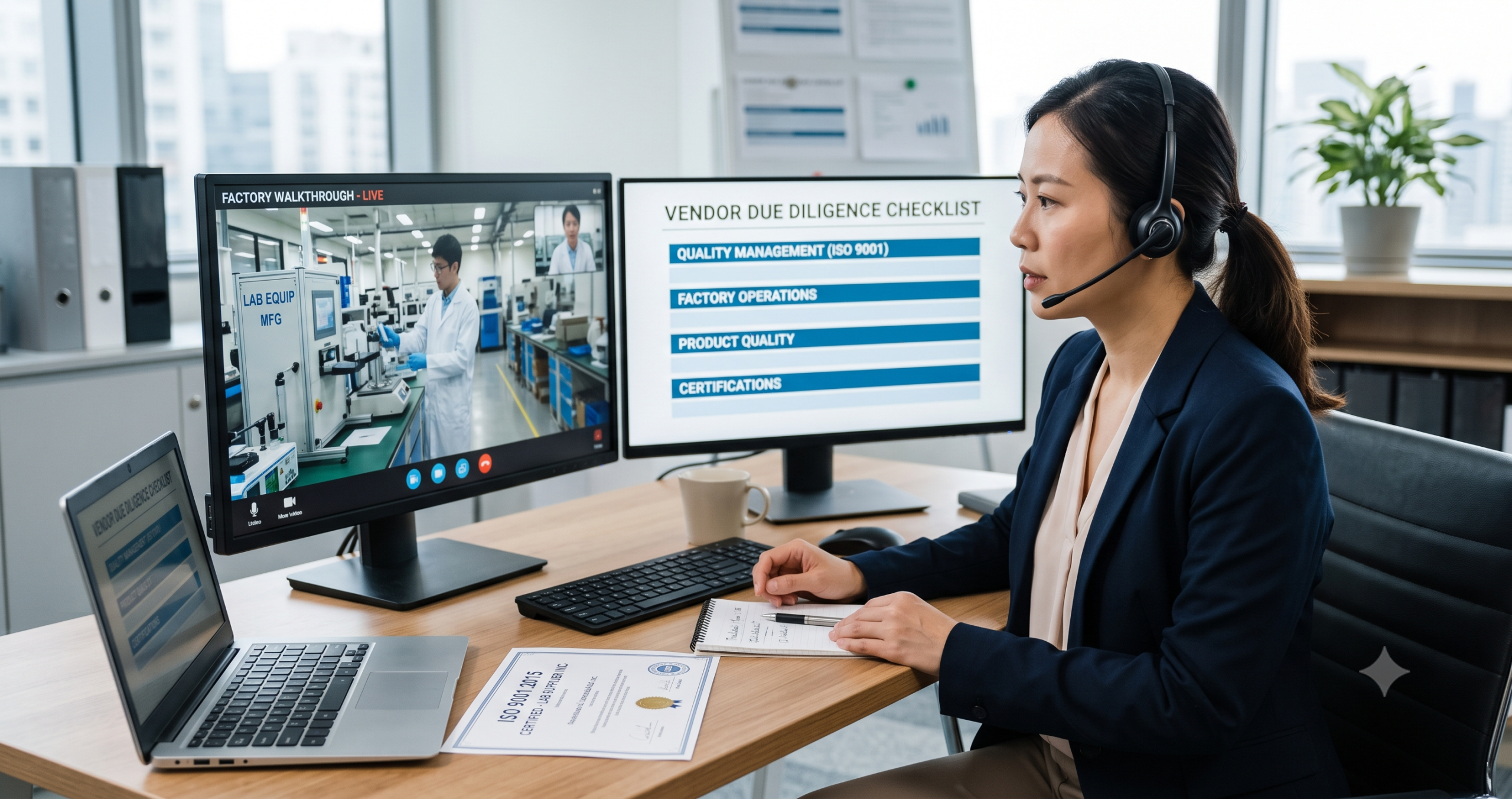
Step 3: Run a Live Video Factory Walkthrough
A live, unscripted video call is the closest remote substitute for a physical factory visit, and it is more useful than most buyers expect if structured correctly. Request a live walkthrough, not a pre-recorded promotional video, and ask the supplier to show you specific things in real time: the raw material receiving area, the production line for the product category you intend to order, the quality control and testing station, and the packing and dispatch area. Ask questions during the walkthrough and request that the camera pause on specific equipment, such as the calibration or testing instruments used for incoming inspection.
What to Look for During the Call
Watch for consistency between what the sales team told you and what the production floor actually shows. A supplier claiming ISO 17025 calibration capability should be able to show you the calibration laboratory and the reference standards used, live, on request. A supplier that redirects every specific question back to a general sales pitch, or cannot produce the specific area you asked to see, is a signal worth taking seriously. When you evaluate lab supplier remotely through video, the value comes from asking for something specific and unscheduled, not from watching a rehearsed tour.
Step 4: Order and Test a Paid Sample Batch
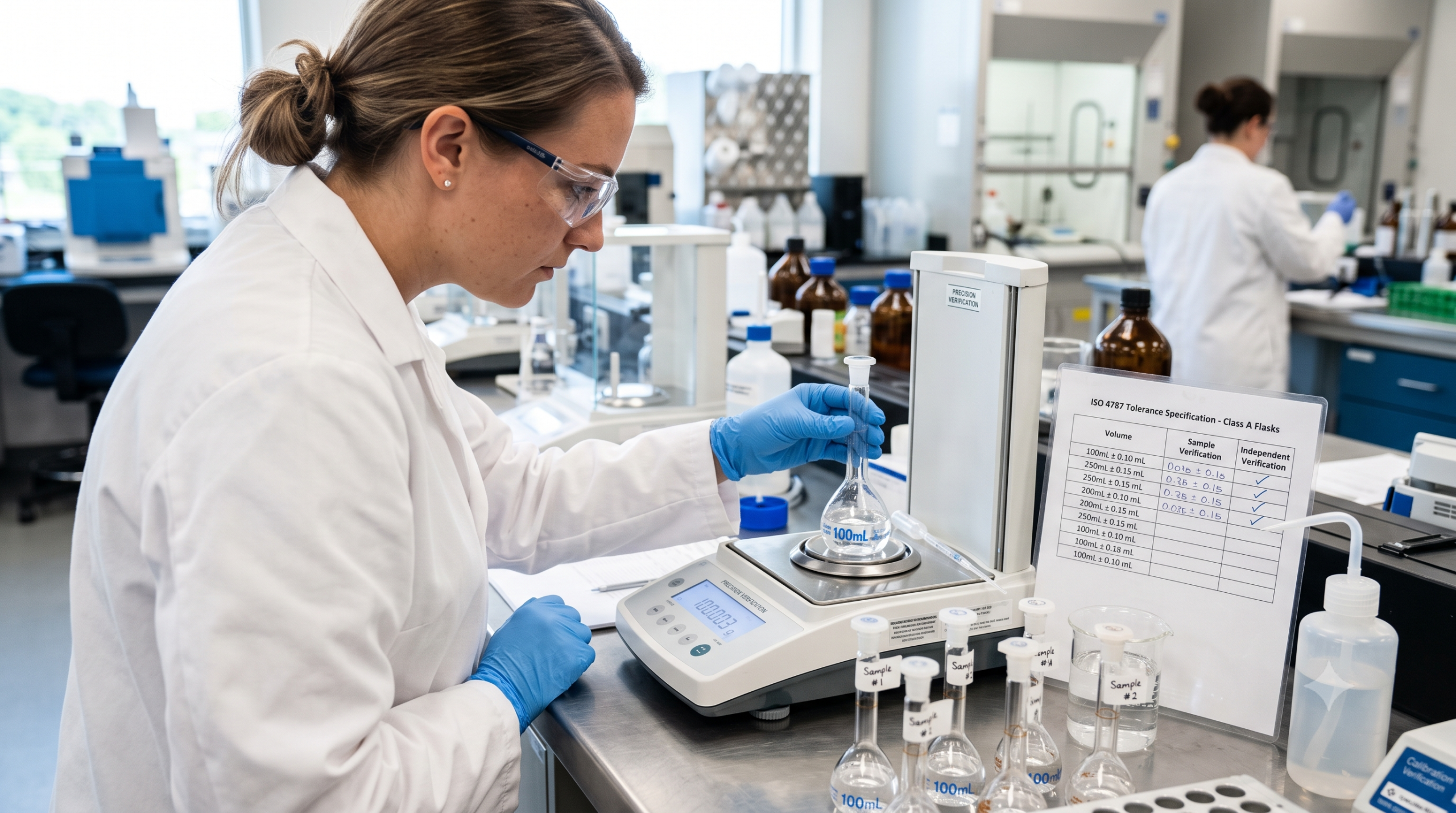
Documentation and video calls establish credibility, but a physical sample is the only evidence that tests the actual product against your own specification. Place a small, paid sample order, not a free promotional sample, of the specific items and specifications you intend to bulk order. Paying for the sample matters: it confirms the supplier’s actual pricing, order processing, and shipping process under normal commercial terms rather than a marketing exception.
What to Test on Receipt
On receipt, test the sample against your specification directly rather than relying on the supplier’s own certificate. For volumetric glassware, verify the calibration mark accuracy gravimetrically if your lab has the capability, or send the sample to an independent testing laboratory for verification against the ISO 4787 tolerance class claimed. Inspect for material consistency, wall thickness uniformity, graduation line clarity, and packaging quality, since packaging quality during a small sample shipment is a reasonable predictor of packaging discipline at bulk order volume. Compare the physical sample against the batch compliance certificate the supplier provided for that specific batch, and flag any discrepancy immediately rather than assuming it is within acceptable variation.
Step 5: Check References from Existing Institutional Buyers
Ask the supplier directly for two or three institutional buyer references, ideally in your own region or a comparable regulatory environment, and contact them independently rather than relying on a written testimonial the supplier provides. A supplier confident in their track record will provide references without hesitation. Ask the reference specific operational questions: order accuracy over multiple shipments, response time to quality complaints, consistency of documentation across orders, and whether pricing and lead times held up over repeat orders rather than only on the first transaction.
References are most useful when you ask about problems, not just satisfaction. Every supplier has had a shipment go wrong at some point; what matters when you evaluate lab supplier remotely through references is how the supplier responded when something did go wrong, not whether anything ever did. A reference who describes a delayed shipment that was resolved with clear communication and a fair remedy is more informative than a reference who reports no issues at all across a short relationship.
Step 6: Review Freight and Logistics Track Record
A manufacturer with excellent product quality but an unreliable export logistics process still creates significant risk for an international buyer. Ask the supplier directly about their standard freight forwarders, typical lead time from order confirmation to dispatch, and their track record on customs documentation accuracy for your destination country. Request to see a sample export packing list, commercial invoice, and certificate of origin from a recent shipment, redacted of buyer-identifying information if necessary, to confirm the supplier’s documentation meets the standard your own customs process requires.
Ask specifically how the supplier has handled freight disruptions in the past: a delayed vessel, a customs hold, or a damaged consignment. A supplier who can describe a specific past incident and the resolution process demonstrates real export experience. A supplier who claims no shipment has ever had an issue, across any meaningful export volume, is either newer to export than they represent or not being candid about their history.
Step 7: Confirm Communication Reliability Before the First Bulk Order
Before placing a bulk order, run a deliberate communication stress test: send a moderately complex technical question, such as a request for a custom specification variation or a clarification on a tolerance value, and time the response. Evaluate whether the response actually answers the technical question or redirects to a generic sales reply. Consistent, specific, and reasonably fast technical communication during the evaluation phase is a strong predictor of how the supplier will handle the inevitable questions and exceptions that arise across a multi-year purchasing relationship.
This step matters because every prior step, documentation, certificates, video call, sample, and references, can be satisfied by a supplier who is genuinely good at first-order transactions but weak at ongoing account management. Confirming communication reliability before the first bulk order protects against exactly that gap.
Red Flags vs Green Flags Checklist
Use the table below as a quick reference when you evaluate lab supplier remotely across the seven steps in this guide. A supplier showing multiple red flags across different categories warrants caution regardless of how strong any single category looks in isolation.
| Evaluation Area | Red Flag | Green Flag |
|---|---|---|
| Documentation | Certificate has no traceable number or issuing body | Certificate verifiable against the issuing body’s registry |
| Video Walkthrough | Only pre-recorded footage offered, no live call | Live, unscripted walkthrough with specific area requests honored |
| Sample Order | Free sample only, paid order refused or discouraged | Paid sample processed through normal commercial terms |
| References | Only written testimonials, no direct contact offered | Direct reference contacts provided without hesitation |
| Freight Record | Cannot describe a specific past shipment issue and resolution | Specific incident history with clear resolution process |
| Communication | Technical questions answered with generic sales replies | Specific, accurate answers to technical questions |
Applying This Framework to Your Next Sourcing Decision
The seven steps in this guide are sequential by design, moving from cheap-to-check documentation through to a bulk order commitment, so that unqualified suppliers are eliminated early before you invest time in a video call, sample order, or reference check. Run Steps 1 and 2 on every candidate supplier before scheduling a video call. Reserve the paid sample order and reference checks for the two or three suppliers who pass documentation and certificate verification, since these steps take real time and should be spent on genuine finalists.
Our guide to laboratory glassware quality standards is a useful companion reference for Step 1 and Step 4, covering exactly which ISO, ASTM, and DIN standards apply to which glassware category and what the certificate should state. If your evaluation surfaces a supplier that passes on quality but you are managing multiple specialist vendors across categories, our analysis of lab supplier consolidation covers the case for evaluating one supplier across your full category range rather than repeating this seven-step process for every product line separately.
For buyers new to international lab equipment sourcing specifically, our overview of how laboratory glassware is manufactured provides useful background for interpreting what you see during a video factory walkthrough, since knowing what a normal production process looks like makes it much easier to notice when something during a live call does not match.
Frequently Asked Questions
Yes, provided the evaluation is structured rather than informal. A single unstructured phone call is not sufficient due diligence, but a process that combines documentation audit, independent certificate verification, a live video walkthrough, a tested paid sample, and direct reference checks produces stronger evidence than a one-day factory tour typically does. Buyers who evaluate lab supplier remotely using this full framework are generally better protected than those who rely on a single site visit and skip the documentation and sample testing steps.
Check that the certificate includes a certificate number, the issuing certification body’s name, and an expiry date, then verify it directly against the issuing body’s own registry or an accreditation database such as IAF CertSearch. Confirm separately that the certification body itself is accredited, since a certificate from an unaccredited certifier can appear legitimate but carries no external oversight. This verification step is one of the most important parts of any process to evaluate lab supplier remotely, and it takes only a few minutes once you know where to check.
Request a live, unscripted call rather than a pre-recorded video, and ask the supplier to show specific areas in real time: raw material receiving, the relevant production line, the quality control and testing station, and packing and dispatch. Watch for consistency between what the sales team claims and what the production floor actually shows, and note whether the supplier can immediately produce the specific area or equipment you ask to see. This is one of the fastest ways to evaluate lab supplier remotely because inconsistency is much harder to hide in an unscripted live call.
Yes. A paid sample order, processed through the supplier’s normal commercial terms rather than as a free marketing sample, tests the actual product, actual pricing, and actual shipping process you will experience at bulk order volume. Testing the sample against your own specification, rather than relying solely on the supplier’s certificate, is one of the few steps in a process to evaluate lab supplier remotely that produces direct physical evidence rather than documentation or a verbal claim.
Two to three references, ideally from institutional buyers in your own region or a comparable regulatory environment, is generally sufficient if you ask specific operational questions rather than requesting a general satisfaction rating. Ask about order accuracy across multiple shipments and how the supplier responded when something went wrong, since that is more informative than whether anything went wrong at all. Reference checks are a core step in any thorough process to evaluate lab supplier remotely, and direct contact with the reference matters more than a written testimonial the supplier provides.
Treat this as a significant red flag. A legitimate manufacturer with genuine production capability has no operational reason to refuse a normal paid sample order or a live video walkthrough of areas relevant to your product category. Suppliers who only offer free samples, pre-recorded promotional videos, or written testimonials instead of direct references are avoidable risks when you have the option to evaluate lab supplier remotely using suppliers who accommodate the full framework without resistance.
Yes. Medilab Exports Consortium regularly supports international buyers who evaluate lab supplier remotely before their first order, including providing traceable ISO 9001 and ISO 17025 certificates, arranging live video walkthroughs of our production and testing facility, processing paid sample orders against buyer specifications, and connecting prospective buyers with existing institutional references across our 40+ country export base. Contact us to begin a structured remote evaluation for your next lab equipment sourcing decision.
Evaluate Medilab Exports as Your Next Lab Equipment Supplier
Medilab Exports Consortium provides everything international buyers need to evaluate lab supplier remotely: traceable ISO 9001 and ISO 17025 certificates, live video facility walkthroughs, paid sample orders, and direct references from institutional buyers across 40+ countries. Start your remote evaluation with no obligation.

[…] you can pass through to your own institutional customers without modification. Our framework to evaluate a lab supplier remotely applies directly here; a manufacturer partner should pass the same documentation, certificate […]
[…] you can pass through to your own institutional customers without modification. Our framework to evaluate a lab supplier remotely applies directly here; a manufacturer partner should pass the same documentation, certificate […]