
This laboratory glassware glossary exists because procurement conversations about glassware are full of terms that are rarely explained anywhere buyers actually look: a supplier mentions “TD calibration,” a specification sheet says “Class A, ISO 4787,” and a certificate references “annealing” without any of it being defined in plain language. For a junior procurement professional or a lab manager sourcing glassware for the first time, this shorthand is a real barrier to reading a quotation, a certificate, or a technical datasheet with confidence.
This laboratory glassware glossary covers more than 50 terms in plain language, organized alphabetically so you can jump straight to the word you need: material terms like borosilicate 3.3 and annealing, precision terms like Class A and Class B tolerance, standards terms like ISO, ASTM, and DIN, and practical procurement terms like batch certificates and minimum order quantity. Each entry is written to be understood without prior glassware knowledge, and cross-references related terms so you can follow a concept as deep as you need.
Medilab Exports Consortium has manufactured ISO-certified borosilicate 3.3 laboratory glassware for 60+ years and works daily with procurement teams who are encountering this terminology for the first time. This laboratory glassware glossary is built from the questions we are actually asked by first-time buyers, and it is designed to be bookmarked and referenced every time an unfamiliar term shows up in a quote, a certificate, or a technical conversation.
A
Actinic Glass (Amber Glass)
Amber-tinted borosilicate glass used for reagent bottles and containers holding light-sensitive substances. The amber tint blocks UV and visible light wavelengths that would otherwise degrade photosensitive reagents, standards, or samples stored inside.
Annealing
A controlled cooling process applied after glass is formed, which relieves internal stress built up during manufacturing. Properly annealed glassware is significantly more resistant to thermal shock and mechanical breakage than glass cooled too quickly, which retains stress and cracks under conditions that annealed glass would tolerate.
ASTM E288
The American Society for Testing and Materials standard covering laboratory volumetric flasks, primarily referenced by laboratories and suppliers serving the North American market as an alternative to ISO 1042.
B
Batch Compliance Certificate
A document issued by the manufacturer confirming that a specific production batch of glassware meets a stated tolerance specification, typically ISO 4787 for volumetric items. It includes the batch number, production date, and the sampling and testing method used to verify compliance.
Beaker
A general-purpose, wide-mouth container with a flat bottom and a pouring lip, used for mixing, heating, and holding liquids. Beakers are not precision volumetric glassware; their printed volume markings are approximate and should never be used for measurements requiring Class A or Class B accuracy.
Borosilicate Glass 3.3
The standard laboratory-grade glass composition, containing approximately 80% silica and 13% boric oxide, which gives it a low coefficient of thermal expansion, strong chemical resistance, and high resistance to thermal shock. Nearly every reputable laboratory glassware item, from beakers to volumetric flasks, is manufactured from borosilicate 3.3 rather than ordinary soda-lime glass.
Burette
A long, graduated tube with a stopcock at the bottom, used to dispense precisely measured variable volumes of liquid, most commonly during titration. Burettes are “To Deliver” (TD) instruments and are manufactured to Class A or Class B tolerance under ISO 385.
C
Calibration
The process of verifying that a piece of volumetric glassware actually holds or delivers the volume printed on it, typically performed gravimetrically by weighing the water it contains or delivers at a 20 degrees C reference temperature. Calibration is what produces the tolerance value stated in a batch certificate.
Certificate of Analysis (CoA)
A document that reports the actual measured results of testing performed on a specific batch or item, as distinct from a general compliance certificate that only states the item meets a specification. A CoA is the more detailed of the two and is typically requested for individually calibrated Class A items.
Certificate of Conformance
A supplier-issued document confirming that a delivered product meets the purchase order’s stated specification. In this laboratory glassware glossary, this term is closely related to but less detailed than a Certificate of Analysis, since it confirms conformance without necessarily reporting individual measured values.
Class A Glassware
Volumetric glassware manufactured to the tightest internationally recognized tolerance for its type, roughly half the permitted error of Class B for the same nominal volume. Class A is required for pharmaceutical assays, analytical chemistry, and any measurement where volumetric accuracy directly affects a reported result.
Class B Glassware
Volumetric glassware manufactured to a wider tolerance, typically double that of Class A for the same item and nominal volume. Class B is manufactured from the same borosilicate glass and meets the same material standards as Class A; only the calibration tolerance differs, making it suitable for teaching labs and general non-critical use.
Coefficient of Thermal Expansion
A numerical value describing how much a material expands or contracts with temperature change. Borosilicate 3.3 has a notably low coefficient of thermal expansion, which is why it withstands sudden temperature changes, such as an autoclave cycle, far better than ordinary soda-lime glass.
Conical Flask (Erlenmeyer Flask)
A flask with a flat bottom, conical body, and narrow neck, widely used for mixing, titration, and swirling reactions without spillage. The narrow neck also reduces evaporation compared to a beaker holding the same volume.
D
DIN Standard
Deutsches Institut fur Normung, the German national standards body whose glassware tolerance specifications closely align with ISO standards and are widely referenced across European laboratory markets.
Desiccator
A sealed glass or plastic vessel containing a drying agent, used to keep hygroscopic materials, calibrated standards, or moisture-sensitive samples free of ambient humidity during storage.
Drainage Time
The specified time a “To Deliver” (TD) instrument, such as a pipette or burette, must be allowed to drain before the delivered volume is considered accurate. Ignoring the specified drainage time is a common source of measurement error, even with correctly calibrated Class A glassware.
E
Etching (Permanent Marking)
A method of permanently marking glassware with graduation lines, volume, class designation, and standard reference, using acid etching or a similar process that will not wear off through normal handling and washing, unlike printed or painted markings.
F
Filter Flask (Buchner Flask)
A thick-walled conical flask with a side arm, designed to withstand the vacuum applied during vacuum filtration. The thick walls prevent implosion under the reduced internal pressure vacuum filtration creates.
Flask, Volumetric
See Volumetric Glassware.
G
Graduated Cylinder
A tall, narrow cylinder marked with graduation lines along its length, used to measure variable volumes of liquid with moderate precision. Less accurate than a volumetric flask at a single fixed volume, but more practical for measuring a range of different volumes with one instrument.
Graduated Pipette
A pipette with graduation marks along its length, allowing it to deliver any volume up to its maximum capacity, as distinct from a one-mark pipette, which delivers only a single fixed volume.
Graduation Line (Calibration Mark)
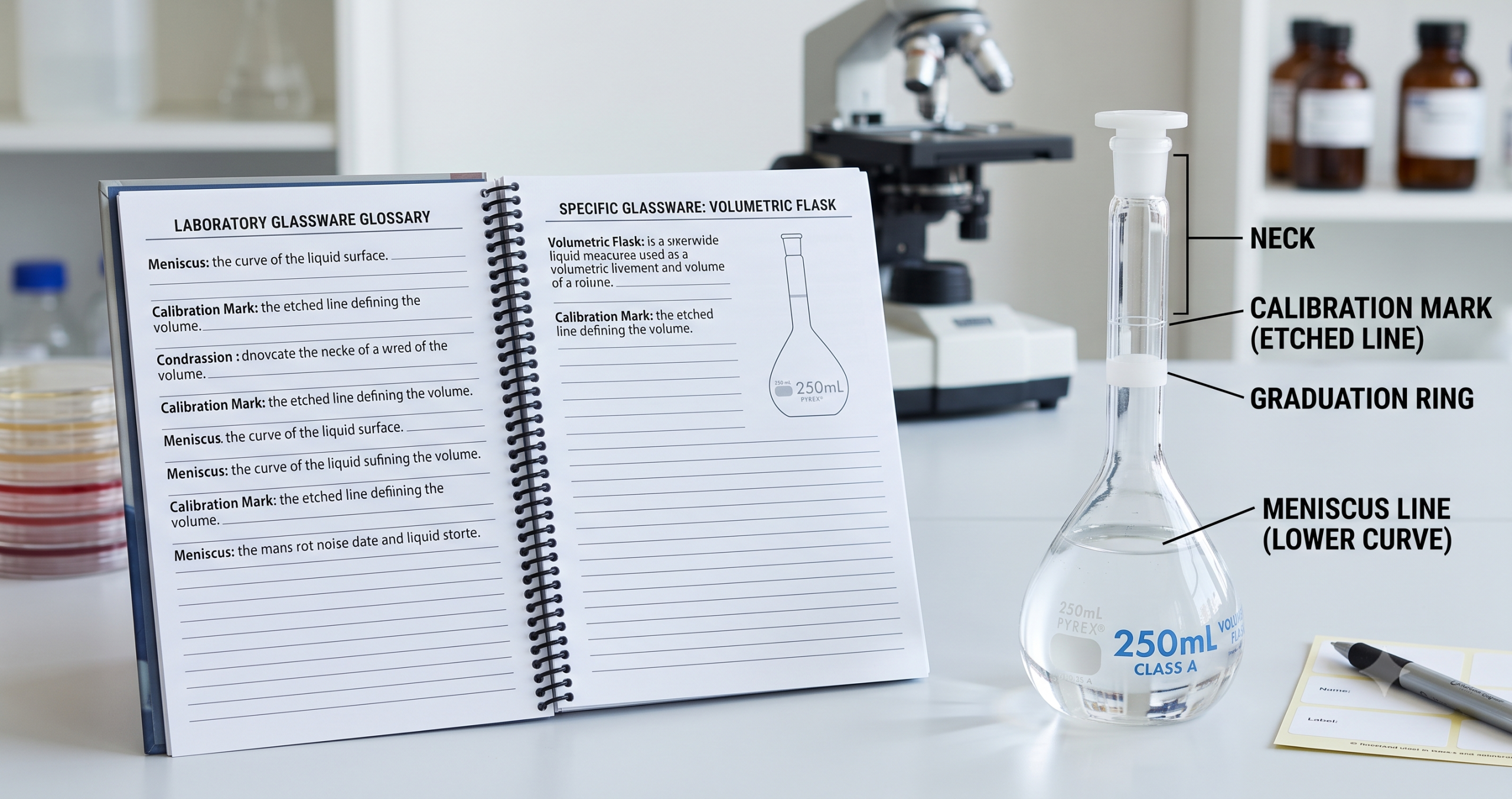
The etched line on a piece of volumetric glassware indicating the calibrated volume. On a volumetric flask, this is a single ring around the neck; on a graduated cylinder or pipette, it is one of a series of marks along the body.
Ground Glass Joint
A precisely machined, frosted glass fitting that creates an airtight seal between two pieces of glassware, such as a flask and a stopper or a condenser, without the need for grease in most modern applications. Joint sizes are standardized so that compatible glassware from different manufacturers can typically be interchanged.
I
ISO 4787
The ISO standard defining tolerance requirements and verification methods for volumetric glassware in general, and the standard most frequently cited on Class A and Class B batch compliance certificates.
ISO 385
The ISO standard specifically covering burettes, defining their tolerance classes, graduation requirements, and construction.
ISO 1042
The ISO standard specifically covering one-mark volumetric flasks, defining tolerance classes and construction requirements.
ISO 9001
The international standard for quality management systems. An ISO 9001 certificate confirms a manufacturer’s overall quality process is certified, but it does not by itself confirm any specific product meets a volumetric tolerance standard, which is a common point of confusion covered elsewhere in this laboratory glassware glossary.
ISO 17025
The international standard for the competence of testing and calibration laboratories. A manufacturer holding ISO 17025 accreditation for its internal calibration laboratory can issue calibration certificates with a higher level of recognized traceability than one without this accreditation.
L
Lead Time
The time between placing a purchase order and receiving the goods. For laboratory glassware, lead time depends on whether the order is filled from existing stock or requires new production, and whether freight is by air or sea.
M
Materials Certificate
A document confirming the actual glass composition used to manufacture an item, most often used to confirm borosilicate 3.3 composition as distinct from lower-grade soda-lime glass that can otherwise be difficult to distinguish visually.
Meniscus
The curved upper surface of a liquid inside a narrow glass tube, caused by surface tension. Volumetric readings are taken at the bottom of the meniscus for most aqueous solutions, at eye level, to avoid parallax error.
MOQ (Minimum Order Quantity)
The smallest quantity of an item a supplier is willing to sell in a single order, often set per product line or per production run. Understanding a supplier’s MOQ structure is essential for buyers evaluating small pilot orders before committing to a larger purchase.
N
Neck (Flask Neck)
The narrow section of a flask above the main body, whose diameter affects both evaporation rate and the practical use of stoppers or ground glass joints. A narrow neck also concentrates the graduation mark into a smaller cross-section, which improves reading precision.
Nominal Volume
The stated capacity of a piece of volumetric glassware, such as “100 mL,” which represents the target volume the item is calibrated to hold or deliver, subject to the tolerance defined by its accuracy class.
O
OEM (Original Equipment Manufacturer)
In laboratory glassware procurement, a supplier that manufactures products which are sold under a distributor’s or buyer’s own brand rather than the manufacturer’s brand, common in institutional and export supply chains.
One-Mark Pipette
A pipette with a single graduation mark, designed to deliver exactly one fixed volume, offering higher accuracy for that specific volume than a graduated pipette covering a range of volumes.
P
Pyrex-Type Glass
A generic industry term for borosilicate glass, derived from a well-known trademarked brand name. Most glassware described informally as “Pyrex-type” is standard borosilicate 3.3, regardless of manufacturer or brand.
Q
QMS (Quality Management System)
The documented set of processes a manufacturer uses to control and verify product quality, which is what an ISO 9001 certificate actually certifies. A strong QMS is what makes consistent batch-to-batch tolerance and documentation possible at scale.
R
Reagent Bottle
A borosilicate storage bottle for chemical reagents, available in clear glass for stable reagents and amber glass for light-sensitive reagents, typically manufactured to ISO 4796.
Round Bottom Flask (Boiling Flask)
A spherical flask with a narrow neck, designed to distribute heat evenly during boiling, distillation, or reflux, and typically used with a heating mantle or water bath rather than a flat surface.
S
Soda-Lime Glass
A lower-cost glass composition used for general containers and non-laboratory glass products. It has a much higher coefficient of thermal expansion and weaker chemical resistance than borosilicate 3.3, making it unsuitable for laboratory heating, autoclaving, or precision measurement applications.
Standard Taper Joint
A standardized ground glass joint size and taper angle, allowing glassware from different manufacturers to be connected interchangeably provided the joint size designation matches.
Star Crack
A radiating crack pattern originating from a point of impact, typically caused by a sharp blow to the glass. Glassware with a star crack should always be retired immediately, since the calibrated volume can no longer be trusted even if the item appears to still hold liquid.
Stopcock
A valve, typically ground glass or PTFE, used to control the flow of liquid from a burette or separating funnel with precision.
T
TC (To Contain)
A calibration designation indicating that an item, such as a volumetric flask, is calibrated to hold the stated volume within its walls, as opposed to delivering that volume when emptied.
TD (To Deliver)
A calibration designation indicating that an item, such as a pipette or burette, is calibrated to deliver the stated volume when drained according to its specified drainage time, accounting for the thin film of liquid that adheres to the glass wall.
Tempering
A heat treatment process, distinct from annealing, that increases surface compression to improve impact resistance. Most laboratory volumetric glassware is annealed rather than tempered, since tempering can distort precision calibration.
Thermal Shock Resistance
A material’s ability to withstand sudden temperature change without cracking. Borosilicate 3.3’s low coefficient of thermal expansion is the primary reason it offers strong thermal shock resistance compared to ordinary glass.
Tolerance
The maximum permissible error, expressed as plus or minus a volume, allowed between the nominal volume printed on an item and its actual calibrated volume. Tolerance is the numeric value that separates Class A from Class B for any given item and size.
U
USP Standards
Standards published by the United States Pharmacopeia governing pharmaceutical testing procedures, which frequently specify Class A volumetric glassware for assay preparation and reference solution preparation.
V
Volumetric Glassware
Glassware manufactured and calibrated to measure a precise volume, as distinct from general-purpose glassware like beakers. Volumetric flasks, pipettes, and burettes are all volumetric glassware; a beaker or Erlenmeyer flask, despite having printed volume markings, is not.
W
Wall Thickness
The thickness of the glass forming an item’s body, which affects both thermal shock resistance and mechanical durability. Consistent wall thickness across a production batch is a quality indicator that reputable manufacturers control closely.
WHO-GMP
World Health Organization Good Manufacturing Practice guidelines, referenced by pharmaceutical buyers when qualifying suppliers of glassware and consumables used in regulated drug manufacturing and testing environments.

Standards Quick Reference
This table summarizes the standards referenced throughout this laboratory glassware glossary, mapped to the item category each one governs. Keep it as a quick lookup whenever a specification sheet or certificate cites a standard by number rather than by name.
| Standard | Governing Body | Applies To | Defines |
|---|---|---|---|
| ISO 4787 | ISO | Volumetric glassware (general) | Tolerance classes and verification methods |
| ISO 1042 | ISO | One-mark volumetric flasks | Tolerance classes, construction |
| ISO 385 | ISO | Burettes | Tolerance classes, graduation, construction |
| ISO 4796 | ISO | Reagent bottles | Material and construction requirements |
| ASTM E288 | ASTM | Volumetric flasks (North America) | Tolerance classes, alternative to ISO 1042 |
| ISO 9001 | ISO | Manufacturer (company-level) | Quality management system certification |
| ISO 17025 | ISO | Testing/calibration laboratories | Calibration competence and traceability |
How to Use This Glossary When Reviewing a Quote or Certificate
The fastest way to get value from this laboratory glassware glossary is to keep it open the next time you review an incoming quotation, specification sheet, or batch certificate. Whenever a term you do not recognize appears, from a tolerance class to a standard number, look it up here before assuming what it means or, worse, skipping past it entirely. Misreading “TD” as “TC,” or assuming a Class B item meets a Class A requirement, are exactly the kind of small terminology gaps that cause real specification errors in a purchase order.
For a deeper walkthrough of how the tolerance classes defined in this laboratory glassware glossary apply in practice, our guide on laboratory glassware quality standards covers ISO, ASTM, and DIN specifications in full detail. If your interest in a specific term was triggered by evaluating a new vendor, our framework to evaluate a lab supplier remotely explains exactly which of these terms should appear on the documentation a legitimate supplier provides.
New procurement professionals sourcing across multiple product lines, not just glassware, may also find it useful to review our guide on lab supplier consolidation, which explains how the documentation and QC terminology in this laboratory glassware glossary extends to plasticware, instruments, and other lab supply categories under a single quality framework.
Frequently Asked Questions
Tolerance class, meaning whether an item is Class A or Class B, is the term that most directly affects whether a piece of volumetric glassware is suitable for your application. This laboratory glassware glossary defines both classes in detail, but the short version is that Class A is required for any measurement where accuracy directly affects a reported analytical result, and Class B is acceptable for general and teaching use.
TC (“To Contain”) means the item is calibrated to hold the stated volume within its walls, and applies to volumetric flasks. TD (“To Deliver”) means the item is calibrated to deliver the stated volume when drained, and applies to pipettes and burettes. This distinction, covered under both entries in this laboratory glassware glossary, matters because a TD item accounts for the thin residual film of liquid left on the glass wall after draining, while a TC item does not.
“Pyrex” is a trademarked brand name, but the term is often used generically in the industry to refer to any borosilicate 3.3 glass, regardless of manufacturer. When a supplier or specification sheet uses “Pyrex-type” informally, it almost always means standard borosilicate 3.3, which is the composition this laboratory glassware glossary and most laboratory specifications actually require.
No. ISO 9001 certifies a manufacturer’s overall quality management system, not the tolerance of any specific product. To confirm Class A tolerance, request the product-specific certificate, typically referencing ISO 4787, ISO 1042, or ISO 385 depending on the item type. This is one of the more common points of confusion this laboratory glassware glossary is written to clear up before it causes a procurement mistake.
Because sourcing laboratory glassware successfully requires understanding both the technical specification and the commercial process used to procure it. A laboratory glassware glossary that only defines material and tolerance terms leaves out the vocabulary buyers actually encounter in quotations and supplier negotiations, which is just as likely to cause confusion for a first-time buyer.
This laboratory glassware glossary is maintained as a living reference and updated as new terms become relevant to buyers or as standards references change. Bookmark this page directly rather than saving a downloaded copy, so you always see the current version.
Yes. Medilab Exports Consortium regularly adds terms to this laboratory glassware glossary based on questions from procurement teams we work with. If you encounter a term on a quote, certificate, or specification sheet that is not covered here, contact us and we will explain it directly and consider it for the next update.
Have a Glassware Term You Need Explained?
This laboratory glassware glossary is maintained by Medilab Exports Consortium, a 60+ year ISO-certified borosilicate 3.3 glassware manufacturer serving 40+ countries. Bookmark this page, or contact our team directly for a term-by-term walkthrough of any quote, certificate, or specification you are reviewing.
