
For two decades, global procurement teams sourcing laboratory equipment framed the decision as a binary choice: a India lab equipment supplier was rarely even considered, with China offering low cost and Europe offering premium quality and trust. That binary framework is now outdated. International distributors and institutional procurement heads are actively adding India as a third sourcing category, not as a discount alternative to either option, but as a distinct combination of quality parity, cost advantage, and supply chain diversification that neither China nor Europe fully delivers alone.
This guide makes the case for why a qualified India lab equipment supplier deserves a place in your sourcing strategy: quality parity with European manufacturing standards, a meaningful cost advantage over European suppliers without China’s post-pandemic reliability concerns, active Indian government export support, and a documented multi-decade track record of institutional export performance. We cover what “quality parity” actually means in verifiable terms, not marketing language, and where India fits realistically alongside your existing China and Europe relationships rather than replacing them outright.
Medilab Exports Consortium has manufactured ISO 9001 and ISO 17025 certified borosilicate 3.3 laboratory glassware from India for 60+ years, exporting to institutional buyers across 40+ countries. We are frequently the first Indian supplier a distributor or procurement head evaluates when adding India as a sourcing category, and this guide reflects the questions we are asked most often during that evaluation process.
Why the China-vs-Europe Framework Is Outdated
The traditional sourcing framework treated cost and quality as a straight-line trade-off: move toward China and you accept more quality risk for lower price, move toward Europe and you pay a premium for certainty. This framework made sense when China’s laboratory equipment manufacturing base was younger and less consistently certified, and when Europe was the only market with a long-established borosilicate glass manufacturing tradition. Neither condition still holds as cleanly as it once did, and neither fully describes what an established India lab equipment supplier now offers.
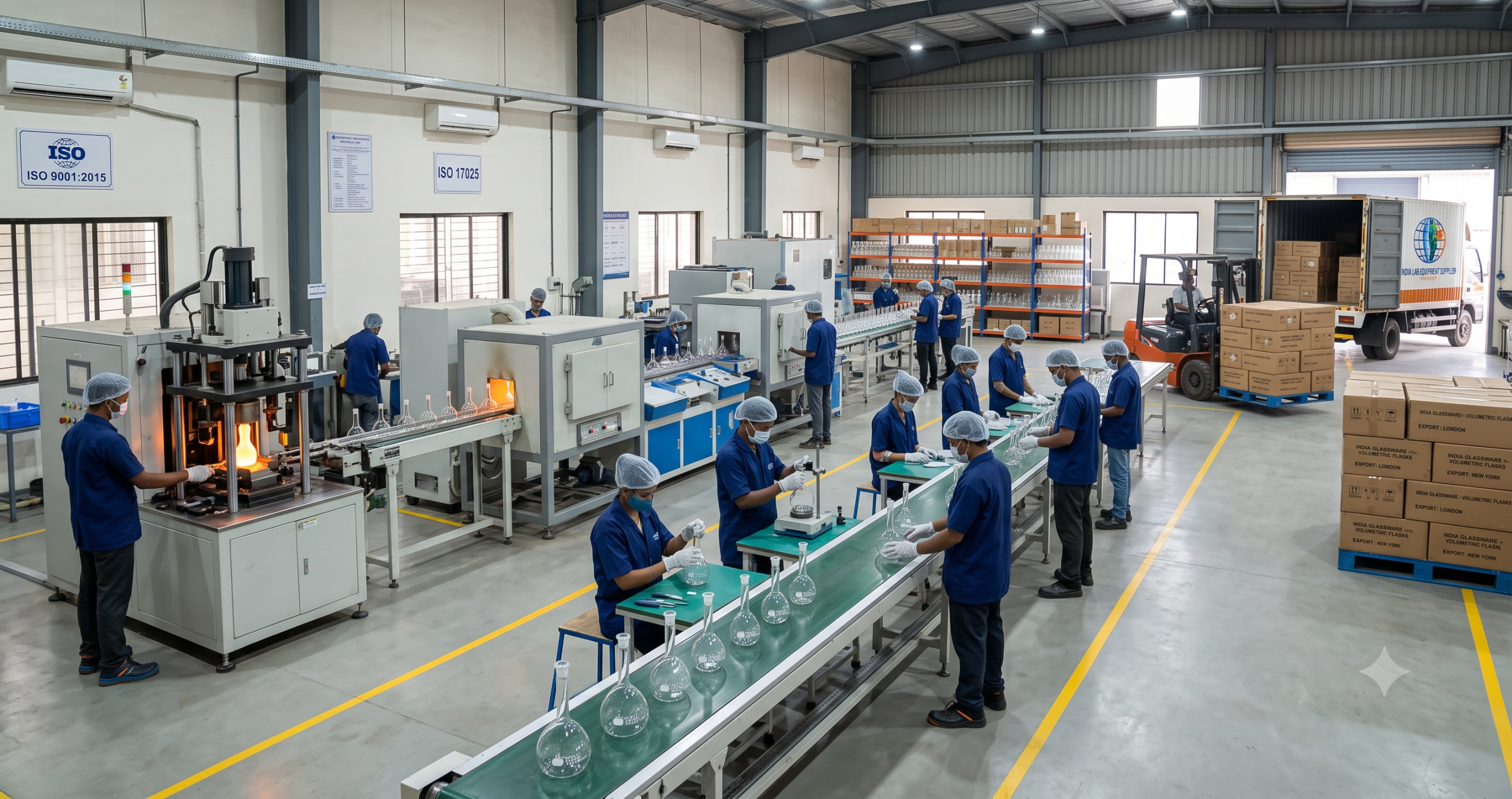
India’s laboratory glassware manufacturing sector has matured over six decades into a base of ISO 9001, ISO 17025, WHO-GMP, and CE-compliant manufacturers producing to the same borosilicate 3.3 specification and the same ISO 4787 tolerance classes used across Europe. This did not happen overnight, and it does not describe every Indian manufacturer indiscriminately, in the same way that not every Chinese or European manufacturer meets the same bar. But for procurement teams willing to qualify suppliers properly, a genuine India lab equipment supplier now competes directly with European quality at a cost structure closer to what China has historically offered, which is exactly why India has become a third category rather than a compromise between the other two.
Reason 1: Quality Parity with European Manufacturing Standards
Quality parity is a specific, verifiable claim, not a marketing assertion. A qualified India lab equipment supplier manufactures glassware from the same borosilicate 3.3 composition used by European manufacturers, calibrated to the same ISO 4787, ISO 1042, and ISO 385 tolerance classes, and certified by the same international accreditation framework. The tolerance value on a Class A 100 mL volumetric flask, plus or minus 0.10 mL, is identical whether the flask was manufactured in Germany, India, or anywhere else certified to the same standard, because the standard itself is the same document referenced by every compliant manufacturer globally.
What buyers should verify, rather than assume, is that a specific candidate supplier holds current, traceable certification against these standards, not simply that “Indian manufacturers generally meet ISO standards” as a category claim. Our guide on laboratory glassware quality standards explains exactly which certificates to request and how to interpret them, and applies equally regardless of which country the supplier operates in.
Reason 2: A Significant Cost Advantage Without the Quality Trade-off
Manufacturing cost in India benefits from lower labor and overhead costs relative to Europe, without requiring the quality compromise that cost-driven sourcing decisions have sometimes assumed. For institutional buyers, this means an India lab equipment supplier can often deliver European-equivalent tolerance and certification at a landed cost meaningfully below European pricing, closing much of the gap that used to exist only between Europe and lower-certification-tier suppliers.
This cost advantage is most valuable to procurement teams managing large-volume institutional contracts, government tenders, or multi-site hospital and university networks, where a per-unit cost difference compounds significantly across thousands of units ordered annually. The advantage is not primarily about undercutting Chinese pricing, since a genuinely quality-matched Indian supplier is not competing purely on lowest price; it is about matching European certification standards at a cost structure that materially improves total procurement budget efficiency.
Reason 3: Post-Pandemic Supply Chain Diversification
The 2020-2022 global supply chain disruption taught procurement teams a lesson that has not faded: single-country sourcing concentration is a strategic risk, independent of that country’s manufacturing quality. Buyers who sourced glassware, consumables, and lab equipment exclusively from one country, regardless of which country, experienced the same category of disruption when factory shutdowns, port congestion, or export restrictions hit that single source.
Adding an India lab equipment supplier to an existing China and Europe sourcing mix is a direct application of the diversification lesson institutional buyers took from that period. India offers a geographically and geopolitically distinct manufacturing base from both existing options, reducing the correlation between disruption events affecting any single sourcing country. This is why many procurement heads now describe their strategy explicitly as “China plus Europe plus India” rather than a binary choice between two options, treating supplier geography itself as a risk variable to manage rather than an afterthought.
Reason 4: Indian Government Export Support
India’s government has actively supported export-oriented manufacturing through policy initiatives including the Make in India program, which promotes domestic manufacturing capability and export competitiveness across sectors including scientific and laboratory equipment. Export incentive schemes, simplified customs procedures for certified exporters, and government-backed trade promotion activity have collectively strengthened the operating environment for an India lab equipment supplier serving international institutional buyers.
This government support translates into practical benefits for buyers: more consistent export documentation standards across Indian manufacturers, growing manufacturing capacity investment in sectors including scientific glassware and instrumentation, and a policy environment actively incentivizing the quality and export-readiness improvements that make Indian suppliers viable partners for large institutional contracts. Trade data compiled by bodies such as the India Brand Equity Foundation documents this sector’s sustained export growth over the past decade, providing buyers with independent evidence of the trend beyond individual supplier claims.
Reason 5: An English-Language Business and Documentation Environment
English is the primary language of business, technical documentation, and international trade communication across India’s export manufacturing sector. For an international buyer, this removes a friction point that can otherwise complicate technical specification discussions, contract negotiation, and certificate interpretation when working with a manufacturer whose primary business language differs from the buyer’s own. Purchase orders, technical datasheets, compliance certificates, and day-to-day email communication with a qualified India lab equipment supplier typically require no translation layer, reducing both the time and the miscommunication risk involved in technical procurement conversations.
This is a practical, operational advantage rather than a quality differentiator, but it materially affects how smoothly a supplier relationship runs day to day, particularly during the technical back-and-forth of specification confirmation, sample evaluation, and documentation review that a structured supplier evaluation process requires.
Reason 6: A Verifiable Multi-Decade Export Track Record
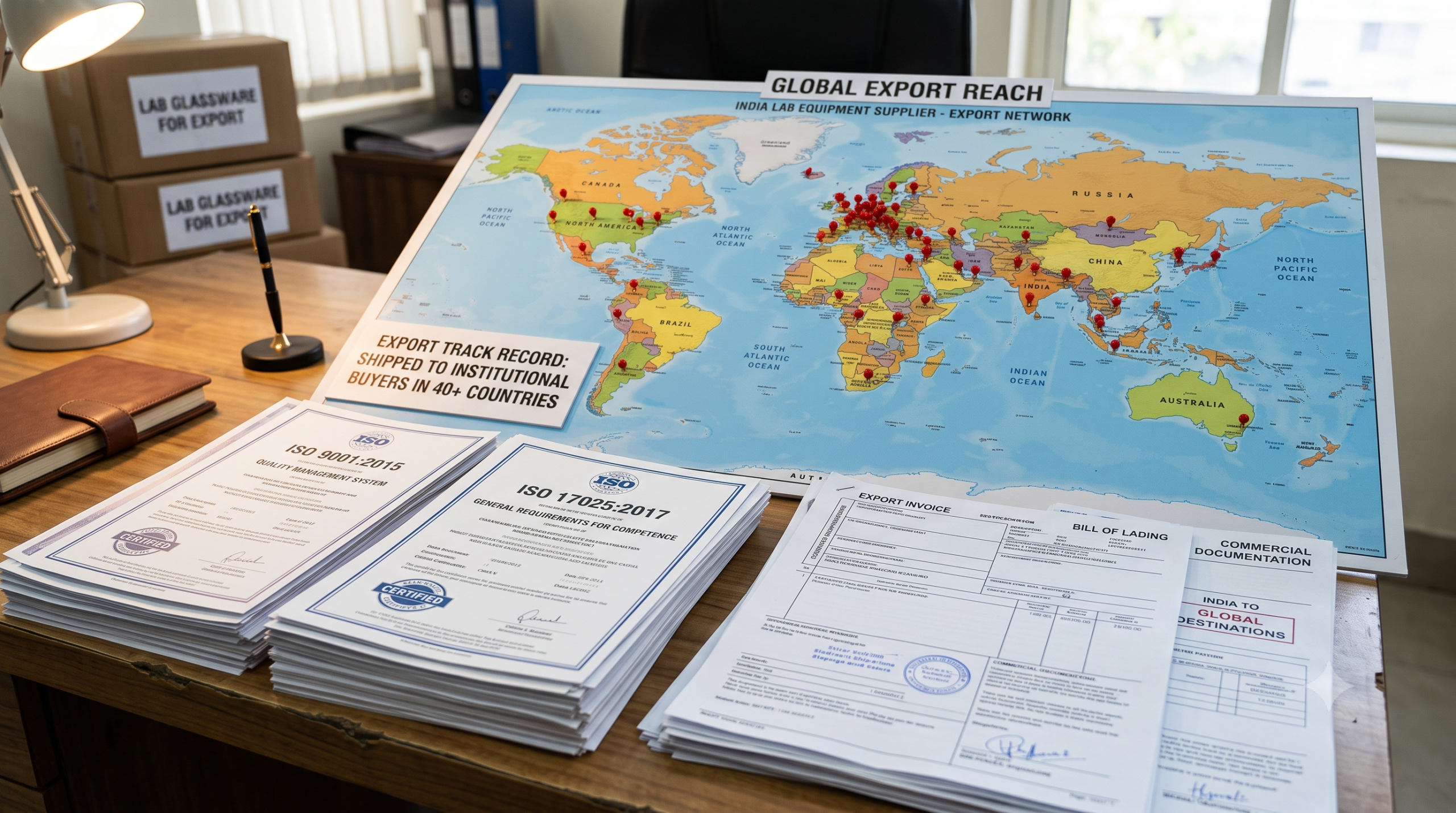
India’s laboratory glassware export sector is not a recent development. Established Indian manufacturers have built multi-decade export relationships with institutional buyers across pharmaceutical, university, hospital, and government laboratory markets in more than 100 countries collectively. Medilab Exports Consortium’s own 40+ country export history spanning 60+ years is one example within a broader sector track record, not an isolated case, and this history is the kind of evidence a buyer should request and verify directly rather than accept as a general claim about “Indian manufacturing” as a category.
When evaluating a specific India lab equipment supplier, ask for the actual list of countries and institution types the supplier currently serves, and request references the same way you would for any other country of origin. A genuine multi-decade export track record is verifiable through exactly the reference-checking and documentation-review process covered in our guide on how to evaluate a lab supplier remotely, which applies identically whether the candidate supplier is based in India, China, or Europe.
India vs China vs Europe: A Sourcing Comparison
The table below summarizes how a qualified India lab equipment supplier compares against typical China and Europe sourcing options across the factors that matter most to institutional procurement decisions. These are general sector patterns, not guarantees for any individual supplier in any country, and should be verified supplier by supplier regardless of which column applies.
| Factor | Typical China Sourcing | Typical Europe Sourcing | Qualified India Sourcing |
|---|---|---|---|
| Unit Cost | Low | High | Moderate to low |
| ISO/ASTM Certification Availability | Variable by supplier | Consistently high | Consistently high among qualified suppliers |
| Business Language | Translation often required | Variable by country | English as primary business language |
| Government Export Support | Strong, established | Mature, established | Actively growing (Make in India, export incentives) |
| Supply Chain Diversification Value | Low if already primary source | Moderate | High as a third, geographically distinct option |
| Freight Time to Europe/Middle East | Longer | Shortest | Competitive, moderate |
How to Add an India Lab Equipment Supplier to Your Sourcing Mix
Adding an India lab equipment supplier to an established sourcing strategy should follow the same qualification rigor you would apply to any new supplier country, not a relaxed process because of general sector reputation. Begin with a small, defined product category rather than migrating your full glassware or equipment spend at once, and apply the full remote evaluation framework, documentation audit, certificate verification, video walkthrough, paid sample testing, and reference checks, before scaling volume.
Our overview of Indian lab equipment manufacturers provides additional background on the manufacturing landscape and sector-wide certification patterns referenced in this guide, useful context before you begin supplier-specific qualification. If your India sourcing decision extends beyond glassware into a broader category range, plasticware, instruments, consumables, and PPE, our analysis of lab supplier consolidation covers how a single qualified supplier across multiple categories can extend the cost and diversification benefits described in this guide across your full procurement list, rather than repeating supplier qualification separately for each product line.
Frequently Asked Questions
For a specific, qualified supplier, yes: a genuine India lab equipment supplier manufacturing to ISO 4787 Class A tolerance from borosilicate 3.3 glass produces a product meeting the identical specification as a European manufacturer certified to the same standard, because both are measured against the same international standard document. This is a supplier-specific claim to verify through certification, not a blanket statement true of every manufacturer in either country, so certificate verification remains essential regardless of country of origin.
Not necessarily, and most procurement teams do not frame it as a replacement decision. Adding an India lab equipment supplier alongside existing China and Europe relationships achieves the supply chain diversification benefit described in this guide, while a full replacement reintroduces the single-country concentration risk you are trying to reduce. Treat India as a third category to qualify and scale gradually, not a wholesale substitution for your existing sourcing base.
The Make in India initiative promotes domestic manufacturing capability and export competitiveness across sectors including scientific and laboratory equipment, alongside export incentive schemes and simplified customs procedures for certified exporters. These programs have contributed to the growing certification consistency and export capacity that make a qualified India lab equipment supplier a credible sourcing option for institutional buyers today, though buyers should still verify individual supplier certification directly.
Apply the same remote verification framework you would use for any supplier regardless of country: request and independently verify ISO 9001 and product-specific certificates, conduct a live video factory walkthrough, order and test a paid sample batch, and check references from existing institutional buyers. An India lab equipment supplier confident in its quality claims will accommodate every step of this process without hesitation, exactly as a genuine European or Chinese supplier would.
A qualified India lab equipment supplier is generally not competing to be the absolute lowest-cost option in the way some Chinese suppliers position themselves, but it typically offers a substantially lower cost than European sourcing at an equivalent certification level. The comparison that matters most for institutional buyers is total cost of ownership against verified quality, not lowest unit price in isolation, and India’s value proposition is strongest in that framing.
Lead times vary by order volume and whether the order is filled from stock or requires new production, similar to any international manufacturing relationship. For institutional buyers in Europe, the Middle East, and Africa, freight time from India is generally competitive and comparable to or better than freight time from East Asian manufacturing hubs, while remaining longer than intra-European shipping. Confirm specific lead time commitments directly with your candidate supplier as part of the evaluation process.
Yes. Medilab Exports Consortium has served as an India lab equipment supplier to institutional buyers, distributors, and laboratories across 40+ countries for 60+ years, manufacturing ISO 9001 and ISO 17025 certified borosilicate 3.3 glassware and an expanded 8-category laboratory supply range. Contact us to begin evaluating India as a sourcing category with full documentation, references, and sample support.
Evaluate India as Your Next Sourcing Category
Medilab Exports Consortium is a 60+ year ISO 9001 and ISO 17025 certified India lab equipment supplier serving institutional buyers across 40+ countries. Request certificates, references, and a paid sample order to evaluate India as a diversification option for your procurement strategy.
