
Description
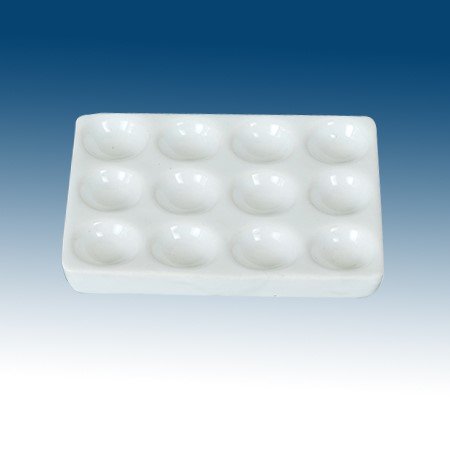
| Spotting Plate | |
| Catalog No | No. of Depressions |
| 19423/01 | 3 |
| 19423/02 | 6 |
| 19423/03 | 9 |
| 19423/04 | 12 |
| 19423/05 | 30 |
The MEDILAB Porcelain Spotting Plate is a multi-cavity reaction plate designed for small-scale qualitative chemical tests and colour reactions. Its durable porcelain construction ensures chemical resistance and consistent performance in routine laboratory workflows. Ideal for micro-scale experiments, it allows users to observe reactions using minimal reagent quantities, making it an essential tool for analytical labs, academic institutions, and research environments.
Key Features
- High-quality glazed porcelain (except the bottom surface) for excellent chemical resistance.
- Multiple uniform cavities for simultaneous testing of various reagents.
- Non-porous, stain-resistant surface ensuring accurate colour observation.
- Stable, flat base for safe benchtop operation.
- Easy to clean, reusable, and designed for long-term laboratory use.
- Suitable for microchemistry, titrations, pH tests, and spot analysis.
Material Specifications
- Material: Laboratory-grade porcelain.
- Chemical Resistance: Highly resistant to acids, alkalis, solvents, and staining reagents.
- Thermal Properties: Can withstand moderate heating; stable under typical lab temperature ranges.
- Mechanical Strength: Dense ceramic composition provides chip and crack resistance.
- Standards: Manufactured in compliance with international ISO laboratory quality standards.
Technical Specifications
- Cavity Options: Multiple-cavity formats are available (e.g., 6-well, 12-well, 24-well).
- Dimensions: Standard laboratory sizes; custom cavity designs available upon request.
- Tolerance & Finish: Precision-moulded cavities for uniform reagent distribution.
- Calibration: Not applicable.
- Accessories: Supplied as a single spotting plate; no additional accessories required.
Handling & Precautions
- Clean after each use with mild detergents; avoid abrasive scrubbing materials.
- Do not expose to thermal shock (rapid heating or cooling).
- Avoid dropping or striking with hard objects to prevent chipping.
- Rinse thoroughly before switching between reagents to avoid cross-contamination.
- Store in a padded container or designated cabinet to maintain longevity.
Applications
- Ideal for qualitative analysis, colour reactions, and microchemical tests.
- Widely used in pharmaceutical, chemical, biotech, and environmental testing labs.
- Suitable for academic teaching experiments and demonstrations.
- Useful for reagent comparison, pH evaluation, small-scale titration, and preliminary compound screening.
- Supports QC/QA workflows by enabling quick multiple-reaction assessments with minimal sample use.