
Description
| Catalog No. | Socket Size | Cone Size |
| 11124/1 | 19/26 | 19/26 |
| 11124/2 | 19/26 | 24/29 |
| 11124/3 | 24/29 | 24/29 |
| 11124/4 | 29/32 | 29/32 |
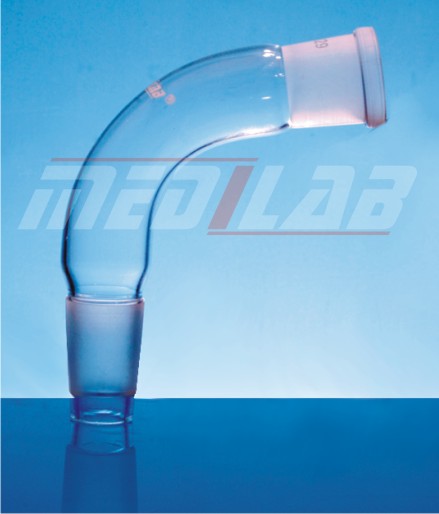
MEDILAB Receiver Adapters (Plain Bend) are precision-engineered borosilicate glass connectors used to safely guide condensate or distillate between apparatus setups. Designed for smooth directional flow without turbulence, these adapters help optimize distillation, solvent recovery, and analytical workflows. Their robust build and accurate ground joints ensure secure, leak-free connections in demanding laboratory and industrial environments.
Key Features
- Manufactured from high-purity Borosilicate Glass 3.3 for superior thermal and chemical stability.
- Smooth plain-bend geometry for efficient transfer of liquids and vapours.
- Precisely machined standard taper ground joints for leak-tight assembly.
- High resistance to thermal shock, mechanical stress, and aggressive chemicals.
- Uniform wall thickness ensures durability and long service life.
- Crystal-clear transparency allows easy visual inspection of the flow.
- Available in multiple joint sizes to support diverse laboratory setups.
- Ideal for distillation systems, extraction lines, and modular glass assemblies.
Material Specifications
Material: Borosilicate Glass 3.3
Properties:
Thermal: High thermal shock resistance; low coefficient of expansion (approx. 3.3 × 10⁻⁶ /K).
Chemical: Excellent resistance to acids, solvents, organic chemicals, and corrosion.
Mechanical: High tensile strength and durability suitable for routine and continuous use.
Standards Compliance:
- Complies with ISO 3585 Borosilicate Glass 3.3 requirements
- Meets international joint standards such as ISO / DIN taper joint specifications
- Compatible with ASTM laboratory glassware systems
Technical Specifications
Specifications may vary based on selected size.
- Available Joint Sizes: 14/23, 19/26, 24/29, 29/32, 34/35, and other standard taper configurations.
- Bend Angle: Plain bend design optimised for smooth flow (typically 105°–120° depending on size).
- Length & Dimensions: Precision-crafted to ensure uniform fit with standard lab apparatus.
- Accuracy Class: Manufactured to tight tolerances for perfect joint sealing.
- Calibration: Not applicable (non-volumetric component)
- Accessories Included: None (compatible with all standard glassware systems)
Handling & Precautions
- Use with compatible ground joints only to prevent leakage or breakage.
- Avoid sudden thermal shocks; allow gradual heating and cooling.
- Suitable for autoclaving; recommended maximum temperature ≈ 500°C for dry heat.
- Clean using mild detergents or suitable solvent rinses; avoid abrasive cleaning materials.
- Inspect joints regularly for chips or cracks before assembly.
- Do not apply excessive mechanical force when fitting or removing joints.
- Store vertically or in padded racks to prevent accidental damage.
Applications
Receiver Adapters (Plain Bend) are widely used in:
- Chemical, Pharmaceutical, and Biotech Laboratories
- University & Research Institutions
- QC/QA Laboratories
- Distillation, Solvent Recovery & Fractional Separation
- Analytical Chemistry, Organic Synthesis, and Sample Preparation
- Pilot-scale and R&D Facilities
They play a key role in directing condensate flow, connecting condensers to receivers, and ensuring safe, efficient handling of distillation outputs.