

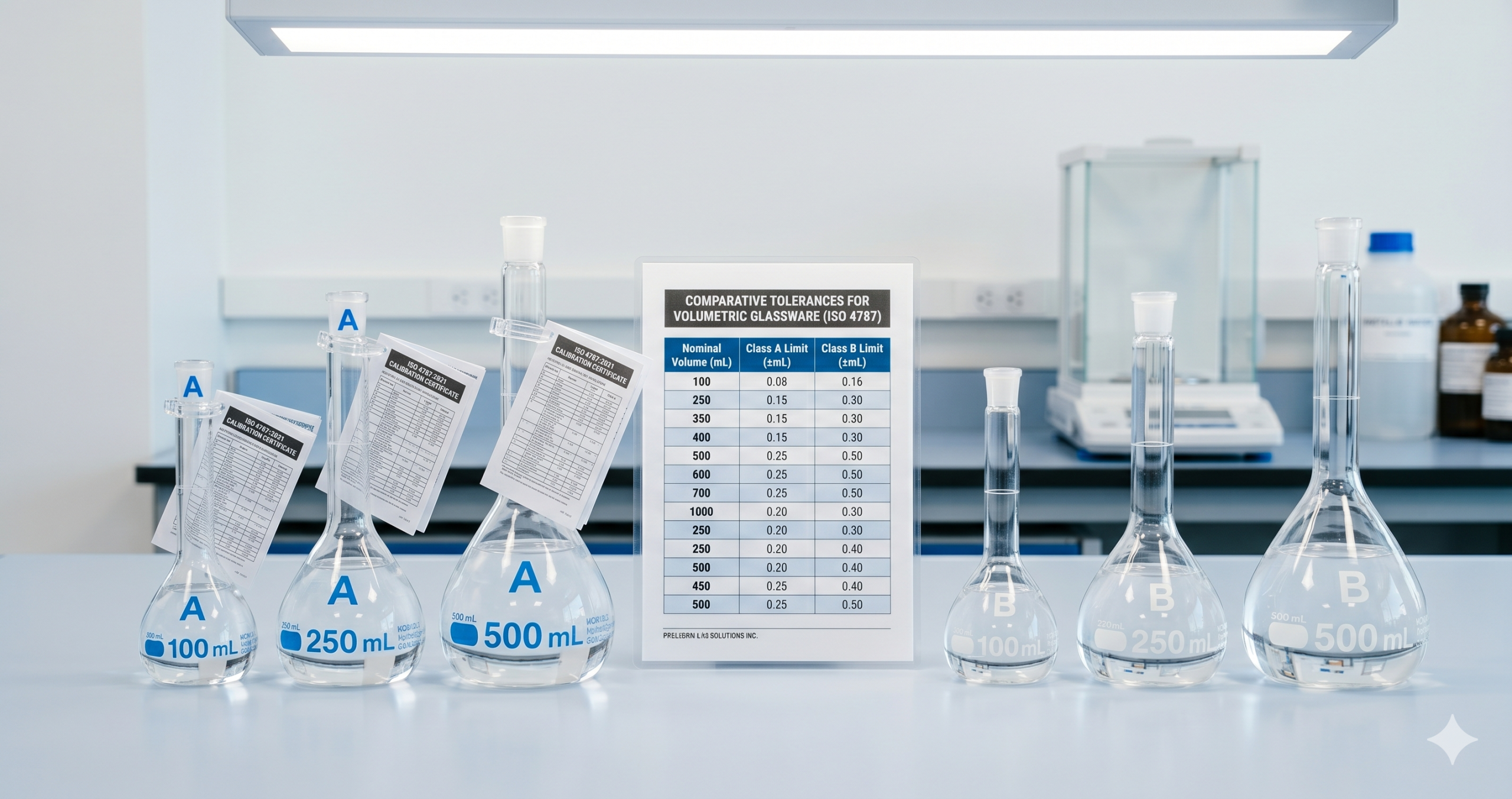
Volumetric glassware tolerance classes determine how closely a volumetric instrument delivers its stated volume – and that precision directly controls the accuracy of every quantitative measurement made with it. Procurement managers, laboratory managers, and quality assurance teams who understand volumetric glassware tolerance classes can specify the correct instrument for each application, interpret calibration certificates accurately, and prevent analytical errors that originate from incorrectly classified glassware entering the laboratory workflow.
This guide explains what volumetric glassware tolerance classes are, how ISO 4787 defines the tolerance limits for Class A and Class B instruments across all major volumetric types, what the numerical difference between classes means for measurement results in practice, and how to match tolerance class selection to application requirements in pharmaceutical, research, clinical, and educational laboratory settings.
Medilab Exports Consortium manufactures ISO-certified borosilicate 3.3 laboratory glassware to Class A and Class B specifications across all standard volumetric instrument types – volumetric flasks, transfer pipettes, graduated pipettes, burettes, and graduated cylinders. Our batch documentation includes ISO 4787 calibration reports that confirm the declared volumetric glassware tolerance class for every lot dispatched. The specifications and guidance in this article reflect the ISO standards we apply to our own production and quality verification processes.
Why Volumetric Glassware Tolerance Classes Determine Analytical Reliability
Every quantitative laboratory procedure that depends on a measured volume – sample preparation, standard solution preparation, titration, dilution, and gravimetric analysis – inherits the measurement uncertainty of the volumetric instrument used. A volumetric flask that delivers 100.15 mL when its stated capacity is 100 mL introduces a 0.15% systematic error into every result that uses that standard solution. Over a series of measurements, that error compounds into results that are consistently off-target by a predictable and avoidable amount.
Volumetric glassware tolerance classes define the maximum permissible deviation between the stated nominal volume and the actual delivered volume. Class A sets tighter limits. Class B permits approximately double the deviation at each nominal volume. This numerical difference appears small in absolute terms – tenths of a milliliter – but it translates directly into measurement uncertainty values that determine whether a laboratory result can be reported with the required confidence level for its intended application.
Regulatory frameworks make this selection mandatory in certain contexts. Pharmaceutical laboratories operating under WHO Good Manufacturing Practices must use volumetric instruments calibrated to defined tolerance standards. ISO 17025-accredited testing laboratories must document the measurement uncertainty contribution of all volumetric instruments used in test procedures. In both cases, the tolerance class of the volumetric glassware is a documented input into the uncertainty budget – not a preference, but a specification requirement.
How ISO 4787 Defines Volumetric Glassware Tolerance Classes
ISO 4787 is the primary international standard governing the capacity tolerances, graduation requirements, and verification methods for laboratory glass volumetric instruments. It applies to volumetric flasks (in conjunction with ISO 1042), one-mark and graduated transfer pipettes (ISO 648), burettes (ISO 385), and graduated cylinders (ISO 4788). Every instrument type covered by ISO 4787 is classified as either Class A or Class B.
ISO 4787 defines Class A as the higher-precision class, with tolerance limits set to approximately one-half of those specified for Class B at each nominal volume. Class A instruments are individually calibrated and carry batch-level calibration documentation. Class B instruments are tested by sampling rather than 100% individual calibration and carry group-level conformance documentation. Both classes are required to be manufactured from borosilicate glass with a thermal expansion coefficient not exceeding 3.3 x 10^-6 K^-1 to ISO 3585 specification.
ISO 4787 also specifies the reference temperature for volumetric measurement: 20 degrees Celsius. All stated capacities and tolerance limits apply at this reference temperature. Measurements taken at temperatures other than 20 degrees Celsius require thermal correction factors. This applies to both Class A and Class B instruments and must be accounted for in laboratory procedures that specify volumetric measurements at ambient temperatures above or below 20 degrees Celsius.
Class A Volumetric Glassware Tolerance: Specifications by Instrument Type
Class A volumetric glassware tolerance limits under ISO 4787 are specified for each instrument type and nominal volume. For volumetric flasks – the most commonly specified Class A instrument in quantitative analysis – the tolerance limits increase with nominal volume but remain proportionally tighter than Class B at every size.
- 5 mL volumetric flask, Class A: ±0.02 mL
- 10 mL volumetric flask, Class A: ±0.02 mL
- 25 mL volumetric flask, Class A: ±0.03 mL
- 50 mL volumetric flask, Class A: ±0.05 mL
- 100 mL volumetric flask, Class A: ±0.10 mL
- 250 mL volumetric flask, Class A: ±0.15 mL
- 500 mL volumetric flask, Class A: ±0.25 mL
- 1000 mL volumetric flask, Class A: ±0.40 mL
- 2000 mL volumetric flask, Class A: ±0.60 mL
For one-mark transfer pipettes under ISO 648, volumetric glassware tolerance classes at Class A level follow a similar structure: 1 mL (±0.007 mL), 2 mL (±0.010 mL), 5 mL (±0.015 mL), 10 mL (±0.020 mL), 20 mL (±0.030 mL), 25 mL (±0.030 mL), 50 mL (±0.050 mL). These limits apply to the nominal delivery volume at the stated delivery time and reference temperature.
For burettes under ISO 385, Class A tolerance limits are: 10 mL (±0.020 mL), 25 mL (±0.030 mL), 50 mL (±0.050 mL), 100 mL (±0.100 mL). Class A burettes must also meet graduation mark accuracy requirements at all intermediate marks along the scale, not only at the nominal capacity mark – a requirement that prevents systematic scale errors from passing instrument-level testing while producing inaccurate intermediate readings in use.
Class B Volumetric Glassware Tolerance: Specifications by Instrument Type
Class B volumetric glassware tolerance limits are defined as approximately twice the Class A limits at each nominal volume. For volumetric flasks, the ISO 4787 Class B limits are: 5 mL (±0.04 mL), 10 mL (±0.04 mL), 25 mL (±0.06 mL), 50 mL (±0.10 mL), 100 mL (±0.20 mL), 250 mL (±0.30 mL), 500 mL (±0.50 mL), 1000 mL (±0.80 mL), 2000 mL (±1.20 mL).
Class B instruments carry volumetric glassware tolerance class markings on the glass body – typically “B” or “Class B” in permanent enamel print alongside the nominal volume designation. Class A instruments are marked “A” and typically carry an additional individual lot number that links to the batch calibration certificate. The absence of a clear class marking on a volumetric instrument is a non-conformance that should be reported and documented at goods receipt.
Class B instruments still represent genuine ISO-conforming calibrated glassware. Their tolerance limits are defined, documented, and verifiable. The distinction from Class A is one of precision level, not of quality. Class B instruments are correctly manufactured and appropriately used in the applications for which they are specified – which excludes quantitative analytical chemistry requiring the precision that Class A delivers, but includes a wide range of preparative, educational, and general laboratory measurement tasks.
What the Difference Between Class A and Class B Means in Practice
The practical significance of volumetric glassware tolerance classes depends on what error contribution the tolerance introduces relative to the total measurement uncertainty budget of the procedure. At 100 mL nominal volume, the Class A tolerance of ±0.10 mL represents a relative error of ±0.10%. The Class B tolerance of ±0.20 mL represents ±0.20%. For a procedure with a total allowable measurement uncertainty of ±0.5%, both classes appear tolerable. For a procedure with a total allowable uncertainty of ±0.15%, Class A is mandatory and Class B fails the requirement.
Standard solution preparation illustrates the stakes precisely. A primary standard prepared at 0.1 mol/L concentration in a 1000 mL Class A volumetric flask (tolerance ±0.40 mL) introduces a concentration uncertainty contribution of ±0.04% from the flask alone. The same solution prepared in a Class B flask (tolerance ±0.80 mL) introduces ±0.08%. In pharmaceutical content uniformity testing or analytical method validation with tight uncertainty requirements, this difference is analytically significant and may determine whether the result passes or fails the specification limit.
Cumulative error in multi-step procedures amplifies the effect. A procedure that uses three volumetric transfers – each with its own tolerance contribution – accumulates error at each step. If each transfer uses Class B instead of Class A glassware, the total accumulated uncertainty is approximately double what Class A instruments would produce. For procedures involving serial dilutions or multiple volumetric steps, specifying Class A instruments throughout the analytical pathway is the correct approach to controlling cumulative measurement uncertainty.
Applications That Require Class A Volumetric Glassware Tolerance
Class A is mandatory for all quantitative analytical chemistry applications where measurement uncertainty must be controlled and documented. Specific applications include: primary and secondary standard solution preparation for titration and spectrophotometry, content uniformity and assay testing in pharmaceutical quality control, preparation of calibration standards for atomic absorption, HPLC, and UV-Vis spectrophotometry, gravimetric and volumetric analysis under pharmacopoeial methods, and external calibration curve preparation for clinical diagnostic assays.
Regulatory requirements reinforce this specification. WHO-GMP and pharmacopoeial methods including those in the United States Pharmacopoeia (USP), European Pharmacopoeia (Ph.Eur.), and Indian Pharmacopoeia (IP) specify volumetric glassware requirements in terms of ISO or pharmacopoeial calibration standards. Most pharmacopoeial method monographs that require precise volumetric measurements implicitly require Class A instruments, and some explicitly state “Class A” in the procedure.
For distributors supplying pharmaceutical and regulated clinical laboratories, specifying and stocking volumetric glassware tolerance classes correctly matters as a supply chain responsibility. A distributor who ships Class B glassware against a Class A order – even inadvertently – creates a compliance problem for the receiving laboratory. Class designation must be clearly marked on the instrument and confirmed in the certificate of conformance for every regulated laboratory order. See our guide on laboratory glassware quality standards for the full ISO and regulatory framework that governs these requirements.
Applications Where Class B Tolerance Is Acceptable
Class B volumetric glassware tolerance is appropriate for applications where the analytical requirement does not demand the precision that Class A delivers. Suitable Class B applications include: preparation of non-critical reagent solutions and buffer solutions where concentration does not require tight control, volume measurement in preparative chemistry and scale-up work where yield matters more than precise concentration, general laboratory coursework and undergraduate teaching where technique development rather than analytical accuracy is the objective, and routine sample preparation for screening assays where approximate concentrations are sufficient.
Class B instruments are also appropriate for any procedure that is validated using the same class of glassware throughout. If a method is validated with Class B instruments and the validation uncertainty budget accounts for Class B tolerances, using Class B instruments is consistent and correct. The error is known, characterized, and managed within the validated procedure – which is a different situation from substituting Class B for Class A in a procedure validated with Class A instruments.
The cost difference between Class A and Class B glassware makes the class selection decision relevant to laboratory procurement budgets. Class A instruments cost more because they require individual calibration, complete batch documentation, and tighter manufacturing process control. Specifying Class A for applications that genuinely require it, and Class B for those that do not, is the correct approach to cost-effective laboratory procurement without compromising analytical performance where it matters.

How to Verify Tolerance Class at Goods Receipt
Verification of volumetric glassware tolerance classes at goods receipt involves three steps: visual marking confirmation, certificate cross-check, and dimensional verification. Visual marking confirmation means checking that the class designation (“A” or “B”), the nominal volume, and the ISO standard reference are permanently marked on the glass body of every instrument in the delivery. Any instrument without permanent class marking is non-conforming and should be quarantined pending supplier response.
Certificate cross-check means verifying that the certificate of conformance identifies the correct class, references ISO 4787 (and the applicable subsidiary standard – ISO 1042, ISO 648, or ISO 385), states the calibration tolerance for the declared class, and carries a lot number that matches the packaging. Certificates that state “ISO-certified” without naming specific standard numbers or that omit lot-level traceability do not satisfy the documentation requirement for regulated laboratory procurement.
Dimensional verification – physically measuring delivered volume against the calibration mark using a calibrated analytical balance and deionized water at 20 degrees Celsius – is the definitive check. For Class A instruments, calculate three repetitions and confirm the mean falls within the stated tolerance. For high-value or large-volume orders, dimensional verification of a sample set provides independent confirmation of the supplier’s calibration data. See our guide on laboratory glassware sample evaluation for the complete pre-order verification protocol.
Volumetric Glassware Tolerance Classes: ISO 4787 Reference Table
The table below provides ISO 4787 tolerance values for volumetric glassware tolerance classes A and B across the most commonly procured instrument types and nominal volumes. Use this reference when specifying glassware, reviewing calibration certificates, or calculating measurement uncertainty contributions for analytical procedures.
| Instrument Type | Nominal Volume (mL) | Class A Tolerance (±mL) | Class B Tolerance (±mL) | Class A % Error at Nominal |
|---|---|---|---|---|
| Volumetric Flask | 5 | 0.02 | 0.04 | 0.40% |
| Volumetric Flask | 10 | 0.02 | 0.04 | 0.20% |
| Volumetric Flask | 25 | 0.03 | 0.06 | 0.12% |
| Volumetric Flask | 50 | 0.05 | 0.10 | 0.10% |
| Volumetric Flask | 100 | 0.10 | 0.20 | 0.10% |
| Volumetric Flask | 250 | 0.15 | 0.30 | 0.06% |
| Volumetric Flask | 500 | 0.25 | 0.50 | 0.05% |
| Volumetric Flask | 1000 | 0.40 | 0.80 | 0.04% |
| Transfer Pipette | 1 | 0.007 | 0.015 | 0.70% |
| Transfer Pipette | 5 | 0.015 | 0.030 | 0.30% |
| Transfer Pipette | 10 | 0.020 | 0.040 | 0.20% |
| Transfer Pipette | 25 | 0.030 | 0.060 | 0.12% |
| Transfer Pipette | 50 | 0.050 | 0.100 | 0.10% |
| Burette | 10 | 0.020 | 0.040 | 0.20% |
| Burette | 25 | 0.030 | 0.060 | 0.12% |
| Burette | 50 | 0.050 | 0.100 | 0.10% |
How to Specify Tolerance Class in Procurement Documents
Tolerance class must appear explicitly in procurement documents – purchase orders, request for quotation forms, and supplier qualification specifications. A purchase order that states “100 mL volumetric flask” without specifying “Class A” or “Class B” is an incomplete specification. The supplier will fulfill the order based on available stock, which may or may not match the intended class. Procurement errors of this type are common and entirely preventable by adding the class designation as a required field in the purchase order template.
The correct specification format is: instrument type + nominal volume + class + standard reference. Example: “Volumetric Flask, 100 mL, Class A, ISO 1042 / ISO 4787.” This format prevents ambiguity, appears in the supplier’s quotation as a confirmed specification, and becomes part of the batch certificate traceability record. For regulated laboratory procurement, the ISO standard reference is not optional – it is the documented basis for the tolerance limit that the certificate confirms. For reference on how precision requirements translate into procurement specification practice, see our guide on precision scientific glassware.
Medilab Exports Consortium marks all volumetric glassware with the ISO class designation in permanent enamel, includes ISO 4787 calibration reports with every Class A lot, and can provide individual calibration traceability records for pharmaceutical procurement orders. Contact our export team to request product specifications for Class A or Class B volumetric instruments, or to confirm documentation scope for regulated laboratory procurement.
Frequently Asked Questions
Class A and Class B are the two volumetric glassware tolerance classes defined by ISO 4787. Class A has tighter tolerance limits – approximately half those of Class B at every nominal volume. A 100 mL Class A volumetric flask must fall within ±0.10 mL of its stated capacity; a Class B flask at the same size must fall within ±0.20 mL. Class A instruments are individually calibrated and carry lot-level documentation. Class B instruments are tested by sampling and carry group-level conformance records. Class A is required for quantitative analytical work; Class B is appropriate for general and preparative laboratory use.
Class A volumetric glassware supplied with an ISO 4787 calibration certificate does not require recalibration at the point of delivery if the certificate is current and covers the specific lot received. However, laboratories operating under ISO 17025 accreditation or pharmaceutical GMP must include volumetric glassware in their periodic instrument verification schedules. Recalibration intervals depend on the laboratory’s quality management system requirements – typically one to three years for glass volumetric instruments in normal use. Any instrument that shows visible damage, surface etching, or graduation mark degradation should be recalibrated or removed from service regardless of interval. Understanding volumetric glassware tolerance classes is the first step in building a compliant verification schedule.
Class B glassware can be used in pharmaceutical laboratory settings for non-analytical applications – reagent preparation, buffer preparation, cleaning operations, and general bench work where measurement uncertainty does not affect the quality decision. Class B glassware cannot be used in place of Class A instruments for pharmacopoeial assays, content uniformity testing, potency determinations, or any quantitative procedure where the pharmacopoeia or the validated method specifies volumetric instruments calibrated to Class A volumetric glassware tolerance classes. Substituting Class B for Class A in a validated analytical procedure invalidates the validation unless the method was originally validated with Class B instruments throughout.
The class designation should be permanently marked on the glass body of the instrument in enamel print – either “A” or “Class A” and “B” or “Class B” alongside the nominal volume marking. ISO 4787 requires this marking on all conforming instruments of both volumetric glassware tolerance classes. An instrument without a visible class marking is non-conforming and should not be used for analytical work until its class designation is confirmed by the supplier’s documentation. If the physical marking has degraded or was never applied, contact the supplier for the batch certificate and confirm the declared class against the lot number on the packaging.
Yes. ISO 4787 specifies that all volumetric capacity tolerances apply at a reference temperature of 20 degrees Celsius. At temperatures above or below 20 degrees Celsius, both the glass volume and the liquid density change, introducing a systematic error that is not captured by the stated tolerance. For borosilicate 3.3 glass, the thermal expansion coefficient is 3.3 x 10^-6 K^-1, which contributes a small but measurable volume change per degree of temperature deviation. The larger source of error at off-reference temperatures is the density change in the measured liquid. Laboratories that work at significantly different ambient temperatures should apply water density correction factors when using volumetric glassware tolerance classes data for uncertainty calculations.
Class A volumetric glassware should ship with: an ISO 4787 calibration report that identifies the instrument type, nominal volume, declared class, tolerance limit, measured value (or confirmation of conformance), calibration date, and lot number; a certificate of conformance with lot-level traceability; and a material composition certificate confirming borosilicate 3.3 glass to ISO 3585. For pharmaceutical procurement, a quality inspection release record is also required. Certificates that reference volumetric glassware tolerance classes without naming the specific ISO standard number, or that omit the lot number, are incomplete and should be returned to the supplier for correction before the instruments enter the laboratory inventory.
Yes. Medilab Exports Consortium manufactures Class A volumetric flasks, transfer pipettes, graduated pipettes, and burettes to ISO 4787 and ISO 1042 specifications. Every Class A lot ships with an ISO 4787 calibration report, certificate of conformance with lot-level traceability, and material composition certificate confirming borosilicate 3.3 composition. Extended documentation packages for pharmaceutical procurement – including incoming inspection records and quality release records formatted for GMP supplier qualification – are available on request. Contact our export team to specify volumetric glassware tolerance classes, nominal volumes, and documentation requirements for your procurement order.
Request Class A Volumetric Glassware with Full ISO 4787 Documentation
Medilab Exports Consortium manufactures ISO-certified borosilicate 3.3 Class A and Class B volumetric glassware for pharmaceutical laboratories, research institutions, and laboratory equipment distributors in 40+ countries. Every Class A lot ships with complete volumetric glassware tolerance class documentation – ISO 4787 calibration report, material certificate, and certificate of conformance with lot-level traceability.
