
Description
| Catalog No. | Capacity ml |
| 11029/11.1 | 60 |
| 11029/11 | 100 |
| 11029/12 | 250 |
| 11029/13 | 500 |
| 11029/14 | 1000 |
| 11029/15 | 2000 |
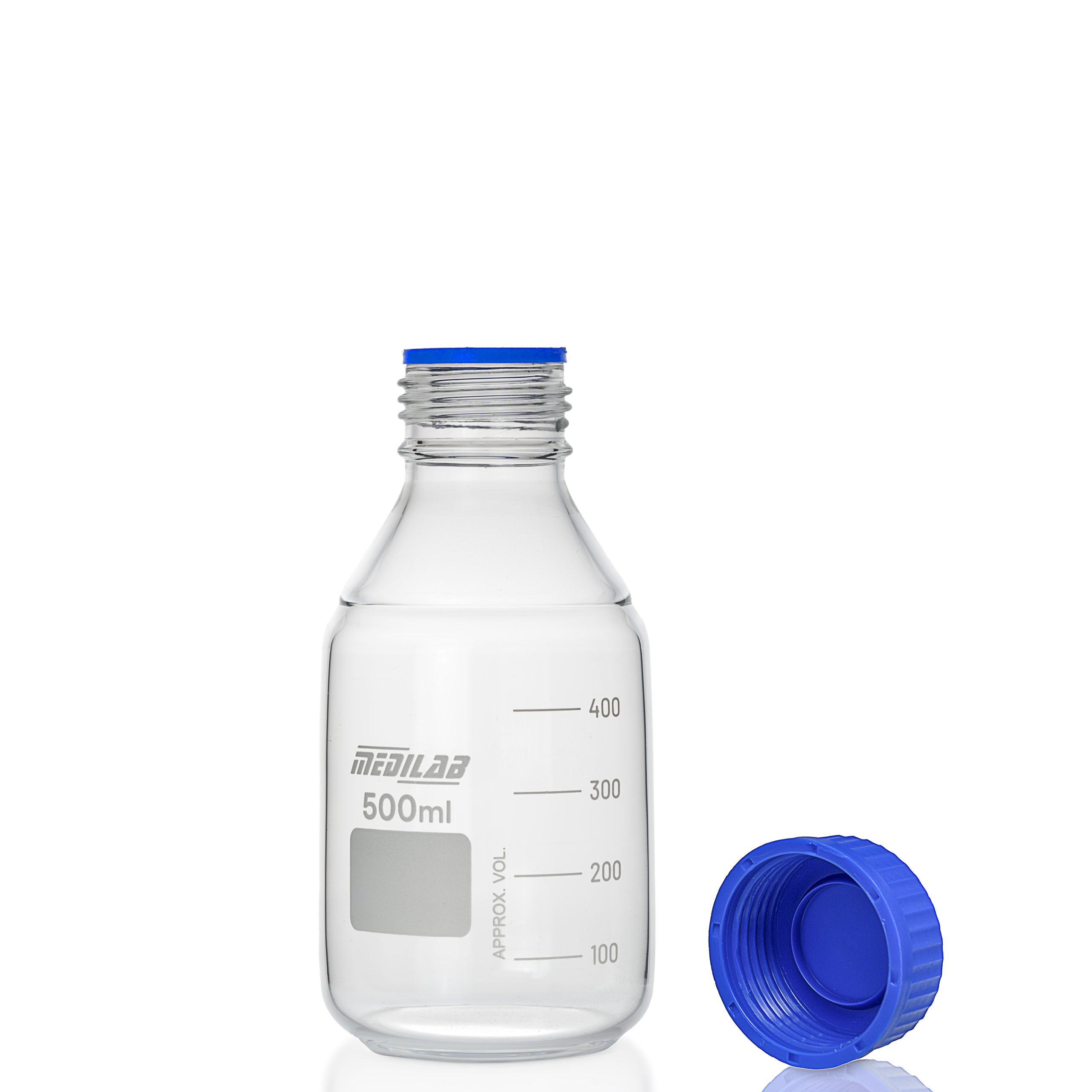
The MEDILAB Reagent Bottle with Screw Cap and Pouring Ring is a high-quality laboratory storage container designed for safe handling, pouring, and long-term preservation of liquid chemicals and reagents. Manufactured from premium Borosilicate Glass 3.3, it offers excellent thermal and chemical stability for routine and demanding laboratory workflows. The screw-cap closure ensures leak-proof sealing, while the integrated pouring ring enables drip-free dispensing. Ideal for pharma, chemical, biotech, and academic laboratories where accuracy, cleanliness, and durability are essential.
Key Features
- Borosilicate Glass 3.3 construction ensures exceptional thermal shock resistance and high chemical durability.
- Leak-proof screw cap (typically PP or GLS-compatible) provides secure closure for safe reagent storage and transport.
- Integrated pouring ring offers clean, spill-free, and controlled dispensing of liquids.
- Autoclavable design for sterilisation and contamination-free use.
- Thick-walled, robust construction for long service life in laboratory and industrial environments.
- Clear, easy-to-read graduations for accurate volume monitoring (when provided).
- Uniform wall thickness ensures consistent performance under varying temperature and pressure conditions.
- Compatible with standard laboratory racks and storage systems.
Material Specifications
- Material: High-quality Borosilicate Glass 3.3
- Thermal Properties: Low Coefficient of Thermal Expansion (~3.3 × 10⁻⁶/K), High resistance to sudden temperature changes Suitable for heating, autoclaving, and cooling cycles
- Chemical Resistance: Excellent resistance to acids, alkalis, solvents, and organic solutions. Non-porous surface prevents contamination and reagent interaction
- Mechanical Properties: Strong, durable, scratch-resistant. Designed for long-term laboratory use
- Standards Compliance: Manufactured in accordance with international standards such as ISO, DIN, and ASTM for laboratory glassware.
Technical Specifications
- Available Capacities: As per the standard size table
- Dimensions: Conform to standard laboratory reagent bottle dimensions; a detailed size chart is provided upon request or as per the product catalogue.
- Tolerance: Manufactured with precision forming for uniformity; tolerances aligned with ISO/DIN norms.
- Closure System: Screw cap with pouring ring (PP/GL-series compatible)
- Calibration: Optional printed graduations are available for approximate volume indication.
- Packaging: Individually shrink-wrapped or boxed, carton-packed with partitioning for maximum transport safety
Handling & Precautions
- Safe Use: Always check the bottle and cap integrity before chemical storage. Avoid sudden heating or cooling beyond recommended thermal limits.
- Cleaning Instructions: Wash with mild laboratory detergents; avoid abrasive scrubbers. Rinse thoroughly with distilled/deionised water.
- Autoclaving: The bottle and pouring ring are autoclavable; caps should be loosened during autoclave cycles. Do not overtighten the cap during sterilisation to avoid pressure buildup.
- Heating Limits: Avoid direct flame contact; use controlled heating appliances only.
- Do’s & Don’ts: Do: Inspect for cracks, chips, or stress marks before use. Don’t: Use for highly alkaline solutions above recommended temperatures for prolonged periods.
- Best Practices: Store in dry, clean conditions. Keep caps loosely closed when cooling after heating.
Applications
- Widely used in chemical, pharmaceutical, biotechnology, academic, and industrial laboratories.
- Ideal for safe storage, transfer, and dispensing of reagents, solvents, buffer solutions, and analytical samples.
- Essential in QC/QA, R&D, analytical chemistry, microbiology, and process labs.
- Suitable for workflows requiring efficient, contamination-free handling and long-term chemical stability.
- Plays a critical role in daily laboratory processes, including sample preparation, solution storage, titration setups, and media handling.