

Description
| Catalogue No. | Size | Bore (mm) |
| 11034/1 | 14.5 | 2.5 |
| 11034/2 | 18.8 | 4.0 |
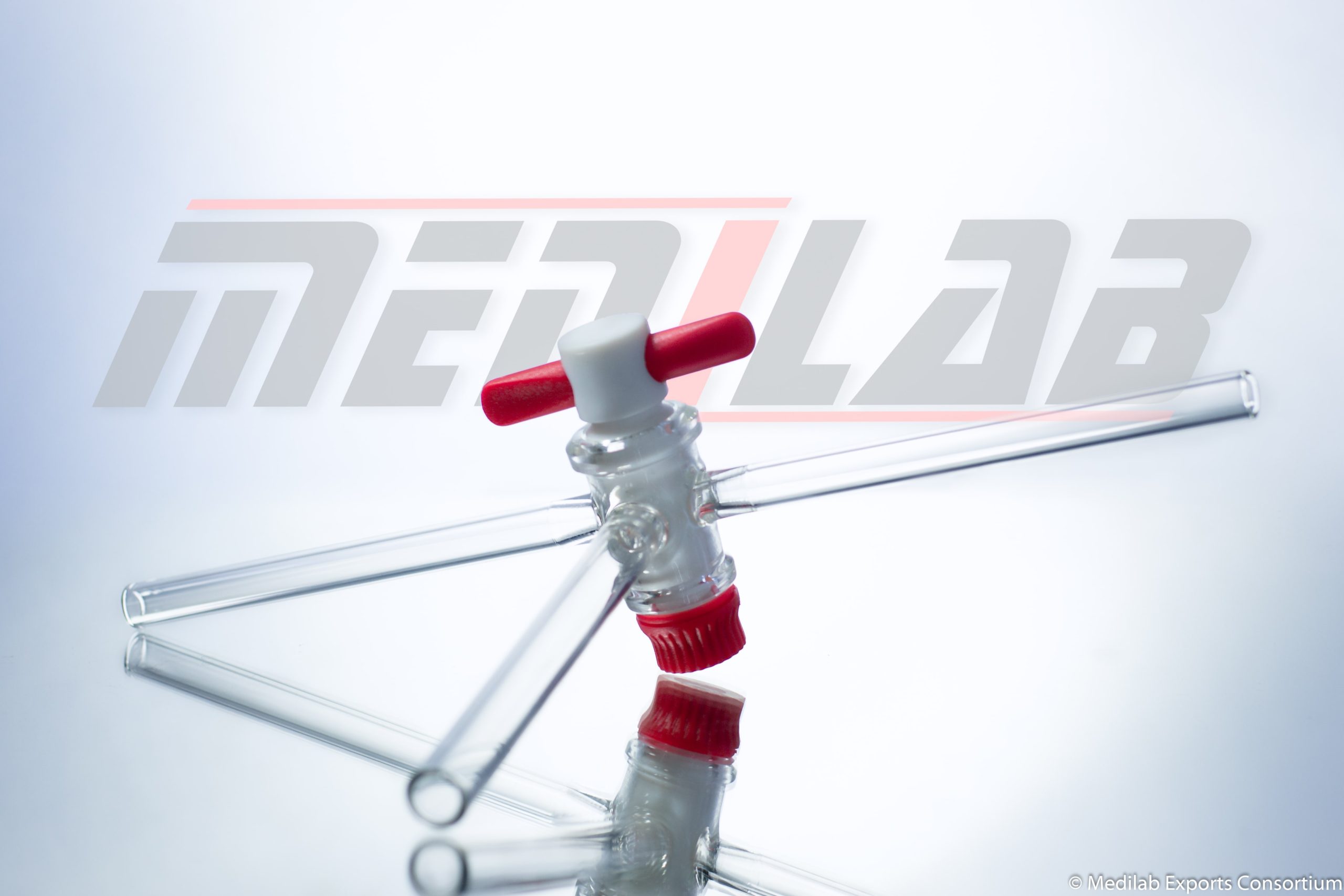
The MEDILAB PTFE Key Stopcock, 3-Way, T-Bore is a precision-engineered flow-control component designed for accurate direction and regulation of gases and liquids in laboratory glassware systems. Widely used in research, analytical, and industrial setups, it ensures smooth, leak-free operation even under demanding chemical environments. Its T-Bore configuration allows easy switching between channels, making it essential for complex fluid transfer, vacuum lines, filtration assemblies, and reaction apparatuses.
Key Features
- 3-Way T-Bore Design enables controlled flow selection between multiple ports.
- Precision PTFE Key ensures excellent chemical resistance and smooth, low-torque operation.
- Crafted from Borosilicate Glass 3.3 for maximum durability and thermal stability.
- Interchangeable Stopcock Key for quick replacement and optimised workflow.
- Leak-proof sealing suitable for vacuum and pressure applications.
- High transparency for easy observation of fluid/chemical pathways.
- Corrosion-resistant, non-reactive construction, ideal for aggressive chemicals and solvents.
- Reusable, long-life component designed for consistent laboratory performance.
Material Specifications
Material: Borosilicate Glass 3.3 (Body) + Virgin PTFE (Key)
Properties:
- High thermal resistance (up to approx. 300°C intermittent).
- Excellent chemical durability against acids, alkalis, and organic solvents.
- Low thermal expansion coefficient ensures dimensional stability.
- Mechanical strength suitable for repeated handling and vacuum use.
Standards Compliance: - Manufactured in accordance with ISO 3585 (Borosilicate Glass 3.3)
- Dimensions and tolerances aligned with common DIN/ISO laboratory glassware norms
- PTFE key manufactured to international laboratory-grade specifications
Technical Specifications
- Type: 3-Way Stopcock, T-Bore
- Material: Borosilicate Glass 3.3 with PTFE Key
- Sizes Available: As per the standard size table
- Connection Compatibility: Interchangeable with standard glassware joints and laboratory tubing systems
- Tolerance/Accuracy: Precision-machined PTFE key ensures optimal sealing with minimal leakage
- Temperature Range: −20°C to +200°C continuous use (glass); PTFE suitable for up to 250°C
- Optional Accessories: Replacement PTFE keys, O-rings (if applicable), customised lengths
Handling & Precautions
- Ensure the stopcock is inserted gently to avoid stress on the glass or chipping.
- Clean with mild detergents or compatible solvents; avoid abrasive cleaners.
- Autoclavable; allow gradual heating and cooling to prevent thermal shock.
- Do not overtighten the PTFE key; operate with light torque for best results.
- Avoid exposure to direct flame or rapid temperature changes.
- Apply a thin layer of stopcock grease only if required (usually unnecessary with PTFE).
- Store in dry, dust-free conditions to maintain smooth operation.
Applications
Ideal for use in:
- Research Laboratories – fluid transfer, distillation setups, gas handling lines
- Pharmaceutical & Biotech Facilities – controlled dispensing, media transfer
- Chemical & Petrochemical Industries – reagent flow regulation, corrosive fluid handling
- Academic & Teaching Labs – general laboratory apparatus assembly
- QC/QA Laboratories – precision sampling, titration setups, vacuum manifolds
Its 3-way routing capability makes it highly versatile for multi-directional flow systems and complex experimental setups.