
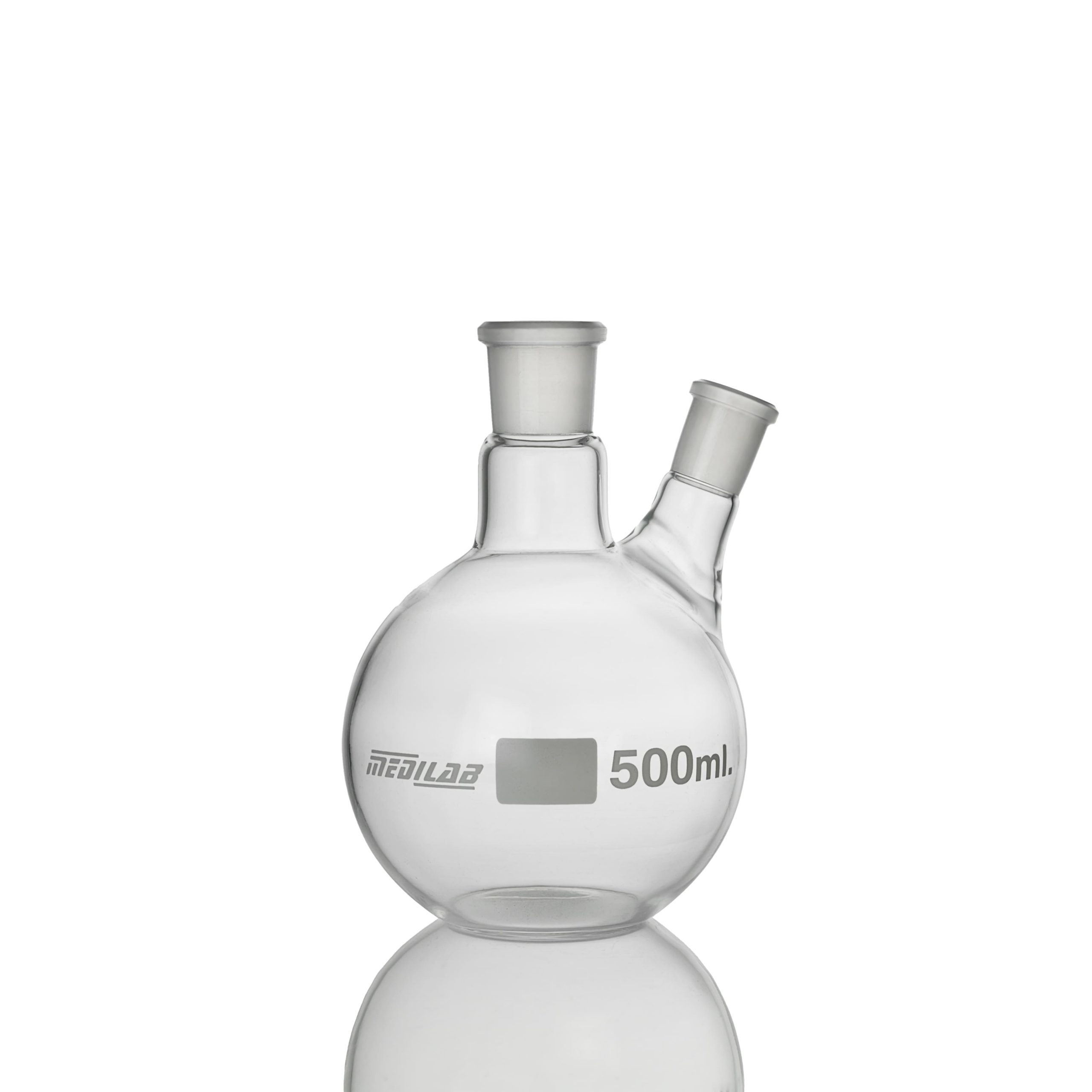
Description
| Catalog No. | Nominal capacity ml | Socket size | Side Socket Size | App. Overall H. mm |
| 11144/1 | 100 | 24/29 | 14/23 | 105 |
| 11144/2 | 100 | 24/29 | 19/26 | 105 |
| 11144/3 | 250 | 24/29 | 14/23 | 140 |
| 11144/4 | 250 | 24/29 | 19/26 | 140 |
| 11144/5 | 500 | 24/29 | 14/23 | 163 |
| 11144/6 | 500 | 24/29 | 19/26 | 163 |
| 11144/7 | 1000 | 24/29 | 19/26 | 200 |
| 11144/8 | 1000 | 24/29 | 24/29 | 200 |
| 11144/9 | 2000 | 34/35 | 24/29 | 240 |
The MEDILAB Round/Flat Bottom Two-Neck Flask (Angled) is a precision-engineered laboratory flask designed for efficient heating, mixing, distillation, and chemical reactions. Its angled second neck provides improved accessibility for condensers, thermometers, dropping funnels, or other apparatus during multi-step procedures. Manufactured from high-strength Borosilicate Glass 3.3, this flask ensures exceptional durability, thermal shock resistance, and chemical reliability. It is an essential vessel for organic synthesis, research workflows, analytical testing, and industrial chemistry operations.
Key Features
- Two-neck angled design for convenient attachment of condensers, adapters, or dosing equipment.
- Round- or flat-bottom options are suitable for heating mantles, sand baths, water baths, or magnetic stirrer setups.
- Manufactured from Borosilicate Glass 3.3, ensuring excellent thermal and chemical resistance.
- Uniform wall thickness for safe heating, reduced stress, and consistent reaction performance.
- Highly transparent construction for easy visual monitoring of reactions.
- Leak-proof, ground-glass joints compatible with standard laboratory glassware systems.
- Autoclavable and reusable, enhancing long-term cost efficiency.
- Ideal for distillation, reflux, heating, and multi-neck reaction setups in R&D and QC environments.
Material Specifications
- Material: Borosilicate Glass 3.3
- Thermal Properties: High thermal shock resistance Low thermal expansion coefficient (~3.3 × 10⁻⁶ /°C) Suitable for continuous heating at high temperatures
- Chemical Resistance: Resistant to acids, alkalis, solvents, and aqueous solutions. Non-reactive, ensuring contamination-free experimentation
- Mechanical Strength: Superior tensile and compression strength. Toughened structure for long operational life
- Standards Compliance: Manufactured according to international quality norms
Technical Specifications
- Available Capacities: As per the standard size table
- Design Options: Round Bottom – Optimal for uniform heating and distillation. Flat Bottom – Stable base for bench-top applications without support rings.
- Joint Types: Standard NS/ISO ground-glass joints (commonly 14/23, 19/26, 24/29, 29/32, 34/35, etc.) Main neck: Straight Second neck: Angled (typically 20–45° depending on capacity)
- Tolerance / Accuracy: Manufactured under strict dimensional and joint tolerance controls
- Optional Accessories: Joint caps, stoppers, cork rings, adapters, condensers, and clamps
Handling & Precautions
- Safe Use: Gradually heat the flask to avoid sudden thermal shock. Ensure proper clamping when using angled neck attachments.
- Cleaning Instructions: Rinse with distilled water after each use. Use laboratory-grade detergents; avoid abrasive scrubbers.
- Autoclaving & Heat Resistance: Fully autoclavable at standard sterilisation temperatures. Do not expose to direct flame without uniform heating support. Follow recommended heating ramp rates for Borosilicate Glass 3.3.
- Do’s & Don’ts: Do: Inspect joints and flanges before use, use proper supports, and preheat if used for high-temperature reactions. Don’t: Rapidly cool a hot flask, use intense localised heat, or expose glass to strong mechanical impacts.
- Best Practices: Use appropriate joint grease where required. Store in padded racks to prevent scratches or chipping.
Applications
- Chemical & Organic Synthesis: Reflux reactions, distillation setups, and extraction processes.
- Pharmaceutical R&D: Controlled heating, compounding, formulation studies.
- Biotechnology & Life Sciences: Reaction media preparation, buffer heating.
- Quality Control / Quality Assurance Labs: Analytical sample preparation, solvent handling.
- Academic & Research Institutions: General laboratory experiments, student training modules.
- Industrial & Pilot Plants: Small-scale reaction vessels, process development trials.
The angled second neck makes it highly versatile for multi-step reactions requiring simultaneous addition, temperature monitoring, and vapor management.