
Description
| Catalogue No. | Dia. mm |
| 11020/1 | 150 |
| 11020/2 | 210 |
| 11020/3 | 240 |
| 11020/4 | 300 |
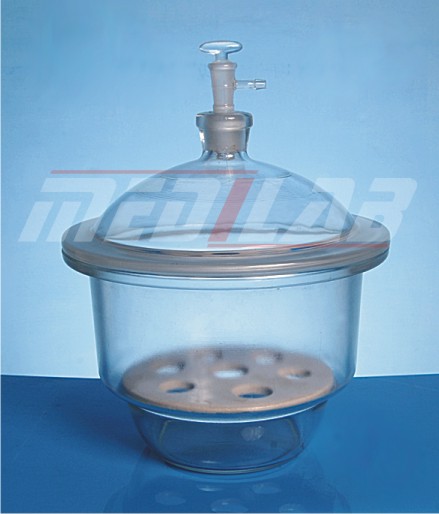
The MEDILAB Vacuum Desiccator is a high-strength, airtight chamber engineered for the safe drying, storage, and preservation of moisture-sensitive samples under controlled vacuum conditions. Made from premium Borosilicate Glass 3.3, it provides outstanding clarity, chemical resistance, and durability for demanding laboratory environments. Its robust vacuum-compatible design ensures reliable performance in research, quality control, pharmaceutical testing, and industrial workflows where accurate humidity reduction is essential.
Key Features
- Vacuum-compatible design with precision-ground flange for superior sealing.
- Heavy-wall Borosilicate Glass 3.3 construction ensures strength, stability, and long service life.
- High-quality stopcock/valve system provides smooth and secure vacuum evacuation and release.
- Uniform glass thickness for safe operation under reduced pressure.
- Crystal-clear visibility for uninterrupted monitoring of samples and desiccant levels.
- A perforated drying plate is included for efficient placement of hygroscopic agents.
- Excellent resistance to most chemicals, including acids and solvents.
- Autoclavable design suitable for standard sterilisation cycles.
- Designed for safe, leak-free vacuum retention during extended storage periods.
Material Specifications
- Material: Borosilicate Glass 3.3
- Thermal Properties: Low thermal expansion coefficient (≈ 3.3 × 10⁻⁶ K⁻¹) Outstanding thermal shock resistance
- Chemical Properties: Inert to most laboratory reagents. Exceptional resistance to corrosion and chemical attack
- Mechanical Strength: Engineered for vacuum integrity. Thick-walled, stress-relieved glass
- Standards Compliance: Manufactured according to international laboratory glassware standards.
Technical Specifications
- Available Sizes: As per the standard size table
- Design: Vacuum lid with integrated stopcock, Precision-ground flange, and perforated internal desiccant plate
- Vacuum Performance: Suitable for low-to-medium vacuum levels used in standard laboratory applications
- Tolerances: Produced within acceptable laboratory glassware dimensional tolerances
- Accessories Included: Glass vacuum lid Stopcock/valve assembly, perforated desiccant plate
Handling & Precautions
- Inspect the desiccator, lid, and stopcock before each use to ensure structural integrity.
- Avoid sudden temperature changes; never place a hot item directly into the desiccator.
- Use appropriate vacuum grease when needed to maintain airtight sealing.
- Do not exceed recommended vacuum levels for Borosilicate Glass 3.3.
- Clean using mild detergents; avoid abrasive materials that may scratch glass surfaces.
- Ensure stopcock parts are clean, lubricated, and reassembled properly.
- Autoclaving is allowed within standard temperature limits for Borosilicate Glass 3.3.
- Avoid mechanical impacts or over-tightening of the stopcock.
- Always release the vacuum gradually to prevent sample disturbance and ensure user safety.
Applications
- Pharmaceutical & QC/QA Laboratories: Drying of hygroscopic materials, stabilising sensitive reagents.
- Chemical Research & Analytical Labs: Controlled vacuum drying, storage of reactive substances, and gravimetric analysis.
- Biotechnology & Life Sciences: Preservation of biological and biochemical samples requiring moisture-free environments.
- Academic & Research Institutions: Ideal for teaching labs, sample preparation, and controlled environmental storage.
- Industrial Quality Testing: Moisture removal in powder samples, plastics, polymers, and speciality chemicals.
It plays a vital role in workflows requiring precise humidity reduction, stable vacuum conditions, and safe reagent preservation.