
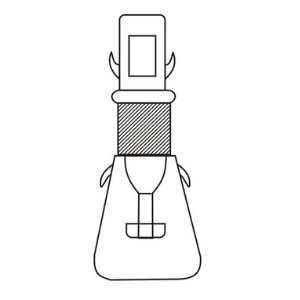
Description
The Cavett Blood Test Apparatus is a precision glass device designed for the estimation of ethanol levels in biological samples such as blood, urine, and saliva. Widely used in forensic, medical, and biochemical laboratories, it supports accurate determination based on the oxidation of alcohol using potassium dichromate. Its robust borosilicate construction ensures high reliability, making it essential for routine clinical testing, forensic analysis, and research workflows.
Key Features
- Manufactured from high-grade Borosilicate Glass 3.3 for excellent thermal and chemical resistance.
- Precision-engineered design ensures high accuracy in ethanol estimation.
- Excellent clarity for easy observation during titration and reaction monitoring.
- Durable, corrosion-resistant components suitable for routine laboratory use.
- Leak-proof joints and secure fittings for safe handling of reactive chemicals.
- Designed for compatibility with standard laboratory setups and accessories.
- Hygienic, easy-to-clean surfaces provide a long service life.
Material Specifications
- Material: Borosilicate Glass 3.3
- Properties: High thermal resistance (Low thermal expansion coefficient ~3.3 × 10⁻⁶/K), Excellent chemical durability against acids, salts, alcohols, and solvents, High mechanical strength suitable for repeated laboratory usage, Superior transparency for visual monitoring of reactions
- Standards Compliance: Meets international laboratory quality and safety standards
Technical Specifications
- Construction: Multi-part Cavett apparatus with calibrated receiving section
- Available Sizes: Standard laboratory configurations (custom sizes available on request)
- Tolerance: High-precision manufacturing with tight dimensional accuracy
- Calibration: Apparatus suitable for certified laboratory calibration procedures
Accessories Included: Ground-glass joint fittings Standard laboratory-compatible connectors. Optional: Stoppers, clamps, and additional accessories upon request
Handling & Precautions
- Handle with care to avoid impact or sudden temperature changes.
- Rinse with distilled water after each use and follow standard laboratory cleaning protocols.
- Suitable for autoclaving up to 121°C; avoid heating beyond recommended limits.
- Do not use abrasive materials that may scratch the glass surface.
- Ensure proper fixation and alignment before performing chemical reactions.
- Store in a clean, dry environment when not in use.
- Avoid direct flame contact and rapid temperature fluctuations to prevent breakage.
Applications
- Forensic laboratories: Ethanol (alcohol) determination in blood samples.
- Clinical & medical labs: Toxicology and biochemical analysis.
- Pharmaceutical and biotech labs: Alcohol estimation in research samples.
- Research institutions & universities: Teaching, demonstration, and analytical studies.
- QA/QC laboratories: Compliance testing and analytical assessment.
This apparatus plays a key role in alcohol quantification workflows, ensuring consistent and reliable results in ethanol estimation procedures.