
Description
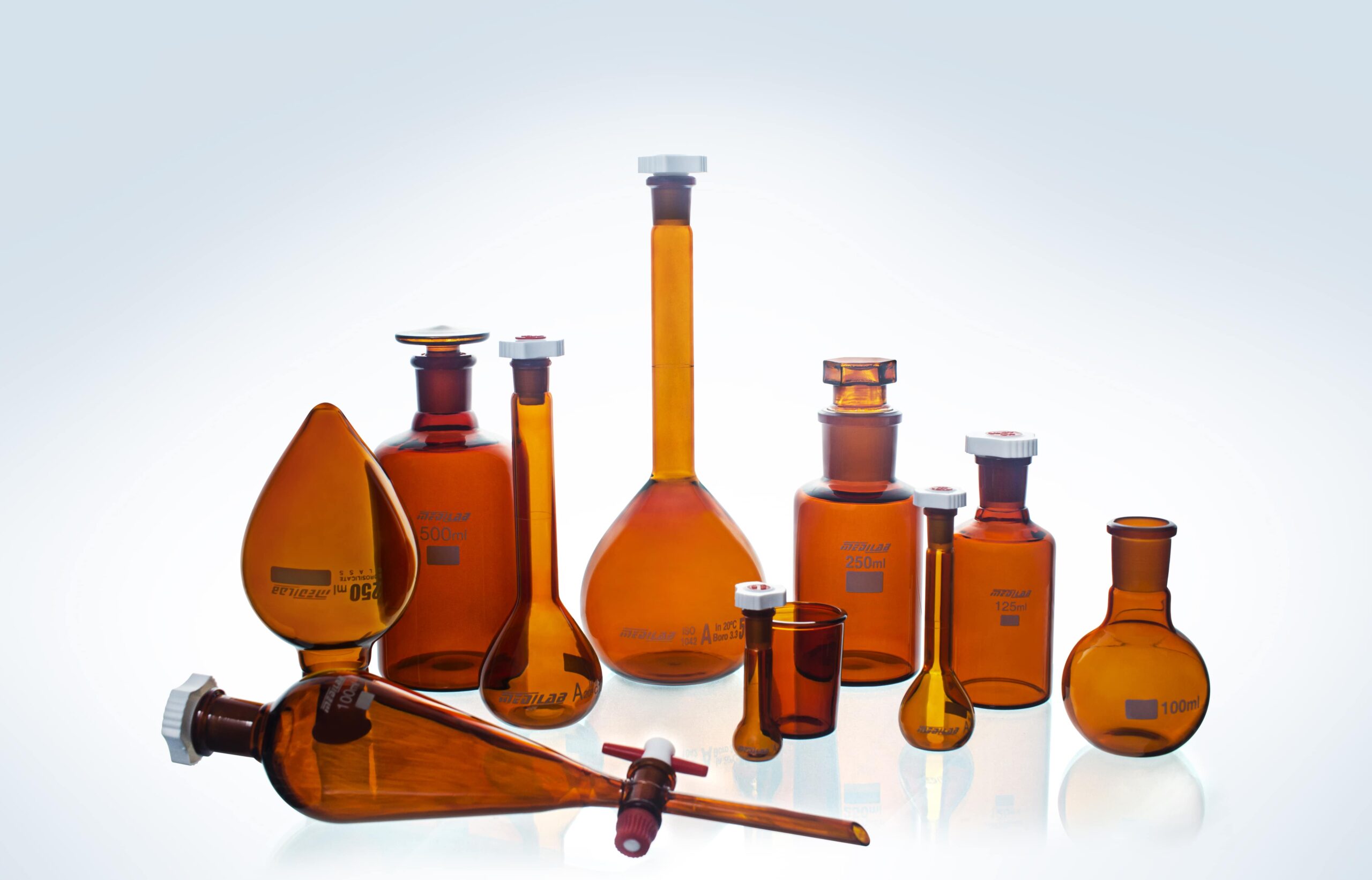
MEDILAB Amber Lab Glassware is a premium range of chemically resistant laboratory vessels designed to protect light-sensitive samples during storage, handling, and analysis. Manufactured from high-grade Borosilicate Glass 3.3, these amber-coloured containers ensure excellent thermal stability and long-term durability. Widely used in research, pharma, and industrial laboratories, they provide reliable protection against UV/visible light degradation, ensuring sample integrity in critical workflows. Their consistent performance makes them essential for routine lab operations, quality testing, and specialised analytical applications.
Key Features
- Amber UV-Protection: Prevents photochemical degradation of light-sensitive reagents, solutions, and biological samples.
- High Chemical Resistance: Suitable for acids, alkalis, solvents, and most laboratory chemicals.
- Superior Durability: Made from Borosilicate Glass 3.3, offering excellent thermal shock resistance and long service life.
- Precision Manufacturing: Smooth contours, uniform wall thickness, and high dimensional accuracy ensure dependable, repeatable use.
- Heat & Autoclave Safe: Withstands high-temperature sterilisation and repeated heating cycles.
- Versatile Range: Available in multiple forms, bottles, flasks, beakers, vials, reagent containers, and speciality glassware.
- Leak-Proof Compatibility: Designed for tight-fitting caps and closures for secure sample storage.
- Ideal for Sensitive Samples: Protects pharmaceuticals, diagnostic reagents, culture media, stock solutions, and organic chemicals.
Material Specifications
- Material: Borosilicate Glass 3.3 (Type 1, Class A glass)
- Thermal Properties: Low coefficient of thermal expansion: 3.3 × 10⁻⁶ /°C High resistance to thermal shock Working temperature: Up to 500°C (intermittent heating)
- Chemical Properties: Highly resistant to acids, alkalis, salts, and organic solvents. Non-reactive surface ensures sample purity
- Mechanical Properties: High hardness and scratch resistance, robust structural strength
- Compliance Standards: Manufactured according to international laboratory glassware norms
Technical Specifications
- Available Capacities: As per the standard size table
- Dimensions: Accurate and standardised as per ISO/DIN norms
- Volume Accuracy: Class A / Class B versions available (for volumetric items)
- Calibration: Volumetric products are available with single or multiple calibration marks. Printed, fired-on graduations for long-lasting clarity
- Accessories (as applicable): Screw caps, PP/GL closures, PTFE liners Pouring rings, stoppers, and adapters. Custom branding and logo printing available
Handling & Precautions
- Safe Use: Handle with care to prevent impact or sudden temperature shifts.
- Cleaning: Use non-abrasive detergents; rinse with distilled/deionised water. Avoid harsh mechanical scrubbing that can scratch the surface.
- Autoclaving: Safe at 121°C for standard cycles. Keep caps slightly loose during sterilisation.
- Heating Limits: Avoid direct flame unless specifically designed for heating. Allow gradual temperature changes to prevent stress fractures.
- Do’s & Don’ts: Do: Inspect regularly for cracks or chips. Don’t: Apply sudden thermal shocks or drop onto hard surfaces.
- Best Practices: Store in padded racks; avoid stacking heavy items. For a long life, maintain proper drying and safe storage conditions.
Applications
MEDILAB Amber Lab Glassware is widely used across scientific, industrial, and quality-testing environments, including:
- Pharmaceutical laboratories (sample storage, reagent preparation, stability studies)
- Chemical and petrochemical industries
- Biotech, microbiology, and life science research
- Universities & research institutes
- QC/QA laboratories for analytical testing
- Environmental, food, and water testing labs
- Light-sensitive sample handling, such as vitamins, essential oils, organic compounds, media, and culture solutions
Its ability to protect light-sensitive materials makes it a core component of daily laboratory workflows.