
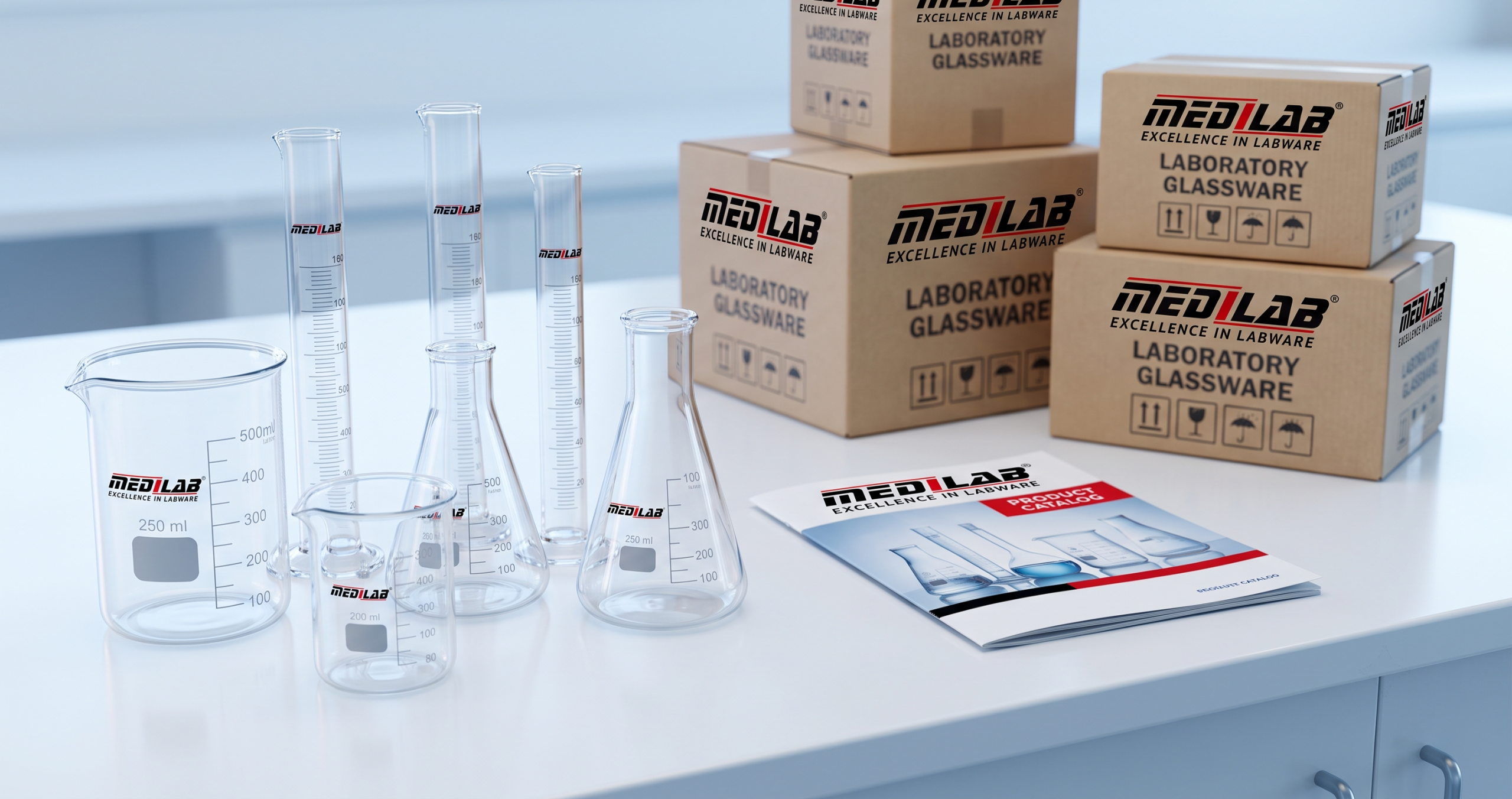
Private label laboratory glassware gives a distributor something a resale catalogue cannot: a brand that belongs to the distributor. Customers remember the name on the glass, and repeat orders follow the name. A strong own-brand line also protects margin, because buyers compare it with similar products rather than with identical items sold by competitors.
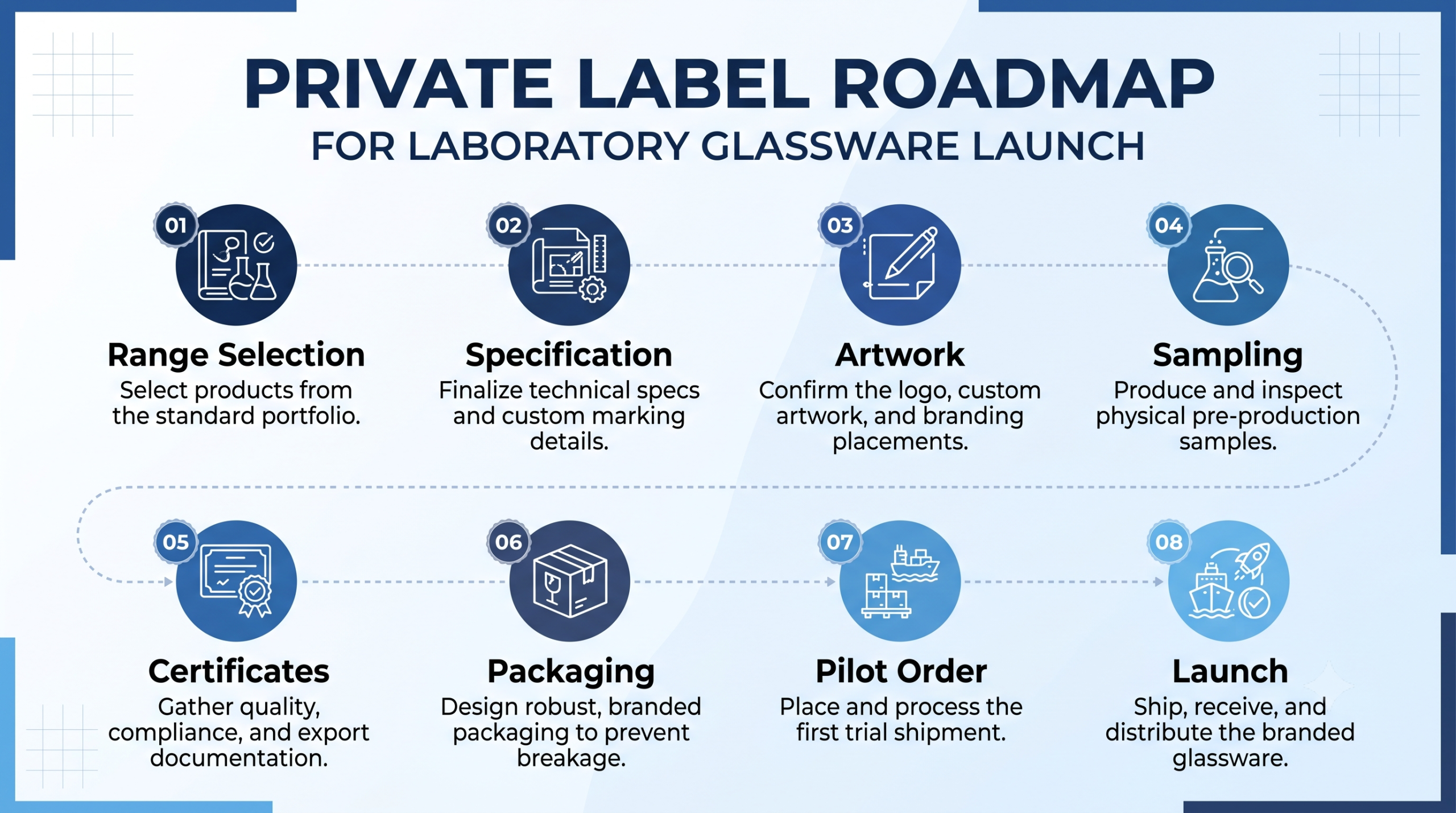
This guide walks through eight steps for building a successful private label laboratory glassware program, from choosing the first range to launching in your market. Each step includes the decisions to make and the pitfalls to avoid. It also covers labeling and documentation points for the USA and China, which are the two markets where many distributors are now expanding.
Medilab Exports Consortium is a 100 percent export-oriented manufacturer that undertakes customized and OEM manufacturing and supplies bulk tender requirements. We work with distributors who want to build their own private label laboratory glassware line without investing in a factory, and this guide reflects what makes those projects succeed.
Why Distributors Choose Private Label Laboratory Glassware
A distributor reselling a manufacturer’s brand competes on price with every other reseller of the same product. The customer sees identical goods and chooses the lowest quote. Margins shrink, and loyalty belongs to the brand owner rather than the distributor.
An own-brand line changes that position. When the product carries your name, the customer’s relationship is with you. You control the catalog, the price structure, the packaging and the documents, and you decide when to add products. Private label laboratory glassware also supports tender work, because institutions often prefer to deal with a local brand owner who can guarantee supply and respond to complaints.
1. Choose the Starting Range
Start narrow with your private label laboratory glassware range. A focused first range lets you control quality, inventory and marketing. Choose items with steady demand and easy specification, such as beakers, Erlenmeyer flasks, graduated cylinders, volumetric flasks and funnels, then expand as the brand gains traction.
Match the range to your customers. A distributor serving teaching laboratories can lead with Class B and general-purpose ware, whereas one serving pharmaceutical customers needs Class A volumetric items with strong documentation. A private label laboratory glassware line aimed at everyone ends up persuasive to no one.
2. Write the Specification
A private label product is only as good as its specification. For each item, define the glass type, the standard, the tolerance class, the dimensions, the wall thickness and the marking. Name borosilicate 3.3 where it applies, and cite the relevant ISO or ASTM standard for volumetric ware. ISO 4787 covers the testing of volumetric instruments, and ISO 1042 defines one-mark volumetric flasks, so both are common references in a specification.
Decide early which items are fixed and which are flexible. Fixed items follow standards and cannot change without retesting, such as volumetric capacity and joint dimensions. Flexible items include marking style, packaging format and carton quantity, where your brand has room to differentiate.
Write acceptance criteria in measurable terms: dimensional tolerance, allowed visual defects, stress inspection method and breakage allowance in transit. Written criteria protect both parties, since the manufacturer knows what to build and you know what to inspect. For a refresher on standards, see our overview of laboratory glassware quality standards.
3. Design the Brand and Artwork
Brand design starts with the logo and a consistent naming system. Decide how the product line will be named, how items are coded and whether the brand will include sub-ranges, such as standard, precision and economy. A clear structure makes the catalog easy to navigate and the line easy to extend.
On the glass itself, branding is usually applied by printing or etching. Printed marks are durable if they are fired into the surface, whereas labels and stickers are cheaper but wear off. Choose a method that survives washing and autoclaving, since the brand should last as long as the glass.
Share vector artwork and color references with the manufacturer, and approve a proof before production. Small errors in a logo or a regulatory mark are expensive to correct once a full batch is printed in your private label laboratory glassware program.
4. Approve Samples Before Production
Samples prove the specification. Ask for a set that includes each product family, marked with your artwork, and evaluate it against your acceptance criteria. Check the marking quality, the clarity of the graduations, the fit of joints and stoppers, the finish of rims and the packaging.
Our guide to laboratory glassware sample evaluation describes a repeatable method. Record results and photographs in a sample approval report, then sign the approved samples and keep a reference set. Future production will be compared with that set.
Insist on sample approval before the first production run of private label laboratory glassware. The cost of a sample cycle is small compared with the cost of reworking a branded batch.
5. Plan Certificates and Documentation
Your customers will ask for certificates with your name on them. Decide which documents the program needs and who issues them. Typical items include a batch certificate of conformance, a material statement for the glass type, and, for volumetric ware, calibration documentation where item-level traceability is required.
Ask the manufacturer whether certificates can be issued in your brand format while keeping the original manufacturer details traceable. Traceability is essential for audits, and an honest private label arrangement discloses the manufacturer to the buyer’s quality team when requested. Quality teams in regulated sectors will often ask who makes the product, so prepare a clear answer.
For measuring glassware in a private label laboratory glassware range, name the tolerance class and the standard on the certificate. Aligning documentation with the class you sell prevents disputes about what the certificate covers, and it gives your sales team a clear statement to quote.
6. Specify Packaging and Labeling
Packaging serves two purposes in private label laboratory glassware: it protects the goods and it carries the brand. Protective design comes first, with individual cells or sleeves, partitioned inner cartons and strong outer cartons rated for export freight. Branding then goes on top, through printed cartons, inserts and labels.
Labeling rules vary by market. For the USA, imported goods must show the country of origin, and the importer of record is responsible for compliance, as explained on the CBP trade portal. For China, ask your customs agent whether Chinese-language labeling or additional filings apply to your product category, since requirements depend on how the goods are classified and sold.
Include product code, description, volume or size, class, lot number and the standard in the label design. Lot numbers allow complaints to be traced to production records, which protects your brand when a customer reports a problem.
7. Run a Pilot Order and Set the MOQ Plan
A pilot order tests the entire chain with limited risk. Choose a small but representative mix of items, place the order with full artwork and packaging, and track lead time, quality, documents and freight performance. Treat the pilot as a rehearsal for the first commercial order.
Minimum order quantities for private label laboratory glassware depend on item type and customization level. Branded printing and custom packaging usually require higher quantities per item than plain catalog ware. Medilab Exports sets a minimum order value of USD 1,500 on a free on board basis for standard export orders, and OEM minimums are agreed per program.
Measure the pilot against targets set in advance, such as on-time delivery, defect rate, document accuracy and breakage in transit. If any target is missed, agree a corrective action with the manufacturer before the next order. A partner that responds constructively to the pilot is likely to do the same when volumes grow.
8. Launch, Support and Expand
A launch needs more than stock. Prepare a catalog, a price list, a certificate pack and a short quality statement that explains how the product is made and tested. Train your sales team to answer technical questions about materials, standards and documents, because credibility in laboratory sales is built on competence.
Choose launch channels for your market. In the USA, distributors often combine direct sales, catalog listings and online marketplaces. In China, business messaging platforms and trade platforms are common routes, and local partners can extend reach. Content marketing, such as technical articles and LinkedIn posts, supports both.
After launch, expand carefully. Add items based on customer requests, review quality data every quarter and refresh artwork as needed. A well-run private label laboratory glassware line grows through trust, so protect that trust with consistent supply.
Resale Versus Private Label: A Quick Comparison
Distributors often ask whether the extra effort of a private label program is worthwhile. The table below compares the two models on the points that matter most for private label laboratory glassware decisions, using typical outcomes rather than guarantees.
| Factor | Resale of a manufacturer brand | Private label program | Typical effect |
|---|---|---|---|
| Brand ownership | Manufacturer owns the brand | Distributor owns the brand | Customer loyalty shifts to the distributor |
| Price control | Set by market comparison | Set by the distributor | Margin protection |
| Documentation | Manufacturer format | Distributor format with traceability | Stronger audit position |
| Minimum orders | Often low per item | Higher for branded items | Greater capital commitment |
| Switching cost for customers | Low | Higher after standardization | Better repeat business |
| Supplier dependency | Replaceable by another brand | Tied to the manufacturing partner | Needs a reliable partner |
Six Mistakes to Avoid in a Private Label Program
Most failed programs share the same causes. The mistakes below are common across markets, and each can be prevented with planning during the early steps of a private label laboratory glassware launch.
- Launching with too many items and too little inventory control
- Changing the specification after samples are approved, which causes rework and delay
- Printing artwork before the regulatory and labeling requirements are confirmed
- Ignoring documentation until the first customer asks for it
- Underestimating freight, duty and landed cost when setting prices
- Choosing a manufacturer by price rather than by capability and consistency
Private Label Notes for the USA and China
In the United States, distributors usually sell into pharmaceutical, university, hospital and industrial laboratories through catalogs, direct sales and online channels. Customers expect complete documentation, consistent availability and fast answers to technical questions. A private label line that meets these expectations competes well on service, even against well-known brands.
In China, many buyers are accustomed to strong domestic production and compare imported goods on calibration, consistency and documentation rather than on availability. Own-brand programs for imported private label laboratory glassware work best when positioned on precision and certification, supported by trusted local partners. Check trademark protection and customs filing requirements early, since both affect timing.
How to Choose the Right Partner for a Private Label Program
Partner choice is the decision that most affects the outcome. Look for a manufacturer that makes its own glass, controls its own quality and can document it. Check certifications, ask for samples and visit or video-audit the plant. Our article on OEM laboratory glassware manufacturing explains the manufacturing side in more detail.
Confirm that the partner has experience with export programs, understands your standards and can support your documents. Ask how the partner treats confidentiality, since your artwork, specifications and customer information are business assets. A written agreement should cover exclusivity, confidentiality, quality terms and what happens to tooling or artwork if the relationship ends.
Finally, check commercial fit. The partner should be able to follow your growth with larger volumes and wider range, and to support your pilot with realistic terms. Discuss your plans openly, because the best private label laboratory glassware programs are built as long-term partnerships.
Frequently Asked Questions
Private label laboratory glassware is glassware made by a manufacturer to a distributor’s specification and sold under the distributor’s brand. The product meets the same standards as the manufacturer’s own range, with the distributor’s name on the glass and packaging. It differs from resale, where the manufacturer’s brand stays on the product.
It can be, because quality depends on the manufacturer, not on the label. A qualified partner produces private label laboratory glassware using the same glass, process and inspection as its own range. Verify through samples, certificates and a plant audit.
It depends on item type, printing and packaging. Branded items need higher quantities than catalog stock. Medilab Exports agrees OEM minimums for each program, so share your range and we will quote a practical starting point for private label laboratory glassware.
Certificates can be issued in your format as long as traceability to the manufacturer is maintained and available to auditors. Discuss the format with your partner in advance, and match the documents to the standards your customers require.
Yes. The USA requires country-of-origin marking, and importers carry compliance responsibility. China may require additional filings or Chinese-language labeling depending on classification. Confirm current rules with your customs broker or agent before printing cartons.
Yes. Medilab Exports Consortium undertakes customized and OEM manufacturing and supports distributors with bulk and tender requirements. Contact us to discuss private label laboratory glassware for your market, with samples and a program proposal.
Launch Your Private Label Laboratory Glassware Line
Medilab Exports Consortium undertakes customized and OEM manufacturing for distributors. Tell us your range, brand requirements and target markets, and we will return a proposal for private label laboratory glassware with documentation and packaging options.
