
pH sensitive laboratory glassware applications expose a fundamental difference between glass types that specification sheets rarely address directly: the glass itself can change the pH of what is stored or prepared inside it. Procurement managers and laboratory managers who understand how glass composition affects pH-critical applications can prevent systematic measurement errors, protect the integrity of biological and pharmaceutical preparations, and specify the correct material for each application from the point of purchase.
This guide covers 7 specific application categories where pH sensitive laboratory glassware material selection directly determines result accuracy – from buffer solution preparation and pH calibration standard storage to pharmaceutical dissolution testing, cell culture media, and enzyme assay vessels. Each section explains the mechanism by which glass composition affects the application, the glass type that prevents interference, and the specification criteria that confirm suitability.
Medilab Exports Consortium manufactures borosilicate 3.3 laboratory glassware meeting ISO 719 Hydrolytic Class 1 (HGB 1) specification – the highest chemical resistance classification for commercial laboratory glassware. Our products are used in pH sensitive laboratory glassware applications across pharmaceutical quality control, clinical diagnostic, and research laboratory settings in 40+ countries. The application guidance in this article reflects the material performance criteria we apply to our own product specifications.
Why Glass Composition Changes Solution pH: The Alkali Leaching Mechanism
Glass is not chemically inert. All silicate glass compositions release ions into aqueous solutions in contact with the glass surface – the extent and rate of release depend on the glass chemical composition, the surface area to volume ratio of the container, the contact time, the solution temperature, and the solution pH itself. In pH sensitive laboratory glassware applications, this ion release is the primary mechanism by which the glass alters the chemistry of its contents.
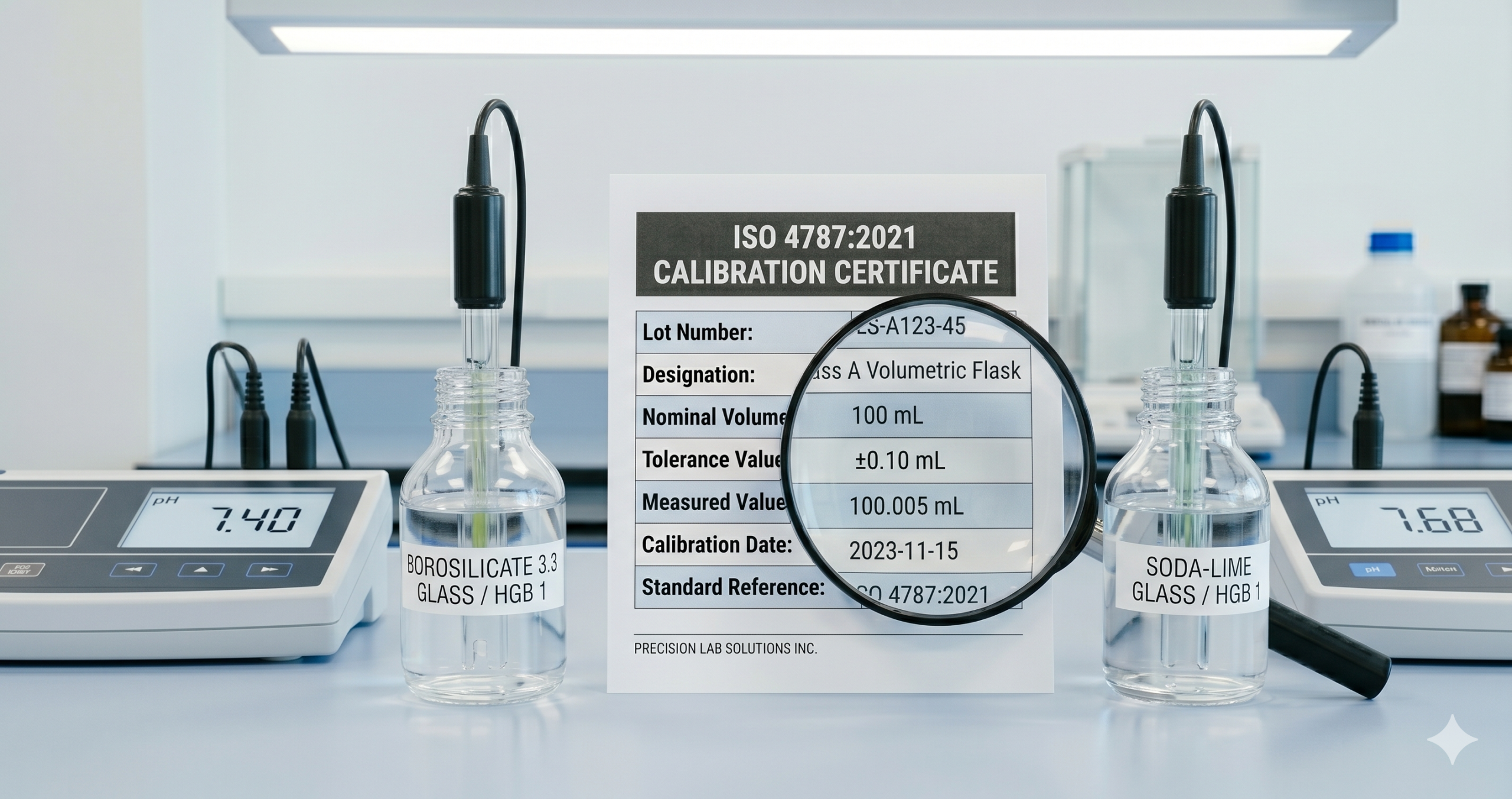
Soda-lime glass – the composition used in most commodity glassware and non-laboratory containers – contains approximately 12-15% sodium oxide (Na2O) and 10-12% calcium oxide (CaO) as network modifiers. When soda-lime glass contacts aqueous solutions, sodium and calcium ions exchange with hydrogen ions from the solution. This ion exchange removes H+ from solution and releases Na+ and Ca2+ – effectively raising solution pH. In distilled water or low-ionic-strength buffer solutions stored in soda-lime glass, documented pH drift of 0.2 to 0.5 pH units within 24 to 48 hours is a consistent finding in laboratory glass leaching studies.
Borosilicate 3.3 glass – composition approximately 80.6% SiO2 and 12.6% B2O3 with only 4.2% Na2O/K2O combined – contains far fewer alkali metal oxides available for exchange. The boron-silica network structure is more chemically resistant than the soda-lime structure. The result is dramatically lower alkali release per unit surface area under the same contact conditions. For pH sensitive laboratory glassware applications, this material difference determines whether the glass is a passive container or an active participant in solution chemistry.
Hydrolytic Resistance Classes and What They Mean for pH Sensitive Applications
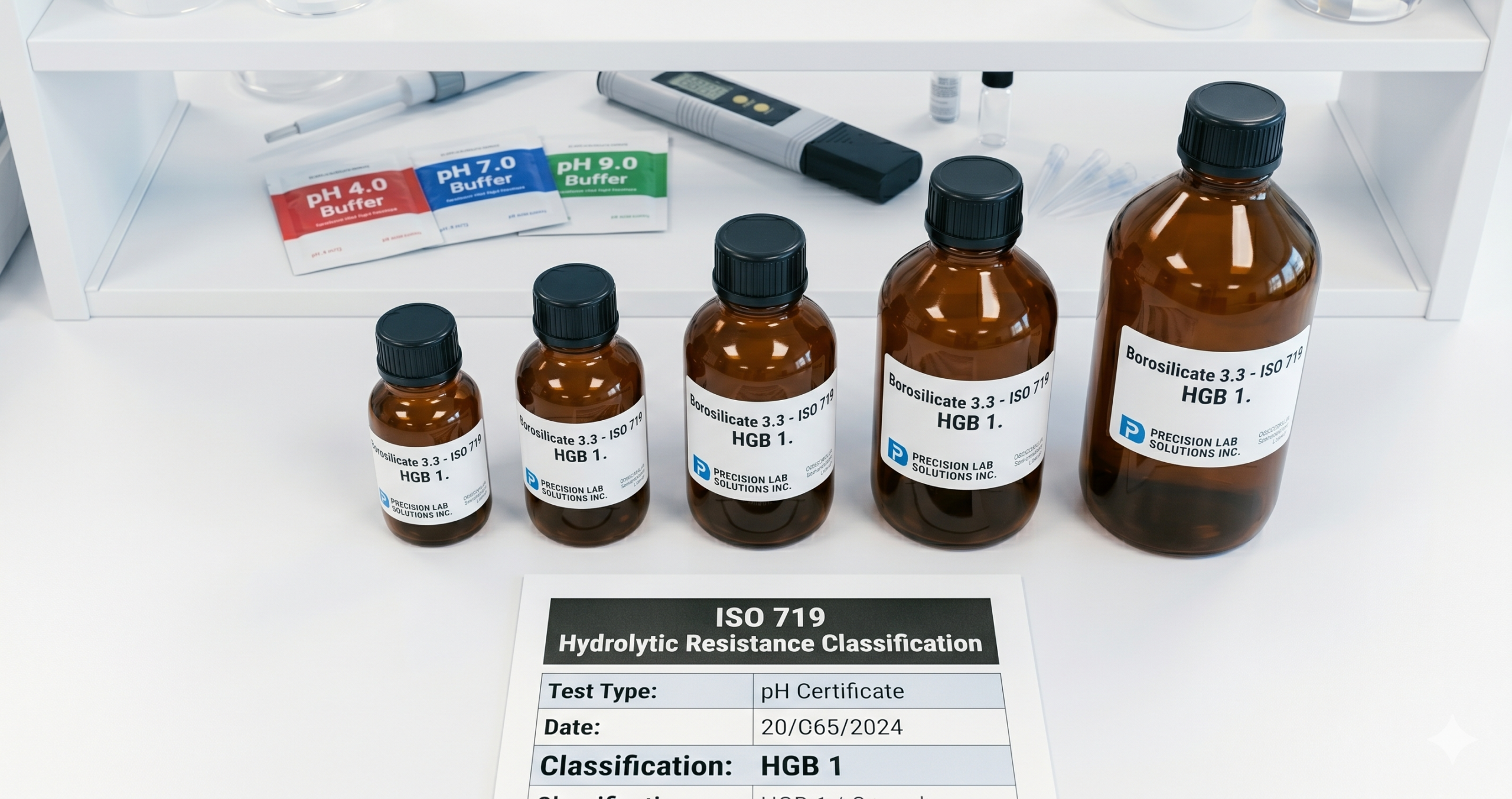
ISO 719 classifies the hydrolytic resistance of glass by measuring the volume of 0.01 mol/L hydrochloric acid required to neutralize the alkali released from crushed glass grains under standard extraction conditions at 98 degrees Celsius. Lower acid consumption means less alkali released – higher chemical resistance. ISO 719 defines four hydrolytic resistance classes: HGB 1 (highest resistance, requiring not more than 0.10 mL per 20 cm2 of glass), HGB 2, HGB 3, and HGB 4 (lowest resistance).
Borosilicate 3.3 glass qualifies as HGB 1 under ISO 719 – the only commercial laboratory glass type that does. Soda-lime glass typically falls into HGB 3 or HGB 4, representing alkali release ten to one hundred times greater than borosilicate 3.3 under the same test conditions. For pH sensitive laboratory glassware applications, this classification determines the maximum permissible container material. HGB 1 (borosilicate 3.3) is the only appropriate material for applications where pH drift of 0.1 units or less is required to protect result integrity.
Surface area to volume ratio amplifies the effect in small containers. A 10 mL reagent bottle has a higher surface area to volume ratio than a 1000 mL reagent bottle, meaning per-milliliter alkali release is higher in smaller containers at the same contact time. This makes pH sensitive laboratory glassware material selection particularly critical for small-volume applications – single-use enzyme substrates, standard stock solutions, and calibration standards – where the glass surface area per milliliter of solution is greatest and pH drift per unit time is fastest. For the regulatory context that governs these requirements, see our guide on laboratory glassware quality standards.
Application 1: Buffer Solution Preparation and Long-Term Storage
Buffer solutions are the most common pH-critical preparation in any laboratory. Phosphate buffers, TRIS-HCl, HEPES, citrate-phosphate, and acetate buffers all maintain pH by the ratio of their conjugate acid-base pairs – a ratio that shifts whenever the overall H+ concentration changes. Alkali release from soda-lime glass into a phosphate buffer at pH 7.4 adds Na+ ions that drive the equilibrium toward the base form of the buffer, raising pH. For TRIS buffer in particular – which has a temperature coefficient of -0.028 pH units per degree Celsius – the combination of thermal sensitivity and glass-induced alkali drift creates cumulative pH error that is difficult to diagnose without controlling for the container material.
Borosilicate 3.3 reagent bottles and media bottles are the correct containers for buffer preparation and storage where pH stability matters. At preparation, pH drift is negligible because the high-purity solution contacts the glass surface for only a short time. During long-term storage (days to weeks), borosilicate 3.3’s HGB 1 hydrolytic resistance prevents the cumulative alkali release that progressively shifts buffer pH in soda-lime containers. Autoclaved buffers require particular attention: autoclaving transiently increases alkali release from glass surfaces, and the increase is significantly larger for HGB 3-4 glass than for HGB 1 borosilicate 3.3.
For pH sensitive laboratory glassware in buffer storage applications, the container selection rule is straightforward: any buffer that will be stored for more than 24 hours, any buffer used in a pH-dependent biological assay, and any buffer prepared for pH calibration or validation purposes must be stored in borosilicate 3.3 glass. Soda-lime containers are acceptable only for short-term holding of solutions where pH drift within the storage window does not affect the outcome.
Application 2: pH Calibration Standard Storage
pH calibration standards – the reference solutions used to calibrate pH meters before measurement – are among the most pH-critical preparations in any laboratory. A calibration standard that drifts by 0.05 pH units during storage transfers that error directly to every pH measurement made after calibration. For laboratory procedures with pH measurement uncertainty requirements of ±0.02 to ±0.05 units, container-induced drift of 0.05 to 0.2 units from soda-lime glass storage makes the calibration standard itself the largest single source of measurement error.
Standard NIST primary pH reference solutions – potassium hydrogen phthalate at pH 4.005, phosphate buffer at pH 6.865, and borax buffer at pH 9.180 at 25 degrees Celsius – are particularly susceptible to container effects because they are low ionic strength solutions with limited buffering capacity against external ion addition. The phosphate reference buffer at pH 6.865 shows measurable alkaline drift within 48 hours in soda-lime glass storage at room temperature, a finding that invalidates calibrations performed after that drift has occurred.
pH sensitive laboratory glassware for calibration standard storage must be borosilicate 3.3 with HGB 1 hydrolytic resistance. Amber borosilicate 3.3 bottles – which add photodegradation protection to the chemical resistance benefit – are the correct container for calibration standards that must be protected from both glass-induced pH drift and light-catalyzed oxidation. Standards prepared in small volumes should use correspondingly small borosilicate containers to minimize headspace and surface contact variability.
Application 3: Cell Culture Media and Biological Buffer Preparation
Cell culture media – DMEM, RPMI 1640, Ham’s F-12, MEM, and similar formulations – use bicarbonate buffering systems calibrated to maintain pH between 7.2 and 7.4 in equilibrium with 5% CO2 atmosphere. Bicarbonate buffers are highly sensitive to changes in H+ concentration because bicarbonate ion concentration is low relative to the total buffer capacity required. Alkali release from non-borosilicate glass into bicarbonate-buffered media raises pH before the CO2 equilibrium can compensate, producing alkaline shift that reduces cell viability and alters proliferation, differentiation, and secretory behavior in ways that confound experimental results.
PBS (phosphate buffered saline at pH 7.4) used for cell washing, dilution, and reagent preparation shows similar susceptibility. PBS contains no significant carbonate buffering and relies on the phosphate system alone to maintain pH. In soda-lime glass storage bottles, PBS pH drift of 0.1 to 0.3 units over 3 to 5 days is consistent with published laboratory data. Cell biologists who observe inconsistent results across experimental repeats that use the same protocol should include glass type verification as a diagnostic step when ruling out pH as a confounding variable.
For cell culture pH sensitive laboratory glassware applications, borosilicate 3.3 glass media bottles, storage bottles, and Erlenmeyer flasks are the correct specification throughout the preparation and storage workflow. Plastic containers (polystyrene or polypropylene) are pH-neutral but introduce plasticizer leaching and gas permeability trade-offs that borosilicate 3.3 glass avoids. The material choice for cell culture media glassware is not a cost decision – it is a biological reproducibility decision. See our guide on why borosilicate glass is used in laboratory equipment for the full material property basis of this choice.
Application 4: Pharmaceutical Dissolution Testing and API Solution Preparation
Pharmaceutical dissolution testing measures the rate and extent to which an active pharmaceutical ingredient (API) dissolves from a dosage form in a dissolution medium at a controlled pH. USP apparatus 1 and apparatus 2 testing uses dissolution media at specified pH values – 0.1 N HCl (pH 1.2), acetate buffer (pH 4.5), and phosphate buffer (pH 6.8) being the most common. The pH of the dissolution medium must remain within ±0.05 pH units of the specified value throughout the test. Alkali leaching from soda-lime dissolution vessels would shift the medium pH systematically upward, producing false dissolution profiles that misrepresent the in vivo release behavior of the dosage form.
API solution preparation for potency and content uniformity testing uses volumetric flasks, beakers, and reagent bottles as intermediate preparation vessels. API solutions in aqueous media at pH values between 5 and 9 are particularly susceptible to glass-induced pH drift because this pH range corresponds to the highest H+/Na+ exchange rate at glass surfaces. For pharmaceutical quality control laboratories operating under WHO Good Manufacturing Practices, the container material specification for pH-critical API preparations must be documented in the validated method and confirmed at each goods receipt inspection.
pH sensitive laboratory glassware for dissolution testing and API preparation must specify borosilicate 3.3 glass throughout. USP General Chapter <661> and equivalent pharmacopoeial chapters covering containers and packaging materials classify borosilicate glass as Type 1 glass – the highest classification for pharmaceutical containers. Type 1 glass corresponds to HGB 1 hydrolytic resistance under ISO 719. Glassware without ISO 719 HGB 1 certification or without USP Type 1 classification documentation does not meet the container material specification for dissolution testing in regulated pharmaceutical laboratories.
Application 5: Clinical Diagnostic Reagent and Sample Handling
Clinical diagnostic assays – immunoassays, enzymatic colorimetric assays, nucleic acid amplification tests, and electrophoresis methods – operate at defined pH conditions optimized for reagent stability, antibody-antigen binding affinity, and enzyme activity. Reagent concentrations and reaction conditions in commercial diagnostic kits are validated in specific container materials. When laboratories substitute reagent storage or preparation vessels without considering glass composition, pH drift from inferior container materials introduces a pre-analytical variable that the kit validation did not account for.
Sample handling in clinical chemistry uses glass tubes, sample cups, and aliquot containers for serum and plasma handling. Serum pH at collection is approximately 7.4. Contact with soda-lime glass surfaces during processing and temporary storage can measurably alter this pH, affecting assays that are sensitive to sample pH – particularly enzymatic rate assays where the measurement signal depends on enzyme activity, which is a steep function of pH in the range 6.8 to 7.8. pH sensitive laboratory glassware specifications in clinical laboratories must extend beyond analytical vessels to include all containers where samples contact glass surfaces between collection and measurement.
For clinical diagnostic reagent storage, borosilicate 3.3 reagent bottles, volumetric flasks, and mixing vessels are mandatory wherever the reagent pH affects assay performance. Reagents stored in HGB 3-4 glass over weekly and monthly timescales show cumulative pH drift that shortens effective shelf life independently of reagent chemical stability. The container is a documented contributor to reagent stability in ISO 17025-accredited clinical laboratories, where material traceability for all preparation vessels is part of the quality record.
Application 6: Enzyme Assay and Biochemistry Reaction Vessels
Enzymes are among the most pH-sensitive analytes and reagents in laboratory work. Most enzymes have a pH optimum – a narrow pH range within which catalytic activity is at or near maximum. Outside this range, activity drops steeply: many clinically relevant enzymes lose 20 to 50% of their activity within 0.2 to 0.5 pH units of their optimum. For enzyme kinetics, enzyme-linked immunosorbent assays (ELISA), and enzymatic substrate assays where activity measurement is the analytical signal, container-induced pH drift directly reduces or artificially alters the measured activity.
Reaction vessels used in biochemistry – Erlenmeyer flasks for enzymatic incubations, volumetric flasks for substrate and buffer preparation, test tubes and reaction vials for kinetic measurements – must be borosilicate 3.3 glass for any procedure where pH stability within the assay window is required. Microvolume enzyme assays are particularly susceptible: a 500 µL reaction in a small glass tube has a very high surface area to volume ratio, and alkali leaching from non-borosilicate glass into 500 µL of reaction buffer can shift pH by measurable amounts within the assay incubation time.
pH sensitive laboratory glassware for enzyme work must also consider the effect of glass surface on enzyme adsorption. Borosilicate 3.3 glass, with its lower alkali content and more stable surface chemistry, shows lower non-specific protein adsorption than soda-lime glass under identical conditions. Reduced enzyme adsorption to the glass surface means more enzyme remains in solution for catalysis – an additional accuracy benefit beyond pH stability that makes borosilicate 3.3 the correct material choice for enzyme assay vessels regardless of whether pH drift alone is the primary concern.
Application 7: Ion-Selective Electrode Calibration Standards
Ion-selective electrode (ISE) measurements for sodium, potassium, calcium, chloride, and hydrogen ion (pH) depend on calibration standards prepared at defined ionic activities. The calibration standards for ISE measurements are high-purity aqueous solutions at controlled ionic strength – solutions with very low buffer capacity against external ion addition. Alkali leaching from soda-lime glass into ISE calibration standards adds Na+ and Ca2+ at concentrations that directly interfere with sodium-selective and calcium-selective electrode calibration, and adds OH- that shifts pH calibration standard values.
Flame photometry and atomic absorption standards used for Na+, K+, and Ca2+ measurement face the same problem. Trace metal standards in the 1 to 100 parts per million range prepared or stored in soda-lime glass receive sodium contamination from the glass surface within hours of preparation. This contamination is not detectable by visual inspection and does not have a fixed value – it varies with contact time, temperature, and the specific lot of glass container – making systematic correction for glass-derived contamination impractical as a substitute for using the correct container material.
For ISE and spectroscopic calibration standard applications, pH sensitive laboratory glassware selection must prioritize both chemical resistance and ion cleanliness. Borosilicate 3.3 glass volumetric flasks, storage bottles, and dilution containers for ionic calibration standards represent the minimum acceptable container specification. For trace element analysis at very low concentrations (below 0.1 mg/L), pre-conditioning glass containers with dilute acid followed by rinsing with high-purity water before use reduces the initial surface ion contribution to acceptable levels. For ISE applications above 1 mg/L, conditioned borosilicate 3.3 glass is consistently suitable without additional treatment.
pH Sensitive Laboratory Glassware: Material Selection Reference Table
The table below summarizes material selection criteria for pH sensitive laboratory glassware across the 7 application categories covered in this guide – showing the pH sensitivity level, the mechanism of glass interference, the required glass specification, and the consequence of using incorrect container material.
| Application | pH Sensitivity Level | Glass Interference Mechanism | Required Glass Specification | Consequence of Wrong Material |
|---|---|---|---|---|
| Buffer solution storage | High (±0.05 units) | Alkali leaching raises buffer pH over time | Borosilicate 3.3, ISO 719 HGB 1 | Buffer pH drift; assay pH shifts; invalid results |
| pH calibration standards | Very high (±0.02 units) | H+/Na+ exchange shifts calibration reference value | Borosilicate 3.3, ISO 719 HGB 1 | Systematic calibration error transferred to all measurements |
| Cell culture media | High (±0.1 units) | Na+ release shifts bicarbonate/phosphate buffer equilibrium | Borosilicate 3.3, ISO 719 HGB 1 | pH-induced cell stress; altered proliferation/differentiation |
| Pharmaceutical dissolution | Very high (±0.05 units per USP) | Alkali raise dissolution medium pH above specification | Borosilicate 3.3, USP Type 1 / ISO 719 HGB 1 | False dissolution profiles; non-compliant test results |
| Clinical diagnostic reagents | Medium-High (±0.1-0.2 units) | pH drift alters antibody affinity and enzyme activity | Borosilicate 3.3, ISO 719 HGB 1 | Assay drift; reduced reagent shelf life; false results |
| Enzyme assay vessels | Very high (±0.1 units at pH optimum) | pH shift moves enzyme off optimum; protein adsorption | Borosilicate 3.3, ISO 719 HGB 1 | Reduced or inaccurate enzyme activity measurement |
| ISE calibration standards | Critical (ion contamination) | Na+/Ca2+ leaching adds direct ionic interference | Borosilicate 3.3, ISO 719 HGB 1, acid pre-conditioned | Calibration error; false ion concentration values |
How to Specify and Verify Glass Type for pH-Critical Applications
Specifying the correct glass type for pH sensitive laboratory glassware applications requires two elements in every procurement document: the glass composition (borosilicate 3.3) and the hydrolytic resistance class (ISO 719 HGB 1). A purchase order that states only “glass reagent bottle” or even “borosilicate reagent bottle” without the ISO 719 HGB 1 confirmation is an incomplete specification – borosilicate formulations other than 3.3 exist, and not all carry HGB 1 classification. The ISO 719 certificate from the supplier is the documentary confirmation that the product meets the chemical resistance requirement.
Verification at goods receipt follows the same three-step approach used for volumetric glassware: check that “borosilicate 3.3” or equivalent is marked on the product or packaging, confirm the supplier’s ISO 719 certificate identifies HGB 1 classification for the current production lot, and optionally run the pH indicator field test described in ISO 719 – rinse the container interior with deionized water at 80 degrees Celsius for 30 minutes and test the rinse water pH with indicator paper. A pH above 8.5 in the rinse water indicates excessive alkali release and disqualifies the product for pH-sensitive applications. For the full pre-order verification protocol covering dimensional accuracy, material composition, and documentation, see our guide on laboratory glassware sample evaluation.
Medilab Exports Consortium provides ISO 719 HGB 1 hydrolytic resistance certificates with all borosilicate 3.3 reagent bottle, media bottle, and storage vessel lots. All products are manufactured from confirmed borosilicate 3.3 glass composition to ISO 3585 specification. For detailed guidance on the material properties that underpin this performance, see our guide on precision scientific glassware. Contact our export team to confirm material certification documentation for pH sensitive laboratory glassware applications in your specific procurement requirement.
Frequently Asked Questions
Published laboratory data shows pH drift of 0.2 to 0.5 pH units within 24 to 48 hours in low ionic strength buffer solutions stored in soda-lime glass at room temperature. The magnitude depends on the solution’s buffering capacity, the container’s surface area to volume ratio, and temperature. Low-concentration and low-ionic-strength solutions – particularly pH calibration standards and dilute biological buffers – show the most pronounced drift. pH sensitive laboratory glassware applications requiring pH stability within ±0.05 units over 24 hours require borosilicate 3.3 glass containers to avoid this drift entirely.
Borosilicate 3.3 glass with ISO 719 HGB 1 hydrolytic resistance reduces alkali leaching to negligible levels for most laboratory applications – typically below 0.01 pH units per 48 hours in standard buffer storage conditions. It does not eliminate all ion exchange at the glass-solution interface, but the release is orders of magnitude lower than soda-lime glass. For pH sensitive laboratory glassware applications requiring pH stability within ±0.02 pH units over extended storage – such as ISE calibration standards or primary pH reference solutions – additional practices such as acid pre-conditioning of the glass surface and use of fresh-prepared standards reduce the remaining contribution further.
ISO 719 is the international standard that measures and classifies the hydrolytic resistance of glass – its ability to resist releasing alkali ions into aqueous solution. ISO 719 defines four hydrolytic classes (HGB 1 through HGB 4), with HGB 1 representing the highest resistance and lowest alkali release. Borosilicate 3.3 glass qualifies as HGB 1. For pH sensitive laboratory glassware, HGB 1 classification under ISO 719 is the material specification that confirms the container will not contribute measurable alkali to pH-critical solutions under normal laboratory storage and preparation conditions. An ISO 719 HGB 1 certificate from the supplier is the required documentation confirming this specification.
Plastic containers (polypropylene, polyethylene, PTFE) do not release alkali and are pH-neutral for most applications. They are appropriate alternatives to borosilicate glass for short-term reagent storage in many pH-sensitive applications. However, plastics introduce different material interactions: plasticizer leaching, non-specific protein adsorption in some polymer types, gas permeability (relevant for CO2-sensitive bicarbonate buffers), and static charge build-up that affects certain sensitive assays. For cell culture media and enzyme assay applications, the choice between borosilicate glass and high-quality plastic depends on the specific reagent chemistry and the validated container specification for the procedure. pH sensitive laboratory glassware guidance applies to glass-container applications specifically; validated plastic containers are a separate material category with their own qualification criteria.
Autoclaving at 121 degrees Celsius transiently increases alkali release from all glass types due to the elevated temperature accelerating the ion exchange process at the glass surface. For borosilicate 3.3 glass with ISO 719 HGB 1 classification, this transient increase remains within acceptable limits for most pH sensitive laboratory glassware applications – the released alkali is low enough that a single rinse with fresh deionized water after autoclaving and cooling returns the container to its baseline chemical resistance state. For soda-lime glass, autoclaving produces substantially larger alkali release that persists through multiple rinse cycles. Autoclaved soda-lime glass should not be used for buffer or reagent storage in pH-critical applications.
A field verification test for pH sensitive laboratory glassware ISO 719 compliance can be performed with standard laboratory equipment. Rinse the interior of the sample container with 80 degrees Celsius deionized water and hold for 30 minutes with a capped or covered opening. Allow to cool and test the rinse water with pH indicator paper or a calibrated pH meter. Rinse water pH should remain below 8.0 for HGB 1 borosilicate glass. A pH result above 8.5 indicates alkali release consistent with HGB 3-4 glass and disqualifies the product for pH-sensitive applications. This test, combined with supplier ISO 719 certificate review and borosilicate 3.3 marking verification on the glass body, provides three independent confirmation points.
Yes. Medilab Exports Consortium provides ISO 719 HGB 1 hydrolytic resistance certificates with all borosilicate 3.3 reagent bottle, media bottle, and storage vessel lots. Documentation includes the hydrolytic resistance classification, the production batch reference, and the ISO 719 standard reference. For pharmaceutical procurement orders, extended documentation sets including USP Type 1 equivalence declarations are available on request. All Medilab borosilicate 3.3 glassware is manufactured from confirmed glass composition to ISO 3585 specification – the same material standard that underpins the HGB 1 hydrolytic resistance classification critical for pH sensitive laboratory glassware applications. Contact our export team to request documentation for your procurement or quality system requirement.
Request Borosilicate 3.3 Glassware with ISO 719 HGB 1 Documentation
Medilab Exports Consortium manufactures borosilicate 3.3 laboratory glassware meeting ISO 719 HGB 1 hydrolytic resistance specification – the material standard required for pH sensitive laboratory glassware applications in pharmaceutical, clinical, and research laboratories. Every lot ships with ISO 719 hydrolytic resistance certificate, material composition certificate, and certificate of conformance.
