
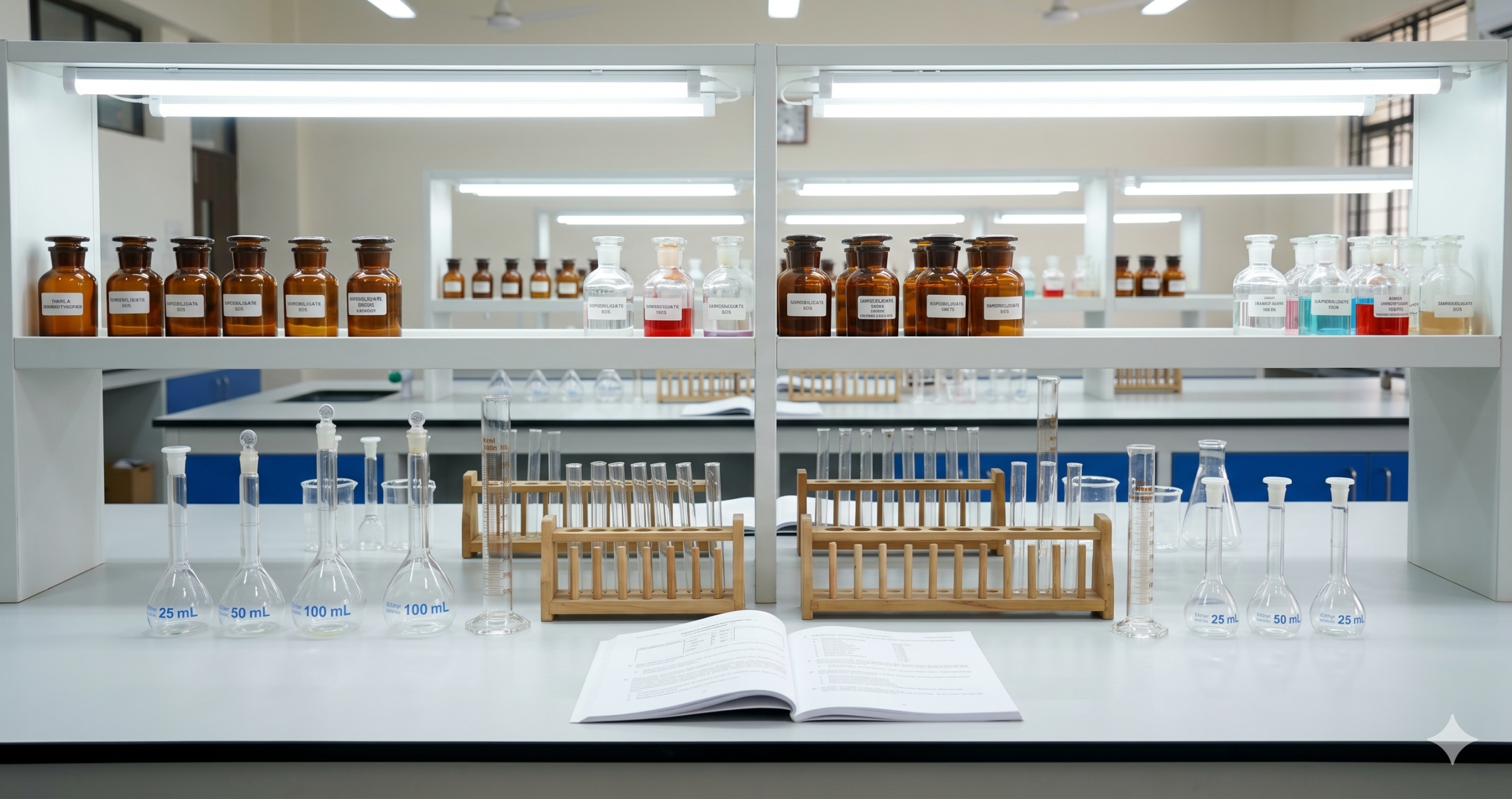
Medical college laboratory equipment requirements are defined by the curriculum – and that curriculum is structured by regulatory bodies who specify minimum laboratory infrastructure as a condition of program accreditation. Procurement managers, laboratory managers, and department heads at medical and nursing colleges who understand what each department’s curriculum demands in terms of laboratory equipment, glassware, and consumables can build procurement plans that satisfy accreditation requirements, support teaching outcomes, and avoid the cost of repeated piecemeal purchasing as curriculum needs become apparent term by term.
This guide covers 9 essential laboratory equipment categories for medical and nursing college programs – from biochemistry and physiology through microbiology, pathology, pharmacology, nursing skills simulation, and community health laboratories. For each category, the guide identifies the curriculum applications that drive equipment requirements, the specific glassware and consumable types needed, and the quality specification standards that apply to each category’s procurement decisions.
Medilab Exports Consortium manufactures and exports ISO-certified borosilicate 3.3 laboratory glassware to medical colleges, nursing institutes, research universities, and healthcare training programs across 40+ countries. Medical college laboratory equipment procurement is a significant part of our institutional supply portfolio – we understand the curriculum-linked requirements that drive glassware specification decisions at each department level, and the guide below reflects the equipment scope we consistently supply to medical education institutions globally.
Why Curriculum Requirements Define Medical College Laboratory Equipment Procurement
Medical and nursing college laboratory infrastructure requirements are not optional specifications – they are regulatory mandates. In India, the National Medical Commission (NMC) specifies minimum laboratory infrastructure, equipment lists, and student-to-equipment ratios as conditions of MBBS program recognition. The Indian Nursing Council (INC) similarly mandates minimum laboratory and clinical simulation infrastructure for GNM and B.Sc. Nursing program approval. Equivalent regulatory bodies govern medical education laboratory standards across all major healthcare education markets. Procurement that does not reference these mandates risks accreditation non-compliance regardless of the quality of equipment purchased.
Curriculum requirements drive equipment needs in two ways. First, they specify the practical exercises that students must complete – and each exercise demands specific equipment, glassware, and reagent storage capable of supporting the procedure. A biochemistry practical on serum enzyme estimation requires calibrated volumetric flasks for standard preparation, spectrophotometer-grade cuvettes, and reagent bottles of sufficient volume for class-level reagent preparation. Second, curriculum requirements specify student batch sizes – the number of students completing the same practical simultaneously – which determines the quantity of equipment needed, not just the type.
Procurement managers who plan medical college laboratory equipment purchases by department and curriculum block rather than by generic equipment category purchase the right types in the right quantities for the teaching schedule they actually need to support. This approach prevents the common situation where a department has surplus equipment in one category and insufficient equipment in another because purchases were made reactively as individual practicals were scheduled rather than against the full curriculum scope from the outset. See our guide on laboratory supply procurement planning for the annual framework that applies equally to medical college procurement cycles.
Category 1: Biochemistry Laboratory
The biochemistry laboratory is the highest-intensity glassware use environment in a medical college. Undergraduate biochemistry practicals cover qualitative and quantitative analysis – carbohydrate identification, protein estimation by Biuret and Bradford methods, lipid separation, enzyme kinetics, serum glucose and cholesterol estimation, and electrolyte analysis. Each of these practicals uses volumetric glassware for standard solution preparation, graduated cylinders for reagent dispensing, beakers for reaction vessels, test tubes for qualitative reactions, and reagent bottles for stock solution storage.
Class A volumetric flasks (25 mL, 50 mL, 100 mL, 250 mL) are the core specification for biochemistry standard solution preparation. Serum enzyme and metabolite standard curves require precise concentration preparation that Class B tolerance cannot reliably support – the ±0.20 mL tolerance on a 100 mL Class B flask introduces concentration error that propagates through the calibration curve and affects every patient sample result modeled against that curve. For teaching laboratories where students are learning to prepare standards correctly, using Class A instruments teaches correct technique against a reliable reference instrument rather than introducing measurement uncertainty as an uncontrolled variable in learning outcomes.
Medical college laboratory equipment for biochemistry must include sufficient volumetric instruments, reagent storage vessels, and analytical glassware to support simultaneous practical work by a full student batch – typically 20 to 30 students working in pairs or groups of three. A practical on glucose estimation for 30 students working in groups of three requires 10 complete sets of the working glassware for each procedure, plus a demonstration set and reserve stock for breakage replacement. Procurement planning for biochemistry must account for this batch-size multiplier across every practical in the annual schedule. For a detailed overview of the glassware types used across these procedures, see our guide on common laboratory glassware uses.
Category 2: Physiology Laboratory
The physiology laboratory in a medical college supports practicals on blood group determination, hematological measurements, pulmonary function testing, nerve and muscle physiology, and cardiovascular physiology. Glassware requirements in physiology are somewhat lower than in biochemistry, but blood work practicals require clean borosilicate glass test tubes, Wintrobe tubes for ESR measurement, and Sahli’s tubes for hemoglobin estimation – all of which require confirmed borosilicate 3.3 composition to prevent chemical interference with the biological samples being analyzed.
Reagent storage in physiology is critical. Physiological buffers, anticoagulant solutions, staining reagents for differential cell counts, and hemolysis agents must be stored in borosilicate 3.3 glass reagent bottles to prevent pH drift and chemical contamination that would alter test results. Sahli’s haemoglobinometer set, Westergren tubes for ESR, and glass counting chambers (Neubauer chambers) are specialized physiology glassware items that must be procured to confirmed specification rather than as generic glass items – the dimensional accuracy of Neubauer chamber grid dimensions directly affects cell count accuracy.
For practical sessions involving 20 to 40 students working in pairs, physiology practical sets typically include: test tubes (12 mm x 100 mm and 15 mm x 150 mm borosilicate), graduated pipettes (1 mL and 5 mL Class A for reagent dispensing), measuring cylinders (25 mL and 100 mL for buffer preparation), conical flasks (100 mL for washing and mixing), and reagent bottles (250 mL to 1000 mL amber and clear) for each bench station. The reagent bottle specification must confirm borosilicate 3.3 with ISO 719 HGB 1 hydrolytic resistance for physiological solution storage – a requirement that rules out soda-lime glass regardless of price differential.
Category 3: Anatomy and Histology Laboratory
The anatomy laboratory requires specialized glass containers for tissue preservation, histological specimen storage, and staining procedures rather than volumetric measurement instruments. Specimen jars – wide-mouth borosilicate glass containers in a range of sizes from 250 mL to 10,000 mL – must withstand long-term contact with formaldehyde fixative solutions and alcohol-based preservatives without leaching contaminants or degrading mechanically. These containers remain in continuous service for years to decades, making borosilicate 3.3 material specification critical rather than optional.
Histology staining procedures in anatomy require Coplin jars, Hellendahl staining jars, staining dishes, and slide storage containers in borosilicate glass. Staining solutions including haematoxylin, eosin, Masson’s trichrome components, and special stains are strongly acidic or alkaline – conditions under which soda-lime glass leaches alkali at rates that shift staining solution pH over time, producing inconsistent staining results across batches. Borosilicate 3.3 staining vessels maintain reagent chemistry stability across the extended service life of staining solutions used in high-throughput teaching laboratories.
Medical college laboratory equipment for anatomy and histology also includes glass slides and coverslips for microscopy, but the primary glass infrastructure procurement – specimen jars, staining vessels, and fixative storage containers – represents the highest-value and longest-service-life glassware category in the anatomy department. A procurement decision to use non-borosilicate containers for formaldehyde storage and histological staining to achieve short-term cost savings consistently results in premature container replacement, staining quality problems, and elevated maintenance costs that make the initial saving counterproductive over a 5 to 10 year service horizon.
Category 4: Microbiology and Bacteriology Laboratory
The microbiology laboratory requires the widest range of glassware types in the medical college curriculum because its practical scope spans culture media preparation, bacterial staining, antimicrobial susceptibility testing, parasitology, and mycology. Each of these areas has distinct glassware requirements. Media preparation uses large-format Erlenmeyer flasks and media bottles (500 mL to 2000 mL) that must withstand repeated autoclaving at 121 degrees Celsius. Bacterial culture uses Petri dishes, culture tubes, and centrifuge tubes. Staining procedures use glass slides, staining jars, and dropping bottles. Water analysis uses Nessler cylinders and BOD bottles.
Autoclave resistance is the defining material requirement for microbiology glassware. Culture media bottles, Erlenmeyer flasks for broth preparation, and glass-stoppered reagent bottles used in microbiology must withstand a minimum of 50 to 100 autoclave cycles across their service life without crazing, clouding, or structural failure. Only borosilicate 3.3 glass with confirmed thermal shock resistance to ISO 3585 specification reliably meets this requirement over the service life that teaching laboratory budgets assume when purchasing media preparation vessels. Soda-lime glass media bottles fail autoclave cycling at rates that require much higher replacement frequency – a total cost of ownership disadvantage that academic procurement budgets frequently underestimate.
For a microbiology department serving a batch of 20 to 30 students, a practical session on culture media preparation requires approximately 10 to 15 media bottles (500 mL borosilicate), 10 to 15 Erlenmeyer flasks (250 mL), glass funnels for media dispensing, and graduated cylinders (100 mL and 250 mL) for volume measurement. These items experience high usage rates and significant breakage risk in student laboratory settings – procurement planning should include a breakage replacement factor of 10% to 15% per year above initial set requirement for heavily used microbiology glassware categories.
Category 5: Pathology and Hematology Laboratory
The pathology laboratory curriculum covers hematology (blood cell morphology, complete blood count, coagulation studies), clinical biochemistry (liver function, kidney function, lipid profile), and histopathology (tissue biopsy processing, staining, and interpretation). The glassware requirements span both volumetric measurement instruments for quantitative analysis and specimen handling vessels for tissue processing. Coagulation studies and enzyme-linked assays in clinical biochemistry require Class A volumetric precision – the same standard as pharmaceutical analytical work – because the clinical interpretation of coagulation ratios and enzyme activity levels depends on accurate standard curve preparation.
Hematology practicals use specialized glass items: EDTA blood collection tubes (standardized glass tubes for anticoagulated sample collection), Westergren pipettes for manual ESR, and counting chambers for manual differential cell counts. These items are consumed in quantity across student batch practicals – a practical session on differential cell counting for 30 students requires 30 blood collection sets and the associated staining glassware for smear preparation. Budget allocation for pathology must therefore distinguish between durable glassware (measuring cylinders, volumetric flasks, reagent bottles that last years) and consumable glassware (collection tubes, slides) that is replaced each practical session.
Medical college laboratory equipment procurement for pathology should confirm that all staining jars, reagent storage bottles, and tissue processing vessels are specified to borosilicate 3.3 with ISO 719 HGB 1 hydrolytic resistance. Haematoxylin and eosin staining reagents, xylene used in tissue dehydration, and formalin used in tissue fixation are all chemically aggressive toward soda-lime glass surfaces. Container degradation in these reagents is not always visible – alkali leaching continues even when glass surfaces appear intact – and its effect on staining quality is cumulative and difficult to diagnose without systematic container material verification. For the full framework of quality standards that govern laboratory glassware material selection, see our guide on laboratory glassware quality standards.
Category 6: Pharmacology Laboratory
The pharmacology laboratory curriculum includes both experimental pharmacology (dose-response studies using animal preparations and isolated organ baths) and clinical pharmacology (drug identification, dissolution testing, bioavailability experiments). The glassware requirements for experimental pharmacology center on organ bath vessels (Sherrington’s drum preparations, isolated gut preparations), burettes for drug infusion measurement, and volumetric flasks for preparing physiological saline solutions, drug stock solutions, and cumulative dose solutions at precise concentrations.
Drug solution preparation for pharmacology practicals requires Class A volumetric precision – particularly for dose-response experiments where the biological response is plotted against the log of the drug concentration. An error of 0.2% in solution concentration at one dose level shifts the dose-response curve horizontally in a way that teaching students to recognize as measurement error rather than pharmacological variance requires verified Class A instruments. Pharmacology departments that use Class B instruments for teaching dose-response practicals introduce an avoidable confound into a learning exercise designed to demonstrate pharmacological principles, not measurement uncertainty.
Organ bath glassware – the specialized borosilicate vessels used for isolated smooth muscle and cardiac preparation experiments – must be thermostated, transparent, and chemically resistant to the oxygenated physiological saline solutions circulated at body temperature. Borosilicate 3.3 is the only glass composition that combines the required optical clarity, thermal resistance (for 37 degrees Celsius water bath service), and chemical inertness for reliable experimental results. Pharmacology departments procuring organ bath apparatus should confirm borosilicate 3.3 specification on all glass components of the organ bath set rather than assuming material compliance based on supplier assurance alone.
Category 7: Nursing Skills and Clinical Simulation Laboratory
The nursing skills laboratory in a medical or nursing college serves a different purpose from analytical laboratories – it simulates clinical procedures in a safe training environment rather than performing chemical analysis. Glassware requirements in the nursing skills laboratory center on clinical procedure supplies: medicine glasses (30 mL to 60 mL graduated borosilicate glass cups for medication dispensing practice), specimen collection containers, IV fluid preparation and measurement vessels, and storage containers for procedure kits.
Medicine glasses used in nursing medication dispensing training must be accurate enough to teach correct measurement technique – graduated markings that are clear, permanent, and correctly calibrated at the specified graduation intervals. Soda-lime or inferior glass medicine glasses with poorly applied graduation marks teach students to measure against an unreliable scale, embedding measurement habits that the clinical setting may not correct. Borosilicate 3.3 medicine glasses with enamel graduation marks applied to ISO standards provide the correct teaching instrument for medication measurement competency development.
Nursing programs require laboratory glassware in quantities proportional to student cohort size – not the small sets that suffice for analytical departments. A B.Sc. Nursing program with 60 students per batch requires medicine glasses, specimen collection jars, and procedure tray glassware in quantities that support full cohort training without equipment shortages that delay or compress the skills training schedule. Medical college laboratory equipment procurement for nursing programs should calculate quantities per practical unit multiplied by full cohort size rather than per-bench quantities based on smaller analytical batch assumptions.
Category 8: Community Health and Environmental Health Laboratory
The community health laboratory curriculum in medical colleges covers water quality analysis, food safety testing, air quality assessment, and epidemiological sample processing. Water analysis practicals use Nessler tubes, BOD bottles, volumetric flasks, and reagent storage containers for colorimetric and titrimetric water testing methods. BOD (Biochemical Oxygen Demand) bottles – 250 mL to 300 mL borosilicate glass bottles with ground glass stoppers – must provide a hermetic seal for dissolved oxygen incubation tests and must be made from borosilicate 3.3 to resist the weakly acidic and alkaline solutions used in nutrient and mineral analysis.
Nessler tubes used for colorimetric water analysis must be matched glass cylinders – graduated cylinders of identical bore diameter and glass thickness so that color comparison is valid across the tube set. Variations in glass thickness or composition that cause color differences between tubes produce false color comparison results. This is a precision requirement that rules out mismatched or non-borosilicate Nessler tube sets regardless of their cost. A set of Nessler tubes where the glass composition is inconsistent across the set makes colorimetric water analysis unreliable as a teaching exercise and as a practical skill.
For food analysis practicals, Kjeldahl digestion flasks, Soxhlet extraction apparatus, and Erlenmeyer flasks for acid and alkali digestion procedures use strong mineral acids and bases that require confirmed borosilicate 3.3 chemical resistance. The Kjeldahl digestion process operates at temperatures above 300 degrees Celsius with concentrated sulfuric acid – conditions that soda-lime glass cannot withstand. Community health laboratory procurement that specifies borosilicate 3.3 for all digestion and extraction glassware prevents the equipment failures and safety incidents that result from using unsuitable glass in high-temperature, high-acid procedures.
Category 9: Forensic Medicine and Toxicology Laboratory
The forensic medicine and toxicology laboratory in a medical college supports practicals on poison identification, alcohol estimation, forensic sample preservation, and medicolegal documentation. Toxicological analysis requires the same analytical precision as clinical biochemistry – calibrated volumetric instruments for standard preparation, spectrophotometric measurements for colorimetric poison identification, and precise sample dilution for quantitative toxicology. The glassware specification is therefore Class A volumetric instruments for quantitative work and ISO 719 HGB 1 borosilicate 3.3 reagent storage for the corrosive and reactive reagents used in forensic analysis.
Forensic sample preservation is a distinct glassware application requiring specimen jars and collection containers that maintain sample integrity over the timescales relevant to medicolegal investigation – months to years in some cases. Borosilicate 3.3 specimen jars with confirmed chemical resistance protect against the container-induced contamination that could compromise a forensic analysis or invalidate a medicolegal finding. Soda-lime containers used for forensic sample preservation introduce the same alkali leaching and ionic contamination mechanisms that affect clinical and biochemistry laboratories, but the consequences in a medicolegal context extend beyond analytical accuracy to evidential reliability.
Medical college laboratory equipment procurement for forensic medicine is often treated as a lower-priority department because practical frequency is lower than in biochemistry or physiology. This priority misjudgment produces under-equipped forensic teaching laboratories that cannot support the practical curriculum adequately. Forensic medicine practicals have specific glass requirements – distillation apparatus for volatile poison extraction, color reaction sets for poison identification, and preservation jars for gross specimen examination – that cannot be improvised from general laboratory stock. Dedicated forensic laboratory procurement against the curriculum list is necessary regardless of overall practical frequency.
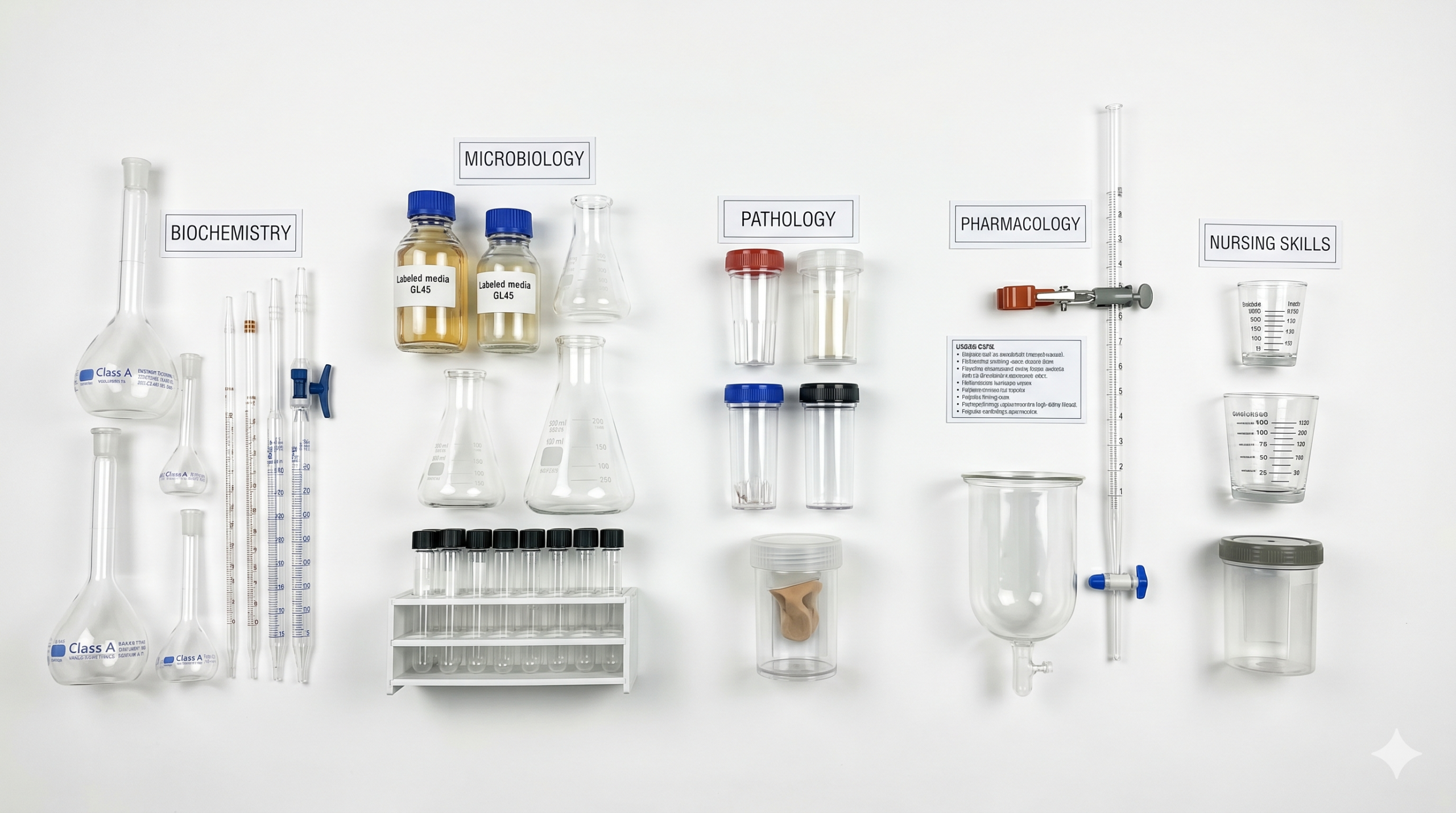
Medical College Laboratory Equipment: Department Reference Table
The table below summarizes the core glassware and equipment requirements for medical college laboratory equipment procurement across all 9 department categories – including the primary curriculum application, required glassware types, material specification, and the quality standard that applies to each department’s procurement.
| Department | Primary Curriculum Application | Core Glassware Required | Material Specification | Key Quality Standard |
|---|---|---|---|---|
| Biochemistry | Standard solution preparation; enzyme and metabolite estimation | Class A volumetric flasks, graduated pipettes, reagent bottles | Borosilicate 3.3, ISO 719 HGB 1 | ISO 4787 Class A calibration |
| Physiology | Hematology practicals; buffer preparation | Sahli tubes, Westergren tubes, Neubauer chambers, reagent bottles | Borosilicate 3.3, ISO 719 HGB 1 | Dimensional accuracy; ISO 3585 |
| Anatomy / Histology | Specimen preservation; tissue staining | Specimen jars, staining jars (Coplin, Hellendahl), slide storage | Borosilicate 3.3, ISO 719 HGB 1 | ISO 3585 chemical resistance |
| Microbiology | Culture media preparation; autoclave procedures | Media bottles, Erlenmeyer flasks, culture tubes, staining jars | Borosilicate 3.3 (autoclave-grade) | ISO 3585 thermal resistance |
| Pathology / Hematology | Tissue processing; coagulation and enzyme assays | Class A volumetric flasks, staining dishes, histopathology jars | Borosilicate 3.3, ISO 719 HGB 1 | ISO 4787 Class A; ISO 719 HGB 1 |
| Pharmacology | Dose-response experiments; drug solution preparation | Class A volumetric flasks, burettes, organ bath vessels | Borosilicate 3.3, thermostated grade | ISO 4787 Class A calibration |
| Nursing Skills | Medication dispensing practice; specimen collection | Medicine glasses (graduated), specimen jars, procedure vessels | Borosilicate 3.3 | Clear, permanent graduation marks |
| Community Health | Water analysis; food safety testing | Nessler tubes (matched set), BOD bottles, Kjeldahl flasks | Borosilicate 3.3, ISO 719 HGB 1 | Matched glass for Nessler; ISO 3585 |
| Forensic Medicine | Poison identification; forensic sample preservation | Distillation apparatus, Class A volumetric flasks, specimen jars | Borosilicate 3.3, ISO 719 HGB 1 | ISO 4787 for quantitative work |
How to Procure and Specify Laboratory Equipment for Medical Colleges
Medical college laboratory equipment procurement should begin with the regulatory equipment list published by the relevant accreditation body – NMC for MBBS programs, INC for nursing programs, and equivalent bodies for other healthcare professional programs. These lists specify minimum quantities and types by department and provide the baseline procurement scope. Build the procurement list from this regulatory minimum outward to curriculum-specific quantities based on student batch size and practical frequency per academic year.
Specification depth in purchase orders for medical college laboratory glassware must include: glass composition (borosilicate 3.3 to ISO 3585), ISO class (Class A or Class B for volumetric instruments), applicable ISO standard references (ISO 4787, ISO 719, ISO 3585 as relevant), and required documentation package (certificate of conformance, material composition certificate, ISO 4787 calibration report for Class A volumetric instruments). Purchase orders that omit glass composition and ISO class create the conditions for supplier substitution – soda-lime glass or borosilicate 5.0 presented as borosilicate 3.3, or Class B instruments delivered against Class A specifications. For guidance on pre-delivery sample verification, see our guide on precision scientific glassware measurement and tolerance verification.
Quantity planning for medical college laboratory equipment must apply the batch-size multiplier to every practical set. A bench set of glassware sufficient for one pair of students must be multiplied by the number of student pairs per batch, plus a 10% to 15% reserve for breakage replacement and equipment under repair. Procurement that does not apply this multiplier produces shortages in the first academic term that require emergency purchasing at higher per-unit costs than a properly planned initial purchase would have incurred. For the annual planning framework that governs medical college procurement cycles, including how to build a multi-department budget across academic year cycles, see our guide on laboratory supply procurement planning.
Frequently Asked Questions
Borosilicate 3.3 glass to ISO 3585 specification is the correct material for all medical college laboratory equipment glassware used in analytical, storage, and teaching applications. Borosilicate 3.3 provides the thermal shock resistance required for autoclave procedures in microbiology, the chemical resistance (ISO 719 HGB 1) required for reagent storage and specimen preservation, and the analytical accuracy (ISO 4787 Class A calibration) required for quantitative biochemistry and pharmacology procedures. Soda-lime glass is not suitable for any of these applications and should not be specified or accepted for medical college laboratory procurement regardless of price differential.
Biochemistry, pharmacology, pathology, and forensic medicine practicals that involve standard solution preparation for quantitative analysis require Class A volumetric glassware to ISO 4787. Class A instruments teach correct measurement technique against a reliable reference and produce standard curves with measurement uncertainty at the level required for the clinical and analytical interpretations being demonstrated. Class B instruments are acceptable for general preparative work, buffer preparation, and volume measurement where analytical precision is not the teaching objective. A practical schedule for a medical college will require both classes – the correct approach is to specify Class A for quantitative analytical practicals and Class B for preparative and general use applications, rather than specifying one class uniformly across all departments.
Calculate practical glassware quantity by multiplying the per-student or per-pair working set by the number of students or pairs per batch, then adding 15% for breakage replacement and reserve stock. A typical MBBS batch of 150 students working in groups of three means 50 working sets per practical session. A department that runs 10 different practicals across the academic year does not need 50 sets of every item simultaneously – it needs 50 sets of the glassware required for any single practical, with reserve stock covering the most frequently broken items. Proper medical college laboratory equipment planning maps equipment needs practical by practical rather than applying a uniform set count across all glassware categories.
Laboratory glassware for medical college laboratory equipment purchases should be accompanied by: a certificate of conformance confirming the glass type (borosilicate 3.3) and applicable ISO class; a material composition certificate confirming borosilicate 3.3 glass composition to ISO 3585; ISO 4787 calibration reports for Class A volumetric instruments; and ISO 719 HGB 1 hydrolytic resistance certificates for reagent storage and specimen preservation vessels. Accreditation audits by NMC, INC, and equivalent bodies may request evidence that laboratory equipment meets specified standards – having supplier certificates organized by product category in the laboratory’s procurement records allows this evidence to be produced without disruption to laboratory operations.
Nursing college laboratory equipment shares the same glass material specification requirements (borosilicate 3.3, ISO 719 HGB 1) as medical college glassware because the applications – reagent storage, specimen handling, medication dispensing practice – are chemically similar. The primary difference between nursing and medical college laboratory equipment is in the type of instruments needed rather than the material specification: nursing programs have lower demand for high-precision Class A volumetric instruments and higher demand for clinical procedure simulation items (medicine glasses, specimen jars, procedure tray glassware) than MBBS program biochemistry and pharmacology departments. Both institution types benefit from borosilicate 3.3 material specification for all glassware categories regardless of application type.
Borosilicate 3.3 glass items in student teaching laboratories typically achieve service lives of 3 to 7 years for general glassware (beakers, Erlenmeyer flasks, graduated cylinders) and 5 to 15 years for less frequently handled items (reagent bottles, specimen jars, staining dishes). Volumetric instruments (Class A flasks and pipettes) should be recalibrated periodically and replaced when graduation marks show wear or when physical damage is observed. Student laboratory settings have higher breakage rates than research or clinical laboratories due to the higher frequency of handling by less experienced users – medical college laboratory equipment procurement budgets should include an annual replacement allocation of 10% to 15% of the durable glassware value to maintain functional set completeness across the academic year without emergency procurement.
Yes. Medilab Exports Consortium supplies complete department-specific glassware sets for medical college laboratory equipment requirements – covering biochemistry, physiology, microbiology, pathology, pharmacology, nursing skills, and community health laboratory departments. Our institutional supply package includes product specification sheets aligned with NMC and INC laboratory requirements, ISO 4787 calibration documentation for Class A volumetric instruments, ISO 719 HGB 1 certificates for reagent and specimen storage vessels, and material composition certificates for all borosilicate 3.3 products. Contact our institutional sales team to discuss your college’s department-wise requirements, batch size calculations, and documentation needs.
Request a Medical College Laboratory Equipment Catalogue
Medilab Exports Consortium supplies ISO-certified borosilicate 3.3 laboratory glassware to medical colleges, nursing institutes, and healthcare training programs globally. Our institutional supply packages cover all 9 department categories with complete medical college laboratory equipment documentation – ISO 4787 calibration reports, material certificates, and certificates of conformance aligned with NMC and INC accreditation requirements.
