
Laboratory supply procurement planning done annually – rather than reactively as stock runs out – consistently reduces per-unit cost, prevents supply disruptions, and gives regulated laboratories the documentation lead time that compliance requirements demand. Procurement managers who approach laboratory supply as a plannable category rather than an ad hoc spend stream gain negotiating leverage with suppliers, reduce emergency purchase premiums, and create the audit-ready procurement records that ISO 17025 and WHO-GMP quality systems require.
This guide covers 7 steps for annual laboratory supply procurement planning – from consumption data audit and activity-linked forecasting through spend categorization, supplier consolidation, budget building, volume agreement negotiation, and safety stock management. Each step is designed to be applied by procurement managers, laboratory managers, and purchasing officers in pharmaceutical, research, clinical diagnostic, and university laboratory settings regardless of organization size.
Medilab Exports Consortium supplies ISO-certified borosilicate 3.3 laboratory glassware to procurement teams and distributors across 40+ countries. Our most efficient and cost-effective supply relationships are built on annual planning cycles – where procurement partners confirm annual volumes, establish documentation requirements, and negotiate supply terms at the start of each year rather than order by order. The laboratory supply procurement planning framework in this guide reflects the approach we see consistently produce better procurement outcomes for the organizations we supply.
Why Annual Laboratory Supply Procurement Planning Reduces Cost and Risk
Reactive laboratory supply purchasing – ordering when stock runs out or when a researcher notices a shortage – consistently produces higher per-unit costs, longer delivery wait times, and greater supply chain risk than planned purchasing against a known annual forecast. Emergency orders placed outside established supplier relationships attract premium freight costs, bypass volume pricing thresholds, and frequently arrive without the complete documentation package that regulated laboratories need for incoming goods records. Each of these costs is avoidable through annual laboratory supply procurement planning.
For regulated laboratories, the planning dimension extends beyond cost. WHO-GMP and ISO 17025-accredited laboratories must maintain documented supplier qualification records, incoming goods verification records, and calibration certificate archives for all critical materials including volumetric glassware. Reactive purchasing from ad hoc suppliers makes this documentation chain impossible to maintain consistently. Annual procurement planning forces the supplier qualification decisions that regulated quality systems require – before the need for an order arises, not after.
Volume consolidation is the primary financial benefit of planned purchasing. A laboratory that places 12 separate small orders across the year for the same volumetric flask product pays list price on every order. The same total volume ordered as a single annual commitment or a quarterly scheduled delivery against an annual agreement qualifies for volume pricing that can reduce per-unit cost by 15% to 30% depending on product category and order size. The difference compounds across a full product range. For a mid-size pharmaceutical laboratory spending $50,000 to $150,000 annually on laboratory glassware and consumables, this reduction represents material budget savings achievable without changing suppliers or reducing quality.
Step 1: Audit Current Inventory and Consumption Data
Accurate laboratory supply procurement planning begins with an audit of what the laboratory currently holds and what it actually consumes. Without this baseline, forecast volumes are guesses rather than calculations, and the budget built on those guesses will be either over-funded (tying up capital in excess inventory) or under-funded (producing the reactive purchasing cycle the planning exercise is designed to eliminate). The audit covers three data sets: current stock levels by product and nominal size, consumption rates from the previous 12 months, and pending orders or committed deliveries for the coming period.
Consumption rate data is the most reliable forecasting input for stable laboratory operations. Pull purchase order and receipt records for the previous 12 months and calculate average monthly consumption for each product line. For laboratories whose activity volume does not vary significantly month to month, this average is a reliable annual forecast base. For laboratories with seasonal research cycles, clinical batch schedules, or academic academic calendar patterns, consumption rates will vary by period and the forecast must reflect that variation rather than applying a flat monthly average across all 12 months.
Stock audit findings frequently reveal waste that planned laboratory supply procurement planning eliminates. Overstocked products – items held in quantities far exceeding 3 months of average consumption – represent capital tied up in inventory that is not generating value. Understocked critical products – items where current stock represents fewer than 4 weeks of average consumption without a delivery on order – represent supply risk that a single delayed shipment can convert to a production or analysis stoppage. Document both conditions in the audit and treat them as planning inputs, not just observations.
Step 2: Map Supply Requirements to Laboratory Activity Schedule
Laboratory supply requirements are not uniformly distributed across a calendar year. A pharmaceutical quality control laboratory that runs accelerated stability studies in Q1 and Q3 uses significantly more volumetric glassware in those periods than in Q2 and Q4. A university research laboratory that runs primary research from September to May and secondary research from June to August has a different demand profile than a hospital clinical laboratory running constant daily throughput. Mapping supply requirements to the actual laboratory activity schedule produces a month-by-month demand forecast rather than a flat annual projection – and a more accurate forecast produces more accurate budget figures and more efficient inventory management.
The mapping exercise requires collaboration between procurement and the laboratory teams who can predict their activity schedule for the coming year. Research project plans, clinical batch schedules, method validation timelines, and accreditation audit schedules all affect supply demand in predictable ways. A method validation project scheduled for Q2 will require volumetric glassware and calibration standards at a higher rate than routine analysis periods. An accreditation renewal scheduled for Q4 may require consumable stock replenishment across the full product range to ensure adequate supply during the audit window. Laboratory supply procurement planning that incorporates this activity-linked demand produces procurement schedules that align delivery timing with actual need.
Buffer demand should be added to the activity-based forecast for critical product lines – items whose absence would halt laboratory operations. A 10% to 15% buffer above the activity-forecast consumption rate for critical items protects against forecast inaccuracy and minor supply delays without generating significant excess inventory. Buffer stock for non-critical items (general beakers, non-calibrated containers, general-purpose flasks) can be set lower – 5% to 10% above forecast – because the operational consequence of a temporary shortage is inconvenience rather than a production or compliance stoppage.
Step 3: Categorize Spend by Product Criticality
Spend categorization by product criticality determines where procurement attention and supplier qualification effort should be concentrated. Not all laboratory supply categories deserve the same level of procurement rigor. Class A volumetric instruments used in pharmacopoeial assays require ISO 4787 calibration documentation, lot-level traceability, and verified supplier qualification – procurement failures in this category create regulatory compliance risk. Standard beakers and general Erlenmeyer flasks used in preparative work require clean, functional borosilicate glass – procurement failures in this category create operational inconvenience.
A practical three-category classification for laboratory supply procurement planning applies the following criteria. Critical items are those whose quality or availability directly affects analytical results, regulatory compliance, or patient safety – Class A volumetric instruments, primary standard storage vessels, dissolution testing apparatus, and calibration reference materials fall in this category. These items require pre-qualified suppliers, full documentation packages, and safety stock levels at minimum 6 weeks of average consumption. Routine items are those whose quality specification is standard and whose short-term unavailability causes operational disruption but not compliance risk – general storage glassware, preparative flasks, and culture vessels. Standard items are those with no specific quality specification requirement and multiple readily available substitutes.
Budget allocation should reflect this criticality hierarchy. Critical items deserve premium supplier relationships, volume agreements, and documentation investment regardless of their share of total spend. Cost-cutting pressure applied to critical supply categories produces regulatory and analytical risk that far exceeds the budget savings achieved. Routine and standard items can be optimized for cost without quality risk – comparing suppliers, increasing order quantities to reach volume pricing thresholds, and standardizing specifications to reduce SKU proliferation are appropriate optimization strategies for these categories. See our guide on laboratory glassware quality standards for the regulatory framework that determines criticality classification for ISO and WHO-GMP compliant laboratories.
Step 4: Qualify and Consolidate Supplier Relationships
Supplier qualification and consolidation is the structural step in laboratory supply procurement planning that most directly reduces per-unit cost and administrative burden. Laboratories with 8 to 15 active laboratory supply suppliers across glassware, plasticware, and consumable categories typically spend 30% to 50% more administrative time on procurement processing than equivalent laboratories that have consolidated to 3 to 5 qualified suppliers. More suppliers means more purchase orders, more invoices, more incoming documentation packages to verify, and more supplier qualification records to maintain – with no corresponding quality or cost benefit if the consolidated suppliers meet the specification requirements across the product categories involved.
Supplier consolidation for laboratory supply procurement planning starts with confirming which current suppliers can supply across the widest range of needed product categories at the required quality level and documentation depth. A supplier of ISO-certified borosilicate 3.3 volumetric glassware who also supplies reagent bottles, media bottles, culture vessels, and general laboratory glassware covers a significantly wider range of critical and routine supply needs than a specialist supplier covering only one product category. Consolidating volume across a broader product range with a single qualified supplier generates larger total order values that qualify for stronger volume discounts than the sum of smaller individual category orders with separate suppliers.
For new supplier qualification as part of the annual planning cycle, see our guide on OEM laboratory glassware manufacturing for distributors – which covers the qualification criteria and documentation requirements that apply equally to direct laboratory procurement from manufacturers. The supplier qualification dossier built during this step – ISO certificates, product documentation packages, sample evaluation results – forms the compliance record that ISO 17025 and WHO-GMP quality systems require for each approved supplier.
Step 5: Build the Annual Budget by Category
Annual budget construction for laboratory supply procurement planning follows directly from Steps 1 through 4: the consumption audit provides volume data, the activity mapping provides timing data, the criticality categorization provides the documentation and supplier qualification cost input, and the supplier consolidation step provides the pricing basis for volume commitments. Combining these four inputs produces a budget that is grounded in actual consumption, aligned with laboratory activity, and priced at volume-agreement rates rather than reactive list prices.
The budget structure should organize spend by criticality category, not by product type or supplier. A criticality-structured budget makes clear how much of the total laboratory supply spend is exposed to regulatory risk (critical category), how much is operationally important but lower-risk (routine category), and how much is genuinely discretionary (standard category). This structure also makes budget defense easier in annual planning meetings – demonstrating that critical category spend cannot be reduced without compliance risk is straightforward when it is presented as a distinct line rather than buried in a total glassware spend figure.
Contingency allocation – typically 5% to 10% of total critical and routine category budget – protects against price increases, unplanned consumption driven by new research projects or expanded batch schedules, and emergency replacement purchases for glassware breakage. A contingency fund prevents the need to request supplementary budget mid-year for foreseeable variance, which is administratively disruptive and signals poor planning to finance and management stakeholders. Laboratory supply procurement planning that includes a stated contingency methodology in the budget proposal demonstrates planning maturity that strengthens the case for the full budget request.
Step 6: Negotiate Annual Supply Agreements and Volume Pricing
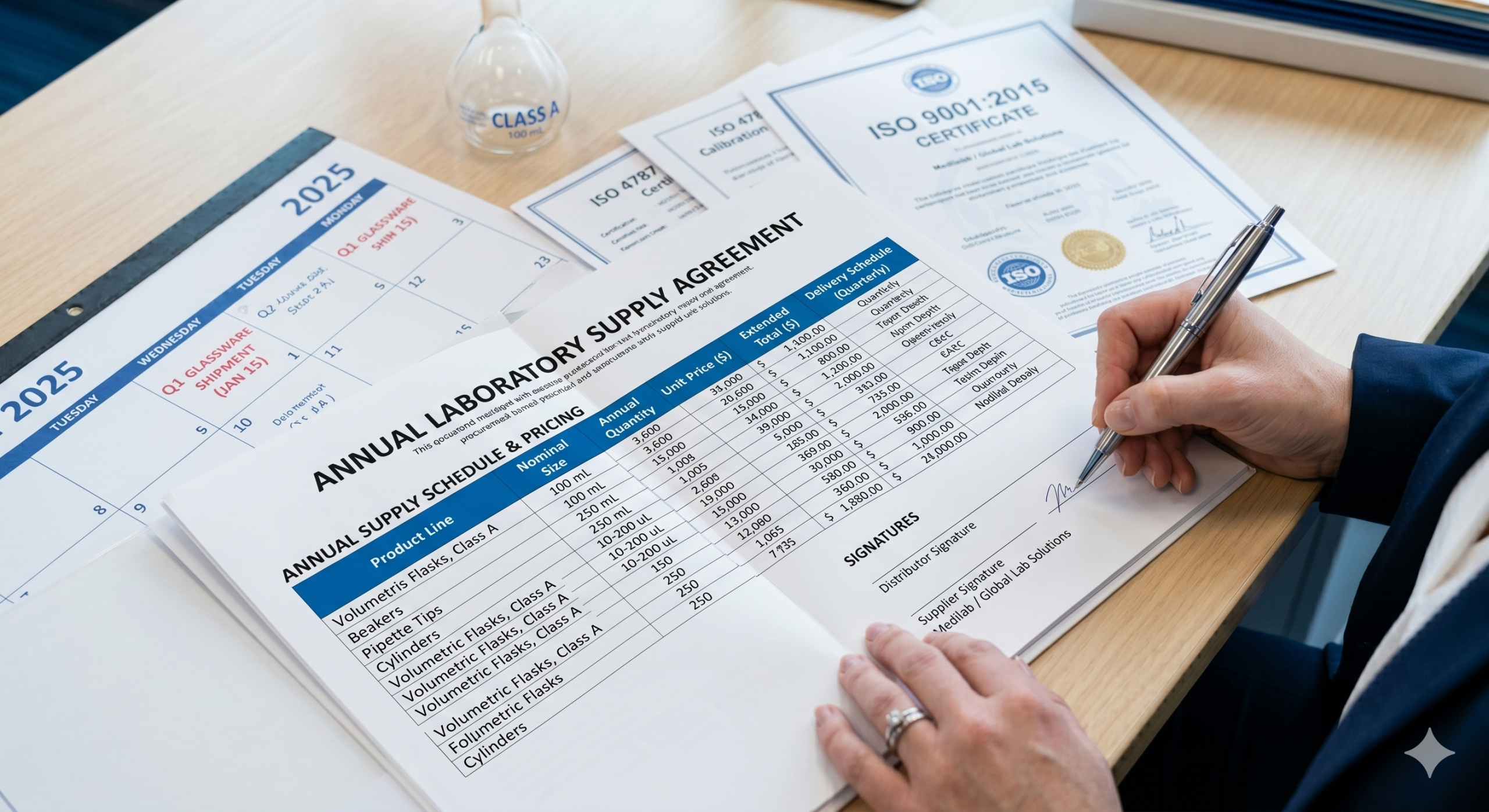
Annual supply agreements convert the volume forecasts and supplier qualification decisions from Steps 1 to 5 into contracted pricing and delivery commitments. An annual supply agreement with a qualified laboratory glassware supplier typically specifies: product lines covered, nominal volumes and sizes, annual committed quantity (or quarterly delivery schedule against the annual total), price per unit at the committed volume tier, documentation package included with each delivery, delivery lead time, and the process for ordering volumes above or below the agreed annual quantity. These terms protect both parties – the buyer secures pricing certainty and supply availability, the supplier secures production planning visibility and cash flow predictability.
Volume pricing negotiation should be based on total annual commitment value, not individual order size. A laboratory that commits to 600 units of 100 mL Class A volumetric flasks across four quarterly deliveries of 150 units each should negotiate pricing on the basis of the 600-unit annual total, not the 150-unit delivery quantity. Many procurement managers negotiate at the delivery order level because that is how individual purchase orders are processed – but the pricing leverage comes from the annual total, and presenting that total to the supplier at the agreement negotiation stage rather than at each individual order stage captures the volume pricing benefit that reactive purchasing never achieves. For guidance on when to use catalogue pricing versus a custom quotation structure, see our guide on laboratory supply catalogue vs custom quotation.
Agreement documentation should confirm the regulatory documentation scope explicitly – which certificates ship with each delivery, in what format, and with what lot-level traceability content. A supplier who commits to annual pricing but is silent on documentation format in the agreement can subsequently change the documentation scope without triggering a contract breach. For laboratory supply procurement planning in regulated settings, documentation commitments are as important as price commitments, and both must appear in the agreement text rather than being assumed from past practice.
Step 7: Set Reorder Triggers and Safety Stock Levels
Reorder triggers and safety stock levels are the operational mechanisms that make an annual plan function in practice. Without defined reorder points, even a well-constructed annual forecast can produce reactive purchasing behavior – staff ordering when they notice stock is low rather than when a pre-calculated trigger point is reached. The reorder trigger is the stock level at which a replenishment order must be placed to ensure new stock arrives before existing stock is exhausted, given the supplier’s standard delivery lead time.
For critical product categories, the safety stock calculation is: safety stock = (maximum daily consumption rate – average daily consumption rate) x maximum delivery lead time in days. This formula sets safety stock at the level needed to cover both above-average consumption and above-average delivery lead time simultaneously – the two conditions that most commonly combine to produce a stockout in a laboratory that otherwise plans adequately. For routine product categories where stockout is operationally inconvenient but not compliance-critical, safety stock can be set at a simpler 3 to 4 weeks of average consumption without the maximum-rate calculation.
Laboratory supply procurement planning that includes defined reorder triggers for each critical and routine product line removes the judgment and monitoring burden from individual laboratory staff and puts it into a systematic process. An inventory management spreadsheet with current stock levels, average monthly consumption, delivery lead time, safety stock level, and reorder trigger for each product line gives a single procurement officer visibility across the full critical and routine product range without requiring constant manual monitoring. Updating this spreadsheet monthly against actual consumption and delivery data takes 30 to 60 minutes and prevents the stockout-driven emergency purchases that cost procurement budgets the most per unit across the course of a year.
Laboratory Supply Procurement Planning: Annual Framework Reference Table
The table below summarizes the 7-step laboratory supply procurement planning framework – covering the objective of each step, the primary input required, the primary output produced, and the benefit delivered to the annual procurement cycle.
| Step | Objective | Primary Input | Primary Output | Benefit Delivered |
|---|---|---|---|---|
| 1. Inventory and consumption audit | Establish accurate baseline consumption rates | 12 months purchase/receipt records; current stock levels | Product-level consumption rates; over/under-stock findings | Forecast based on fact, not estimate |
| 2. Activity-linked demand mapping | Match demand forecast to laboratory schedule | Research/batch/clinical activity calendar | Month-by-month demand schedule by product line | Delivery timing aligned with actual need |
| 3. Spend categorization | Direct rigor to compliance-critical products | Regulatory compliance requirements by product | Critical / routine / standard product classification | Risk-proportionate procurement investment |
| 4. Supplier qualification and consolidation | Reduce suppliers; increase per-supplier volume | Current supplier list; qualification documentation | Approved supplier shortlist; qualification dossiers | Volume leverage; admin reduction |
| 5. Annual budget construction | Build a grounded, defensible budget | Volume data; pricing at committed volume tiers | Category-structured annual budget with contingency | Budget certainty; finance stakeholder credibility |
| 6. Annual supply agreement negotiation | Convert volume forecast to contracted pricing | Annual committed volumes; documentation requirements | Signed supply agreement with price, delivery, doc scope | Volume pricing; supply availability certainty |
| 7. Reorder triggers and safety stock | Eliminate stockout-driven emergency purchases | Lead times; max/average consumption rates | Reorder point and safety stock level per product | Eliminates reactive purchasing premium costs |
How to Structure an Annual Supply Agreement with a Qualified Supplier
An annual supply agreement for laboratory glassware procurement should be a written document – not an informal understanding or a verbal commitment between a procurement officer and a sales representative. The agreement should specify: the product lines covered (with product code, nominal size, and ISO class for each line), the annual committed quantity per product line, the delivery schedule (single annual delivery, quarterly deliveries, or on-demand against the annual total), the agreed unit price per product at the committed volume, payment terms, delivery lead time and freight terms, and the documentation package that ships with each delivery.
The documentation scope clause is particularly important for regulated laboratory procurement. The agreement should state by name which certificates accompany each delivery – “ISO 4787 calibration report (lot-level), certificate of conformance (lot-level), material composition certificate confirming borosilicate 3.3 to ISO 3585” – rather than using general language like “standard quality documentation.” General language gives the supplier discretion over what documentation to include; named documents create a contractual commitment that can be enforced if a delivery arrives without the required records. For the full regulatory framework that drives documentation requirements, the WHO Good Manufacturing Practices guidelines and ISO 9001 quality management standard define the minimum supplier documentation commitments for pharmaceutical and quality system-compliant procurement.
The agreement should include a review clause – a defined point in the year (typically 6 months after signing) at which actual consumption is compared to forecast and the annual committed quantity is adjusted if needed. Consumption patterns change with new research projects, clinical volume changes, or product substitution decisions. A supply agreement with no review mechanism locks the buyer into a committed quantity that may no longer match actual need by mid-year. A review clause protects both parties: the buyer avoids over-commitment, and the supplier avoids a buyer who simply stops ordering below the committed quantity without formal agreement to do so. Medilab Exports Consortium builds annual supply agreement review clauses as standard into all volume supply relationships, and our export team can advise on the specific documentation and review structure appropriate for your procurement context.
Frequently Asked Questions
Volume commitment through laboratory supply procurement planning typically reduces per-unit cost by 15% to 30% compared to reactive list-price purchasing for the same product at the same total annual volume. The reduction depends on order size relative to the supplier’s volume pricing thresholds, the product category (calibrated volumetric instruments typically have tighter margin structures than general glassware), and the buyer’s negotiating leverage from supplier consolidation. Beyond unit pricing, planned purchasing eliminates emergency freight premiums that can add 20% to 50% to individual shipment costs when urgent orders bypass standard logistics arrangements – a cost category that annual planning eliminates entirely for planned product lines.
Any laboratory with annual laboratory supply spend above $10,000 to $15,000 per year benefits from a formal laboratory supply procurement planning process. Below that threshold, the administrative investment in building and maintaining a formal plan may exceed the cost savings generated. Above it, the combination of volume pricing, freight consolidation, documentation pre-qualification, and emergency purchase elimination consistently produces financial returns that outweigh the planning investment. Regulated laboratories – pharmaceutical QC, ISO 17025-accredited testing, and clinical diagnostic laboratories – benefit from formal planning at any spend level because the compliance documentation discipline the planning process creates is required by their quality systems regardless of cost considerations.
Annual plans should include a contingency allocation – typically 5% to 10% of total budget – specifically to handle consumption that exceeds forecast due to new research projects, expanded batch schedules, or unplanned glassware breakage. Requests for spend against the contingency allocation should require a brief written justification (one to two sentences identifying the cause of the unplanned need) so that recurring patterns can be incorporated into the following year’s baseline forecast. Laboratory supply procurement planning does not eliminate all unplanned purchases – it minimizes them, prices them within an agreed budget envelope, and creates a feedback mechanism that improves forecast accuracy year over year.
For critical product categories (Class A volumetric instruments, dissolution apparatus, primary standard storage vessels), supplier qualification requires: current ISO 9001 certificate, product-level ISO compliance documentation (ISO 4787, ISO 3585, ISO 719 as applicable), sample calibration reports confirming the declared class and tolerance, and a completed supplier qualification dossier in the laboratory’s quality management system. For routine and standard product categories, a current ISO 9001 certificate and product-level ISO compliance documentation are the minimum acceptable qualification. Annual laboratory supply procurement planning provides the timing structure to complete supplier qualification before orders are placed – not as a response to a delivery arrival without expected documentation.
Laboratory supply procurement planning is most directly applicable to consumable laboratory supplies – products consumed or replaced regularly such as volumetric glassware, reagent bottles, media bottles, graduated cylinders, and pipettes. Capital equipment (analytical instruments, autoclaves, centrifuges) follows a different procurement cycle with longer decision timelines, higher per-unit values, and separate budget approval processes. However, the consumption audit step (Step 1) should include a review of capital equipment replacement schedules and service contract renewals as context for consumable planning – laboratories that anticipate capital equipment replacement should plan for the associated increase in consumable demand that often follows instrument upgrades or new method validations.
Annual supply agreements for laboratory glassware and consumables should be initiated 60 to 90 days before the start of the period they cover. This lead time allows for consumption data analysis (Step 1), activity mapping (Step 2), supplier qualification review (Step 4), and agreement negotiation without time pressure. Initiating earlier – 90 to 120 days before the start date – is appropriate for laboratories with complex documentation requirements, multiple suppliers to consolidate, or significant volume changes expected in the upcoming year. Laboratory supply procurement planning that begins after the new fiscal year has already started forces reactive purchasing for the first weeks or months of the period, partially negating the cost and risk benefits the annual plan is designed to deliver.
Yes. Medilab Exports Consortium offers annual supply agreements for all standard borosilicate 3.3 product lines – covering committed annual volumes, quarterly or scheduled delivery arrangements, volume-tier pricing, and confirmed documentation packages for each product category. Annual agreements include a mid-year review clause as standard to adjust committed quantities against actual consumption. Our export team can assist with consumption-based volume forecasting for new supply relationships and can structure documentation packages aligned with WHO-GMP, ISO 17025, and institutional procurement requirements. Contact our team to initiate an annual laboratory supply procurement planning discussion for your organization’s requirements.
Set Up an Annual Supply Agreement with Medilab Exports
Medilab Exports Consortium supports laboratory supply procurement planning with annual supply agreements, volume pricing, scheduled deliveries, and complete ISO documentation packages for pharmaceutical, research, and clinical diagnostic laboratories in 40+ countries. Contact our export team to discuss annual volume commitments, documentation requirements, and pricing for your upcoming procurement cycle.
