

A laboratory supply catalogue is the default procurement tool for most scientific and clinical buyers, but relying on it exclusively produces avoidable mismatches between what the catalogue lists and what a specific procurement requirement actually demands. Procurement managers who understand when to use a laboratory supply catalogue and when to request a custom quotation reduce sourcing errors, close documentation gaps, and control unit costs more effectively than those who default to one approach in all situations.
This guide identifies 7 factors that determine whether a laboratory supply catalogue or a custom quotation is the correct tool for a given procurement decision. Each factor covers a practical scenario where one approach consistently produces better outcomes than the other, with guidance on how to apply both tools together when procurement complexity requires it.
Medilab Exports Consortium supplies ISO-certified borosilicate 3.3 laboratory glassware to distributors, pharmaceutical manufacturers, research institutions, and hospital procurement teams across 40+ countries. We issue both a laboratory supply catalogue for standard product ranges and custom quotations for specification-specific, volume-tiered, and OEM-labeled orders. The 7 factors in this guide reflect the criteria we apply when advising procurement partners on which approach their order requires.
Why the Laboratory Supply Catalogue vs Quotation Choice Affects Procurement Outcomes
Using the wrong procurement tool for a given order type generates predictable problems. A laboratory supply catalogue order placed for a product with non-standard specification requirements arrives without the documentation a regulated laboratory requires. A custom quotation request submitted for a standard stocked item delays procurement by two to five business days without adding any value over catalogue ordering.
The stakes are highest in pharmaceutical, clinical diagnostic, and research laboratory procurement. A catalogue purchase placed without confirming documentation scope creates compliance gaps under WHO-GMP or ISO 17025 audit conditions. A quotation request for an urgent restocking need delays operations that cannot wait five business days for supplier approval. Applying the correct tool to each purchase type eliminates both failure modes.
The 7 factors below are not a checklist to work through for every order. They are decision criteria for situations where a buyer faces ambiguity – where a standard catalogue order might satisfy the requirement, or might not. Applying these factors at the point of purchase decision consistently produces better procurement outcomes than defaulting to either approach without review.
What a Laboratory Supply Catalogue Contains and When It Applies
A laboratory supply catalogue lists standardized product specifications, nominal sizes, ISO class designations, packaging quantities, and list prices for a defined product range. For borosilicate laboratory glassware, a catalogue organizes products by type – volumetric flasks, graduated cylinders, beakers, Erlenmeyer flasks, pipettes, and burettes – with each line showing the nominal volume, declared ISO class, and standard packaging unit.
A laboratory supply catalogue is the correct procurement tool when the product specification matches what is listed exactly, the order volume falls within standard packaging quantities, delivery is routine, and documentation requirements are limited to a standard certificate of conformance. Distributors placing replenishment orders for stocked items, laboratories restocking consumables to a defined inventory level, and procurement teams sourcing standard beakers or reagent bottles all operate within catalogue parameters.
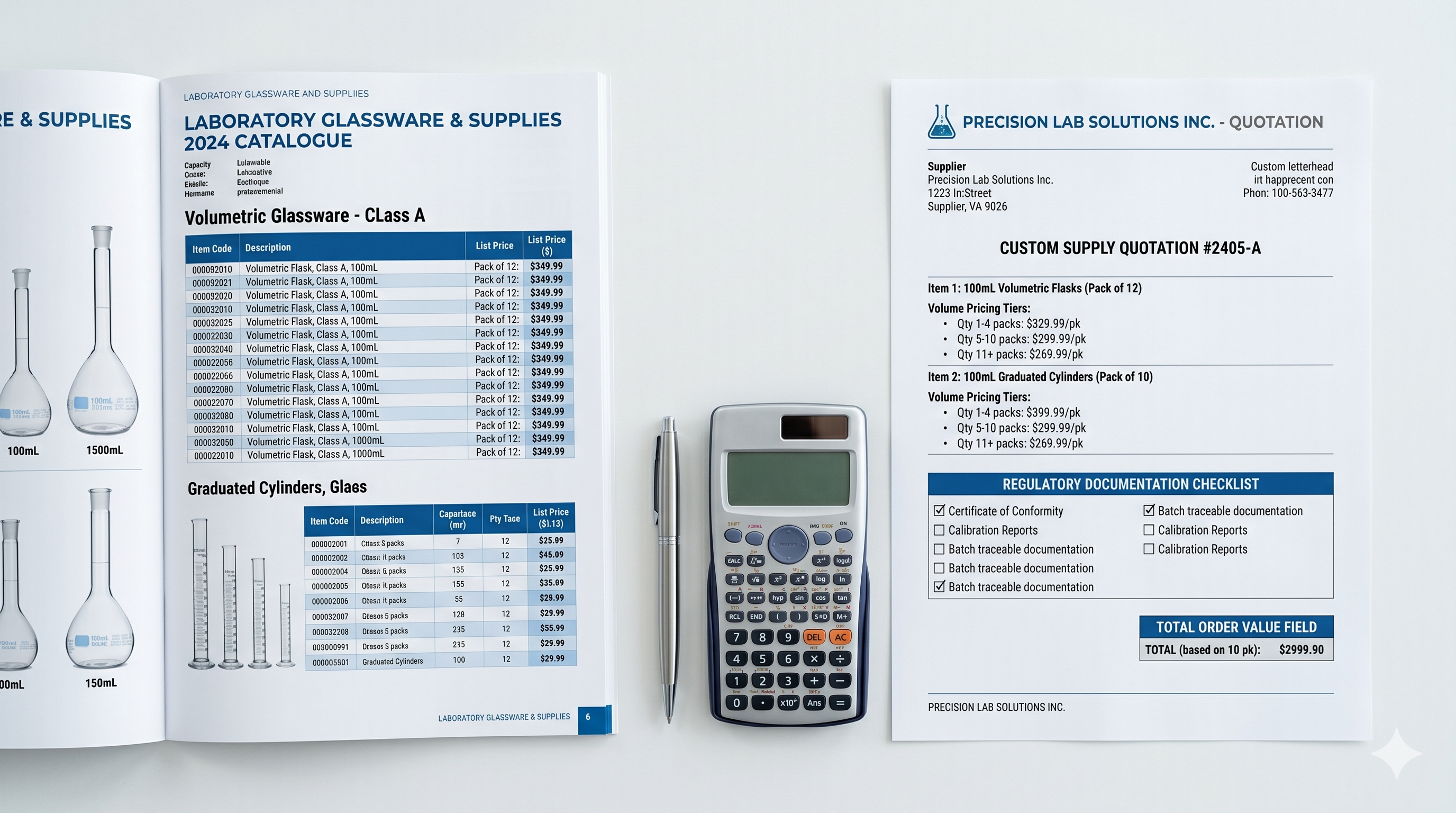
Catalogue pricing reflects published list prices for standard quantities. It does not reflect volume-tiered pricing, project-specific discounts, OEM or private label arrangements, or non-standard packaging configurations. When any of these conditions apply, the catalogue alone cannot complete the procurement decision.
What a Custom Laboratory Quotation Contains and When It Applies
A custom laboratory quotation is a supplier-generated document that specifies pricing, product parameters, delivery terms, and documentation for a defined order outside the scope of standard catalogue conditions. A quotation for laboratory glassware may include volume-tier pricing for large-format orders, specification adjustments for non-standard nominal sizes, OEM or private label terms, custom packaging configurations, and regulatory documentation packages tailored to the buyer’s compliance requirements.
Custom quotations are the correct tool when procurement involves non-standard product specifications, high-volume purchases where volume pricing applies, documentation requirements beyond standard certificates, custom labeling, or first-time supplier qualification orders where terms need formal establishment. Pharmaceutical manufacturers, large hospital procurement offices, and scientific equipment distributors placing large-format import orders regularly require custom quotation rather than catalogue purchasing.
A quotation takes longer to generate than a catalogue order – typically two to five business days for a new product configuration and one to two business days for a repeat quotation request. This processing time is a cost of the quotation approach and must be factored into the procurement timeline from the point of order initiation.
Factor 1: Order Volume and Repeat Purchase Frequency
High-volume orders consistently favor custom quotations over catalogue pricing. Laboratory supply catalogue list prices reflect single-packaging-unit pricing. They do not incorporate the volume discounts that suppliers offer at defined order size thresholds – 100 units, 500 units, 1,000 units, or full container quantities. A procurement manager who places a 500-unit volumetric flask order at catalogue price pays more per unit than the same order placed via a volume-tier quotation.
Repeat purchase frequency changes this calculation. A distributor placing the same 50-unit replenishment order twelve times per year may benefit more from an annual supply agreement negotiated via custom quotation than from repeatedly purchasing at catalogue rates. An annual supply agreement quotation typically includes fixed pricing, committed delivery schedules, and a simplified reorder process that bypasses the standard quotation cycle for individual repeat orders.
For small, infrequent, or opportunistic orders at standard quantities, the laboratory supply catalogue is the faster and more practical tool. Volume and frequency only shift the decision toward quotation when the order size or purchase pattern generates enough cost saving to justify the quotation processing time.
Factor 2: Product Specification Complexity
Standard laboratory supply catalogue listings cover the most common product configurations – nominal sizes, ISO Class A and Class B designations, and standard packaging. They do not cover non-standard nominal volumes, special graduation intervals, atypical stopper sizes, non-standard neck dimensions, or material certifications beyond standard borosilicate 3.3 composition. Any product requirement that falls outside listed parameters requires a custom quotation.
Specification complexity also arises when a buyer needs to confirm that a catalogue product meets requirements not explicitly stated in the listing. A pharmaceutical laboratory that needs ISO 4787 Class A calibration documentation, lot-level traceability, and material composition certificates for every shipment cannot assume that a catalogue order will automatically include these documents. A custom quotation explicitly specifies what documentation will accompany each shipment.
The rule is straightforward: if the product specification matches the laboratory supply catalogue listing exactly and no additional documentation is required, use the catalogue. If any parameter deviates from catalogue conditions – specification, class, documentation, packaging – request a quotation instead.
Factor 3: Regulatory Documentation Requirements
Regulated laboratories – pharmaceutical manufacturers operating under WHO-GMP, ISO 17025-accredited testing laboratories, and hospital central stores with incoming material qualification requirements – need documentation that a standard catalogue order does not automatically generate. Required documents may include ISO 4787 calibration reports with lot-level traceability, material composition certificates confirming borosilicate 3.3 to ISO 3585, hydrolytic resistance certificates to ISO 719, and incoming inspection records.
A custom quotation is the correct tool for any procurement where documentation requirements exceed the standard certificate of conformance. The quotation document should explicitly list which certificates will accompany each shipment, the format in which they will be provided, and the lead time between order placement and documentation availability. This establishes the documentation commitment before the purchase order is issued – not after the shipment arrives.
For a detailed review of the quality standards that drive these documentation requirements, see our guide on laboratory glassware quality standards. Understanding which ISO standards apply to a given product category clarifies exactly which certificates a compliant quotation must include.
Factor 4: Procurement Timeline and Delivery Urgency
The laboratory supply catalogue is faster to use than the custom quotation process. A buyer who identifies a stocked catalogue item, confirms the required quantity is available, and places an order can typically complete the transaction within one business day. A custom quotation requires supplier review of the specification, pricing calculation, document preparation, and buyer approval – a cycle that takes two to five business days for a new request.
For urgent procurement – emergency glassware replacement after breakage, last-minute reagent bottle restocking before a batch run, or time-sensitive research consumable replenishment – catalogue purchasing is the correct approach if the product is available in the standard range. Submitting a quotation request for an item that needs immediate shipping creates a timeline conflict the quotation process cannot resolve.
The exception applies when urgency combines with non-standard specification. A non-standard product that cannot be ordered from a catalogue cannot be made faster by bypassing the quotation process. In that scenario, a supplier who can turn a quotation around within 24 hours and hold near-specification stock provides the most practical resolution.
Factor 5: Budget Authority and Internal Approval Workflow
Many laboratory procurement teams operate under tiered budget authority rules: purchases below a defined value threshold can be approved at the department level, while purchases above that threshold require finance or procurement committee approval. A laboratory supply catalogue purchase at list price often falls below the threshold and can be processed without formal quotation documentation. Larger purchases almost always require a formal quotation to satisfy the internal approval requirement.
Custom quotations create the formal paper trail that approval workflows require. A quotation that specifies unit price, total order value, payment terms, and delivery schedule satisfies the documentation requirements of most procurement approval systems. Catalogue printouts or price list extracts do not provide the same formal purchase record and may be rejected by finance systems that require supplier-issued quotation numbers.
Procurement managers who are uncertain about whether a purchase requires a quotation for internal approval purposes should confirm this against their organization’s procurement policy before placing an order. Placing a large order at catalogue price without a formal quotation may create approval compliance issues even when the purchase itself is technically correct.
Factor 6: Supplier Relationship Stage
A laboratory supply catalogue is appropriate for orders placed with established and qualified suppliers whose terms, documentation practices, and product consistency are already known and on record. First-time orders from a new supplier should be processed via custom quotation regardless of whether the product specification matches catalogue listings. A formal quotation establishes the terms of the relationship, documents the supplier’s commitments on documentation and delivery, and creates a reference record for supplier qualification.
New supplier qualification involves both formal quotation and sample evaluation before any bulk purchase is confirmed. For guidance on identifying and assessing manufacturing partners, see our guide on OEM laboratory glassware manufacturing for distributors – which covers the qualification criteria procurement managers use to evaluate supplier credentials, ISO certifications, and export documentation before placing first orders.
For established supplier relationships with a documented order history and consistent quality record, catalogue ordering is appropriate for routine replenishment. Reserve quotation requests for volume changes, specification adjustments, documentation upgrades, or contract renewals – rather than for every individual reorder from a supplier already qualified in the procurement system.
Factor 7: Customization, Private Labeling, and OEM Requirements
Any order that requires product customization cannot be completed through a laboratory supply catalogue. Customization includes private labeling, OEM packaging, non-standard graduation intervals, customer-specific packaging configurations, modified stopper or closure specifications, and branded printed documentation. Each of these requires a custom quotation that specifies the customization parameters, unit pricing for the modified product, and the minimum order quantity that makes the customization economically viable.
Private label and OEM orders are a common requirement for laboratory equipment distributors who supply institutional buyers under their own brand. A distributor who sources borosilicate glassware for resale under a house brand requires a custom quotation that addresses labeling artwork, packaging format, language requirements for the destination market, and the documentation format that will accompany each shipment under the distributor’s brand identity.
Minimum order quantities for custom configurations are typically higher than for standard catalogue products. A custom quotation will specify the minimum batch size below which the customization cannot be produced economically. Procurement managers who require customization but cannot meet minimum order quantities should discuss hybrid solutions with the supplier – for example, standard catalogue product with custom outer packaging – before ruling out the quotation approach entirely.
Laboratory Supply Catalogue vs Custom Quotation: Reference Comparison Table
The table below summarizes all 7 decision factors for choosing between a laboratory supply catalogue and a custom quotation – showing when each approach applies, the key advantage of each, and the typical processing time difference.
| Factor | Use Catalogue When | Use Custom Quotation When | Key Advantage of Correct Choice | Processing Time |
|---|---|---|---|---|
| 1. Order Volume | Standard packaging quantities, small repeat orders | High-volume orders, annual supply agreements | Volume pricing saves per-unit cost on large orders | Immediate vs 2-5 business days |
| 2. Specification Complexity | Exact match to catalogue listing | Non-standard size, class, or configuration | Specification accuracy confirmed in writing | Immediate vs 2-5 business days |
| 3. Regulatory Documentation | Standard CoC sufficient | ISO 4787 reports, lot traceability, ISO 719 certs required | Documentation commitment established before order | Immediate vs 2-5 business days |
| 4. Procurement Timeline | Urgent need, stocked item available | Planned purchase with procurement lead time | Avoids timeline conflict on urgent restocking | Same day vs 2-5 business days |
| 5. Budget Authority | Below internal approval threshold | Above threshold, formal supplier document required | Quotation number satisfies approval system | Immediate vs 1-2 business days |
| 6. Supplier Relationship | Established, previously qualified supplier | First-time order, new supplier qualification | Formal terms established before first purchase | Immediate vs 2-3 business days |
| 7. Customization / OEM | Standard catalogue product, no branding required | Private label, OEM packaging, custom configuration | Customization parameters agreed before production | Not applicable vs 3-7 business days |
How to Structure Your Procurement Approach Before Placing an Order
Most laboratory procurement cycles use both a laboratory supply catalogue and custom quotations – applying each tool to the correct purchase type. Standard replenishment orders for stocked items (beakers, reagent bottles, measuring cylinders in standard sizes) belong in the catalogue track. Non-standard orders, high-volume purchases, first-time supplier engagements, and regulated pharmaceutical procurement consistently require custom quotations.
Distributors managing a mixed product portfolio can streamline procurement by separating orders into two tracks at the point of order preparation. Items that match the laboratory supply catalogue exactly and require no additional documentation go through the catalogue track with immediate order placement. Items that deviate from catalogue conditions on any of the 7 factors above go to the quotation track, with a defined lead time built into the procurement schedule.
For reference on the precision requirements that drive quotation-level documentation in volumetric instruments, see our guide on precision scientific glassware – covering how ISO 4787 tolerance specifications translate into documentation requirements for Class A instruments. The ISO 9001 quality management standard requires documented supplier selection and purchasing criteria for organizations operating under quality management systems – a requirement that a formal quotation process directly satisfies.
For pharmaceutical procurement, the WHO Good Manufacturing Practices guidelines require formal documentation of incoming material qualification and supplier approval. A custom quotation that specifies product parameters, certification commitments, and batch documentation requirements satisfies this requirement. Medilab Exports Consortium provides both a current laboratory supply catalogue and custom quotations for all product categories. Contact our export team to request either document for your specific procurement requirement.
Frequently Asked Questions
A laboratory supply catalogue lists standardized products at fixed list prices for immediate ordering – no supplier review required. A custom quotation is a supplier-generated document that establishes pricing, product parameters, delivery terms, and documentation commitments for an order that falls outside standard catalogue conditions. Catalogues are faster; quotations are more flexible and provide a formal written record of agreed terms.
Use the laboratory supply catalogue when the product specification matches a listed item exactly, the order quantity falls within standard packaging units, the delivery timeline is routine, no additional documentation beyond a standard certificate of conformance is required, the purchase value falls below the internal approval threshold, and the supplier is already qualified in the procurement system. When all six conditions are met, catalogue ordering is faster and equally effective.
A new custom quotation for a non-standard product configuration typically takes two to five business days from request to supplier issue. A repeat quotation for a previously specified product or an annual supply agreement renewal typically takes one to two business days. Suppliers who maintain a current laboratory supply catalogue can often turn around quotations faster because standard product data, pricing structures, and documentation templates are already prepared. Build quotation lead time into the procurement schedule from the point of order initiation.
Not always – but regulated laboratories need to verify that whatever procurement method they use produces the required documentation. A laboratory supply catalogue order from a supplier with pre-confirmed documentation practices can satisfy regulatory requirements if the supplier routinely includes ISO 4787 calibration reports, lot-level traceability, and material certificates with every shipment. If those documents are not automatically included with catalogue orders, a custom quotation that explicitly commits the supplier to providing them is the safer approach for WHO-GMP or ISO 17025 compliance.
Yes. Medilab Exports Consortium maintains a current laboratory supply catalogue covering all standard borosilicate 3.3 product lines – volumetric flasks, graduated cylinders, beakers, Erlenmeyer flasks, pipettes, burettes, and reagent bottles in Class A and Class B configurations. Custom quotations are available for volume orders, OEM and private label arrangements, non-standard specifications, and regulated pharmaceutical procurement requiring extended documentation packages. Contact our export team to request a current catalogue or initiate a custom quotation for your product specification.
A custom quotation for pharmaceutical laboratory procurement should explicitly list: the product specification and ISO class, the applicable ISO standards (ISO 4787 for volumetric instruments, ISO 3585 for material composition, ISO 719 for hydrolytic resistance), the documentation package included with each shipment (calibration report, material certificate, certificate of conformance, inspection release record), lot-level traceability commitment, and delivery terms. A quotation that omits any of these elements does not satisfy WHO-GMP incoming material qualification documentation requirements. Request a revised document before issuing a purchase order.
Laboratory supply catalogue list prices are not negotiable at the published rate – they reflect standard single-unit or standard-pack pricing. Volume discounts require a custom quotation because they involve price tiers specific to the order quantity and the buyer’s purchasing history. The quotation process creates the formal record of the agreed discounted price. A buyer who regularly purchases at volume should request an annual supply agreement quotation that fixes pricing for the year, eliminating the need for individual quotation requests on each repeat order.
Request a Laboratory Supply Catalogue or Custom Quotation
Medilab Exports Consortium supplies ISO-certified borosilicate 3.3 laboratory glassware to distributors and procurement teams in 40+ countries. Request our current laboratory supply catalogue for standard product specifications and list pricing, or contact our export team to initiate a custom quotation for volume orders, OEM arrangements, or regulated pharmaceutical procurement.
