

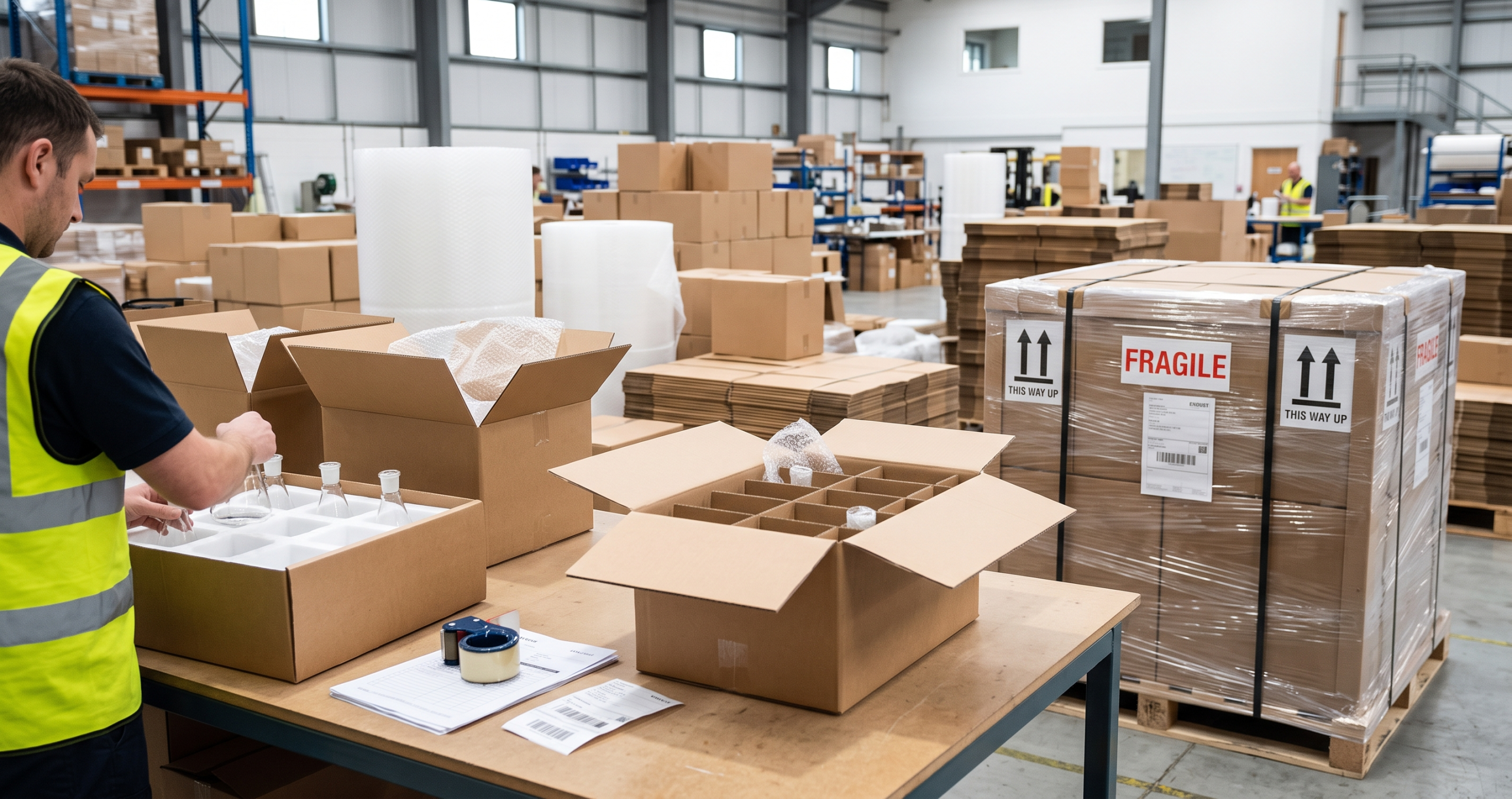
Laboratory glassware export packaging is the last line of defense between a certified product and a broken shipment. A flask can pass every inspection in the factory and still arrive as shards if the carton is weak, the pallet is unstable or the container is loaded carelessly. Breakage is the most common physical complaint in international glassware trade, and most of it is preventable.
This guide explains eight methods that reduce breakage in international shipments, from the first layer of protection around each piece to the way pallets are loaded into containers. Each method is practical and testable, so buyers can write it into a purchase order. Strong laboratory glassware export packaging also lowers claims, saves freight on replacements and protects customer relationships.
Medilab Exports Consortium packs laboratory glassware for export to buyers in more than 35 countries from Ambala, India. The principles of laboratory glassware export packaging below are the ones we apply to our own shipments, and they are the points we suggest every importer verify with any supplier.
Why Laboratory Glassware Export Packaging Needs Its Own Specification
Export packaging faces forces that domestic delivery does not. A carton may be handled many times, lifted by forklift, stacked beneath other cargo, vibrated for days on a truck, rocked on a ship and dropped during transfer. The route from an Indian factory to a US distribution center or a Chinese warehouse typically involves road, port handling, ocean freight and inland delivery.
Glass is strong in compression and weak in tension and impact. A rim that taps a neighbor, a flask that shifts in its carton or a carton that crushes under stacking can all start a fracture. Each failure is cheap to prevent and expensive to repair.
For these reasons, laboratory glassware export packaging deserves a written specification, not an assumption. The specification should cover materials, carton strength, pallet design, wood treatment, marking and testing. When both buyer and supplier sign the same packing specification, disputes about damage become simple to resolve.
1. Individual Protection: Cells, Sleeves and Foam
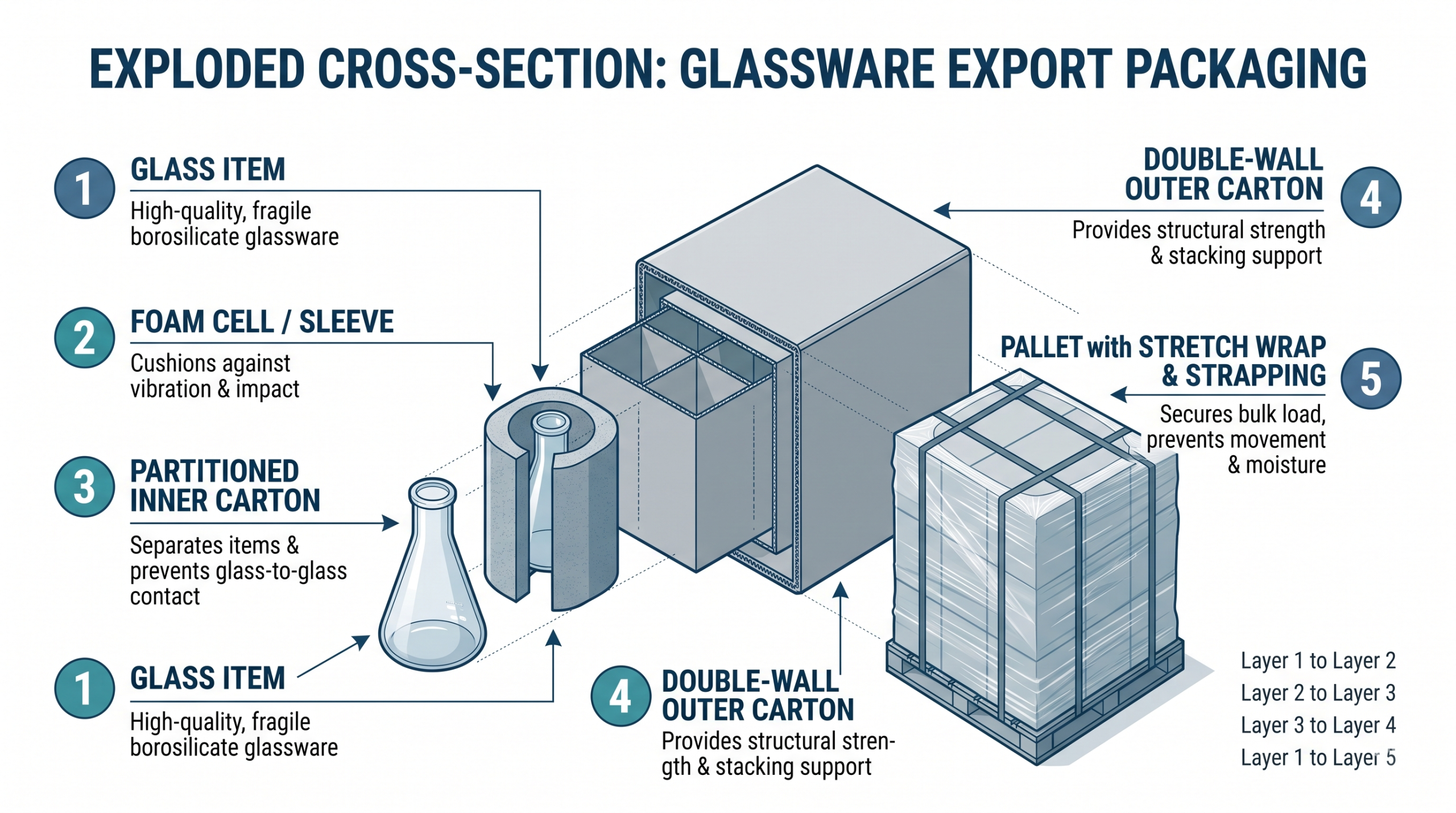
Protection starts at the level of the single item. Each piece should be separated from its neighbors by a cell, a sleeve or a molded foam insert, so that glass never touches glass. Polyethylene foam sleeves and partitioned cells are common choices because they absorb shock and are clean and light.
Different shapes need different protection. Round-bottom flasks need support that holds the body without pressing on the neck. Burettes and pipettes need long, rigid sleeves or tubes to prevent bending.
Condensers with side arms need cutouts that hold the arms. The best laboratory glassware export packaging is designed around the item, not around a generic box.
Check the fit when you evaluate samples. An item that rattles inside its cell will move during transit, and an item that is jammed too tightly can be stressed. A snug fit with soft contact is the target.
2. Partitioned Inner Cartons
Inner cartons organize items into protected groups. Cardboard partitions form a grid that keeps pieces apart, holds them upright and spreads load across the carton. For heavier items, double-thickness partitions or additional dividers prevent sagging.
Inner cartons also limit the damage if a failure does occur. A broken piece in a partitioned carton is likely to affect only its own cell, whereas a break in an unpartitioned carton can chip or crack every neighbor. Smaller inner cartons are generally safer than a single large one, because less weight rests on any single layer.
Match the carton configuration to the product family. Tall items such as burettes and cylinders ride best in vertical partitions, while low items such as beakers and Petri dishes can be nested in stacks with separators. Using the right layout for each family reduces both breakage and wasted space.
Mark each inner carton with product code, quantity and lot number. Good labeling at this level speeds receiving and lets the buyer check contents without opening every outer carton, which reduces handling risk for laboratory glassware export packaging on arrival.
3. Outer Carton Strength
The outer carton carries the stacking load and takes the knocks. Double-wall corrugated board is the usual choice for heavy glassware, with higher edge crush strength than single wall. Check the board grade, the carton dimensions and the weight rating, and keep the contents within the stated limit.
Carton size should match the contents. An oversized carton leaves room for movement, and an undersized one bulges and weakens. Good practice leaves a defined cushion space on every side and fills it with cushioning material so that nothing can shift.
Weight limits protect people as well as glass. A carton that is too heavy is dropped, tilted or handled roughly, which raises the risk for laboratory glassware export packaging of every kind. Keep carton weight within a range that one or two handlers can manage, and mark the gross weight on the outside.
Seal and strap cartons properly. Use quality tape across the seams and, for heavy cartons, strapping to add rigidity. Our guide to laboratory glassware breakage explains how the forces that break glassware in the laboratory also act inside a poorly packed carton.
4. Void Fill and the No-Movement Rule
The golden rule of fragile packing is that nothing moves inside the carton. Even a small gap lets an item accelerate during an impact, and the force on the glass grows with the distance it travels before it stops. Void fill removes that distance.
Common void fill materials include corrugated inserts, molded pulp, foam sheets and paper. Choose materials that stay in place and do not compress permanently. Loose fill that settles during vibration can leave an empty space at the top of the carton by the time it reaches the destination, which is why rigid inserts often outperform loose fill in laboratory glassware export packaging.
Test the rule with a simple shake test. Close a sample carton, shake it gently and listen. Any rattle or shift shows that the packing needs work, and the fix at this stage costs a few cents rather than a full replacement shipment.
5. Palletizing, Stretch Wrap and Strapping
Pallets turn many cartons into one load that can be moved by forklift. A stable pallet stacks cartons in an interlocking pattern, keeps them within the pallet footprint and uses corner boards to protect edges. The load is then secured with stretch wrap and strapping so that it behaves as a single unit.
Weight distribution matters. Heavy cartons belong at the bottom and lighter ones on top, and the height should stay within the stability limits of the pallet and container. Overhanging cartons crush at the edges and are exposed to damage from forklifts.
Add protective top caps and fragile labels. For export loads, many shippers also use anti-slip sheets between layers to reduce sliding. A well-built pallet is the foundation of laboratory glassware export packaging, because it governs how the carton group responds to every lift, turn and brake.
6. Wood Packaging Compliance: ISPM 15
Wooden pallets and crates must meet international rules. ISPM 15, the International Standard for Phytosanitary Measures, requires solid wood packaging used in international trade to be heat treated or fumigated and marked with an approved stamp. Customs authorities in many countries, including the United States and China, can reject, treat or destroy cargo with non-compliant wood.
Check that pallets and crates carry the mark and that the treatment is genuine. A shipment delayed at the port for wood compliance can lose days or weeks, and the resulting storage and treatment costs often exceed the value of the packaging. Plywood and some engineered wood products are generally exempt, though rules can change, so confirm with your forwarder.
Some exporters switch to plastic or composite pallets to avoid the issue. That is a valid choice if strength and cost fit your route. In every case, wood compliance is a compulsory element of laboratory glassware export packaging, not an optional extra.
7. Container Loading, Bracing and Moisture Control
The container is the final environment. Loads should be placed to distribute weight evenly, with no gaps that allow movement. Dunnage, airbags or bracing fill the spaces between pallets and the container walls, preventing shifts during acceleration and braking at sea and on land.
Moisture is a hidden risk. Containers can experience condensation as temperature changes, which can soften cartons and weaken stacking strength. Desiccants, liner bags and sealed wrapping can reduce the risk, particularly for long sea routes or humid destinations. Check the container for cleanliness and structural condition before loading.
Choose the shipping mode with risk in mind. Full container loads are handled less than less-than-container loads, which are consolidated and deconsolidated at ports. Air freight is faster and gentler in handling but more costly. Whatever the mode, state it in the packing specification, since laboratory glassware export packaging designed for a full container may not suit a consolidated shipment.
8. Marking, Handling Symbols and Documentation
Marking tells handlers what is inside and how to treat it. Use clear, durable labels with handling symbols such as fragile, this way up and keep dry, following common pictorial marking practice such as that in ISO 780. Place labels on more than one side of each carton and on the pallet, so that they are visible from any direction.
Include shipping marks that match the documents: consignee, destination, carton number, gross weight and lot reference. Matching marks speed customs clearance and receiving, and they help trace a damaged carton to a specific production lot.
Record the packing condition before dispatch. Photographs of cartons, pallets and loaded containers provide evidence if a claim is needed, and they help the supplier improve. Good records turn laboratory glassware export packaging from an opinion into a documented process.
Six Packing Mistakes That Cause Breakage
Breakage claims tend to come from the same short list of mistakes. Recognizing them lets buyers and suppliers correct them before an order ships, and the list below works well as a checklist during sample approval of laboratory glassware export packaging.
- Using single-wall cartons for heavy glassware that will be stacked
- Leaving gaps in the carton so that items can move
- Packing mixed heavy and light items in one carton without dividers
- Building pallets that overhang or lean, which crushes the bottom layer
- Ignoring wood treatment rules until the container is at the port
- Skipping marking, so handlers do not know the cargo is fragile
Another common error is changing packaging to save cost without testing the result. A cheaper carton or thinner foam can look equivalent on paper and fail in transit. Any change should be treated as a new design and checked with a shake test, a drop test and a pallet stability check before it is approved.
Cost pressure deserves a straight answer. Packaging is typically a small part of the landed cost of glassware, while breakage costs the product, the freight to replace it, the buyer’s time and sometimes the customer. Spending slightly more on protection is almost always cheaper than absorbing even a modest breakage rate.
Testing Packaging Before You Ship at Scale
Testing replaces guesswork with data. Organizations such as ISTA publish transit test procedures that simulate vibration, compression, drops and shocks, and ASTM D4169 provides a practice for performance testing of shipping containers and systems. A package that passes an appropriate test has a much lower chance of failing in the field.
Not every shipment needs formal testing. A simple program can combine drop tests from a defined height, a compression test on a stacked carton and a vibration check on a sample pallet. The key is to test the final packaging, with real glassware or representative dummies, and to document the results.
Re-test when something changes, such as a new carton supplier, a different pallet pattern or a new product shape. A packaging design that worked for flasks may not suit tall burettes. Ongoing testing keeps laboratory glassware export packaging aligned with the products and routes you actually ship.
Packaging Layers at a Glance
The table below summarizes the layers of laboratory glassware export packaging, their purpose and the checks a buyer can make on samples or on arrival. Use it as a basis for the packing clause of a purchase order.
| Layer | Typical materials | Purpose | What to check |
|---|---|---|---|
| Individual protection | Foam sleeves, cells, molded inserts | Separate items and absorb shock | Snug fit, no glass-to-glass contact |
| Inner carton | Corrugated cartons with partitions | Group and organize items | Intact partitions, correct counts |
| Outer carton | Double-wall corrugated board | Carry stacking load | Board grade, weight rating, seal |
| Void fill | Inserts, pulp, foam, paper | Remove empty space | No rattle in the shake test |
| Pallet | Treated wood or plastic, corner boards | Unitize the load | ISPM 15 mark, stable stacking |
| Wrap and strapping | Stretch wrap, straps, top cap | Hold the load together | Tight wrap, no loose cartons |
| Marking | Handling symbols, shipping marks | Guide handlers and customs | Visible on several sides |
| Container | Dunnage, airbags, desiccant | Prevent movement and moisture | No gaps, dry and clean interior |
Insurance, Inspection on Arrival and Claims
Even the best packaging cannot remove all risk, so insurance and process matter. Under the CIF Incoterm, the seller must buy only minimum marine cover, which may not suit fragile goods. Buyers shipping glassware should consider broader cargo insurance and confirm exactly what it covers, including breakage and handling damage. The ICC Incoterms rules explain how risk and insurance responsibility are divided.
On arrival, inspect before signing. Note any visible damage on the delivery receipt, photograph cartons and pallets from several angles and open a sample of cartons promptly. Prompt notice is often a condition of insurance and carrier liability, and delay can weaken a claim.
Share the findings with your supplier with photographs and carton numbers. A supplier committed to laboratory glassware export packaging quality will use the information to improve the next shipment, and a clear record makes it easy to agree replacement or compensation.
How to Specify Packaging in Your Purchase Order
Write the packaging requirements into the purchase order so that they are part of the contract. Specify the inner packing for each product family, the outer carton grade, the maximum carton weight, the pallet type and size, the wood compliance requirement, the marking and the documents. Refer to samples you have approved, and keep a reference photograph.
Pair the packing specification with the quality plan. Our guide to laboratory glassware quality checks covers the pre-shipment inspections that verify counts, labels and documents, and our article on how to evaluate a lab supplier remotely explains how to verify packing practices when you cannot visit the factory.
Finally, agree on how breakage will be handled. Define an acceptable breakage allowance, the evidence required for a claim and the remedy, whether replacement, credit or reshipment. Clear terms agreed in advance make laboratory glassware export packaging a shared responsibility rather than a source of conflict.
Frequently Asked Questions
Use individual cells or sleeves for each piece, partitioned inner cartons, double-wall outer cartons, firm void fill, a stable palletized load and clear handling marks. Together these form effective laboratory glassware export packaging that prevents glass touching glass and stops movement in transit.
There is no universal figure. Many buyers agree a small allowance in the contract, such as a low percentage of pieces, and require evidence for claims above it. Strong laboratory glassware export packaging keeps real breakage well below the allowance.
Yes. Solid wood packaging in international trade must comply with ISPM 15, which requires heat treatment or fumigation and an approved mark. Non-compliant pallets can be rejected or treated at the port, causing delay and cost. Confirm compliance with your supplier.
Air freight involves less handling and shorter transit but costs more. Sea freight in a full container is generally safe when the load is braced properly, while consolidated shipments involve more handling. Match laboratory glassware export packaging to the mode you choose.
Note the damage on the delivery receipt before signing, photograph cartons and pallets, and open a sample promptly. Notify the carrier, insurer and supplier within the required time. Provide carton numbers and clear images to speed resolution.
Yes. You can run drop, compression and vibration tests on sample cartons, or follow procedures from organizations such as ISTA and ASTM. Testing the final design is the most reliable way to validate laboratory glassware export packaging before volume shipments.
Yes. Medilab Exports Consortium packs glassware with cells, partitioned cartons and palletized loads, and can adapt packing to your route and mode. Share your destination, volume and shipping method and we will propose laboratory glassware export packaging to match.
Plan Laboratory Glassware Export Packaging With Your Supplier
Medilab Exports Consortium packs laboratory glassware for export in cells, partitioned cartons and palletized loads. Send us your destination and shipping mode and we will recommend laboratory glassware export packaging that fits your route and risk.
