
Laboratory glassware – sourcing ISO-certified, ASTM-compliant borosilicate labware for American research facilities – is one of the most critical procurement decisions for US lab managers. Choosing the right glassware directly affects experiment accuracy, regulatory compliance, and lab safety.
Laboratory glassware is the backbone of scientific research across the United States. From measuring a precise 10 mL of reagent in a university lab to distilling complex organic compounds in a pharmaceutical facility, the right glassware determines whether your experiment yields reliable, reproducible results or ends in failure.
Whether you manage a university research lab, a pharmaceutical QC facility, or an industrial analytical laboratory in the US, understanding the full landscape of laboratory glassware helps you make better purchasing decisions, maintain compliance with ASTM and ISO standards, and optimize lab performance.
This complete guide covers everything from glassware types and materials to selection criteria, care protocols, and quality certifications – written by the team at Medilab Exports Consortium, a manufacturer with over 30 years of experience supplying precision labware to distributors across the US and 13+ countries worldwide.
What Is Laboratory Glassware?
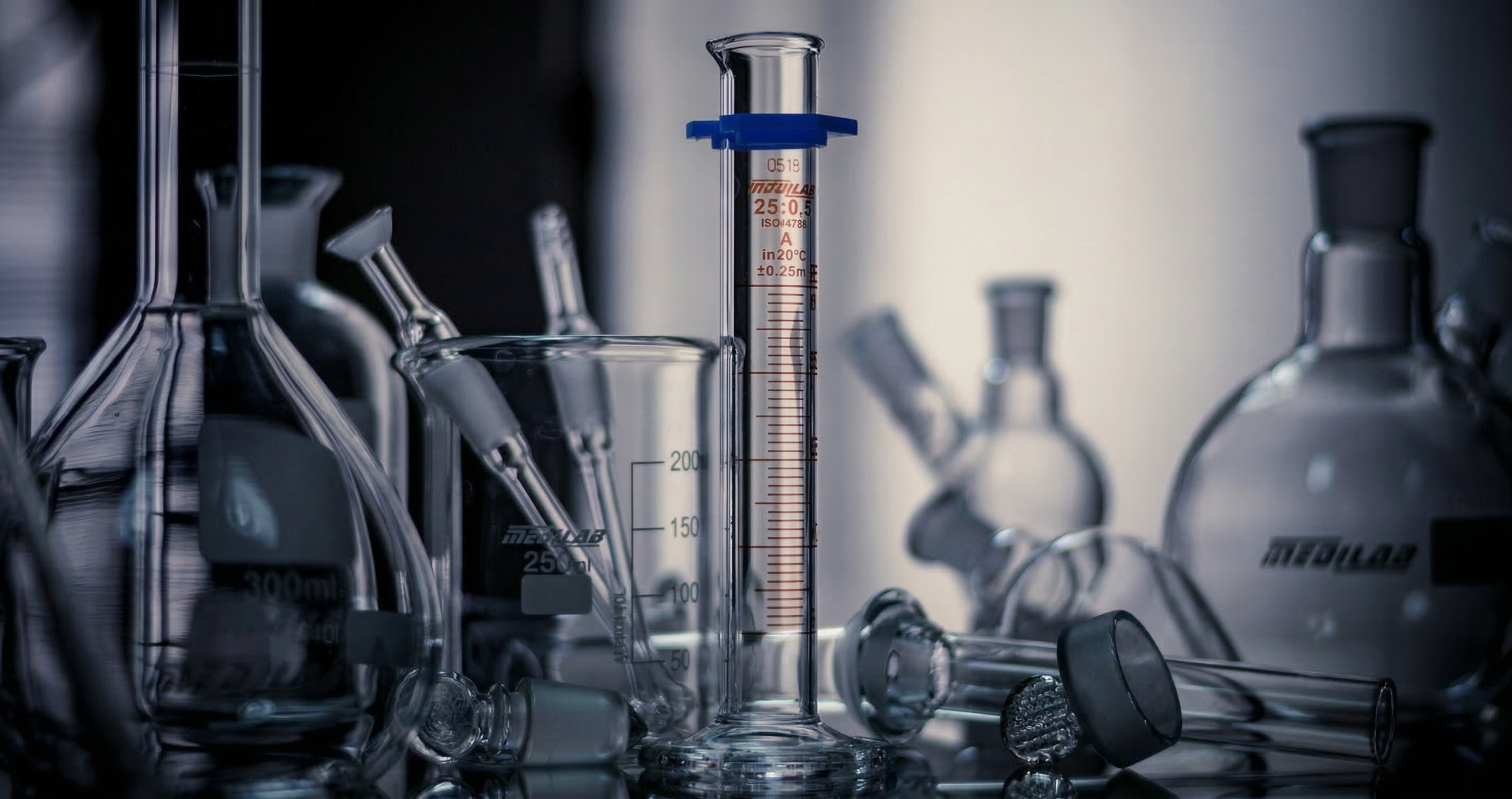
Laboratory glassware refers to equipment made from glass used in scientific experimentation, analysis, and research. It encompasses a wide range of items – from simple beakers and test tubes to precision volumetric flasks and complex distillation assemblies.
Unlike ordinary household glass, laboratory glassware is manufactured from specialized glass formulations – primarily borosilicate glass – engineered to withstand chemical exposure, extreme temperatures, and sterilization processes while maintaining dimensional accuracy. In the United States, labware must also meet strict ASTM International standards alongside globally recognized ISO certifications.
Why Glassware Remains Essential in US Labs
Despite advances in plasticware and automated liquid handling, glass remains indispensable in American research labs for several important reasons. First, it offers superior chemical inertness. Second, it provides unmatched optical clarity. Third, it delivers exceptional thermal stability. Fourth and most importantly, it achieves Class A volumetric tolerances that plastics simply cannot match.
For any application requiring high-accuracy measurements or exposure to harsh chemicals – standard in FDA-regulated pharmaceutical labs, EPA-certified environmental labs, and NIH-funded research facilities – borosilicate laboratory glassware remains the material of choice.
7 Major Types of Laboratory Glassware
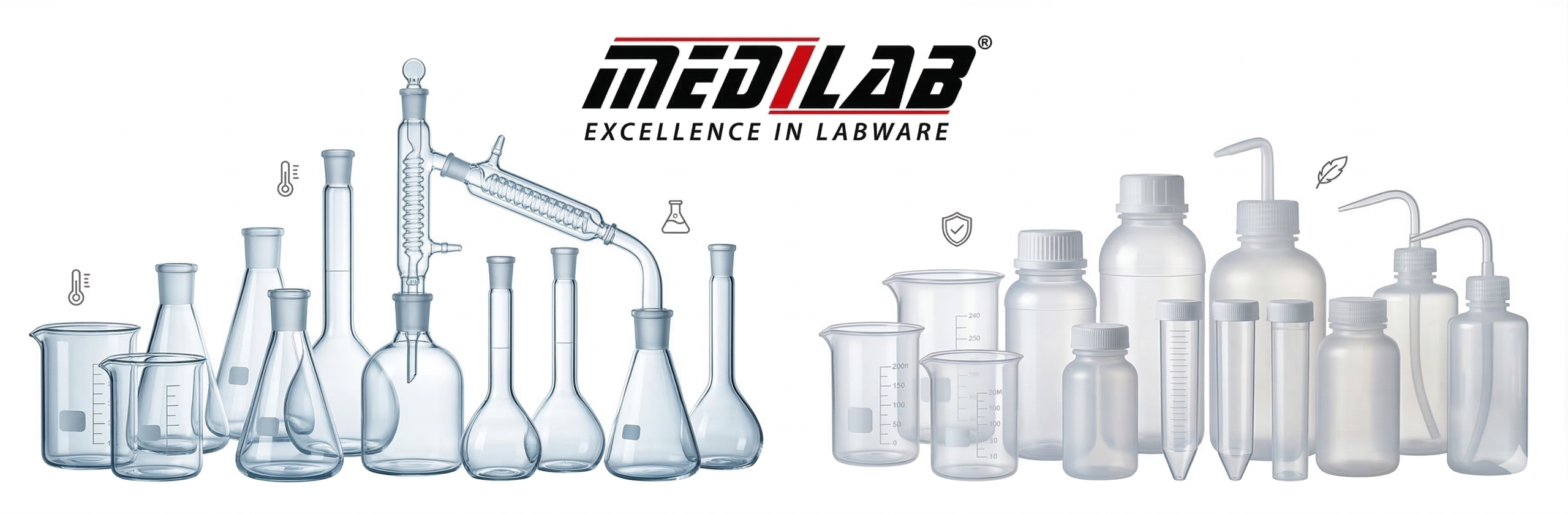
Laboratory glassware falls into three broad functional categories, each serving distinct scientific purposes. To summarize, these cover volumetric, general-purpose, and specialized apparatus. Browse our full range of laboratory glassware products to find the right fit for your US lab.
1. Volumetric Glassware
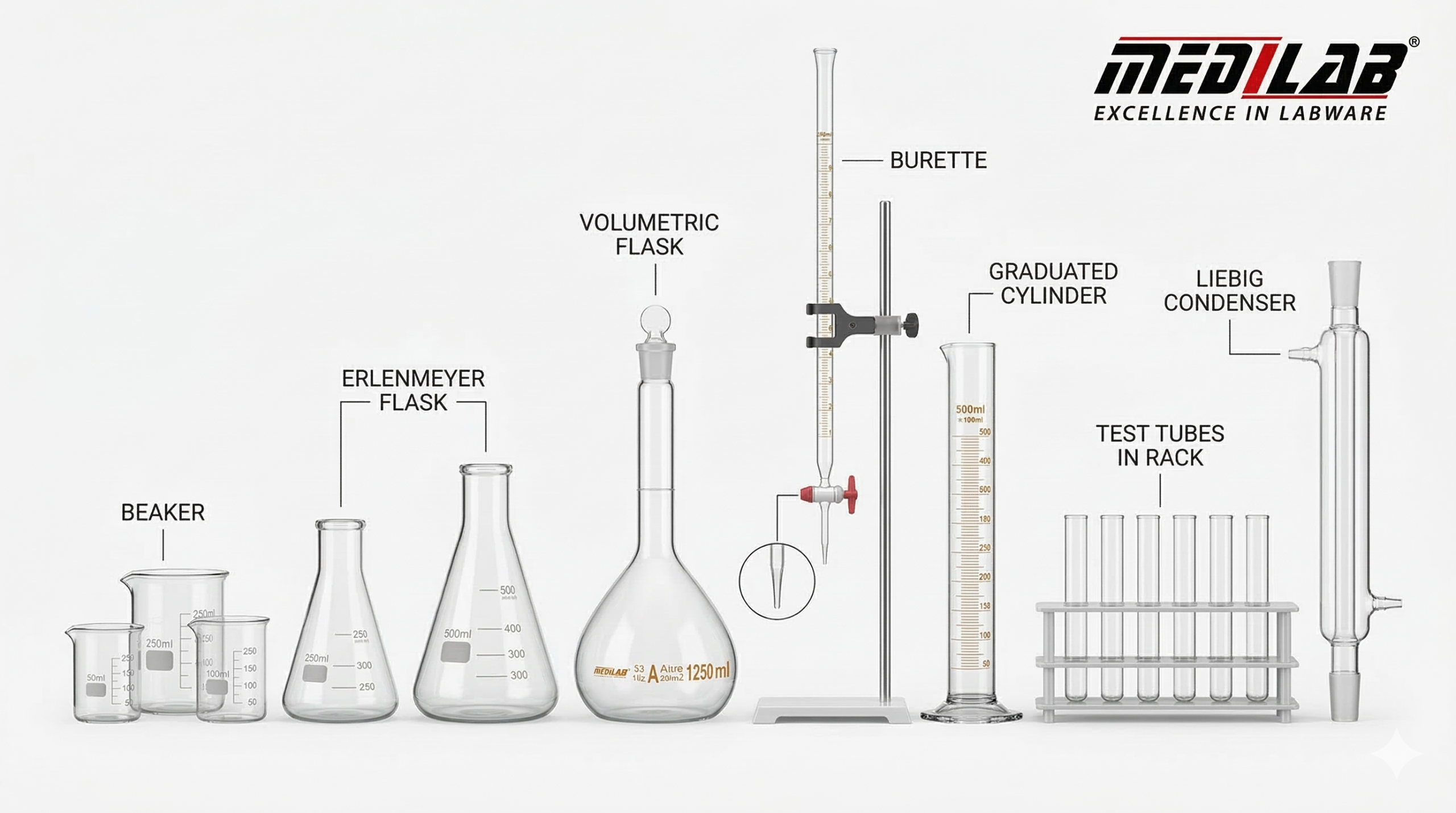
Designed to measure or contain precise, fixed volumes of liquid. Every item in this category is calibrated to an exact volume at 20 degrees C and marked accordingly. Key examples include volumetric flasks, volumetric pipettes, burettes, and one-mark measuring flasks. These are essential in any ASTM-compliant or ISO-compliant analytical workflow.
2. General Purpose Glassware
Used for mixing, heating, containing, and transferring liquids without needing high-precision measurement. This includes beakers (low form), beakers (tall form), Erlenmeyer flasks, round-bottom flasks, test tubes, watch glasses, and graduated cylinders.
3. Specialized Apparatus
Designed for specific scientific procedures. For instance, condensers (Liebig, Graham, Allihn) are used for distillation; Soxhlet extractors for solid-liquid extraction; Kjeldahl flasks for nitrogen analysis; Buchner funnels for vacuum filtration; and distillation flasks for separation processes widely used in organic chemistry and pharmaceutical labs across the US.
| Glassware Type | Primary Use | Common Sizes | Accuracy Class |
|---|---|---|---|
| Volumetric Flask | Preparing standard solutions | 10-2000 mL | Class A / Class B |
| Beaker | Mixing, heating, general use | 5-5000 mL | N/A (approximate) |
| Erlenmeyer Flask | Titration, culture media | 25-5000 mL | N/A |
| Burette | Titration (dispensing) | 10-100 mL | Class A / Class B |
| Graduated Cylinder | Approximate volume measurement | 5-2000 mL | Class A / Class B |
| Volumetric Pipette | Accurate liquid transfer | 1-100 mL | Class A / Class B |
| Condenser | Distillation, reflux | 200-600 mm | N/A |
| Test Tube | Small-scale reactions, culture | 10×75 to 25×200 mm | N/A |
Materials Used in Laboratory Glassware
The glass composition directly determines a piece of laboratory glassware performance – its thermal resistance, chemical durability, and optical properties. Understanding these materials is especially important when sourcing laboratory glassware for labs operating under FDA, USP, or EPA regulatory frameworks.
Borosilicate Glass (Type I – The Industry Standard)
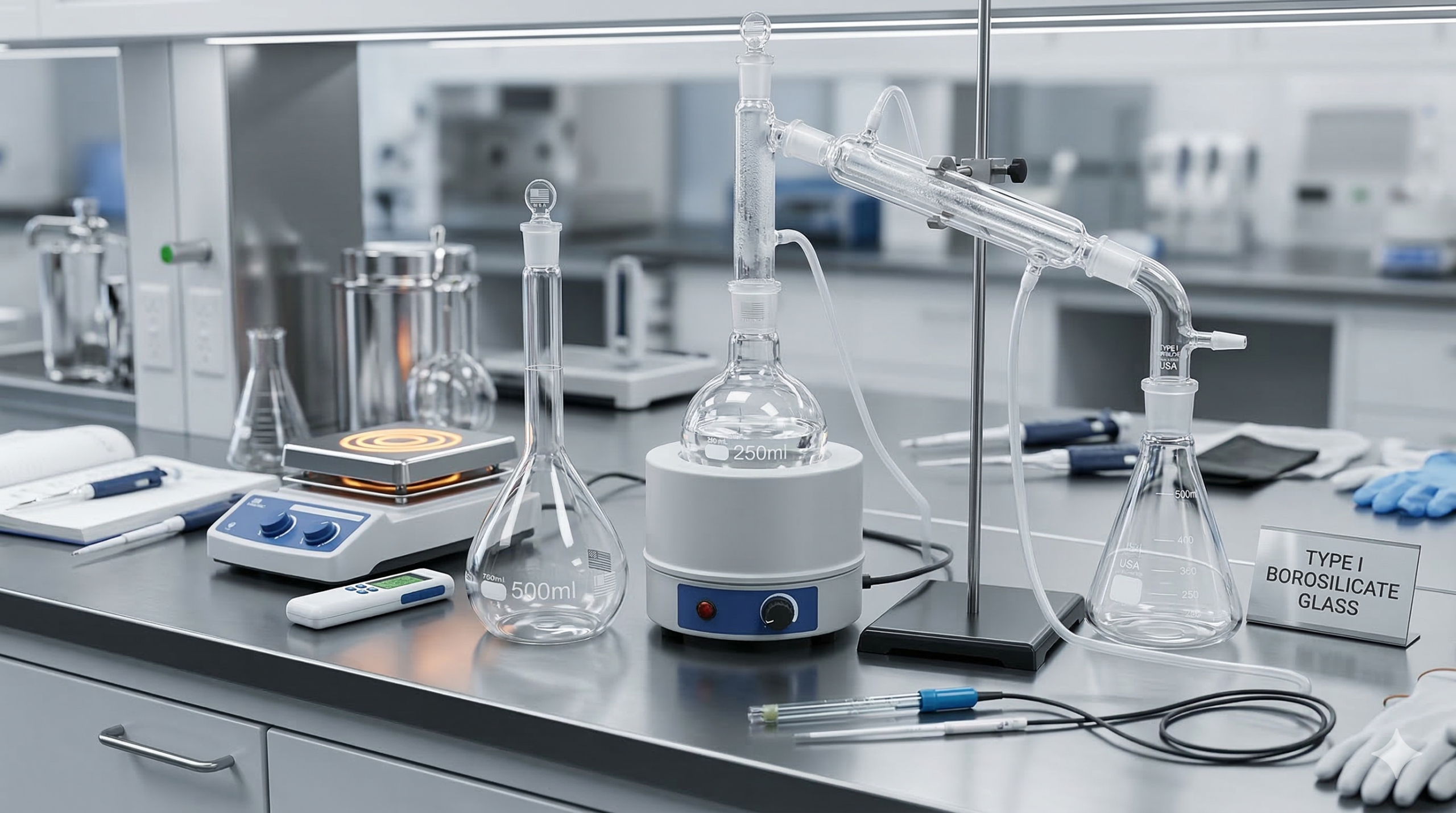
Composed of silica (SiO2) and boric oxide (B2O3, typically 12-15%), borosilicate glass offers a low coefficient of thermal expansion (3.3 x 10⁻⁶/K for Borosilicate 3.3), excellent chemical resistance, and high hydrolytic resistance (Hydrolytic Class 1 per ISO 719). It is therefore the material of choice for virtually all precision laboratory glassware used in US research, pharmaceutical, and environmental testing labs.
All Medilab Exports laboratory glassware is manufactured from premium borosilicate 3.3 glass, fully compliant with both ISO and ASTM standards.
Soda-Lime Glass (Type III)
The most common glass in everyday applications, soda-lime glass has a higher thermal expansion coefficient and lower chemical resistance than borosilicate. It is used for certain basic lab supplies (disposable culture tubes, some reagent bottles) where high thermal or chemical resistance is not critical. Notably, it is not recommended for regulated US laboratory environments.
Quartz (Fused Silica) Glass
Offering extreme temperature resistance (up to 1000 degrees C) and UV transparency, quartz glass is used in specialized applications: UV spectrophotometry cuvettes, high-temperature furnace tubes, and semiconductor research. It is significantly more expensive than borosilicate and is commonly found in advanced US research institutions and semiconductor fabrication labs.
Amber (Actinic) Glass
Brown-tinted borosilicate glass that blocks UV and visible light wavelengths, protecting light-sensitive reagents and samples from photodegradation. Widely used in US pharmaceutical labs for amber reagent bottles and storage containers in USP-compliant workflows.
Key Fact: Borosilicate glass 3.3 is classified as Hydrolytic Class 1 (HGB 1) per ISO 719 – the highest chemical resistance rating for commercial glass. This means minimal ion leaching into your samples, which is critical for trace analysis and pharmaceutical applications regulated by the FDA and USP.
Glassware by Lab Application in the United States
Different laboratory disciplines have distinct glassware requirements based on their specific procedures and accuracy demands. Here is how US labs typically source and specify their laboratory glassware:
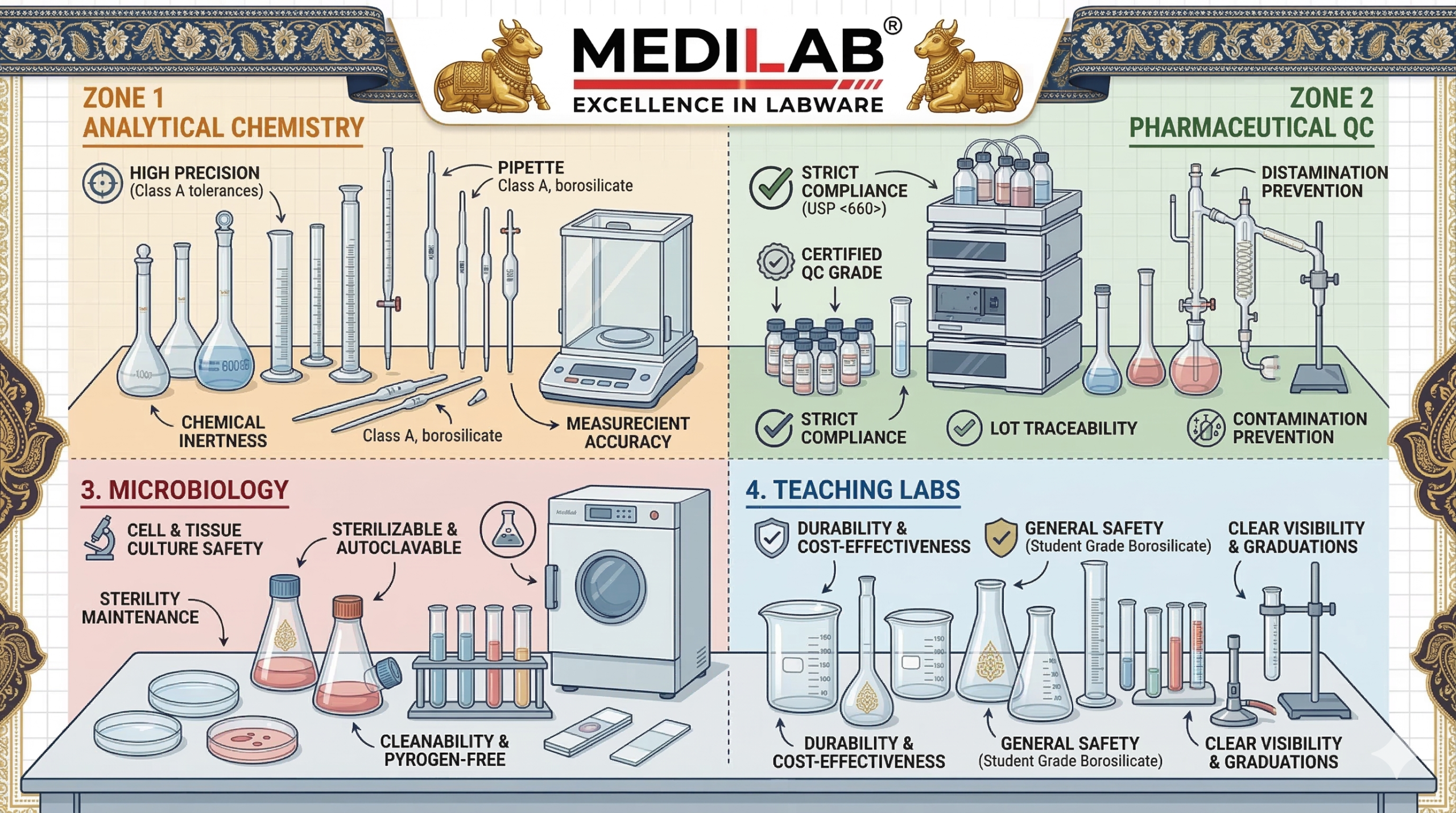
Analytical Chemistry Labs
Require Class A volumetric glassware for the highest accuracy: Class A volumetric flasks, burettes, and pipettes. Borosilicate glass is mandatory. Standards governing US analytical labs include ASTM E288 (volumetric flasks) and ASTM E287 (burettes), alongside ISO 1042, ISO 385, and ISO 648/4788.
Pharmaceutical / QC Labs
Subject to FDA regulatory oversight and USP (United States Pharmacopeia) standards. Require certified Class A glassware with full traceability documentation. Amber glassware is required for UV-sensitive assays. Calibration certificates are mandatory for FDA audit compliance.
Biology and Microbiology Labs – laboratory glassware Requirements
Heavy use of culture tubes, Petri dishes, Erlenmeyer flasks (including baffled culture flasks), and reagent bottles. Emphasis on autoclavability and sterility – critical for BSL-certified labs in the US. Wide-mouth bottles for media preparation are standard.
Teaching and Educational Labs
Class B glassware is generally acceptable for educational purposes in US colleges and high schools where teaching technique is the goal rather than research-grade accuracy. It is more economical, though still manufactured from borosilicate for safety compliance with OSHA lab safety standards.
How to Choose Quality Laboratory Glassware
Selecting the right laboratory glassware involves evaluating multiple factors beyond just price. For US lab managers and procurement officers, here is a proven framework to guide your decision.
Certifications to Look For
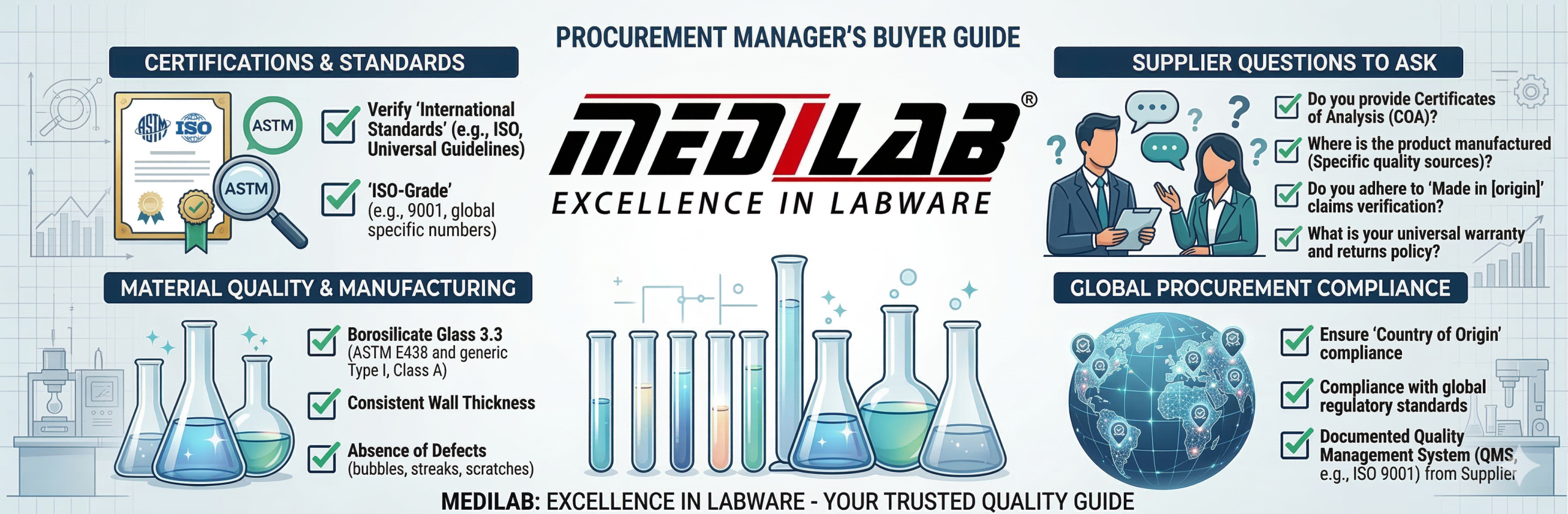
Quality glassware for US laboratories should comply with internationally recognized standards. For North American markets, look specifically for ASTM E288 (volumetric flasks) and ASTM E287 (burettes). Also look for ISO 1042 (volumetric flasks), ISO 4788 (graduated cylinders), ISO 385 (burettes), and ISO 648 (pipettes). The manufacturer should hold ISO 9001 certification for quality management systems. For pharmaceutical-grade labware, FDA-compliant documentation and USP Chapter 660 compliance are essential.
5 Key Questions to Ask Your Manufacturer
Before committing to a supplier for your US lab, ask these important questions:
- What glass type do you use – borosilicate 3.3 or soda-lime?
- Do your products carry ISO and ASTM certification?
- Can you provide calibration certificates and certificates of conformance?
- What is your QC sampling procedure and batch traceability?
- Do you offer Class A and Class B options, and what are your MOQ and lead times to the USA?
Medilab Exports is a trusted supplier to US distributors with dedicated export packaging, competitive bulk pricing, and full documentation for customs and regulatory compliance. Download our product catalog or request a free quote today.
Caring for Your Lab Glassware
Proper maintenance of your laboratory glassware extends glassware life, protects measurement accuracy, and ensures lab safety – all critical for maintaining OSHA compliance in US laboratory environments. Therefore, following these key practices is essential:
- Cleaning: Use lab-grade detergents (e.g., Extran, Decon 90) and a thorough rinse sequence ending with deionized water. Avoid abrasive materials that scratch glass surfaces. In regulated US labs, document your cleaning validation procedures.
- Drying: Air-dry volumetric glassware inverted on a rack – never heat it in an oven, as this can alter calibration volume. Non-volumetric glassware can be oven-dried at a maximum of 120 degrees C.
- Storage: Store glassware upright or inverted on dedicated racks. Never stack beakers directly inside each other without padding – this causes rim chips that can lead to safety incidents reportable under OSHA guidelines.
- Inspection: Before each use, inspect for chips, star cracks, and etched or faded graduation marks. Damaged glassware should be retired immediately and disposed of according to your institution’s glass waste disposal policy.
- Heating: Always heat borosilicate glassware gradually. Avoid placing hot glass on cold surfaces or adding cold liquids to very hot glassware – thermal shock is a leading cause of breakage in US teaching and research labs.
Frequently Asked Questions
Type I and Type II refer to the hydrolytic resistance classification of glass, not the shape of the glassware. Type I (borosilicate glass) has the highest chemical resistance – classified as Hydrolytic Class 1 per ISO 719 – meaning it releases minimal alkaline ions into solutions. Type II glass is surface-treated soda-lime glass with improved (but still inferior) hydrolytic resistance. For research, analytical, and pharmaceutical applications in the US – especially those governed by USP, FDA, or EPA standards – Type I borosilicate laboratory glassware is always preferred.
With proper care, high-quality borosilicate laboratory glassware can last many years – sometimes decades in research settings. The main factors that shorten glassware lifespan are physical damage (chips and cracks from drops or thermal shock), chemical etching (from HF, concentrated phosphoric acid, or strong alkalis over time), and worn or faded graduation markings that compromise measurement accuracy. Regular inspection and retirement of damaged pieces is more important than any fixed service life.
Borosilicate glass can withstand direct flame from a Bunsen burner, but with important caveats. Round-bottom flasks and test tubes are better suited for direct heat than flat-bottomed vessels. Always use a wire gauze on a tripod stand to distribute heat more evenly when heating beakers or Erlenmeyer flasks. Volumetric glassware (volumetric flasks, burettes, graduated cylinders) should NEVER be heated directly – it will alter their calibrated volumes permanently. This is especially important in US labs operating under ASTM or ISO volumetric tolerance standards.
For US laboratories, quality glassware should comply with ASTM standards: ASTM E288 (volumetric flasks) and ASTM E287 (burettes), alongside ISO standards – ISO 1042 for volumetric flasks, ISO 4788 for graduated cylinders, ISO 385 for burettes, and ISO 648 for volumetric pipettes. The manufacturer should hold ISO 9001 certification. For pharmaceutical applications under FDA oversight, certificates of conformance and USP Chapter 660 compliance documentation are also essential.
Medilab Exports Consortium is a leading ISO-certified manufacturer of borosilicate laboratory glassware supplying distributors across the US, UK, Germany, France, Italy, Australia, and more. With over 30 years of manufacturing experience, Medilab offers the full range of lab glassware – beakers, flasks, burettes, pipettes, graduated cylinders, and specialized apparatus – at competitive bulk pricing with OEM and private-label options for US distributors. Contact us at [email protected] or request a free catalog and quote.
Ready to Source Trusted Laboratory Glassware for Your US Lab?
Medilab Exports Consortium supplies ISO and ASTM-certified borosilicate lab glassware to distributors across the USA and 13+ countries. Request a quote today – no obligation.