

International laboratory glassware supply looks simple from a distance: choose a price, place an order, wait for a container. In practice, every step has failure points, and most of them are invisible until the shipment arrives. Late deliveries, mixed quality, missing certificates and broken cartons all trace back to supplier choices made months earlier.
This guide sets out nine criteria for choosing a manufacturer for international laboratory glassware supply. Each criterion includes the question to ask, the evidence to request and the common warning signs. The advice is written for importers and distributors in the USA and China, though it applies to any export market.
Medilab Exports Consortium is a 100 percent export-oriented manufacturer in Ambala, India, supplying laboratory glassware and related labware to more than 35 countries. We have written this article from the supplier side of international laboratory glassware supply, which means we know which questions importers should ask and which answers should worry them.
Why International Laboratory Glassware Supply Needs a Structured Approach
The United States laboratory glassware market is estimated at about 3.2 billion dollars in 2025 and is growing at roughly 4.7 percent a year. Customs data compiled by the Observatory of Economic Complexity shows the country imported about 227 million dollars of laboratory glassware in 2025, with Germany, Mexico, Japan, China and Chinese Taipei as the leading origins. India is not yet in that top group, which signals both an opening and a need to prove reliability.
China sits at the other end of the supply chain. Industry reports put it at more than half of global borosilicate glass production capacity, and imports of premium borosilicate containers continue to rise with healthcare investment. For a Chinese buyer, international laboratory glassware supply is not about availability but about precision, documentation and consistency that local commodity production does not always provide.
In both markets, a structured supplier evaluation protects the importer. The nine criteria below can be turned into a scorecard that every candidate completes.
1. Direct Manufacturer or Trading Company
The first question in international laboratory glassware supply is who actually makes the glass. Trading companies and manufacturers can look identical on a website. The difference appears when a quality problem occurs, because a trader must ask someone else to investigate while a manufacturer can inspect its own production records.
Ask for the factory address, photographs or a video tour, and the names of the production departments. A genuine manufacturer can describe its melting, forming, annealing and inspection stages, and can name the skilled glassblowers who handle specialized work. Verify that the address on the quotation matches the address on the quality certificate.
A practical test is to ask a technical question that only a producer can answer, such as the annealing schedule for a given wall thickness or the tolerance on a ground joint. Traders tend to forward the question and return a general reply days later. Manufacturers answer quickly and specifically because the knowledge sits inside the plant.
Direct supply also shortens the chain. Fewer intermediaries mean lower prices, faster answers to technical questions and clearer accountability for every lot.
2. Certifications and Quality Documentation
Certification is the evidence that a supplier runs a controlled process. Look first for ISO 9001 quality management certification and confirm that the scope covers the products you are buying. Medilab Exports operates under an ISO 9001:2015 certified quality management system.
For measuring glassware, add calibration evidence. Batch certificates of conformance support routine Class A purchases, and accredited calibration supports item-level traceability where required. Our guide to laboratory glassware quality standards explains how ISO, ASTM and DIN requirements fit together.
Check the certificate numbers with the issuing bodies. A genuine certificate can be verified, and a supplier that is reluctant to share certificate numbers for international laboratory glassware supply is giving you useful information.
3. Product Range and Consolidation Ability
Importers rarely buy glassware alone. A typical laboratory distributor stocks glassware, plasticware, porcelain, instruments and teaching aids, and every additional supplier adds paperwork and freight. A manufacturer with a wide catalogue simplifies international laboratory glassware supply by allowing consolidation into fewer purchase orders and fewer shipments.
Medilab Exports lists about 3,000 products across eight categories: laboratory glassware, laboratory plasticware, general labware, microscopes and optical equipment, physics laboratory instruments, laboratory equipment, biology models and slides, and analytical instruments. Mixed orders from one source reduce freight cost per item and simplify customs entry.
When you assess range, ask which items are made in-house and which are sourced from partners. This tells you where quality control is direct and where it depends on another supplier, which is a legitimate trade-off if it is disclosed honestly.
4. Minimum Order Quantity and Order Structure
Minimum order quantity shapes how easily a distributor can start. A high threshold forces large stock positions before demand is proven, whereas a flexible threshold allows a pilot order. Our minimum order value is USD 1,500 on a free on board basis, which allows first orders to be set up without a full container.
Compare order structures, not just thresholds. Some suppliers allow mixed items within one order, while others require minimums per item. Ask about repeat order pricing, tender supply and OEM options, since these determine how your costs improve as volume grows.
Customization is the other lever. If you plan to sell under your own name, ask early whether the supplier accepts private label and OEM orders, what artwork and packaging lead times apply and whether branded orders carry a different minimum. Settling these points before the first order avoids a second round of qualification later.
Plan the container strategy early. Mixed less-than-container-load shipments suit trial orders, and full container loads suit established lines. A supplier that understands both can help you move from one to the other as sales grow in international laboratory glassware supply programs.
5. Export Documentation and HS Classification
Export paperwork decides whether cargo clears customs on time. The core set includes the commercial invoice, the packing list, the bill of lading or airway bill, and the certificate of origin where required. Quality documents such as batch certificates travel alongside, so that your receiving team can release the goods.
Laboratory glassware is classified under Harmonized System heading 7017, which covers laboratory, hygienic and pharmaceutical glassware, whether or not graduated or calibrated. Duty rates and any import requirements depend on the country, so agree the code with your customs broker before the order ships. Importers in the USA can find guidance on the CBP trade portal, and Chinese importers should confirm filing requirements with their customs agent and local authorities.
Marking rules also apply. US customs requires imported goods to show their country of origin, and your supplier should know how to mark glassware and cartons correctly. For ocean freight to the United States, the importer must also file security information with customs before loading, so confirm that your supplier can provide shipment details on time.
Request a sample set of documents before the first order. A supplier experienced in international laboratory glassware supply can show real examples, with confidential details removed, and explain each one.
6. Incoterms and Payment Terms
Incoterms define who pays for freight, who carries risk at each stage and where responsibility passes from seller to buyer. The most common terms for glassware are free on board, cost insurance and freight, and delivered at place. Each shifts risk differently, and for fragile goods the point at which risk transfers matters as much as the price.
The ICC Incoterms rules are the authoritative reference. Choose the term that matches your freight capability. An importer with a trusted forwarder often prefers free on board, while a first-time importer may prefer a delivered term.
Payment terms deserve equal attention. Telegraphic transfer with an advance is common for first orders, and letters of credit suit larger or tender-based orders. In international laboratory glassware supply, clear written terms prevent disputes about damaged goods, delays and partial shipments.
7. Export Packaging and Transit Protection
Glassware is fragile, and ocean freight is rough. Packaging quality is therefore a procurement criterion, not an afterthought. Ask how each product category is packed, which materials are used, and whether the outer carton and pallet are designed for stacking and handling.
Ask whether packing has been tested. Distribution test methods from ASTM and ISTA simulate vibration, compression and drop events, and a supplier that has validated its carton design can show the results. Even without formal testing, a supplier should be able to explain why each carton is built the way it is.
Look for individual cells or sleeves for each piece, partitioned inner cartons, double-wall outer cartons, strapping and clear handling marks. If cartons are palletized, ask how the pallet is wrapped and whether wooden pallets are treated to meet international phytosanitary rules for wood packaging.
Breakage claims are expensive and slow, so prevention is the right investment. Include packing specification and acceptable breakage terms in the purchase agreement for international laboratory glassware supply, and photograph cartons on arrival.
8. Communication, Time Zones and Responsiveness
Responsiveness predicts how a supplier behaves when something goes wrong. Test it before ordering. Send a technical question and note how long the reply takes, how complete it is and whether it comes from someone who understands the product.
Time zones matter in practice. India is about ten and a half to thirteen and a half hours ahead of the US mainland and two and a half hours behind China, so same-day exchanges are normal with Chinese partners and need planning with American ones. Agree a response window and a named contact.
Set expectations for escalation as well. Agree who handles commercial questions, who handles technical questions and who handles shipping, and how quickly each will respond. A clear contact structure turns a minor problem into a same-week fix.
English-language documentation is a quiet advantage of Indian suppliers. Specifications, certificates and correspondence are written in the language of most international standards, which reduces translation errors in international laboratory glassware supply documents.
9. Samples, Trial Orders and Reference Checks
Samples convert claims into evidence. Request a representative set including your most critical items, and test them against your own acceptance criteria for dimensions, markings, annealing and, for volumetric ware, capacity. Our guide to laboratory glassware sample evaluation provides a practical test plan.
After samples, run a trial order that is small enough to limit risk and large enough to reveal consistency. Watch lead time, packing quality, document accuracy and the match between sample and production. Consistency between the first and second shipment is the real quality signal.
Document everything you learn. Record sample test results, lead times, document accuracy and packing condition in a supplier file, so that the approval decision can be defended later and the next review starts from facts. Quality teams in regulated sectors will expect this file during their own audits.
Ask for references from customers in your region or sector, and contact them. A manufacturer confident in its international laboratory glassware supply performance will agree.
Regional Notes for the USA and China
The USA and China differ in how importers work, and a good supplier adapts to both. American buyers are often distributors serving pharmaceutical, university and hospital customers, so they need audit-ready documents, clear country-of-origin marking and predictable replenishment. Price matters, but a failed audit or stock-out costs more than a small unit price difference. Because tariff policy between the two countries has changed several times in recent years, check the current duty position with your broker before you fix a delivered price for international laboratory glassware supply to the United States.
Chinese buyers combine domestic production strength with demand for premium, calibrated and documented ware. They often value private label programs, consistent calibration and a supplier who can answer technical questions without delay. Communication through business messaging platforms such as WeChat is normal in China, so agree a primary channel early and keep written confirmations of any technical or commercial agreement.
In both markets, the safest path is a small, well-documented first order that tests the whole chain, from specification through customs clearance to the first receiving inspection.
Five Mistakes Importers Make
Experienced importers still repeat a handful of avoidable errors in international laboratory glassware supply. Most come from rushing the qualification stage because a price looks attractive.
- Choosing on price alone and ignoring the cost of breakage, rejected lots and delays
- Skipping samples because the supplier appears professional
- Failing to agree the standard, class and certificate type before production
- Leaving packaging out of the contract, then arguing about damage after arrival
- Depending on a single source for critical items with no second qualified supplier
Each of these has a cheap preventive step. Write the specification into the purchase order, test samples, define packing, and keep a second source on the approved list. The time spent before the first order is small compared with the cost of a rejected container.
A Supplier Scorecard for International Laboratory Glassware Supply
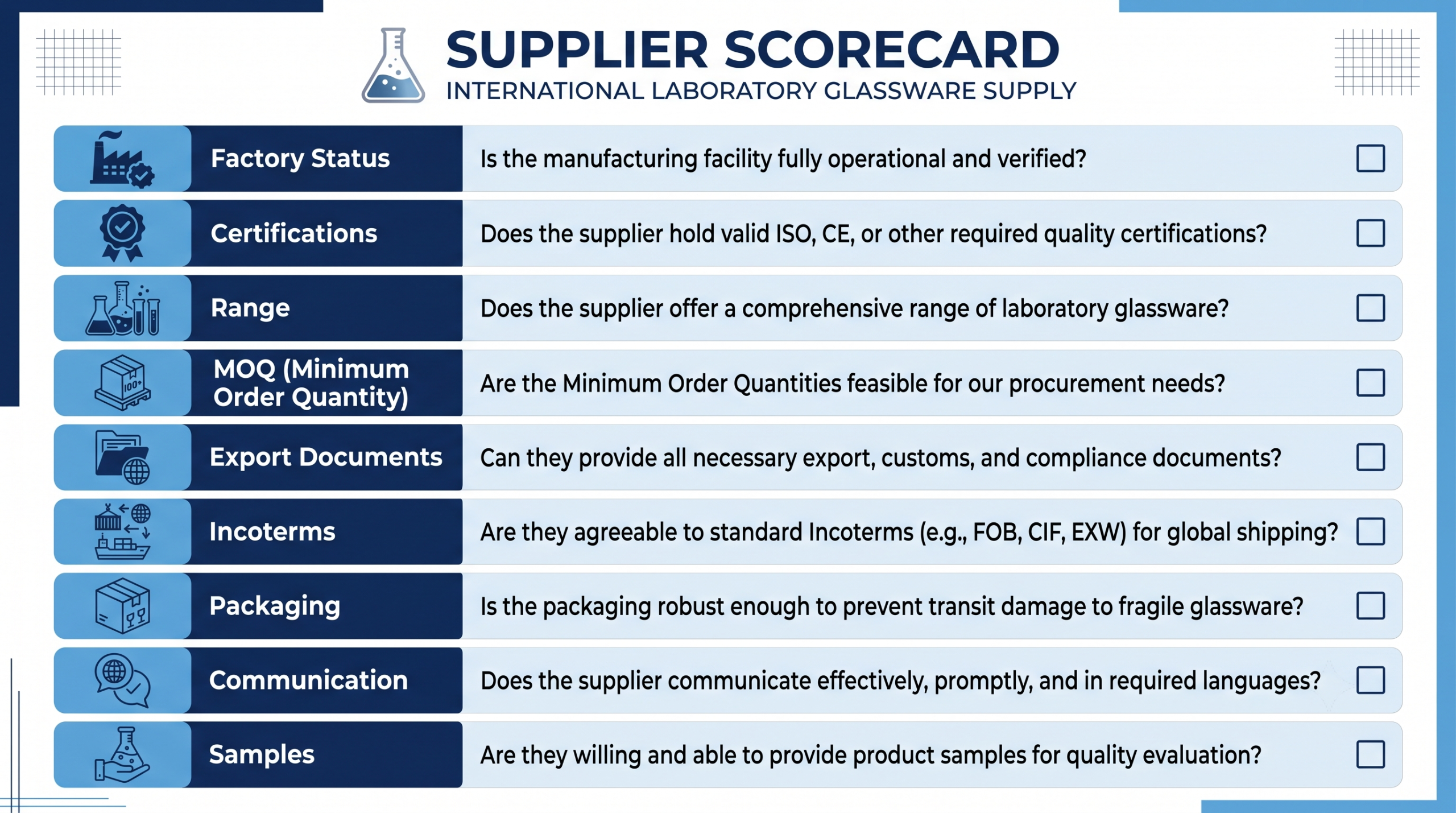
Combine the nine criteria into a single scorecard so that every candidate is judged the same way. The table below suggests the question, the evidence and the warning sign for each criterion in international laboratory glassware supply, which you can adapt to your own weighting.
| Criterion | Key question | Evidence to request | Warning sign |
|---|---|---|---|
| Direct manufacturer | Who makes the glass? | Factory address, video, production stages | Cannot name production departments |
| Certification | Is the quality system certified? | ISO 9001 certificate with number | Certificate scope does not match products |
| Range | Can orders be consolidated? | Catalogue by category | Range changes by the week |
| MOQ | What is the entry point? | Written MOQ and mixed order rules | Different MOQ in every message |
| Export documents | Are documents accurate? | Sample document set, HS code | Unable to quote the HS code |
| Incoterms | Who carries risk? | Written Incoterm and payment terms | Vague or shifting terms |
| Packaging | How is glass protected? | Packing specification, photographs | No packing specification |
| Communication | How fast and clear are answers? | Response time test | Slow or evasive replies |
| Samples | Do samples match production? | Sample test plan and results | Refuses samples or trial orders |
How to Start Your First International Laboratory Glassware Supply Order
Start with a shortlist of two or three manufacturers and send each the same request: product list, quantities, standards, packing requirements and target delivery date. Comparing like with like makes the scorecard meaningful. Our article on how to choose a laboratory glassware manufacturer gives a wider evaluation framework.
Next, run the sample and trial order process in sequence, and record the results against the scorecard. Use the findings to set the specification for your standing agreement, covering standards, certificates, packing, lead time and complaint handling. Review the supplier every year, and keep a second qualified source for critical items so that international laboratory glassware supply is never dependent on one factory.
Finally, plan for growth. Distributors that expand from stock items into private label and tender supply need a manufacturer able to follow them. Talk to us early about your plans so that we can match capacity, documentation and range to your market.
Frequently Asked Questions
Check the factory address, ISO 9001 certificate number and product scope, then request a video tour and a sample set. Test samples against your acceptance criteria. For international laboratory glassware supply, reference checks with existing customers in your region add useful confirmation.
It varies by supplier. Medilab Exports sets a minimum order value of USD 1,500 on a free on board basis, which suits trial and mixed orders. Ask any supplier for written MOQ rules before you start international laboratory glassware supply discussions.
Laboratory, hygienic and pharmaceutical glassware is classified under Harmonized System heading 7017. The exact tariff line and duty rate depend on the importing country. Confirm the classification with your customs broker before the first international laboratory glassware supply shipment.
There is no single answer. Free on board suits importers with a trusted forwarder, and delivered terms suit buyers who want the seller to manage transit. Whichever you choose, define packing and breakage terms in the contract, because Incoterms alone do not address them.
Lead time depends on stock, customization and shipping mode. Standard catalogue items are faster than OEM or custom items, and air freight is faster than sea freight. Agree a written lead time and review it after the trial order of international laboratory glassware supply.
Yes, where the manufacturer has a broad catalogue. Medilab Exports lists around 3,000 products across eight categories, which allows consolidated orders and fewer shipments. Confirm which items are made in-house and which are sourced.
Yes. Medilab Exports Consortium supplies distributors and institutions in more than 35 countries and supports importers with documentation, mixed orders and private label programs. Send your requirements to start international laboratory glassware supply with a quotation and samples.
Start Your International Laboratory Glassware Supply Program
Medilab Exports Consortium is a 100 percent export-oriented manufacturer serving more than 35 countries. For international laboratory glassware supply that is documented, consistent and priced directly from the factory, send us your product list and target markets.
