
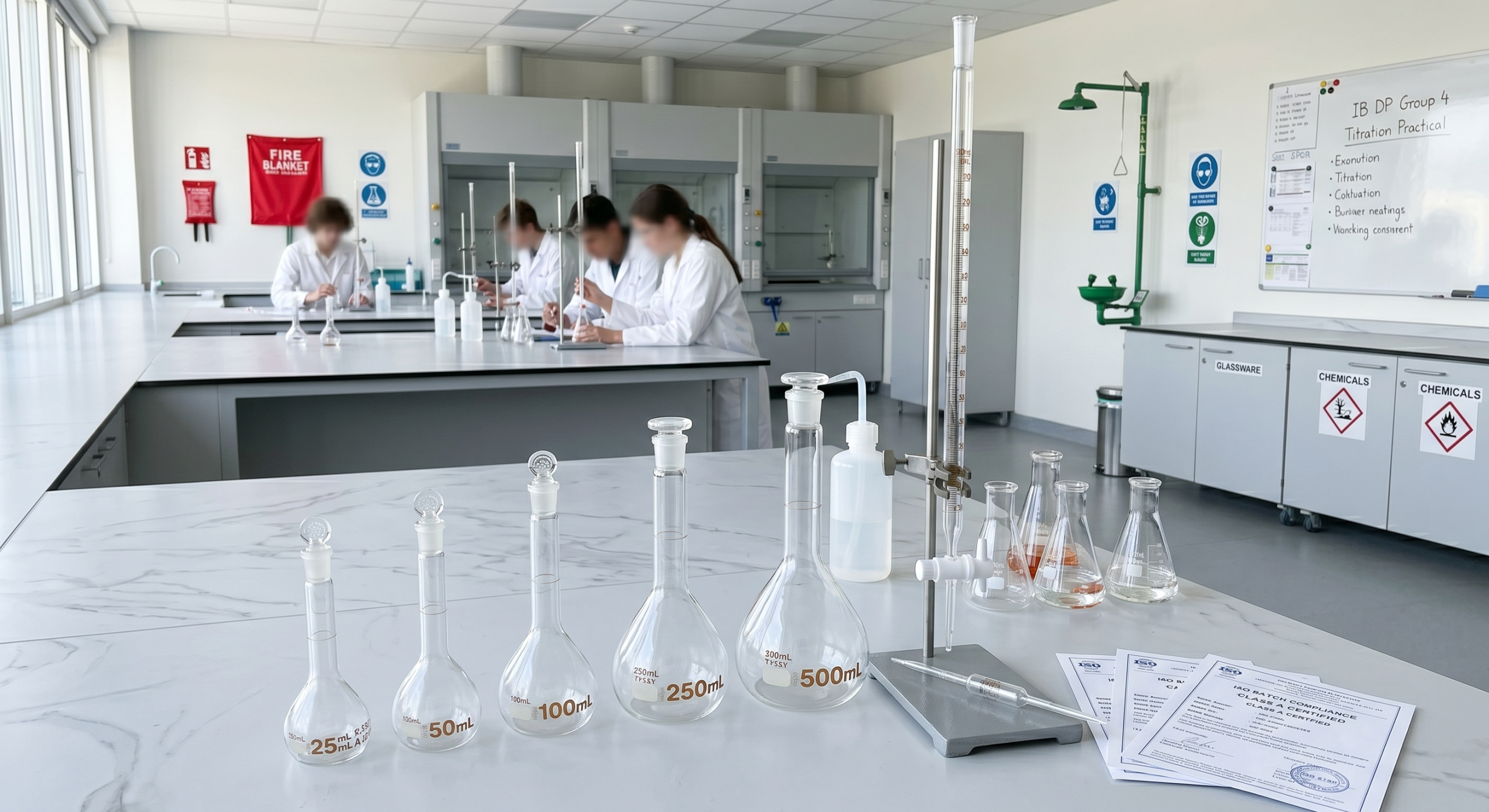
IB laboratory equipment requirements are defined by three major international curriculum frameworks – the International Baccalaureate Diploma Programme, Cambridge International AS and A Levels, and the College Board’s Advanced Placement program. Schools seeking or maintaining accreditation under these frameworks must demonstrate that their laboratory infrastructure supports the practical components embedded in each curriculum. Procurement managers and laboratory managers who understand what each framework specifies can build a compliant inventory from the outset rather than discovering gaps during an accreditation visit.
This guide covers what IB, Cambridge A-Level, and AP programs require from school laboratories – the specific glassware types, volumetric tolerances, safety infrastructure, and documentation practices that each framework’s practical assessment demands. It also covers how to evaluate suppliers of IB laboratory equipment and how to build an audit-ready procurement record that supports accreditation renewal across all three curricula.
Medilab Exports Consortium manufactures and exports ISO 9001-certified borosilicate 3.3 laboratory glassware to IB World Schools, Cambridge-affiliated institutions, and international schools across 40+ countries. IB laboratory equipment procurement is a consistent part of our international institutional supply work – we understand the volumetric tolerances, dimensional standards, and certification requirements that school laboratory accreditation involves, and this guide reflects the equipment scope we regularly supply to schools running Group 4 and A-Level science programs.
Why International Curriculum Programs Set Strict Laboratory Equipment Standards
International curriculum programs embed practical science as a non-negotiable assessment component – not as an optional enrichment activity. The IB Diploma Programme assesses practical work through the Individual Investigation and a portfolio of laboratory skills. Cambridge A-Level awards a Practical Endorsement that students cannot pass without access to functioning, properly specified laboratory equipment. AP programs publish laboratory investigation frameworks that teachers and schools are expected to implement with appropriate equipment. In each case, the curriculum documentation specifies not just what activities students must complete but also what equipment types and measurement capabilities the laboratory must provide to support those activities.
IB laboratory equipment accreditation is not a one-time event. IB World Schools are subject to periodic authorization and evaluation visits during which laboratory infrastructure is reviewed against IB standards. Cambridge-registered centres must demonstrate that their laboratory facilities support the practical endorsement programme at each subject level they offer. AP-delivering schools are expected to provide the laboratory environment described in the College Board’s AP Science Laboratory Investigations guides. Failing to meet these infrastructure standards affects a school’s authorization status, limits which science subjects it can offer at the assessed level, and directly affects students’ university admissions competitiveness – many universities require evidence of practical science experience that only properly equipped laboratories can provide.
The practical implication for procurement teams is that IB laboratory equipment specification is not a general procurement decision but a curriculum-aligned one. Equipment must be traceable to specific practicals listed in each program’s subject guide. It must meet the tolerance and accuracy standards that make the specified procedures executable. And it must be documented – schools that cannot produce procurement records, supplier certificates, or calibration documentation during an accreditation review face compliance challenges that properly managed procurement can prevent entirely.
IB Diploma Group 4 Sciences: Core Laboratory Equipment Requirements
The IB Diploma Programme groups biology, chemistry, physics, environmental systems and societies, and sports exercise and health science into Group 4. Each subject has a guide that specifies the practical skills students must demonstrate, the types of investigations they must conduct, and the equipment and measurement tools they are expected to use. The IB Diploma Programme Group 4 sciences framework requires schools to provide laboratory environments where students can design, execute, and evaluate quantitative scientific investigations with appropriate precision instruments.
For IB Chemistry, core IB laboratory equipment includes Class A volumetric flasks (25 mL to 500 mL), calibrated burettes with 0.05 mL graduation, transfer pipettes with stated tolerances, conical flasks for titration, and graduated cylinders for reagent preparation. Students are expected to record and evaluate measurement uncertainty – which means the equipment they use must have documented tolerance values. ISO 4787-compliant borosilicate 3.3 volumetric flasks provide the ±0.08 mL tolerance for 100 mL Class A instruments that the precision requirements of IB Chemistry standard solution preparation demand. Using uncertified or non-borosilicate equipment introduces unquantified measurement error that compromises the evaluation component of student investigations.
For IB Biology, laboratory equipment requirements centre on microscopy, dissection, and quantitative biological investigations. Core glassware includes test tubes, boiling tubes, beakers, measuring cylinders, and pipettes for enzyme investigations and osmosis experiments. IB Biology investigations on enzyme reaction rates, osmotic potential, and photosynthesis rates require consistent reagent preparation – which depends on accurate volumetric glassware to maintain solution concentrations across repeated experimental runs. Schools running IB laboratory equipment inventories for Group 4 sciences typically maintain separate equipment trolleys or storage units per subject to prevent cross-contamination between chemistry reagents and biology specimens.
- Class A volumetric flasks: 25 mL, 50 mL, 100 mL, 250 mL, 500 mL per subject
- Burettes: 50 mL, borosilicate, with PTFE stopcock for acid-base and redox titrations
- Transfer pipettes: 1 mL, 5 mL, 10 mL, 25 mL, ISO 835 compliant
- Graduated cylinders: 10 mL, 25 mL, 50 mL, 100 mL per bench position
- Conical flasks: 100 mL, 250 mL for titration work
- Test tubes: 150 x 18 mm borosilicate, sufficient for class batch size x 3
- Reagent bottles: amber borosilicate for light-sensitive reagents, clear for general storage
- Watch glasses, evaporating dishes, crucibles: for preparatory and qualitative work
Cambridge A-Level Practical Endorsement: Laboratory Supplies and Glassware
Cambridge International AS and A Level sciences award a Practical Endorsement alongside the written examinations. This endorsement certifies that students have met the required level of practical competence through a defined set of assessed practicals supervised by their teacher. Cambridge specifies the types of practical work students must complete for each science subject and publishes guidance on the apparatus and techniques that teachers must assess. Schools must provide laboratory facilities that support the full range of apparatus and techniques listed in each subject’s Practical Endorsement framework.
Cambridge A-Level Chemistry Practical Endorsement requires students to demonstrate competence with volumetric analysis – titrations using burettes, pipettes, and volumetric flasks – and with qualitative analysis procedures using test tubes, dropping pipettes, and gas collection apparatus. IB laboratory equipment procurement teams at schools offering both IB and Cambridge A-Level simultaneously often manage a shared equipment inventory, since both curricula require the same Class A borosilicate volumetric glassware for standard solution preparation and titration practicals. Shared inventory is efficient, but each programme’s specific requirements must be verified separately against the respective subject guide to ensure no gaps exist between what each curriculum demands and what the school’s inventory provides.
Cambridge A-Level Biology requires dissection instruments, microscopy equipment, and wet chemistry apparatus for enzyme and osmosis investigations. Cambridge A-Level Physics requires specific apparatus for optics, mechanics, and electrical measurements. The Cambridge International A-Level programme publishes apparatus lists for each subject that schools can use to audit their laboratory inventory against programme requirements. Procurement managers should download and use these apparatus lists as the primary specification reference rather than relying on general laboratory equipment catalogues that may not map to the specific apparatus and technique items Cambridge assessors evaluate during practical endorsement.
- Burettes: 50 mL, white-line graduation, Grade A for Cambridge A-Level Chemistry titrations
- Volumetric pipettes: 25 mL, Class A, for precise volume dispensing in quantitative practicals
- Measuring cylinders: 10 mL, 25 mL, 100 mL borosilicate for reagent preparation
- Gas collection apparatus: pneumatic trough with measuring cylinders or gas syringes
- Dropping pipettes: borosilicate, for qualitative cation and anion identification tests
- Microscope slides and cover slips: pre-cleaned glass, for biology practical endorsement
- Dissection instruments: scalpels, forceps, scissors in stainless steel, one set per student
AP Chemistry Laboratory Equipment: College Board Specifications
The College Board’s AP Chemistry curriculum framework embeds science practices that require students to use appropriate tools and instruments, analyse data with awareness of measurement uncertainty, and design and evaluate experimental procedures. The AP Chemistry Laboratory Investigations guide publishes 16 investigations covering stoichiometry, thermochemistry, equilibrium, kinetics, electrochemistry, and spectroscopy. Each investigation specifies the equipment and reagents required. AP Chemistry is a university-level course taught in secondary school – the College Board expects the laboratory environment to reflect entry-level university chemistry infrastructure, not a reduced secondary school version of it.
IB laboratory equipment specifications and AP Chemistry specifications overlap significantly in volumetric and analytical glassware requirements. Both curricula require Class A volumetric flasks, calibrated burettes, and accurate pipettes for quantitative work. The AP Chemistry investigation on stoichiometry of a copper cycle requires beakers, evaporating dishes, glass stirring rods, and analytical balances. The acid-base titration investigation requires burettes, volumetric pipettes, and conical flasks. The Beer’s Law spectroscopy investigation requires matched cuvettes and a spectrophotometer. AP schools that align their glassware procurement with Class A borosilicate standards meet the measurement accuracy requirements for AP investigations and simultaneously position themselves to add IB or Cambridge programmes in the future without re-equipping their laboratories.
AP Chemistry teachers are responsible for sourcing laboratory equipment within their school’s budget framework. The College Board provides guidance on minimum laboratory requirements but does not mandate specific brands or certifications. However, the measurement uncertainty components built into AP Chemistry investigation design function correctly only when the equipment used has documented tolerance values. Students in AP Chemistry are expected to identify and evaluate sources of experimental error – this evaluation is only meaningful when the equipment has defined tolerances against which measurement performance can be assessed. Borosilicate Class A glassware with ISO 4787 certification provides the tolerance basis that AP Chemistry error analysis requires.
AP Biology and AP Physics: Laboratory Equipment for Investigations
AP Biology publishes 13 required laboratory investigations covering evolution, cellular processes, genetics, and ecology. These investigations use spectrophotometry, gel electrophoresis, enzyme kinetics analysis, and population-level measurement. Core laboratory equipment for AP Biology includes pipettes, spectrophotometers with matched cuvettes, standard glassware for solution preparation, and chromatography materials. The enzyme investigation requires a colorimetric assay – accurate volume measurement for substrate and buffer preparation directly affects the quality of the kinetics data students analyse. A school running AP Biology alongside AP Chemistry gains efficiency from a shared borosilicate glassware inventory that supports solution preparation for both curricula.
AP Physics investigations focus on mechanics, electricity, waves, and optics. Glassware requirements for AP Physics are lower than for chemistry or biology, but standard laboratory glassware still supports experimental work – beakers for fluid mechanics investigations, graduated cylinders for density measurements, and borosilicate containers for calorimetry experiments. IB laboratory equipment procurement for schools offering multiple AP sciences benefits from a shared volumetric glassware inventory since the same Class A beakers and cylinders serve AP Chemistry, AP Biology, and AP Physics investigations without specialised modification per subject.
AP Environmental Science investigations cover water quality, soil analysis, and environmental monitoring – each requiring standard chemistry glassware for sample preparation, titration, and colorimetric analysis. A school running three or four AP science courses can consolidate equipment procurement into a single borosilicate 3.3 Class A specification, supplemented by subject-specific apparatus (electrophoresis equipment for AP Biology, calorimeters for AP Chemistry, spectroscopes for AP Physics) sourced separately. This consolidation reduces procurement complexity and allows volume-based pricing from a single certified supplier.
Volumetric Glassware Specifications for IB, Cambridge, and AP School Labs
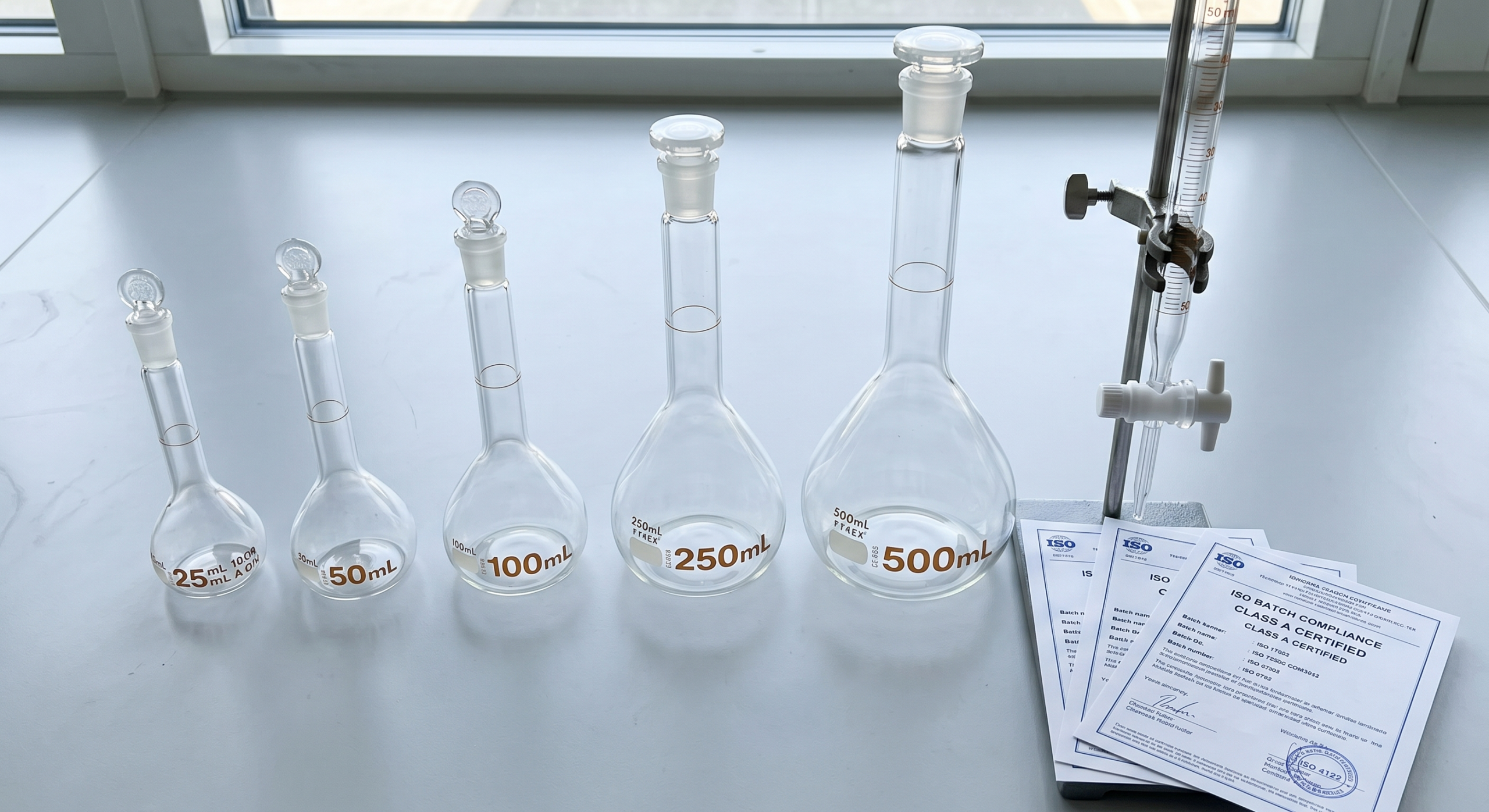
All three major international curriculum frameworks require volumetric precision instruments that allow students to make measurements they can then evaluate for uncertainty. This requires equipment with documented tolerance values – specifically, ISO 4787-compliant borosilicate 3.3 volumetric flasks, ISO 835-compliant pipettes, and ISO 4797-compliant burettes. IB laboratory equipment procurement that specifies ISO-compliant Class A borosilicate glassware meets the measurement standards of IB, Cambridge, and AP curricula simultaneously, removing the need to maintain separate equipment specifications per curriculum.
Class A volumetric flasks for school laboratories should be specified in the standard sizes used across the IB, Cambridge, and AP investigation portfolio: 25 mL, 50 mL, 100 mL, 250 mL, and 500 mL. Class A tolerance for a 100 mL flask is ±0.08 mL – sufficient for standard solution preparation at the accuracy level these curricula require. Class B tolerance (±0.20 mL for 100 mL) is acceptable for preparatory rinsing, approximate reagent dispensing, and demonstrations but should not be used for standard solution preparation in assessed practicals. Schools that stock only Class B glassware are limiting the measurement quality of their students’ assessed work. The ISO 4787 standard for volumetric glassware defines the tolerance classes and calibration methods applicable to school laboratory instruments.
Borosilicate 3.3 composition is required for all volumetric and analytical glassware used in these curricula – not ordinary soda-lime glass. The thermal expansion coefficient of borosilicate 3.3 (3.3 x 10⁻⁶ K-1) provides dimensional stability across the temperature range of school laboratory operations. Soda-lime glass volumetric instruments expand significantly with temperature, introducing calibration drift that undermines the measurement accuracy students need for valid investigation results. Calibration marks on borosilicate 3.3 glassware remain accurate across the 15-30 degrees C temperature range typical of school laboratory environments, where temperature fluctuations between sessions are common and equipment is rarely stored in temperature-controlled conditions between practicals.
Safety Equipment and Compliance for Accredited School Laboratories
International school laboratory accreditation covers not just the precision instruments used in practical work but also the safety infrastructure that surrounds laboratory operations. IB World School authorization requires schools to demonstrate that laboratory environments meet applicable health and safety standards for the country in which they operate, with reference to international best practice. IB laboratory equipment audits by IB authorization teams typically include a review of fume cupboard provision, emergency shower and eyewash station locations, chemical storage arrangements, and personal protective equipment availability for students and staff.
Cambridge International registered centres must meet the health and safety requirements that Cambridge sets as a condition of offering practical endorsement programmes. These requirements address chemical storage, disposal procedures, fume extraction, and emergency response protocols. AP schools outside the United States – which represent a growing share of AP-delivering institutions globally – must reference applicable local safety regulations and the College Board’s own laboratory safety guidance published in the AP Chemistry and AP Biology laboratory manuals. Schools cannot achieve practical endorsement or AP programme approval if their safety infrastructure does not meet the framework’s stated requirements.
Core safety equipment for accredited school laboratories includes: fume cupboards for work with volatile reagents, laboratory-grade safety spectacles for all students and personnel, chemical-resistant gloves, fire blankets, CO2 fire extinguishers, clearly marked emergency exits, and chemical spill kits. IB laboratory equipment inventories should include a documented safety equipment inspection schedule – not just the equipment itself, but evidence of regular inspection and maintenance that can be presented during accreditation visits. Schools that maintain laboratory safety records alongside equipment procurement records present a complete laboratory management profile to accreditation reviewers.
How to Evaluate IB Laboratory Equipment Suppliers
International schools face specific challenges when sourcing IB laboratory equipment: they operate in diverse geographies, procure in USD or EUR, need consistent quality across repeated orders, and must justify procurement decisions to accreditation bodies. These requirements favour manufacturers with documented quality management systems – ISO 9001 certification for manufacturing quality assurance, ISO 17025 calibration capability for volumetric instruments, and WHO-GMP alignment where applicable. Distributor relationships with manufacturers who hold these certifications provide the documentation that accreditation audits require.
When evaluating suppliers, request ISO 4787 batch compliance certificates for volumetric flask, burette, and pipette orders. These certificates should identify the lot number, the instrument type, the tested tolerance class, and the calibration result against the Class A or Class B specification. Suppliers who cannot provide per-batch certificates for volumetric glassware are not operating to the documentation standards that IB and Cambridge accreditation processes expect. The ability to produce supplier certificates on demand – not just at the time of initial purchase but for repeat orders years later – is a differentiating quality for institutional laboratory procurement where accreditation visits may occur years after the original equipment purchase.
Lead time and supply continuity matter for schools that cannot afford mid-term equipment shortages. Evaluate suppliers on standard order-to-delivery timelines for institutional quantities (50-200 pieces per item), minimum order quantities, packaging standards for international air freight, and replacement policy for transit breakage. IB laboratory equipment procurement that sources from manufacturers with established international logistics capability avoids the delays that occur when educational institutions order through intermediary distributors who hold no buffer stock of the specific items required. Request references from other international school accounts before committing to a supplier relationship.
The following table summarizes core IB laboratory equipment requirements by glassware type across IB Diploma, Cambridge A-Level, and AP science curricula, with the applicable ISO standard and recommended tolerance class for each instrument category.
| Equipment Category | IB Diploma (Chem/Bio) | Cambridge A-Level | AP Chemistry/Biology | ISO Standard |
|---|---|---|---|---|
| Volumetric Flasks | Class A, 25-500 mL; borosilicate 3.3 | Class A, 25-250 mL; borosilicate 3.3 | Class A, 25-500 mL; borosilicate 3.3 | ISO 4787 |
| Burettes | 50 mL, 0.05 mL graduation, PTFE stopcock | 50 mL, white-line graduation, Grade A | 50 mL, 0.05 mL graduation, borosilicate | ISO 4797 |
| Transfer Pipettes | 1-25 mL, Class A, ISO compliant | 25 mL volumetric, Class A for titrations | 1-25 mL, Class A for quantitative work | ISO 835 |
| Graduated Cylinders | 10-100 mL, Class B acceptable for prep | 10-100 mL, borosilicate for prep work | 10-100 mL, borosilicate for reagents | ISO 4788 |
| Conical Flasks | 100-250 mL for titration and reactions | 100-250 mL, primary titration vessel | 100-250 mL for titration investigations | DIN 12385 |
| Test Tubes | 150 x 18 mm borosilicate, qualitative work | 150 x 18 mm borosilicate, ion tests | 150 x 18 mm borosilicate, qualitative | ASTM E438 |
| Reagent Bottles | Amber borosilicate, 100-1000 mL range | Clear and amber borosilicate for reagents | Amber and clear borosilicate, all sizes | ISO 4796 |
| Beakers | 50-1000 mL range, Griffin style | 50-600 mL, Griffin and Berzelius styles | 50-1000 mL for reactions and heating | ISO 3819 |
| Dropping Pipettes | Borosilicate for qualitative tests | Borosilicate, required for ion ID tests | For colorimetric and indicator work | ISO 7335 |
Specifying IB Laboratory Equipment: A Practical Procurement Guide
Specifying IB laboratory equipment for a school running IB Diploma, Cambridge A-Level, or AP sciences follows a three-stage process: map the curriculum to equipment, specify the equipment to certification standards, and document procurement for accreditation. Curriculum mapping begins with each subject guide’s practical requirements – the list of investigations students must complete and the apparatus each investigation requires. This list becomes the procurement scope. Each item on the scope is then specified by material (borosilicate 3.3), tolerance class (Class A for volumetric instruments), and applicable ISO standard. The specified list becomes the purchase order, and the supplier’s certificates against that specification become the accreditation documentation.
Quantity planning requires accounting for batch size and breakage reserves. A class of 24 students working in pairs needs 12 sets of working glassware per bench position, plus 2-3 reserve sets for breakage, and a teacher demonstration set. Volumetric flasks and burettes are high-use, high-breakage items in school chemistry laboratories. Schools running IB laboratory equipment inventories should hold 20-30% surplus over minimum batch requirements for volumetric instruments to maintain operational continuity through the academic year. Our guide on common laboratory glassware uses provides reference data on glassware types and frequency of use across standard chemistry and biology procedures that apply directly to IB and Cambridge school laboratory planning.
Quality documentation for school laboratory procurement should include: ISO 4787 batch compliance certificates for all volumetric instruments, a materials certificate confirming borosilicate 3.3 composition, supplier ISO 9001 certification, and a receiving inspection record confirming instrument integrity on arrival. These four document types provide the evidence chain that accreditation reviewers require to confirm that IB laboratory equipment meets the precision and reliability standards each curriculum specifies. For guidance on the precision standards applicable to each glassware type, see our analysis of precision scientific glassware specifications and how they apply to quantitative school laboratory work.
Indian laboratory glassware manufacturers have become a primary procurement source for IB laboratory equipment in international schools across South Asia, the Middle East, Southeast Asia, and East Africa. The combination of ISO 9001 manufacturing quality, competitive pricing relative to European manufacturers, and established international logistics capability makes Indian manufacturers well-suited to institutional procurement at the volume and budget parameters that international school laboratory programmes operate within. Schools evaluating supplier options can review the ISO and quality certifications these manufacturers maintain in our overview of Indian lab equipment manufacturers and the quality standards they hold for export-grade borosilicate glassware.
Frequently Asked Questions
IB laboratory equipment for IB Chemistry centres on Class A volumetric flasks (25-500 mL), 50 mL burettes with PTFE stopcocks, transfer pipettes (1-25 mL), conical flasks (100-250 mL), and graduated cylinders (10-100 mL). All volumetric instruments should be borosilicate 3.3 and ISO 4787 certified to provide the documented tolerance values that IB investigations require for measurement uncertainty evaluation. Reagent bottles, test tubes, beakers, and watch glasses support preparatory and qualitative work alongside the volumetric instruments.
Cambridge A-Level Practical Endorsement does not specify a mandatory ISO certification number for school laboratory equipment. However, it requires equipment that supports the accuracy and reproducibility expected of the assessed procedures – which in practice means ISO 4787-compliant volumetric glassware for chemistry practicals and calibrated instruments throughout. Schools that use ISO-certified borosilicate IB laboratory equipment for Cambridge A-Level practicals have the documentation to demonstrate equipment quality during Cambridge centre inspections, even when the standard is not explicitly mandated.
Class A volumetric glassware is manufactured to tighter dimensional tolerances than Class B. For a 100 mL volumetric flask, Class A tolerance is ±0.08 mL while Class B tolerance is ±0.20 mL. For IB laboratory equipment used in assessed practicals – standard solution preparation, titration work, and quantitative investigations – Class A is the appropriate specification because it supports the measurement precision that IB, Cambridge, and AP investigation frameworks require. Class B is acceptable for preparatory rinsing, reagent dilution, and non-assessed demonstration work.
AP Chemistry specifies laboratory equipment requirements through its Laboratory Investigations guide, which publishes 16 investigation protocols each listing the required apparatus and reagents. The College Board does not mandate specific brands or ISO certifications, but the investigation design assumes equipment of sufficient precision to support quantitative analysis and error evaluation. IB laboratory equipment specifications – Class A borosilicate volumetric glassware with ISO 4787 certification – align with the measurement accuracy AP Chemistry investigations require. AP schools sourcing to this standard meet College Board expectations while building documentation for any future IB or Cambridge accreditation pursuit.
Yes – Indian manufacturers of borosilicate 3.3 laboratory glassware supply IB laboratory equipment to international schools in over 40 countries. Leading Indian manufacturers hold ISO 9001 manufacturing certification, produce Class A volumetric glassware to ISO 4787 tolerance standards, and provide per-batch compliance certificates suitable for accreditation documentation. International school procurement teams can source complete laboratory glassware inventories from Indian manufacturers with competitive pricing, 4-6 week delivery lead times for standard orders, and English-language certification documentation.
Schools undergoing IB World School authorization or Cambridge centre inspection for IB laboratory equipment compliance benefit from maintaining: supplier ISO 9001 certificates, per-batch ISO 4787 compliance certificates for all volumetric instruments, materials certificates confirming borosilicate 3.3 composition, receiving inspection records, and a laboratory equipment register mapping each item to its supplier lot number and storage location. This documentation package allows schools to respond to accreditation reviewer requests on the same day, demonstrating that procurement was managed to the quality standards the curriculum requires.
IB laboratory equipment quantity planning should start from the class batch size – typically 20-28 students per practical session. Students working in pairs require half the batch size in working sets per bench position. Add 2-3 reserve sets for breakage replacement and one demonstration set for the teacher. For a class of 24 students working in pairs, a minimum of 15-16 complete working sets per glassware type is appropriate. For high-breakage items such as burettes and volumetric flasks, a 20-25% surplus over minimum requirements helps schools maintain operational continuity through the full academic year without emergency procurement.
Source Certified IB Laboratory Equipment for Your School
Medilab Exports supplies ISO 9001-certified borosilicate 3.3 IB laboratory equipment to international schools, IB World Schools, and Cambridge-affiliated institutions across 40+ countries. We provide Class A volumetric glassware with per-batch ISO 4787 compliance certificates, borosilicate 3.3 materials certificates, and full procurement documentation suitable for accreditation records.
