
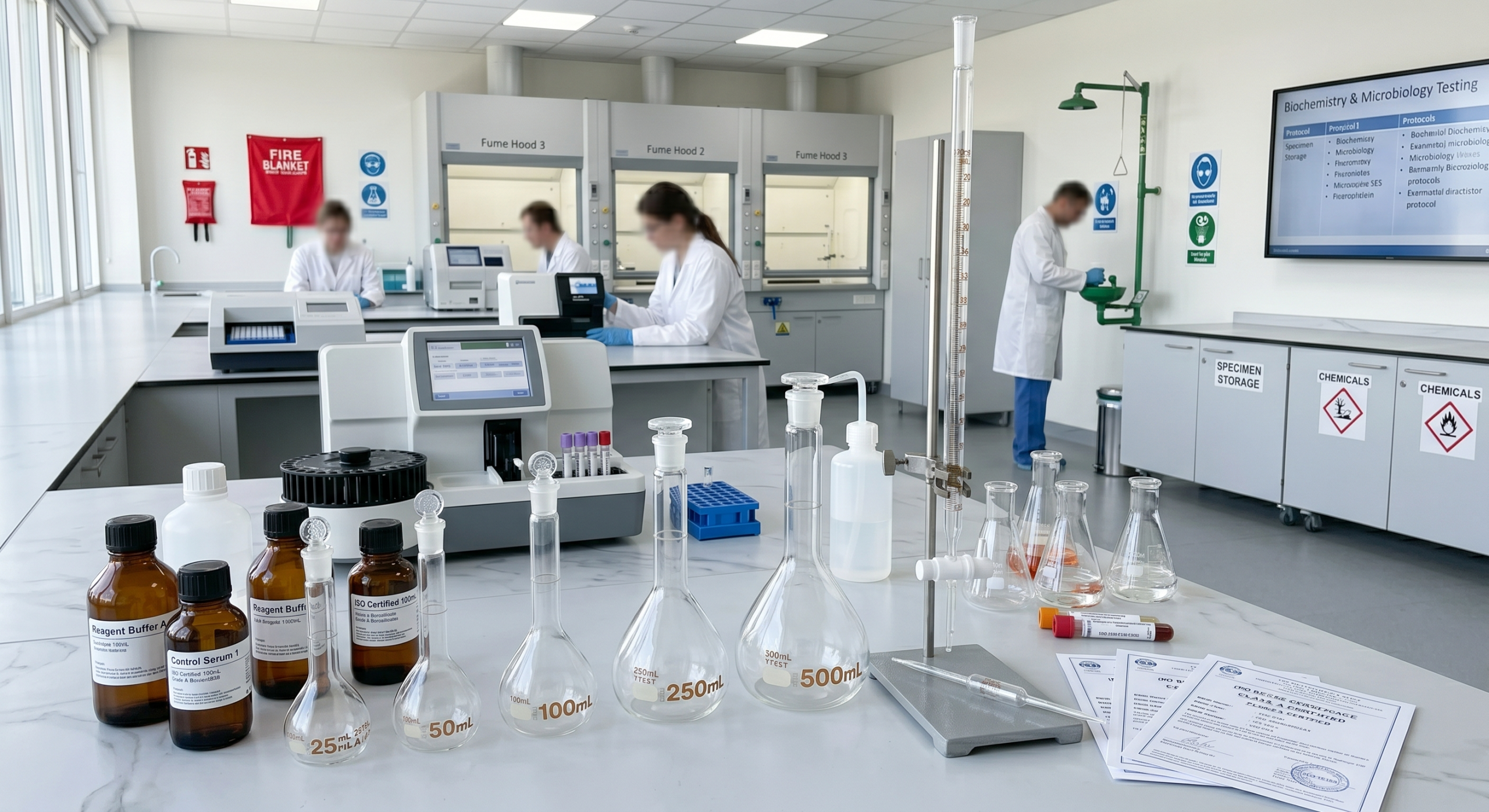
Hospital laboratory equipment procurement for a new pathology or clinical laboratory is one of the highest-stakes purchasing decisions a hospital makes. The equipment selected determines which diagnostic tests the laboratory can perform, the accuracy and reliability of every result it produces, and whether the facility meets the accreditation standards that regulatory bodies, insurance networks, and patient safety programmes require. Errors in procurement – buying equipment that cannot support the planned test menu, sourcing consumables that do not meet clinical-grade specifications, or failing to document procurement for accreditation purposes – create operational problems that are expensive and time-consuming to correct after commissioning.
This guide covers a structured, 9-step approach to hospital laboratory equipment procurement for new pathology and clinical laboratory setups. It addresses how to define the laboratory’s diagnostic scope before specifying equipment, how to translate test menu requirements into equipment specifications, how to evaluate and qualify suppliers, how to plan budgets with lifecycle costs included, how to build the procurement documentation that NABL, ISO 15189, and hospital accreditation bodies require, and how to validate equipment before patient sample processing begins.
Medilab Exports Consortium manufactures and exports ISO 9001-certified borosilicate 3.3 laboratory glassware and consumables to hospital pathology laboratories, clinical diagnostic centres, and healthcare institutions across 40+ countries. Hospital laboratory equipment procurement for glassware, reagent storage vessels, sample handling consumables, and clinical chemistry apparatus is a core part of our institutional supply portfolio – we understand the clinical-grade specification requirements, accreditation documentation needs, and supply continuity expectations that hospital laboratory setups demand.
Why Hospital Laboratory Equipment Procurement Requires a Structured Approach
A hospital laboratory is a regulated diagnostic environment, not a general-purpose scientific facility. Every instrument, every reagent, and every piece of glassware it uses contributes directly to patient diagnosis and treatment decisions. Hospital laboratory equipment procurement that begins with a general equipment catalogue rather than a structured needs analysis produces laboratories that are either under-equipped for the test menu they need to run, over-equipped with instruments that sit unused because they exceed the laboratory’s actual throughput, or non-compliant with accreditation standards because procurement decisions were not referenced to the applicable regulatory framework from the outset.
The regulatory landscape for hospital pathology laboratories is demanding. In India, the National Accreditation Board for Testing and Calibration Laboratories (NABL) accredits medical testing laboratories against ISO 15189 – the international standard for medical laboratory quality and competence. NABL-accredited laboratories must demonstrate that their equipment meets defined metrological and performance requirements, that equipment is maintained and calibrated on schedule, and that procurement records support audit trails linking equipment to the tests they perform. Internationally, accreditation bodies including CAP (College of American Pathologists), Joint Commission International, and ISO 15189 certification bodies impose equivalent requirements.
A structured approach to hospital laboratory equipment procurement produces three outcomes that a reactive or catalogue-driven approach cannot: an equipment inventory that exactly matches the diagnostic scope the laboratory is authorised to operate, procurement documentation that supports accreditation audit without retrospective reconstruction, and a total cost of ownership that reflects reagent consumption, maintenance contracts, calibration schedules, and consumable replacement rather than just capital equipment purchase price. The nine steps in this guide address each component of this structured approach in the sequence that a new laboratory setup project should follow them.
Step 1: Define Diagnostic Scope and Test Menu Before Specifying Equipment
The first step in hospital laboratory equipment procurement is defining what the laboratory will and will not do. A hospital pathology laboratory’s diagnostic scope – the range of tests it is authorised to perform – determines every subsequent procurement decision. Attempting to specify equipment before the test menu is finalised produces either over-specification (instruments purchased for tests the laboratory never runs) or under-specification (tests requested by clinicians that the laboratory cannot perform because the required instrument was not procured). Both situations are costly: over-specification wastes capital and creates maintenance obligations for idle equipment, while under-specification forces the hospital to refer tests to external laboratories at additional cost per test.
Test menu definition begins with the clinical departments the laboratory will serve and the diagnostic questions those departments need answered routinely. A secondary care hospital’s pathology laboratory will typically require biochemistry (liver function, renal function, lipid profile, blood glucose, HbA1c, thyroid function), haematology (CBC with differential, coagulation studies, ESR), microbiology (culture and sensitivity, gram staining, urine analysis), and histopathology (biopsy processing, cytology) as core test categories. Each category’s test list then drives the specific instrument and consumable requirements. A laboratory planning to run 200 biochemistry tests per day requires different instrument capacity from one planning to run 1,000 tests per day, even if both laboratories perform the same biochemistry panel.
Document the finalised test menu in a formal scope-of-work before any hospital laboratory equipment procurement is initiated. This document becomes the reference against which all subsequent equipment specifications are justified and all procurement decisions are audited. Include anticipated test volume per category (tests per day, tests per month), the patient population the laboratory will serve (inpatients, outpatients, emergency department), the turnaround time requirements for each test category, and any planned expansion of the test menu within the first three years of operation. Laboratories that scope procurement against three-year projected volume rather than day-one volume avoid the disruptive and expensive process of instrument replacement or capacity upgrade within a short period of initial operation.
Step 2: Translate Test Menu Requirements into Equipment Specifications
Each test in the finalised menu maps to a specific set of instruments, glassware, and consumables. Hospital laboratory equipment procurement that works from a test-to-equipment mapping table – rather than a general laboratory equipment list – ensures complete coverage of the test menu and prevents both gaps and duplications. The mapping table should identify: the test name, the analytical method it requires, the instrument type that performs that method, the sample type and collection container the test requires, the reagents and standards needed for each run, and the glassware and consumables involved in sample preparation and result recording.
For a biochemistry laboratory, a serum electrolyte panel (sodium, potassium, chloride, bicarbonate) maps to an ion-selective electrode analyser or a clinical chemistry analyser with electrolyte modules, serum separator tubes for sample collection, calibration standards prepared in volumetric flasks, quality control solutions in reagent bottles, and reaction vessels appropriate to the analyser platform. For a microbiology laboratory, a culture and sensitivity workflow maps to an incubator, culture media preparation equipment including volumetric glassware for broth preparation, sterile inoculation instruments, and a microscope with oil immersion capability for gram staining. Each test category generates a distinct equipment list, and the union of all test category lists produces the complete laboratory equipment specification.
Cross-reference the equipment mapping against the laboratory’s floor plan and utilities at this stage of hospital laboratory equipment procurement. Large analysers require specific electrical supply, drainage, and ventilation provisions. Histopathology tissue processing equipment requires fume extraction. Autoclave and sterilisation equipment requires steam supply or electrical load that must be confirmed with the building’s facilities team. Equipment that arrives at commissioning and cannot be installed due to an infrastructure gap creates delays that affect the laboratory’s go-live timeline and can require expensive building modifications after equipment delivery.
Step 3: Specify Clinical-Grade Glassware and Consumables
Clinical laboratory glassware and consumables occupy a specific quality tier above general laboratory glassware. Hospital laboratory equipment procurement that sources clinical glassware from general laboratory suppliers without verifying material specification and tolerance class introduces measurement variability into diagnostic workflows where measurement accuracy directly affects patient outcomes. Borosilicate 3.3 glass is the required material for all analytical and volumetric glassware in clinical chemistry and microbiology laboratories – its chemical resistance to the acids, alkalis, solvents, and biological materials encountered in clinical testing, combined with its thermal stability during sterilisation and autoclaving, makes it the only appropriate material for hospital laboratory use.
Volumetric glassware used for standard solution preparation and calibration in clinical chemistry must be Class A, ISO 4787 compliant. Calibration standards prepared in Class B volumetric flasks introduce the ±0.20 mL tolerance error of a 100 mL Class B flask into every analytical run calibrated against that standard – in a clinical context, this error propagates into patient result interpretation and can affect diagnostic decisions. Reagent bottles for clinical chemistry reagent storage must be borosilicate 3.3 to prevent leaching of alkali metal ions from soda-lime glass into reagents, which would shift pH and interfere with enzyme-based assays. Amber borosilicate reagent bottles are required for all light-sensitive reagents including bilirubin standards, fluorescent dyes, and enzyme substrates prone to photodegradation.
Consumable specification for hospital laboratory equipment procurement must also address sample collection and handling materials: blood collection tubes (EDTA tubes for haematology, SST tubes for biochemistry, citrate tubes for coagulation studies), urine collection containers, transport swabs for microbiology, and tissue fixation containers for histopathology. Each of these consumables must meet the pre-analytical requirements for the tests they support – tube additives must be at the correct concentration, container materials must not interfere with analytes, and closure systems must maintain sample integrity during transport. Poor pre-analytical consumable specification is a leading cause of sample rejection and analytical interference in hospital laboratories, and it is entirely preventable through proper procurement specification at setup.
Step 4: Evaluate and Qualify Hospital Laboratory Equipment Suppliers
Supplier qualification for hospital laboratory equipment procurement is a documented process, not an informal selection. Hospital laboratories operating under NABL or ISO 15189 are required to maintain an approved supplier list with qualification records demonstrating that each supplier has been evaluated against defined criteria before purchase orders are placed. Supplier evaluation criteria for hospital laboratory glassware and consumables should include: ISO 9001 manufacturing certification, product-specific compliance certificates (ISO 4787 for volumetric glassware, ISO 15223 for medical device symbols on packaging), traceability of materials to certified borosilicate 3.3 composition, and ability to supply Certificate of Analysis with each batch.
Evaluate suppliers on supply continuity and lead time reliability alongside product quality. A hospital laboratory cannot tolerate stockout situations for critical consumables – reagent bottles, collection tubes, and sterile specimen containers must be available on short notice when consumption patterns deviate from forecast. Preferred suppliers should be able to demonstrate buffer stock capability, standard order-to-delivery timelines of 7-14 days for routine replenishment orders, and an escalation pathway for urgent orders when critical consumables are running low. Suppliers who can reference other hospital laboratory accounts provide evidence of established institutional supply capability that reduces onboarding risk.
For hospital laboratory equipment procurement of analytical instruments (clinical chemistry analysers, haematology analysers, microbiology systems), the evaluation must also cover: reagent-instrument lock-in (whether the analyser requires proprietary reagents), service contract availability and engineer response time commitments, spare parts availability, software update provision, and the supplier’s track record in supporting the same instrument platform in other hospital laboratories in the same region. Instrument procurement decisions that minimise capital cost but create high ongoing reagent costs or poor service availability often produce higher total cost of ownership over a five-year period than higher-capital instruments with competitive reagent pricing and reliable service support.
Step 5: Budget Planning and Lifecycle Cost Analysis
Capital equipment purchase price is the most visible component of hospital laboratory equipment procurement budgets but rarely the largest cost over a five-year period. A clinical chemistry analyser acquired at a capital cost of ₹15 lakhs may consume ₹8-12 lakhs per year in reagents, calibrators, and quality control materials. An autoclave with a low purchase price may require expensive annual servicing. Budget planning for a new hospital laboratory must account for the full lifecycle cost of each major instrument and the ongoing consumable cost of each test category – not just the one-time acquisition cost of equipment and initial reagent stock.
Build the laboratory budget in three components: capital equipment (instruments, major equipment, furniture, and infrastructure), consumables for the first year of operation (reagents, standards, QC materials, glassware, collection containers), and operational costs (service contracts, calibration fees, staff training, waste disposal). For the consumable component of hospital laboratory equipment procurement, calculate annual consumption from the projected test volume – tests per day multiplied by reagent volume per test multiplied by working days per year – and apply a 15-20% safety stock buffer to account for QC runs, repeat testing, and demand peaks. Under-budgeting consumables in year one forces mid-year budget revisions and can delay the laboratory’s ability to expand its test menu.
Negotiate reagent pricing alongside instrument acquisition. Many clinical chemistry analyser suppliers offer instrument-reagent bundle agreements that reduce reagent unit cost in exchange for a minimum annual reagent volume commitment. These agreements are acceptable when the committed volume aligns with projected test volumes, but they carry risk if the laboratory’s actual test volume falls below the commitment threshold – the hospital then pays for reagents it does not use. Evaluate bundle agreements carefully against realistic volume projections before committing. Independent pricing of reagents from alternative suppliers provides a benchmark for negotiating fair bundle terms.

Step 6: Procurement Documentation for Hospital Accreditation
Hospital laboratory equipment procurement documentation is not administrative overhead – it is a primary input to the accreditation process. ISO 15189: Medical laboratories – Requirements for quality and competence requires that laboratories maintain records of equipment, including manufacturer name and type, serial number or unique identification, equipment receiving dates and condition at receipt, and maintenance and calibration records. NABL accreditation assessors review these records during on-site assessment and use gaps in equipment documentation as a basis for non-conformity findings. Laboratories that begin building documentation from day one of procurement – rather than retrospectively before an accreditation visit – avoid the compressed, error-prone process of document reconstruction under time pressure.
The minimum documentation package for each piece of major equipment in an accredited hospital laboratory includes: purchase order and invoice, delivery note confirming receipt condition, manufacturer’s certificate of conformance or calibration certificate, equipment installation record, user acceptance testing record, and entry in the laboratory’s equipment register. For consumables and glassware, documentation requirements are met by: supplier ISO 9001 certificate, Certificate of Analysis or ISO 4787 batch compliance certificate for volumetric instruments, materials certificate confirming borosilicate 3.3 composition, and goods received note. This consumable documentation package supports hospital laboratory equipment procurement audit trails and demonstrates to NABL assessors that consumables were sourced from qualified suppliers operating to defined quality standards.
Establish a laboratory equipment register at the start of procurement – not at commissioning. The register should capture: equipment name and model, manufacturer, serial number, purchase date, supplier name and contact, warranty expiry, service contract details, calibration frequency and next due date, and the assigned laboratory area. Maintaining this register in real time throughout the procurement and commissioning process ensures it is complete and accurate when the laboratory opens and when accreditation assessors request it. Laboratories that build documentation habits during procurement find accreditation preparation far less disruptive than those that attempt to reconstruct records from purchase orders and delivery notes months after equipment was installed.
Step 7: Validate and Commission Equipment Before Patient Sample Processing
No item of equipment or reagent system acquired through hospital laboratory equipment procurement should be used on patient samples before it has been formally validated and commissioned. Validation confirms that the equipment performs as specified, produces results within the manufacturer’s stated performance parameters, and meets the laboratory’s own defined acceptance criteria for accuracy, precision, and linearity. Commissioning confirms that the equipment is installed correctly, connected to appropriate utilities, integrated with the laboratory information system if applicable, and operated by trained staff following documented standard operating procedures.
For analytical instruments, validation protocol includes: precision study (running the same QC material repeatedly to confirm coefficient of variation is within acceptable limits), accuracy study (comparing results against a reference method or certified reference material), linearity study (confirming the instrument reports accurate results across its stated analytical measurement range), and interference study (confirming that common interferents such as haemolysis, lipaemia, and icterus do not cause clinically significant result bias). For glassware, validation is simpler – confirm volumetric accuracy by gravimetric testing of a sample from the batch, confirm chemical resistance by contact testing with the reagents the glassware will store, and confirm breakage rate during receipt inspection is within acceptable limits.
Document all validation results formally before the laboratory commences patient testing. Hospital laboratory equipment procurement validation records become part of the laboratory’s quality management documentation and support both initial accreditation and ongoing surveillance audits. Laboratories that skip or abbreviate validation to accelerate the go-live timeline take on significant clinical and regulatory risk – a poorly performing analyser that is not identified during validation may produce inaccurate patient results for weeks before systematic errors are detected through QC failure or clinical complaint. The investment in thorough validation before go-live is far smaller than the cost of investigating and correcting diagnostic errors after patient testing has begun.
Hospital Laboratory Equipment Procurement: A Practical Setup Guide
A new hospital pathology or clinical laboratory should be approached as a planned project with defined phases: scope definition (test menu, patient population, throughput volume), specification (equipment mapping, glassware and consumable standards, supplier qualification criteria), procurement (purchase orders, supplier certificates, delivery documentation), commissioning (installation, validation, staff training), and go-live (accreditation submission, operational launch). Each phase produces documentation that feeds the next – scope definition drives specification, specification drives procurement, and procurement documentation feeds the accreditation submission. Hospital laboratory equipment procurement that is managed as a project rather than a series of individual purchase decisions produces a laboratory that opens on schedule, within budget, with complete documentation.
Glassware and consumable procurement for a new hospital laboratory should be managed separately from instrument procurement but with a coordinated timeline. Instruments typically have 8-16 week lead times from order to delivery. Glassware and consumables can typically be delivered in 4-8 weeks. Stagger orders to ensure glassware and consumables arrive after the laboratory is equipped and staff are ready to organise and store them – but before instrument installation begins, so reagent preparation can begin as part of the commissioning process. Our guide on common laboratory glassware uses provides a reference for matching glassware types to the specific procedures each laboratory department performs during setup and routine operation.
For quality assurance of hospital laboratory equipment procurement, specify borosilicate 3.3 Class A glassware with ISO 4787 batch compliance certificates for all volumetric instruments. Request supplier ISO 9001 certification before placing first orders, and request Certificate of Analysis with each delivery. Maintain these certificates in the laboratory’s quality management system alongside the equipment register. For detailed guidance on the precision standards and tolerance classes applicable to clinical laboratory glassware, see our analysis of precision scientific glassware and how measurement uncertainty in glassware propagates into analytical results. The quality standards framework applicable to hospital laboratory glassware procurement is covered in our overview of laboratory glassware quality standards including ISO, ASTM, and DIN specifications.
The following table summarises core glassware and consumable requirements by laboratory department for a standard hospital pathology setup, with applicable standards for each equipment category.
| Equipment Category | Biochemistry | Microbiology | Haematology | Histopathology | Standard |
|---|---|---|---|---|---|
| Volumetric Flasks | Class A, 25-500 mL, for standard and calibrator preparation | Class A, 100-1000 mL, for broth and buffer preparation | Class A, 100-250 mL, for reagent preparation | Class A, 100-500 mL, for fixative preparation | ISO 4787 |
| Reagent Bottles | Amber borosilicate, 250-2000 mL, all reagents | Clear and amber borosilicate, 100-2000 mL | Amber borosilicate, 100-500 mL for staining solutions | Wide-neck borosilicate, 500-5000 mL for fixatives | ISO 4796 |
| Graduated Cylinders | 10-500 mL, borosilicate, reagent dispensing | 10-500 mL, borosilicate, media preparation | 10-100 mL, borosilicate, reagent preparation | 100-1000 mL for fixative and processing solutions | ISO 4788 |
| Beakers | 50-2000 mL Griffin style, heating and mixing | 50-1000 mL, autoclaving and media preparation | 50-250 mL, reagent mixing and dilution | 250-2000 mL, processing and staining preparation | ISO 3819 |
| Test Tubes / Sample Tubes | Borosilicate 16×150 mm, secondary samples | Borosilicate 16×150 mm, culture and qualitative | Borosilicate 10×75 mm, sample dilution | Borosilicate 16×100 mm, tissue digestion | ASTM E438 |
| Transfer Pipettes | 1-25 mL Class A, standard preparation | 1-10 mL, sterile, inoculation and dilutions | 1-5 mL, reagent and dilution transfer | 1-10 mL, fixative dispensing | ISO 835 |
| Staining Dishes | Not applicable | Coplin jars, borosilicate, gram staining | Coplin jars and staining racks, Leishman/Giemsa | Coplin jars and large staining dishes for H&E | ISO 3819 |
| Conical Flasks | 100-500 mL, mixing and reaction vessels | 100-500 mL, autoclaved media and broths | 100-250 mL, general reagent preparation | 250-1000 mL, processing solution preparation | DIN 12385 |
| Dropping Pipettes | Borosilicate, indicator and reagent addition | Borosilicate, sterile, inoculation drops | Borosilicate, stain and reagent drops | Borosilicate, mounting media application | ISO 7335 |
Frequently Asked Questions
Priority sequence for hospital laboratory equipment procurement should follow the diagnostic test menu: first procure the instruments and consumables that support the highest-volume, most clinically urgent test categories – typically clinical chemistry analyser (biochemistry), haematology analyser (CBC), and basic microbiology infrastructure (incubators, culture media, microscopes). Glassware and reagent storage should be procured ahead of instrument delivery so that reagent preparation and storage is ready when analysers arrive. Sample collection consumables (blood tubes, swabs, specimen containers) should be available before the laboratory accepts its first patient samples.
ISO 15189 is the international standard for medical laboratory quality and competence – it defines requirements for quality management, technical competence, and the pre-analytical, analytical, and post-analytical processes of medical testing. For hospital laboratory equipment procurement, ISO 15189 is directly relevant because it requires laboratories to maintain complete equipment records, perform validation before clinical use, maintain calibration schedules, and qualify suppliers before sourcing from them. Hospitals that procure equipment without referencing ISO 15189 requirements face significant documentation gaps during accreditation assessment. Building ISO 15189-aligned procurement practices from the first purchase order eliminates these gaps.
Hospital pathology laboratories require borosilicate 3.3 glassware throughout – not soda-lime glass. For volumetric instruments used in standard and calibrator preparation, ISO 4787 Class A tolerance is the applicable specification (±0.08 mL for 100 mL flasks). Reagent bottles must be borosilicate 3.3 per ISO 4796, and graduated cylinders must meet ISO 4788. Hospital laboratory equipment procurement for glassware should always request the supplier’s ISO 4787 batch compliance certificate for volumetric instruments and a materials certificate confirming borosilicate 3.3 composition. These certificates become part of the laboratory’s NABL or ISO 15189 accreditation documentation package.
Ongoing hospital laboratory equipment procurement for consumables and reagents is typically managed through a combination of annual supply agreements with approved vendors, monthly or quarterly reorder cycles based on consumption data, and safety stock targets for critical consumables. Hospitals operating under ISO 15189 or NABL maintain an approved supplier list and reprocure only from qualified suppliers with current quality certificates. Monthly consumption tracking against forecasted test volume allows procurement teams to identify trend deviations early – rising reagent consumption per test signals analyser performance issues that may need servicing, while falling consumption against volume growth signals under-stocking that risks stockout.
NABL accreditation for a hospital laboratory requires a comprehensive documentation package that includes equipment records (purchase invoices, installation records, calibration certificates, maintenance logs), supplier qualification records (ISO 9001 certificates, Certificates of Analysis, batch compliance certificates for volumetric glassware), validation records for all analytical instruments, a laboratory equipment register, and standard operating procedures for each test performed. For hospital laboratory equipment procurement, the NABL assessor will specifically review whether consumables and glassware were sourced from qualified suppliers with documented quality certifications – unsupported procurement from unknown suppliers is a common source of non-conformity findings during NABL on-site assessments.
Yes – Indian borosilicate 3.3 glassware manufacturers supply hospital pathology laboratories across India and in export markets spanning 40+ countries. Leading Indian manufacturers hold ISO 9001 manufacturing certification, produce Class A volumetric glassware to ISO 4787 standards, and provide per-batch compliance certificates and materials certificates suitable for NABL accreditation documentation. For hospital laboratory equipment procurement, sourcing from ISO-certified Indian manufacturers offers the combination of clinical-grade quality, competitive pricing relative to European imports, domestic supply continuity, and certification documentation in formats directly usable for NABL and ISO 15189 accreditation purposes.
A new hospital pathology laboratory setup typically takes 6-12 months from initial scope definition to first patient sample processing, depending on the size and diagnostic scope of the facility. The timeline for hospital laboratory equipment procurement alone – from finalising the equipment list to receiving and installing all instruments and consumables – is typically 12-20 weeks. Add 4-8 weeks for validation and commissioning, and 4-8 weeks for NABL or ISO 15189 accreditation application and assessment scheduling. Hospitals that begin procurement planning 9-12 months before the intended go-live date have sufficient time to complete each phase without compressing validation or documentation, both of which carry patient safety risk if rushed.
Source Certified Equipment for Your Hospital Laboratory Setup
Medilab Exports supplies ISO 9001-certified borosilicate 3.3 glassware and consumables to hospital pathology laboratories, clinical diagnostic centres, and healthcare institutions across 40+ countries. Our hospital laboratory equipment procurement support includes Class A volumetric glassware with per-batch ISO 4787 compliance certificates, borosilicate 3.3 materials certificates, and supplier ISO 9001 documentation – everything your NABL and ISO 15189 accreditation documentation requires.
