

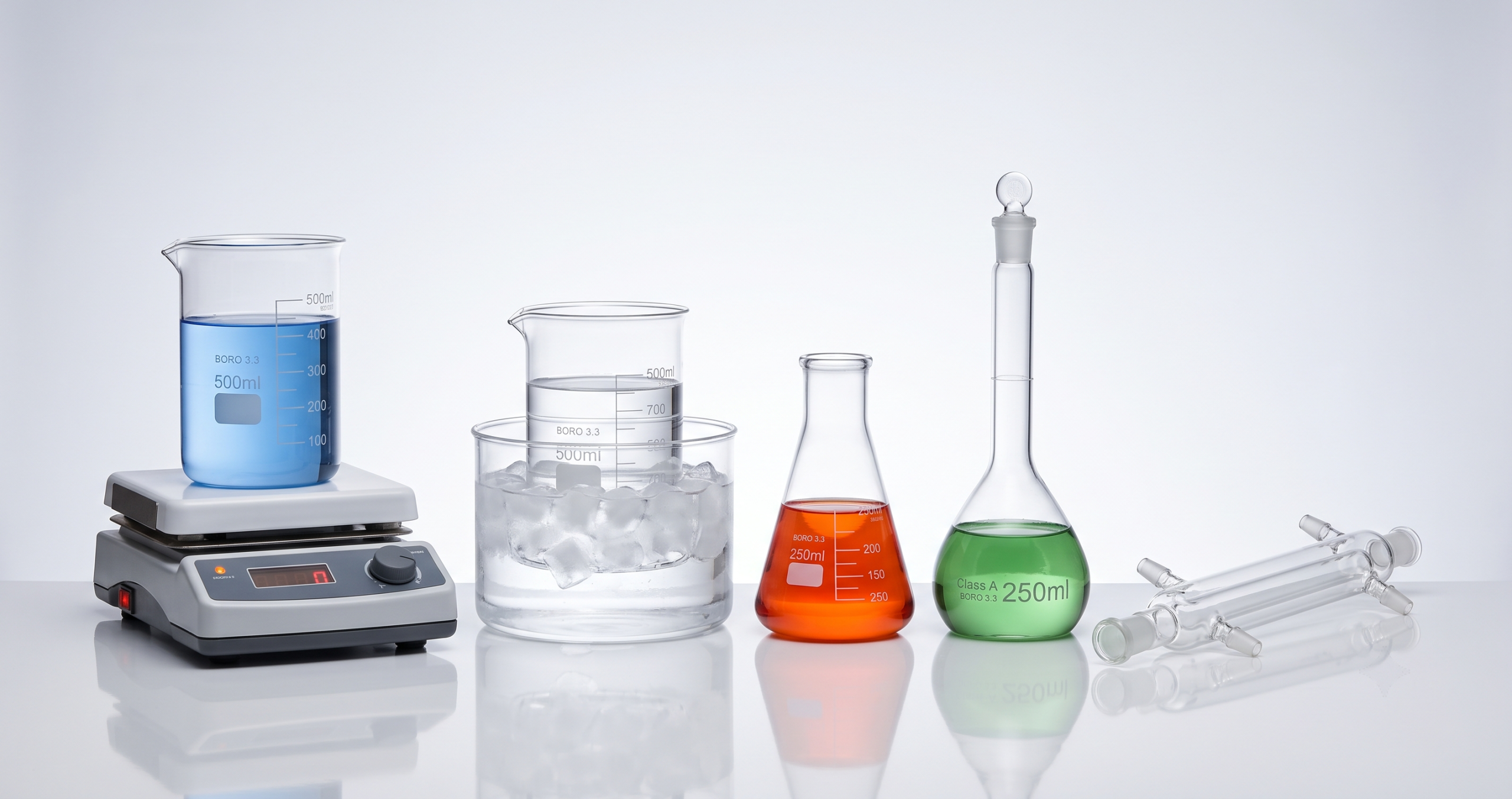
Borosilicate 3.3 laboratory glassware is the default material for beakers, flasks, condensers and volumetric ware in laboratories around the world. The label is easy to print and hard to verify. Buyers who accept the words without checking the properties behind them take on risk in every thermal cycle and every acid wash.
This guide gives seven specifications to verify on any quote for borosilicate 3.3 laboratory glassware. It explains what each number means, which standard defines it, and what to request from a supplier in writing. It also covers where borosilicate is the wrong choice, because honest specification includes the limits.
Medilab Exports Consortium manufactures borosilicate 3.3 laboratory glassware from our base in Ambala, India, and supplies distributors and institutions in more than 35 countries. The checks in this article are the same checks we expect our own customers to run, and they apply equally to samples from any other supplier.
What Makes Borosilicate 3.3 Laboratory Glassware Different
Ordinary glass is soda-lime glass, built from silica, sodium oxide and calcium oxide. It is cheap and easy to form, and it expands sharply when heated. Pour hot liquid into a cold soda-lime beaker and the temperature difference across the wall can crack it.
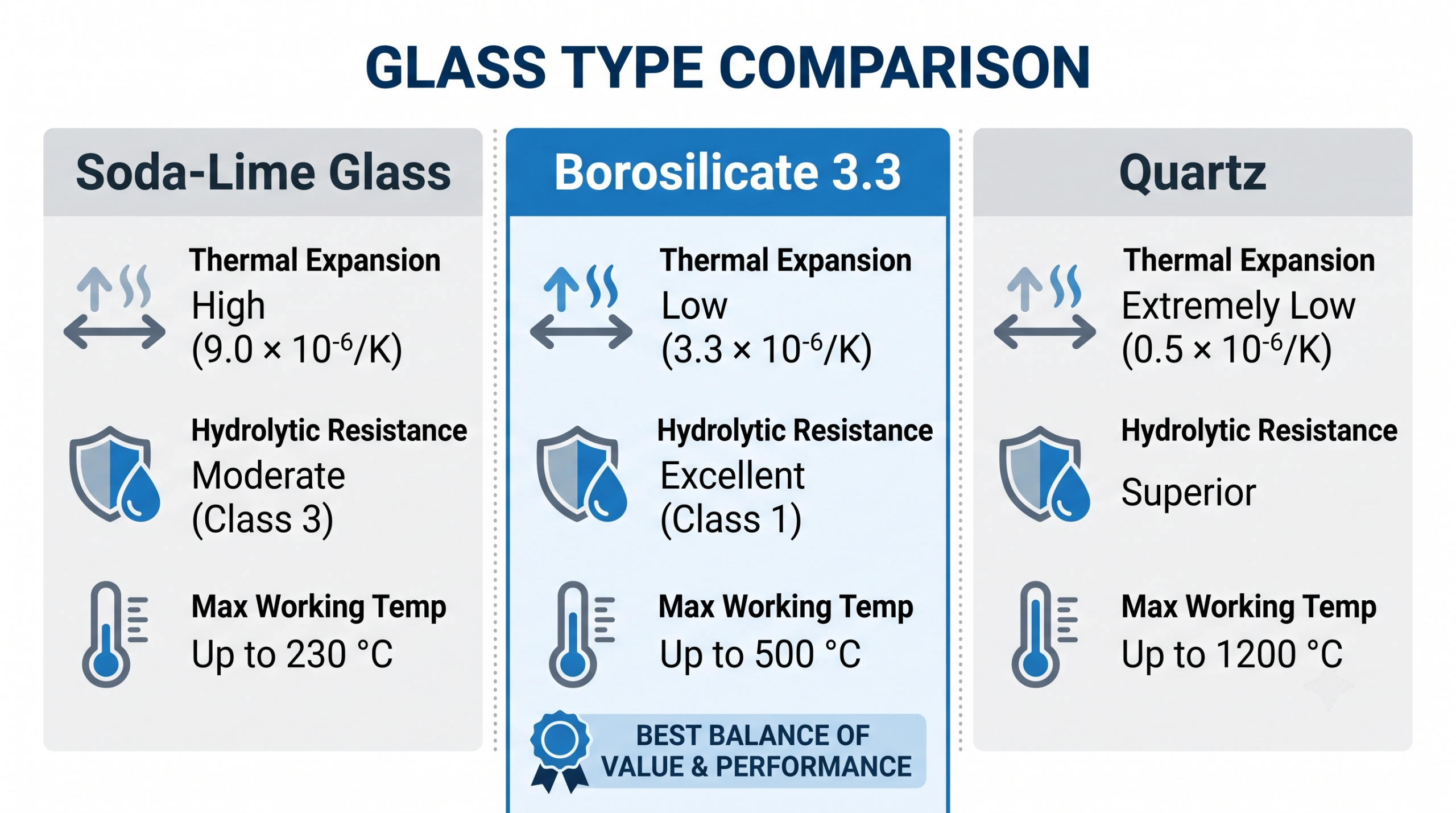
Borosilicate glass replaces much of the sodium oxide with boron trioxide. The result is a glass network that expands far less with temperature and resists attack from water, acids and most organic solvents. The “3.3” in borosilicate 3.3 laboratory glassware refers to the coefficient of linear thermal expansion, about 3.3 x 10 to the power of minus 6 per kelvin, roughly a third of soda-lime glass.
Two other grades share the borosilicate name, and the difference matters when you read a quote. Borosilicate 5.0, often called medium borosilicate, is common in pharmaceutical tubing and vials. Chinese specifications often use the terms high borosilicate for 3.3 glass and medium borosilicate for 5.0 glass, so confirm which grade a supplier means before comparing prices.
1. Composition and the ISO 3585 Definition
The first specification is the material definition. ISO 3585 describes the properties of borosilicate glass 3.3, including its composition range, expansion and chemical resistance. A supplier of borosilicate 3.3 laboratory glassware should be able to state that the glass conforms to this standard and show the melt certificate that supports the claim.
Typical composition is about 80 percent silica, 13 percent boron trioxide, 4 percent alkali oxides and 2 to 3 percent alumina. Small shifts in these proportions change expansion, durability and working behavior. A manufacturer that controls its own melt can hold the composition steady, whereas a trader buying tubing from several sources cannot.
Ask these questions when you review a quote:
- Does the supplier melt its own glass or draw tubing from an identified source?
- Is the glass described as ISO 3585 borosilicate 3.3 on the material certificate?
- Can the lot or melt number be traced from the product back to the glass?
Written answers to these three questions filter out most substitute materials before samples are even shipped.
Chinese and US buyers alike should also ask how the supplier handles cullet, which is recycled glass from earlier production. Controlled, segregated cullet is routine and safe, while uncontrolled cullet can introduce foreign glass and cause streaks or expansion mismatch in the finished item.
2. Thermal Expansion and Thermal Shock Resistance
Thermal expansion controls how a vessel behaves when one side is hot and the other is cold. A low coefficient means less differential stress across the wall. For borosilicate 3.3 laboratory glassware the stated value is 3.3 x 10 to the power of minus 6 per kelvin, measured between 20 and 300 degrees C.
Thermal shock resistance follows from low expansion, but it also depends on wall thickness, shape and annealing. A thin flask tolerates a larger sudden temperature difference than a thick one, because the stress builds across a shorter distance. Typical tolerable differences fall in the range of roughly 100 to 160 degrees C depending on geometry, compared with about 40 to 60 degrees C for soda-lime glass.
This is why autoclaving, oven drying and flame heating are routine for borosilicate and risky for ordinary glass. Rapid cooling is more dangerous than rapid heating, because cooling puts the outer surface into tension, and glass is weakest in tension. Never pour cold liquid into a hot vessel, and never place hot glass on a cold metal bench.
When a supplier quotes a thermal shock rating, ask for the wall thickness and test method behind it. A figure without those details is a marketing statement, not a specification.
3. Chemical Resistance Classes: Water, Acid and Alkali
Chemical durability is specified by class, and each class has its own test. Hydrolytic resistance, the release of alkali into water, is classified under ISO 719 at 98 degrees C, where borosilicate 3.3 laboratory glassware achieves class HGB 1, the best category. Acid resistance under ISO 1776 is also class 1, and alkali resistance under ISO 695 is class A2, which means moderately resistant.
The classification system exists so that two laboratories on different continents can compare glass without testing it themselves. A class number on the certificate is shorthand for a defined test, a defined temperature and a defined limit of released alkali. That shared language is the reason these standards matter to export buyers.
These classes explain real behavior. Low hydrolytic release protects trace analysis, buffer preparation and storage of pH-sensitive reagents from contamination by the vessel itself. High acid resistance suits digestion and cleaning. The alkali figure is a reminder that hot, concentrated caustic solutions slowly dissolve any silicate glass.
For US pharmaceutical users, the regulatory hook is 21 CFR 211.65, which requires that equipment surfaces in contact with components must not be reactive, additive or absorptive in a way that alters safety or quality. Class 1 hydrolytic resistance is how most quality teams document that the glass meets this requirement.
4. Working Temperature, Softening Point and Annealing Quality
Borosilicate 3.3 handles continuous service up to roughly 500 degrees C, with a softening point near 820 degrees C. Short exposures above the continuous limit are possible, but repeated cycling there accelerates devitrification and weakens the surface. For ignition, fusion and sustained high-temperature work, porcelain or quartz is the correct choice.
Annealing is the hidden specification. Glass formed at high temperature cools unevenly, and the surface freezes before the interior, leaving internal stress. A properly annealed piece of borosilicate 3.3 laboratory glassware has had that stress relaxed in a controlled lehr cycle, and a polarized light stress viewer shows the result.
Ask whether the supplier inspects annealing with a polariscope and whether the check is performed on every lot or on a sample. Poorly annealed glass can pass every dimensional test and still crack on its first heating cycle, which is why this check deserves a line in the contract.
5. Mechanical Durability, Wall Thickness and Dimensional Tolerance
Durability in practice means how a piece behaves under handling, washing and clamping. Wall thickness is the main lever. Thicker walls resist impact and clamping stress but respond more slowly to temperature change, so the specification should match the use case.
Dimensional tolerance matters for fit. Ground joints must interchange across suppliers, stoppers must seat, and flask necks must match closures. For borosilicate 3.3 laboratory glassware with standard taper joints, request the joint standard in the quote and test a sample for fit with your existing apparatus.
Joint and neck dimensions deserve their own line in the specification. Standard taper joints such as 14/23, 19/26 and 24/29 are widely used, and a joint that is slightly out of tolerance either leaks or seizes. Request the taper standard and test fit a sample against your existing apparatus before releasing a full order.
Surface finish also affects service life. Fire-polished rims resist chipping better than rough-cut edges, and rims are where most damage starts. A quick check of rim finish across a sample carton tells you more about workmanship than a brochure does.
Visual defects are a durability warning. Stones, seeds, cords and checks create stress concentrations that become fracture origins. A reasonable incoming inspection looks at the rim, the base and any seam under bright light, and rejects pieces with chips or star marks.
6. Documentation and Lot Traceability
A specification is only as good as the paper that proves it. For regulated buyers, the minimum package for each shipment includes a material statement naming the glass type and standard, a certificate of conformance for the product standard, and lot identification that links cartons to production records.
Distributors serving pharmaceutical customers should also request the supplier’s quality system certificate and the calibration status of any measuring instrument used in release testing. Medilab Exports operates under an ISO 9001:2015 quality management system and can supply batch documentation to match the standards named on your purchase order.
A batch of borosilicate 3.3 laboratory glassware without these documents may be perfectly good, but the buyer cannot prove it. In regulated work, an item you cannot document is treated as an item you cannot use.
Documentation errors cause a high share of shipment disputes. The simplest preventive step is to place the glass type, the standard, the class and the document list on the purchase order itself, so that the supplier has agreed to them in writing before production starts.
7. Verifying Authenticity: Simple Checks for Mislabeled Glass
Mislabeled glass is a known problem in international sourcing. Low-boron or soda-lime glass can be sold as borosilicate because the two look alike on a shelf. Simple incoming checks reduce the risk at low cost.
- Density: borosilicate 3.3 is about 2.23 g per cubic centimeter, lower than soda-lime at roughly 2.5
- Refractive index: a quick refractometer reading separates the two families
- Thermal shock: heat a sample piece moderately and quench it, then inspect for cracks
- Polariscope: look for strain patterns that reveal poor annealing
- Markings: genuine borosilicate 3.3 laboratory glassware carries clear brand, volume and standard markings
Destructive tests should be run on spare samples from the lot, never on production stock. Record the results with the lot number so that they support any later claim against the supplier.
Why Manufacturing Control Shapes the Specification
Every property of borosilicate 3.3 laboratory glassware discussed in this guide is set at the factory. Batch composition, melting temperature, forming method and annealing schedule decide whether the finished piece matches the standard. Two suppliers can quote the same words on the same product and deliver very different glass because their process controls differ.
Forming matters as much as melting. Tubing for pipettes and cylinders must hold a uniform bore, because the internal diameter determines how volume relates to the graduation marks. Blown ware such as flasks depends on even wall distribution, which is controlled by mould quality and operator skill. Medilab Exports employs skilled glassblowers and technicians for this reason, since hand finishing remains essential for joints, necks and specialized apparatus.
When you audit a supplier, ask to see the stages that govern these properties: batching, melting, forming, annealing, inspection and release. A manufacturer proud of its process will show you the lehr, the polariscope and the inspection bench. A trader will show you a showroom.
Where Borosilicate 3.3 Is Not the Right Material
Borosilicate 3.3 is not universal, and a good supplier will tell you so. Hydrofluoric acid attacks any silicate glass and requires fluoropolymer vessels. Hot concentrated phosphoric acid and strong hot alkali etch the surface, which is especially damaging for graduated ware because etching removes the calibration marks.
Mechanical shock is another limit. Borosilicate resists thermal stress well, but it remains a brittle material, and a hard knock or a scratch near a stressed zone can start a crack that spreads on the next heating cycle. Inspect used glassware regularly, and retire pieces with star marks even if they still hold liquid.
High temperatures beyond the continuous limit call for quartz or porcelain. Single-use biological work often favors plastic for cost and break resistance. Choosing the right material is part of good specification, and borosilicate 3.3 laboratory glassware remains the best general-purpose choice because it covers the widest range of conditions.
Seven Specification Mistakes to Avoid
Most disputes about borosilicate 3.3 laboratory glassware come from specification gaps rather than from dishonest suppliers. The same errors appear in quotes from every region, and each is simple to fix before an order is placed.
- Writing “borosilicate glass” on the purchase order without naming the 3.3 grade or ISO 3585
- Comparing quotes for 3.3 and 5.0 glass as if they were the same product
- Accepting a thermal shock figure with no wall thickness or test method
- Leaving the chemical resistance class out of the specification
- Skipping the stress inspection because the glass looks clear
- Ordering volumetric ware without naming the tolerance class and standard
- Treating the lowest unit price as the lowest total cost
The last point deserves emphasis. Glassware that fails in service costs far more than its purchase price, because a broken vessel can ruin a sample, an experiment or a production batch. Total cost includes breakage, rejected lots, downtime and the cost of requalifying a supplier.
Borosilicate 3.3 Compared With Other Common Glass Types
The table below places borosilicate 3.3 laboratory glassware next to soda-lime glass and borosilicate 5.0 so that procurement teams can see which grade belongs in which application. Values are typical and should be confirmed against the material certificate for any specific product.
| Property | Borosilicate 3.3 | Borosilicate 5.0 | Soda-lime glass | Reference |
|---|---|---|---|---|
| Thermal expansion (10 to the power of minus 6 per K) | 3.3 | about 5.0 | about 9 | ISO 3585 and supplier data |
| Hydrolytic class | HGB 1 | HGB 1 | HGB 3 | ISO 719 |
| Typical continuous use | up to about 500 degrees C | up to about 450 degrees C | below about 110 degrees C | Supplier data |
| Thermal shock tolerance | roughly 100 to 160 degrees C | roughly 80 to 120 degrees C | about 40 to 60 degrees C | Geometry dependent |
| Density (g per cubic cm) | about 2.23 | about 2.34 | about 2.5 | Material certificate |
| Typical use | Laboratory apparatus | Pharmaceutical vials and tubing | Windows, bottles | Application guide |
A Buyer Checklist for the USA and China
Buyers in the USA usually specify glass type through ASTM E438, which classifies laboratory glass and places low-expansion borosilicate in Type I. Confirm that the supplier’s material statement can be mapped to that classification, since the same glass may be described differently in different standards. Review how standards relate in our guide to laboratory glassware quality standards, and see the ASTM standards catalogue for current editions.
Buyers in China should confirm whether the quote refers to high borosilicate 3.3 or medium borosilicate 5.0 glass, and ask for national standard references alongside ISO references. Chinese production capacity for borosilicate is large, so the deciding factors for imported borosilicate 3.3 laboratory glassware are usually calibration, documentation and consistency rather than raw availability.
For the full property background, read our article on borosilicate glass laboratory equipment, and for a view of which glassware types to buy first, see common laboratory glassware uses. Combine the seven specifications above into a single data sheet that every supplier completes, and compare quotes on that sheet rather than on price alone.
Frequently Asked Questions
It is the coefficient of linear thermal expansion, about 3.3 x 10 to the power of minus 6 per kelvin. The low figure explains why borosilicate 3.3 laboratory glassware tolerates heating, cooling and autoclaving without cracking under normal use. The grade is defined in ISO 3585.
Pyrex and Duran are trade names for borosilicate glass in this family, while the 3.3 designation describes the glass type itself. Any manufacturer whose glass meets ISO 3585 can supply borosilicate 3.3 laboratory glassware. Ask for the material certificate rather than relying on the brand name.
Yes. Borosilicate 3.3 laboratory glassware is routinely autoclaved at 121 degrees C, provided it is inspected for chips and cracks, loaded without clamping stress and allowed to cool gradually. Closed vessels need venting, because pressure rather than temperature is the hazard.
Combine simple checks: look for standard markings, compare density and refractive index, and run a moderate thermal shock test on a spare sample. A polariscope shows annealing quality. Ask the supplier for a material certificate and lot number that support the claim of borosilicate 3.3 laboratory glassware.
Hydrofluoric acid, hot concentrated phosphoric acid and strong hot alkali attack the glass surface. Etching removes graduation marks and weakens the vessel. Use fluoropolymer vessels for hydrofluoric acid and replace etched pieces of borosilicate 3.3 laboratory glassware.
Request a material statement naming the glass type and standard, a certificate of conformance for the product standard, lot traceability, and the quality system certificate. For measuring glassware also request calibration documentation. Write the list into the purchase order.
Yes. Medilab Exports Consortium manufactures borosilicate 3.3 laboratory glassware including beakers, flasks, condensers and volumetric ware, and exports to more than 35 countries. Contact us with your specification and we will send documentation and samples.
Specify Borosilicate 3.3 Laboratory Glassware With Confidence
Medilab Exports Consortium manufactures borosilicate 3.3 laboratory glassware in Ambala, India, for distributors and institutions in more than 35 countries. Send us your specification and we will return material documentation, samples and pricing.
