
Description
[table id=813 /]
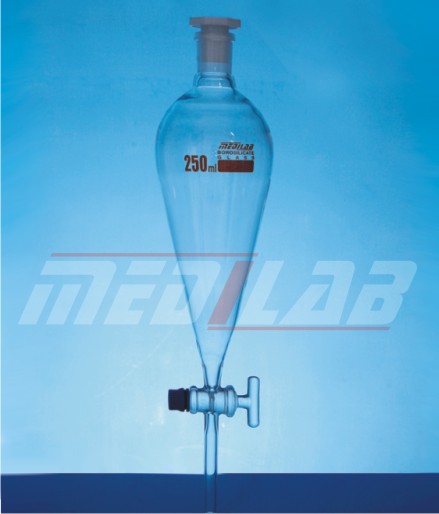
The MEDILAB Separating Funnel, Conical/Squibb Shape, with Glass Stopcock is a precision-crafted laboratory vessel designed for the efficient separation of immiscible liquid phases based on density differences. Its classic conical profile promotes clean phase separation, ensuring high accuracy during liquid–liquid extractions, solvent partitioning, and purification steps. This funnel is an essential tool across research labs, academic institutions, pharmaceutical industries, chemical R&D centres, and analytical QC/QA departments where reproducibility, chemical resistance, and operational safety are paramount.
Key Features
- Premium Borosilicate Glass 3.3 Construction: Exceptional thermal and chemical resistance suitable for a wide range of solvents and reagents.
- Precision Glass Stopcock: Ensures smooth, controlled drainage without leakage; resistant to chemical corrosion.
- Conical/Squibb Geometry: Helps achieve sharper separation lines and more accurate phase decantation.
- Leak-Proof Operation: Glass-to-glass joints and precision-ground interfaces ensure tight sealing.
- PE Stopper Included: Lightweight, chemically compatible stopper for airtight closure during mixing and shaking.
- ISO 4800 Compliance: Manufactured to international quality standards for consistency and reliability.
- User-Friendly Handling: Clear volume markings, easy-grip design, and stable handling for routine lab operations.
- Long Service Life: High mechanical durability and scratch-resistant surface for heavy daily use.
Material Specifications
- Material: High-grade Borosilicate Glass 3.3
- Thermal Properties: Low coefficient of thermal expansion, High resistance to thermal shock Suitable for heating and cooling cycles
- Chemical Properties: Excellent resistance to acids, alkalis, organic solvents, and most chemicals. Non-reactive and non-porous surface ensuring contamination-free performance
- Mechanical Strength: High stability and impact resistance within standard laboratory conditions
- Standards & Compliance: Conforms to and is equivalent to laboratory glassware guidelines
Technical Specifications
- Available Capacities: As per the standard size table
- Dimensions: Each size is manufactured with standardised height-to-diameter ratios for optimal phase separation
- Stopcock Type: Precision-ground glass stopcock, grease-compatible
- Stoppers Provided: Polyethene (PE) stopper included; glass stopper available upon request
- Tolerance: High-accuracy volume markings with tight calibration tolerances
- Accessories Included: Glass separating funnel, PE stopper, Glass stopcock (factory fitted)
Handling & Precautions
- Safe Use: Ensure the stopcock is securely inserted before adding liquids. Shake the funnel only while holding the stopper and stopcock firmly
- Cleaning Instructions: Rinse immediately after use to prevent residue buildup. Use non-abrasive detergents and soft brushes. Compatible with most laboratory cleaning solutions
- Autoclaving: The Funnel and glass stopcock may be autoclaved at standard temperatures. Remove the PE stopper before autoclaving
- Dos and Don’ts: Do: Inspect the stopcock regularly for smooth rotation. Do: Lubricate the glass stopcock when necessary (use appropriate stopcock grease). Don’t: Expose sudden temperature shocks beyond glass tolerance. Don’t: Use if cracks, chips, or deformation are observed
- Best Practices: Store vertically to prevent accidental damage. Dry thoroughly before storage to maintain clarity and longevity
Applications
- Pharmaceutical & Biotech Labs: Solvent extraction, purification of compounds, and phase separation.
- Chemical Research & Industrial R&D: Separation of organic/aqueous phases for analytical and preparative work.
- Environmental Testing Labs: Extraction of contaminants from water, effluent, and soil samples.
- Academic & Research Institutions: Routine teaching experiments, organic chemistry labs, and practical demonstrations.
- Food & Beverage Testing: Isolation of analytes for quality control and safety assessments.
- Quality Control / Quality Assurance: Reproducible phase separation is essential for regulated analytical workflows.
Its consistent performance and reliability make it indispensable in workflows involving extraction, washing, and purification steps.