
Description
| Catalog No. | Socket Size | Cone Size |
| 11121/1 | 14/23 | 14/23 |
| 11121/2 | 14/23 | 19/26 |
| 11121/3 | 19/26 | 19/26 |
| 11121/4 | 19/26 | 24/29 |
| 11121/5 | 24/29 | 24/29 |
| 11121/6 | 24/29 | 29/32 |
| 11121/7 | 29/32 | 29/32 |
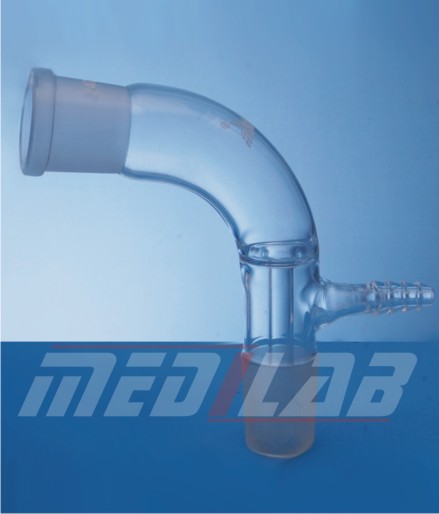
The MEDILAB Receiver Adapter, Bend with Vacuum Connection, is a specialised glassware component designed to connect receiving vessels in vacuum-assisted distillation and filtration systems. Its bent design ensures smooth directional flow, while the integrated vacuum hose connection allows controlled pressure regulation. This adapter is essential for safe, efficient, and stable laboratory operations involving reduced pressure.
Key Features
- Bent adapter design for efficient transfer of vapors or liquids
- Integrated vacuum side-arm for secure hose connection
- Precision-ground joints for leak-proof performance
- Smooth internal bore to minimize flow resistance
- High resistance to thermal and chemical stress
- Compatible with standard interchangeable laboratory glassware
Material Specifications
- Material Type: Premium borosilicate laboratory glass
- Thermal Properties: Excellent resistance to thermal shock and high temperatures
- Chemical Resistance: Resistant to acids, alkalis, and organic solvents
- Mechanical Strength: Uniform wall thickness for enhanced durability
- Standards Compliance: Manufactured in accordance with ISO / DIN laboratory glassware standards
Technical Specifications
- Design: Bent receiver adapter with vacuum connection sidearm
- Joint Type: Standard ground glass joints (multiple sizes available)
- Vacuum Connection: Hose nozzle suitable for standard vacuum tubing
- Dimensions: Compatible with standard laboratory assemblies
- Accuracy Class: Not volumetrically calibrated
- Accessories Included: Adapter supplied without tubing or clamps
Handling & Precautions
- Ensure vacuum tubing is securely attached before operation
- Avoid sudden pressure or temperature changes during use
- Clean thoroughly after use with appropriate lab detergents
- Suitable for autoclaving under standard laboratory conditions
- Inspect joints and side arms regularly for cracks or wear
- Store in padded or dedicated glassware racks when not in use
Applications
- Vacuum distillation and solvent recovery systems
- Reduced-pressure filtration setups
- Chemical synthesis and separation processes
- Pharmaceutical and biotechnology laboratories
- Academic research and teaching laboratories
- Quality control and analytical testing environments