

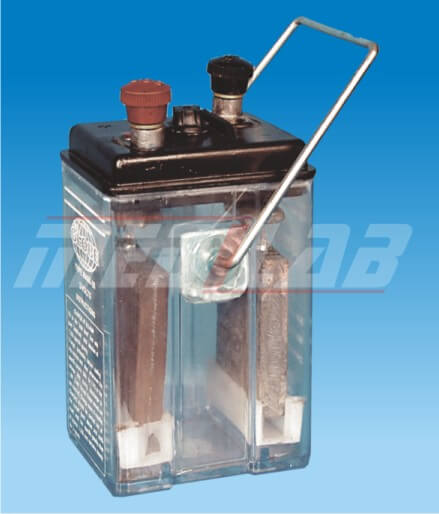
Lead Accumulator

Catalogue No. – 19004

Lead Accumulator is capable of storing electrical energy from an external source(charging) and supplying it during discharge

Catalogue No.Rating
19004/012V, 20Ah
19004/022V, 45Ah

SKU: 19004 Categories: ,

Description

A Lead-Acid Battery, also known as a Lead Accumulator, is a type of rechargeable battery that uses a chemical reaction to store and release electrical energy.

The battery consists of several cells, each containing a positive electrode (made of lead dioxide), a negative electrode (made of lead), and an electrolyte solution (usually sulphuric acid). When the battery is charged, the lead dioxide on the positive electrode reacts with the sulfuric acid to form lead sulfate and water. In contrast, the lead on the negative electrode reacts with the sulphuric acid to form lead sulphate and hydrogen gas.

When the battery is discharged, the chemical reaction is reversed, with the lead sulfate on the electrodes reacting with the electrolyte to form lead dioxide, lead, and sulphuric acid, releasing electrical energy in the process.

Lead-acid batteries are commonly used as backup power sources for telecommunications equipment, emergency lighting systems, and uninterruptible power supplies (UPSs). They are also used in vehicles as the primary power source for starting the engine and operating the electrical systems, such as lights and radio.

Overall, Lead-Acid Batteries are a reliable and versatile type of rechargeable battery that is widely used in various applications due to their long service life, low cost, and high energy density. However, they also have some drawbacks, such as being heavy, requiring regular maintenance, and being sensitive to overcharging and deep discharge.