
Description
| Catalogue No. | Size (mm) |
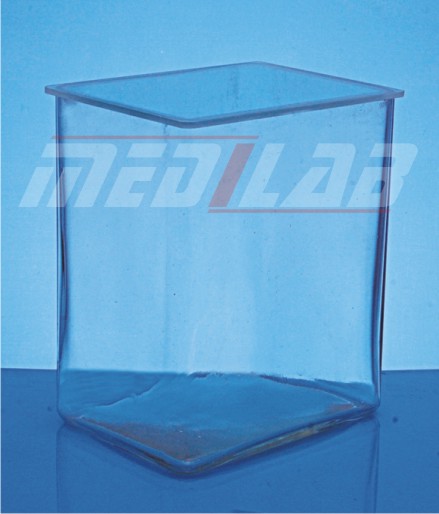
| 11020/6 | 140x140x220 |
| 11020/7 | 170x130x210 |
| 11020/8 | 225x125x225 |
| 11020/9 | 250x150x250 |
The MEDILAB Chromatographic Tank, also known as a Developing Chamber, is a precision-crafted glass vessel designed for Thin Layer Chromatography (TLC) solvent development. It provides a controlled environment for mobile phase saturation, ensuring sharp, reproducible, and high-resolution chromatographic separations. Widely used in research, pharmaceutical QC, chemical analysis, and academic labs, this chamber is essential for reliable compound identification and purity testing.
Key Features
- Manufactured from premium Borosilicate Glass 3.3 for superior chemical resistance and thermal stability.
- Ensures uniform solvent vapour saturation for accurate and reproducible TLC results.
- Smooth, stress-free construction minimises streaking and solvent disturbances.
- Airtight lid design (depending on model) to prevent solvent evaporation and maintain consistent developing conditions.
- Excellent visibility for monitoring solvent level and plate positioning.
- Available in both rectangular and cylindrical models to suit diverse laboratory workflows.
- Resistant to acids, alkalis, organic solvents, and routine lab reagents.
- Robust and durable design ideal for routine analytical and research work.
Material Specifications
- Material: Borosilicate Glass 3.3
- Thermal Properties: High thermal shock resistance, Low thermal expansion coefficient (~3.3 × 10⁻⁶ /K)
- Chemical Resistance: Highly resistant to most acids, solvents, and chemicals. Non-reactive surface for high-purity analytical applications
- Mechanical Strength: Stress-free, annealed construction for durability in repeated daily use
- Standards Compliance: Manufactured in accordance with ISO 3585 (Borosilicate Glass 3.3 standard). Follows international laboratory glassware norms (ISO / DIN equivalents)
Technical Specifications
- Available Variants: Rectangular TLC Developing Chambers, Cylindrical TLC Developing Chambers
Typical Specifications:
- Wall Thickness: Uniform, optimised for mechanical stability
- Lid Type: Ground glass or flat glass lid (depending on model)
- Tolerance: Within standard lab glassware dimensional tolerance
- Calibration: Not applicable (non-volumetric instrument)
- Accessories (optional): Glass rods, TLC plate holders, Chamber liners
Handling & Precautions
- Handle with care to avoid sudden impacts or thermal shocks.
- Clean using mild laboratory detergents; avoid abrasive materials that may scratch the glass.
- Compatible with acetone, ethanol, and most solvent cleaning agents.
- Do not expose to open flame or extreme direct heat; maximum recommended heating: up to 200°C (dry heat).
- Allow gradual heating and cooling to maintain glass integrity.
- Ensure the chamber is completely dry before adding solvent to avoid contamination.
- Store in a well-padded, dust-free location when not in use.
Applications
- Pharmaceutical QC & QA: Impurity profiling, identity testing, purity checks.
- Chemical & Analytical Laboratories: Separation of organic and inorganic compounds.
- Biotechnology & Life Sciences: Monitoring biomolecules, pigments, amino acids, and metabolites.
- Academic & Research Institutions: TLC training, method development, and routine chromatographic studies.
- Industrial Quality Testing: Dyes, polymers, oils, adhesives, and fine chemicals.
- Essential for any workflow involving Thin Layer Chromatography (TLC) or solvent development.