

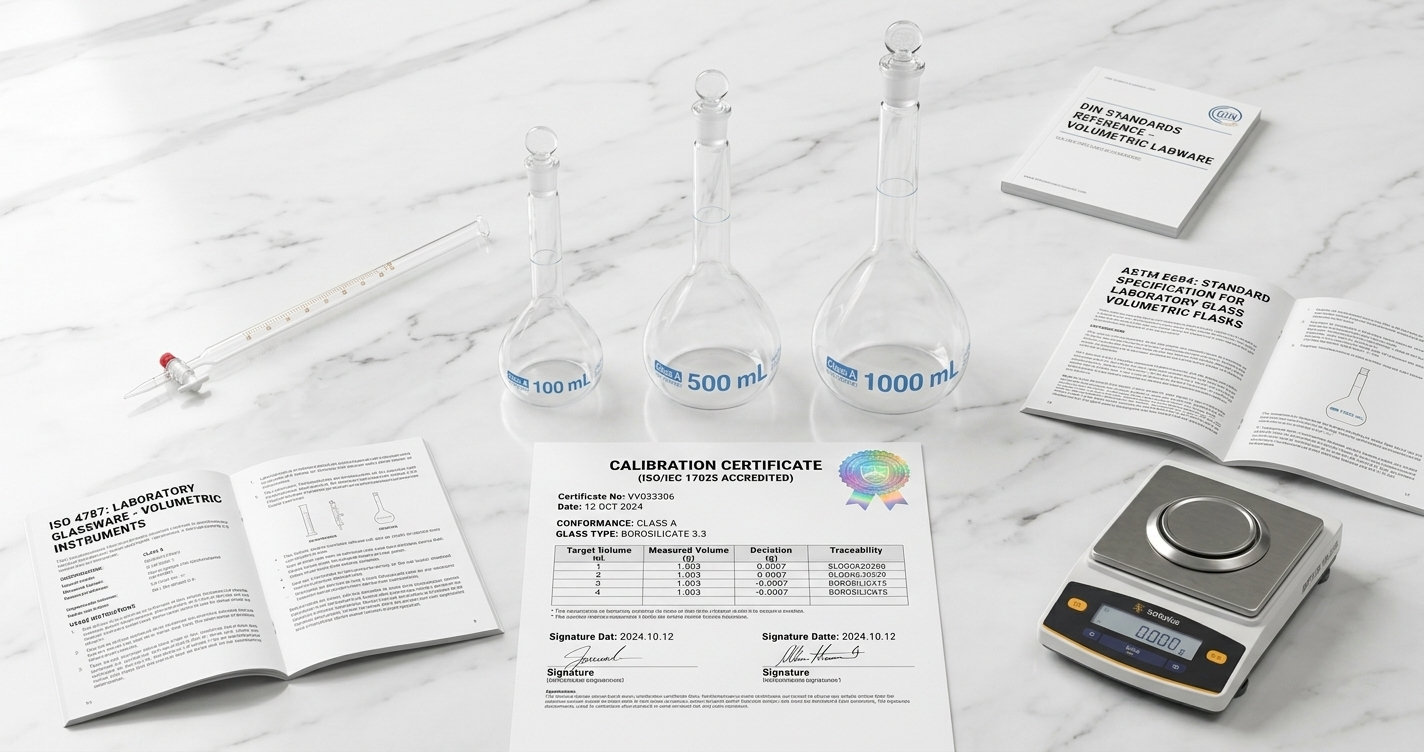
Laboratory glassware quality standards are the backbone of every reliable analytical result. When a chemist records a titre from a burette, or a pharmaceutical technician measures a reagent volume in a volumetric flask, the accuracy of that measurement depends entirely on whether the glassware was manufactured and verified against a recognised international standard.
Without laboratory glassware quality standards, there is no traceability, no assurance of accuracy, and no basis for regulatory compliance. A laboratory can have the most advanced instruments in the world and still produce unreliable results if the glassware used to prepare standards and samples falls outside defined tolerances.
Three major standards bodies govern laboratory glassware quality standards globally: ISO (International Organization for Standardization), ASTM International, and DIN (Deutsches Institut fur Normung). Each publishes detailed specifications for volumetric accuracy, material properties, calibration methods, and permissible tolerances.
This guide covers the 7 most important laboratory glassware quality standards from ISO, ASTM, and DIN that every modern laboratory should know. It also explains Class A versus Class B tolerances, verification protocols, glassware marking requirements, and what certified documentation should look like when you receive a shipment.
- Why Laboratory Glassware Quality Standards Matter
- Standards 1-4: ISO Product Standards (ISO 1042, 385, 648, 4788)
- Standard 5: ISO 4787 – Volumetric Verification Methods
- Standard 6: ASTM E694 – The American Volumetric Framework
- Standard 7: DIN 12600 Series – Germany’s Precision Legacy
- Class A vs Class B: What the Standards Actually Define
- How to Read Compliance Markings on Laboratory Glassware
- ISO 9001 and ISO 17025: Systems-Level Quality Assurance
- How to Verify Compliance When Sourcing Glassware
- Frequently Asked Questions
Why Laboratory Glassware Quality Standards Matter
Laboratory glassware quality standards exist because volumetric measurement is inherently difficult to reproduce without a shared reference framework. A nominal 100 mL volumetric flask does not automatically contain exactly 100 mL. It contains 100 mL only when manufactured to the tolerance defined in the applicable standard, calibrated at the reference temperature (20 degrees C), and used correctly.
The scale of the problem becomes visible in real-world measurement chains. A pharmaceutical analyst preparing a 1000 ppm primary standard starts by weighing the reference material on a calibrated balance, then dissolves and dilutes it in a volumetric flask.
If that flask carries a volume error of 0.8 mL (the Class B limit for a 1000 mL flask), the final concentration is 0.08% off before any analytical instrument is even involved.
In a potency assay with a regulatory specification of 98-102%, an 0.08% volumetric error can push a passing result to a borderline failure.
In regulated industries, the consequences of ignoring laboratory glassware quality standards are direct and severe. The FDA CGMP regulations require that all volumetric instruments used in pharmaceutical testing be calibrated and traceable to national standards.
The USP General Chapter on Volumetric Apparatus specifies maximum permissible errors that align directly with ISO Class A tolerances. A laboratory using uncertified glassware in a GMP-regulated assay is operating with an undefined error margin.
Beyond regulated industries, the same principle applies in environmental testing, food safety analysis, forensic chemistry, and academic research. Any discipline where a volumetric measurement feeds into a calculation or a decision is affected by adherence to laboratory glassware quality standards.
These standards also provide a common language across international supply chains. When a laboratory in Germany and a laboratory in India both specify “ISO 1042 Class A, 1000 mL,” they are specifying the same maximum permissible error, the same test temperature, and the same verification methodology.
Standards 1-4: ISO Product Standards (ISO 1042, 385, 648, 4788)
ISO Technical Committee 48 (Laboratory Glassware and Related Apparatus) has published individual product standards for the most common volumetric glassware types. These four ISO laboratory glassware quality standards are the most widely referenced in procurement specifications worldwide:
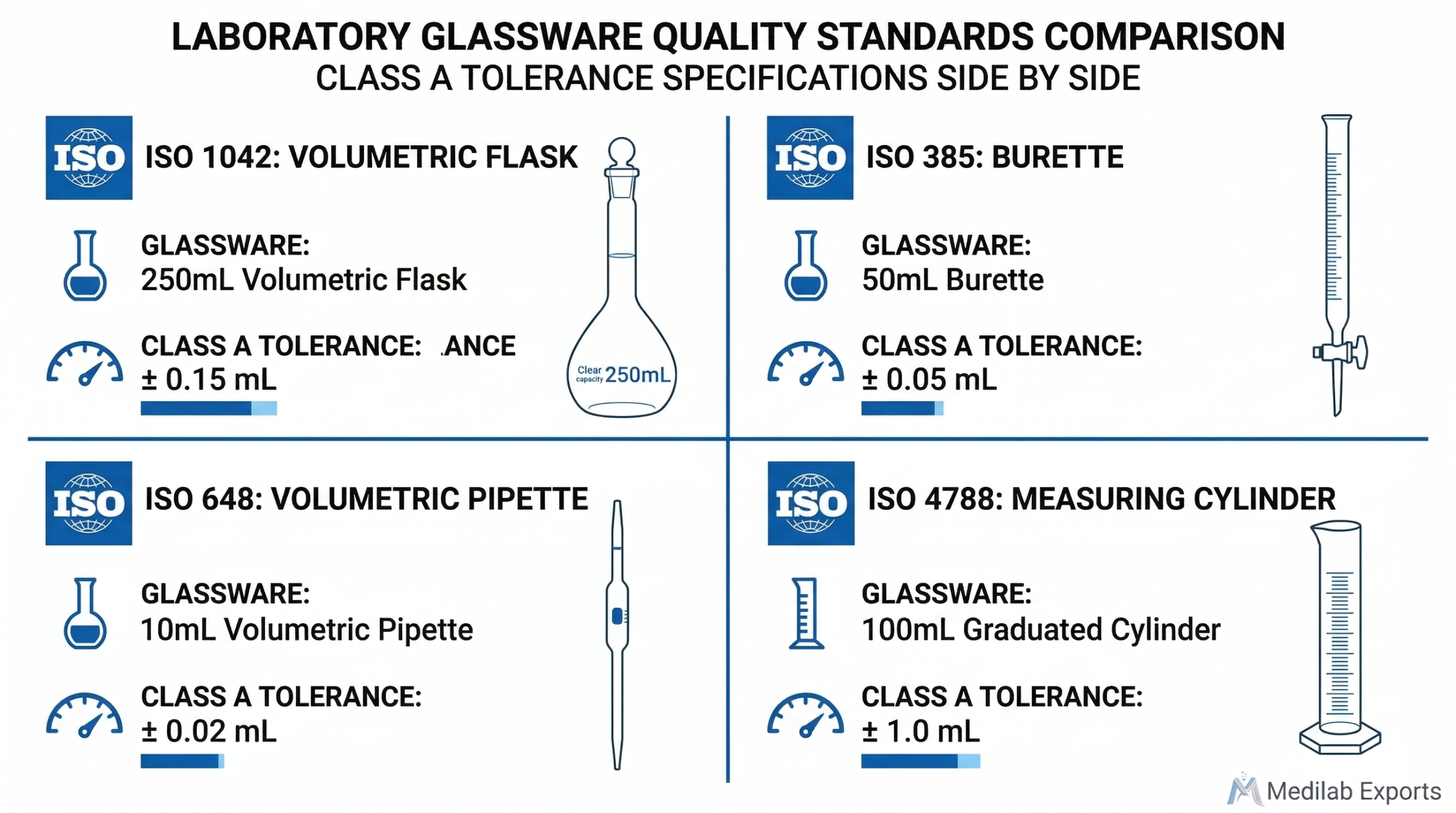
| ISO Standard | Glassware Type | Class A Example Tolerance | Class B Example Tolerance |
|---|---|---|---|
| ISO 1042 | One-mark volumetric flasks | +/- 0.40 mL at 1000 mL | +/- 0.80 mL at 1000 mL |
| ISO 385 | Burettes | +/- 0.05 mL at 50 mL | +/- 0.10 mL at 50 mL |
| ISO 648 | One-mark pipettes | +/- 0.08 mL at 10 mL | +/- 0.15 mL at 10 mL |
| ISO 4788 | Graduated measuring cylinders | +/- 1.0 mL at 100 mL | +/- 2.0 mL at 100 mL |
Each standard specifies: the nominal capacity range, the reference temperature (20 degrees C), the maximum permissible error (MPE) for each nominal volume, graduation interval requirements, marking and labelling requirements, and material requirements (borosilicate glass 3.3 per ISO 3585 for Class A).
Importantly, these are product standards. They define what finished glassware must achieve, not how to test it. The test methodology is covered separately by ISO 4787.
ISO 1042 – One-Mark Volumetric Flasks
ISO 1042 is the most widely referenced of all laboratory glassware quality standards for volumetric work. It covers single-mark volumetric flasks from 1 mL to 10,000 mL and specifies that Class A flasks must carry the graduation mark etched or permanently applied at the neck.
The Class A tolerance at 1000 mL is +/- 0.40 mL, representing a relative error of 0.04%. This tolerance was established to ensure that primary standards prepared in ISO 1042 Class A flasks contribute less uncertainty than the typical analytical instrument, keeping glassware as the smallest error source in the measurement chain.
ISO 385 – Burettes
ISO 385 covers graduated burettes from 5 mL to 100 mL used for titration. It specifies graduated subdivision intervals, minimum tube length requirements, stopcock design requirements, and both Class A and Class B tolerance tables across the full capacity range.
A 50 mL Class A burette must achieve a maximum permissible error of +/- 0.05 mL at any point along its scale – not just at the full 50 mL reading. This per-graduation accuracy requirement makes burette testing more complex than flask testing, requiring gravimetric verification at multiple points along the scale.
ISO 648 – One-Mark Pipettes
ISO 648 covers single-mark transfer pipettes from 0.5 mL to 200 mL. These pipettes are designed to deliver a fixed volume by gravity flow with the tip in contact with the receiving vessel wall – a technique specified by ISO 4787 to ensure consistent drainage behaviour.
The Class A tolerance at 10 mL is +/- 0.08 mL. ISO 648 also specifies the drainage time (the wait time after the liquid level passes the graduation mark before removing the tip), which is critical for volume reproducibility.
ISO 4788 – Graduated Measuring Cylinders
ISO 4788 covers graduated measuring cylinders from 5 mL to 2000 mL. Measuring cylinders carry wider tolerances than flasks or pipettes because they are designed for approximate rather than precise volume measurement.
The Class A tolerance at 100 mL is +/- 1.0 mL (1% relative error), compared to 0.04% for an ISO 1042 flask at 1000 mL. The standard also mandates that the base be designed to prevent tipping and specifies minimum graduation interval requirements throughout the scale.
Standard 5: ISO 4787 – Volumetric Verification Methods
ISO 4787 (Laboratory Glassware – Volumetric Instruments – Methods for Testing and Use) is the procedural companion to the product standards above. Where ISO 1042, 385, 648, and 4788 define the tolerances, ISO 4787 defines exactly how to measure them.
The standard specifies the gravimetric method as the primary verification technique. Water is dispensed from the glassware into a weighing vessel on a calibrated analytical balance. The mass is then converted to volume using the density of water at the measured temperature. This eliminates the meniscus-reading error that occurs when comparing glassware against a reference vessel.
The step-by-step gravimetric process under ISO 4787 involves six stages:
- Cleaning: Glassware must be cleaned with a defined protocol (dilute sulfuric acid or laboratory detergent, followed by thorough rinsing with purified water) to ensure consistent wetting behaviour during testing.
- Conditioning: Clean glassware must be conditioned at 20 degrees C (+/- 0.5 degrees C) for a minimum period, typically 30 minutes in a temperature-controlled room or water bath.
- Weighing: A clean receiving vessel is tared. Water is dispensed from the glassware under test using the drainage technique specified in ISO 4787 for that instrument type.
- Temperature measurement: The water temperature is recorded immediately using a calibrated thermometer to allow accurate density conversion.
- Volume calculation: The measured mass is divided by water density at the recorded temperature and compared against the MPE in the applicable product standard.
- Replicate measurements: ISO 4787 specifies a minimum number of replicate determinations to ensure a statistically valid result.
These controls exist because glassware volume changes measurably with temperature. A 1 degree C deviation at the 1000 mL level produces a volume error of approximately 0.03 mL – 7.5% of the entire Class A tolerance at that volume.
For procurement teams, ISO 4787 compliance at the manufacturer’s quality control stage is the most important single indicator of reliable laboratory glassware quality standards implementation. When requesting documentation from a new supplier, ask them to confirm in writing that their calibration verification follows ISO 4787 gravimetric methodology, not comparator-based visual inspection.
Standard 6: ASTM E694 – The American Volumetric Framework
ASTM E694 (Standard Specification for Laboratory Glass Volumetric Apparatus) is the primary ASTM standard governing laboratory glassware quality standards in North America. It is functionally equivalent to the ISO product standards in terms of tolerance requirements but uses slightly different terminology and references.
Key ASTM volumetric standards relevant to North American markets:
- ASTM E287 – Standard Specification for Laboratory Glass Volumetric Flasks (complements ISO 1042)
- ASTM E969 – Standard Specification for Glass Volumetric Transfer Pipets (complements ISO 648)
- ASTM E1044 – Standard Specification for Glass Serological Pipets
- ASTM E694 – General volumetric apparatus framework covering all common types
One important difference from ISO: ASTM standards require NIST (National Institute of Standards and Technology) traceability for calibration verification.
This means the analytical balance used for gravimetric testing must be calibrated using weights traceable to NIST reference standards. This traceability chain is formally documented in the calibration certificate that accompanies the glassware.
For laboratories purchasing glassware for US regulatory submissions (FDA, EPA, USDA), ASTM-certified glassware with NIST-traceable calibration documentation is often the preferred or explicitly required specification.
For global supply chains, ISO laboratory glassware quality standards certification is generally broader and more universally recognised by regulatory authorities in Europe, Asia, and other regions. When in doubt, specify both ISO and ASTM compliance for shipments destined for US regulatory use.
Standard 7: DIN 12600 Series – Germany’s Precision Legacy
The DIN (Deutsches Institut fur Normung) 12600 series represents Germany’s contribution to laboratory glassware quality standards, developed through decades of precision manufacturing expertise centered in the Jena and Wertheim glassware-making tradition.
DIN standards are published by Germany’s national standards body and have been adopted throughout the European Union as complementary or equivalent specifications alongside ISO standards.
Key DIN standards in the series:
- DIN 12600 – General requirements for laboratory glassware, including marking, material, and workmanship requirements applicable across all glassware categories
- DIN 12601 – Borosilicate glass 3.3 material specification, harmonised with ISO 3585
- DIN 12620 – Volumetric flasks, tolerances equivalent to ISO 1042
- DIN 12700 – Pipettes and related measurement apparatus
- DIN 12775 – Burettes, covering design and tolerance requirements equivalent to ISO 385
DIN standards carry particular weight in European regulatory frameworks, especially for compliance with European Pharmacopoeia (Ph.Eur.) requirements.
The Ph.Eur. Section 2.1.3 (Volumetric Glassware) specifies that glassware used in official pharmacopoeial methods must comply with Class A tolerances as defined in European (DIN/EN/ISO) standards.
For global procurement from manufacturers in Germany, Switzerland, or Austria, DIN certification is a strong quality signal for laboratory glassware quality standards compliance. For procurement from Asian manufacturers supplying European customers, ISO certification that aligns with harmonised DIN/EN standards provides equivalent assurance.
Class A vs Class B: What the Standards Actually Define
All ISO, ASTM, and DIN laboratory glassware quality standards define two accuracy classes: Class A (higher precision) and Class B (general purpose). The distinction is quantitative, not qualitative. Both classes are manufactured as laboratory glassware, but they are appropriate for fundamentally different applications.
Class A glassware meets tighter maximum permissible errors (typically half the Class B tolerance at every nominal volume). Class A verification requires gravimetric testing per ISO 4787, and Class A items carry individual or batch calibration certification. Class A glassware is required for:
- Pharmacopoeial assays (USP, Ph.Eur., IP, BP, JP)
- Primary reference standard preparation
- Titration with documented accuracy requirements
- GMP-regulated analytical procedures in pharmaceutical QC
- Method validation experiments where volumetric uncertainty must be quantified
- Environmental testing where sample dilution accuracy affects regulatory compliance
Class B glassware meets the wider tolerance band and is calibrated to a less stringent specification. It is appropriate for:
- Routine buffer and reagent preparation where exact concentration is not critical
- Educational and teaching laboratories
- Non-critical serial dilutions in research settings
- General bench chemistry where approximate volumes are sufficient
Class B is not suitable for primary standard preparation or regulatory compliance assays. Choosing Class B for critical applications to save cost represents a direct GMP deviation in regulated industries.
Both classes must be manufactured from borosilicate glass 3.3 to carry ISO or DIN certification. However, Class A additionally requires gravimetric verification at the manufacturer’s facility. This difference in verification rigor is a significant part of the price premium for Class A – not just the tighter manufacturing tolerance.
Understanding the distinction between Class A and Class B is one of the most practical aspects of applying laboratory glassware quality standards in daily procurement decisions.
How to Read Compliance Markings on Laboratory Glassware
One of the simplest and most overlooked compliance steps is reading the markings on the glassware itself. ISO, ASTM, and DIN laboratory glassware quality standards all specify required markings that must appear on compliant items. Learning to read these markings allows laboratory staff to instantly verify the specification of any piece of glassware without referring to documentation.
A correctly marked ISO 1042 Class A volumetric flask at 1000 mL should show all of the following:
- Nominal volume: 1000 mL (or 1 L)
- Class designation: A (or Class A)
- Reference temperature: 20 degrees C (shown as TC 20 degrees C for “to contain” or TD 20 degrees C for “to deliver”)
- Standard number: ISO 1042 (or equivalent EN/DIN standard number)
- Manufacturer’s mark or trademark
- Batch or lot number (required for Class A items in regulated applications)
The distinction between “TC” (to contain) and “TD” (to deliver) is critical. Most volumetric flasks are calibrated TC – they contain the stated volume when filled to the mark. Most pipettes and burettes are calibrated TD – they deliver the stated volume when drained.
Using a TD pipette as if it were TC introduces a systematic error equal to the volume of liquid retained on the inner wall after drainage.
If any required markings are absent or illegible, the glassware should be quarantined and returned. A piece of glassware without clear standard markings cannot be considered compliant with any laboratory glassware quality standards, regardless of what the supplier’s certificate states.
ISO 9001 and ISO 17025: Systems-Level Quality Assurance
Beyond product-level standards, two systems-level certifications determine whether a manufacturer’s entire quality infrastructure supports reliable laboratory glassware quality standards implementation.
ISO 9001 (Quality Management Systems) is the world’s most widely adopted quality management standard. ISO 9001 certification for a glassware manufacturer verifies that the company has a documented, regularly audited quality management system covering:
- Document and record control
- Design and development controls for new glassware types
- Production and process controls
- Supplier qualification and purchasing controls
- Inspection and test equipment calibration
- Nonconforming product management
- Corrective and preventive action procedures
An ISO 9001 certificate from an accredited certification body (UKAS in the UK, DAkkS in Germany, NABCB in India, or ANAB in the US) means an independent auditor has verified the manufacturer’s QMS against the standard’s requirements. This is the minimum system-level certification a glassware supplier should hold.
ISO 17025 (General Requirements for the Competence of Testing and Calibration Laboratories) is the highest-level accreditation for any laboratory performing calibration verification.
If a manufacturer’s in-house calibration laboratory is ISO 17025-accredited, their gravimetric verification data is considered technically equivalent to data from a national metrology institute.
ISO 17025 requires the calibration laboratory to demonstrate technical competence across qualified personnel, validated methods, and traceable reference standards – rather than just procedural compliance.
For pharmaceutical clients requiring full metrological traceability, ISO 17025 accreditation at the manufacturing stage is the gold standard of laboratory glassware quality standards implementation. It provides unbroken traceability from the delivered glassware back through gravimetric verification to the national measurement system.
Medilab Exports Consortium operates under ISO 9001 quality management protocols and works with ISO 17025-accredited calibration verification for Class A volumetric product lines. Our certification documentation is available to distributors and direct customers upon request.
How to Verify Compliance When Sourcing Glassware
Knowing the laboratory glassware quality standards framework is only half the equation. You also need to confirm that your supplier actually meets them in practice. Here is a comprehensive verification framework for procurement teams.
Before Placing an Order
These steps establish laboratory glassware quality standards compliance before any material arrives at your facility:
- Request the ISO 9001 certificate: Ask for the current certificate issued by an accredited certification body. Verify it covers laboratory glassware and that the expiry date is current. Check the accreditation body’s name against the ISO CASCO list of recognised accreditation bodies.
- Request the product compliance declaration: Ask for a written declaration of conformity stating which specific ISO product standards the glassware meets (e.g., ISO 1042 Class A, ISO 385 Class A). Generic statements like “meets international standards” are not sufficient.
- Ask about the calibration verification method: Request written confirmation that gravimetric verification per ISO 4787 is used for Class A product calibration – not comparator-based visual inspection.
- Request the material declaration: Confirm that the glassware is manufactured from borosilicate glass 3.3 per ISO 3585. A statement of “borosilicate glass” without the 3.3 designation does not confirm the required thermal expansion coefficient or hydrolytic resistance classification.
On Receipt of Shipment
- Inspect markings on every piece: Check that all required markings are present and legible (nominal volume, class designation, reference temperature, standard number, manufacturer mark). Quarantine any unmarked or partially marked items.
- Review the calibration certificate: For Class A volumetric items in regulated applications, the batch calibration certificate should identify the batch number, nominal volume tested, actual measured volume, measurement uncertainty, test temperature, balance model, and the metrologist’s signature.
- Perform incoming gravimetric inspection: Use a calibrated analytical balance (resolution 0.1 mg or better) and purified water to spot-check critical items per ISO 4787 on receipt. A minimum 2% sample from each production batch is recommended for Class A glassware in GMP applications.
- Check batch and lot numbers: Confirm that the batch number on the calibration certificate matches the batch number marked on the glassware. This basic step ensures the certificate actually refers to the product you received.
For more details on evaluating your glassware supplier’s manufacturing capability, see our guide on Laboratory Glassware Manufacturing: Complete 8-Step Process. For an overview of common glassware types and their specification requirements, see 12 Common Laboratory Glassware and Their Uses. For a detailed look at the precision tolerances that make Class A glassware indispensable, see Precision Scientific Glassware: 7 Critical Reasons Why It Matters.
Medilab Exports Consortium supplies ISO-certified borosilicate labware with full laboratory glassware quality standards documentation to distributors and institutions in over 40 countries. All Class A volumetric products ship with batch calibration certificates referencing ISO 4787 gravimetric verification. Contact our team for product specifications and distributor pricing.
Frequently Asked Questions
ISO laboratory glassware quality standards (ISO 1042, 385, 648, 4788, 4787) are published by the International Organization for Standardization and are recognised globally, including in the EU, Asia, and most regulated markets. ASTM standards (E694, E287, E969) are published by ASTM International and are most commonly referenced in North American regulatory contexts (FDA, EPA, USDA). Both specify similar tolerance classes and gravimetric verification methods. The key practical difference is that ASTM standards require NIST-traceable calibration documentation. For global supply chains, ISO certification provides broader recognition. For US regulatory submissions, ASTM certification with NIST-traceable documentation may be specifically required.
No. Class A glassware is required for applications where volumetric accuracy is critical and must be traceable: pharmacopoeial assays, primary standard preparation, GMP-regulated titrations, and regulatory compliance testing. Class B glassware is appropriate for routine solution preparation, teaching laboratories, and general bench chemistry where the tighter Class A tolerance is not needed. The key is matching the glassware class to the precision requirement of the specific procedure – a risk-based approach consistent with laboratory glassware quality standards and good laboratory practice.
At minimum: the manufacturer’s ISO 9001 certificate (from an accredited body), a declaration of conformity stating which ISO product standards the glassware meets (e.g., ISO 1042 Class A), and a material declaration confirming borosilicate glass 3.3 per ISO 3585. For Class A volumetric items in regulated applications, a batch calibration certificate referencing ISO 4787 gravimetric methodology should also be provided. This certificate should identify the batch number, the measured volume, the measurement uncertainty, the test temperature, the balance calibration status, and the signature of the responsible metrologist. The batch number on the certificate must match the batch number etched on the glassware itself.
ISO 4787 is the ISO standard that defines the gravimetric method for testing and verifying volumetric laboratory glassware. It specifies the complete procedure for weighing water dispensed from a volumetric instrument, converting mass to volume using water density at the measured temperature, and determining whether the result falls within the maximum permissible error defined by the applicable product standard. ISO 4787 compliance at the manufacturing verification stage is the most direct indicator that a manufacturer’s laboratory glassware quality standards certification is based on defensible, traceable measurement data rather than visual inspection against a reference vessel. Without ISO 4787 compliance, a Class A claim is an unverified commercial assertion rather than a metrologically grounded certification.
Yes. ISO 4787 provides the full gravimetric verification procedure that can be performed in any laboratory with a calibrated analytical balance (resolution 0.1 mg or better), a calibrated thermometer (resolution 0.1 degrees C), and purified water. The procedure involves: pre-cleaning the glassware, conditioning at 20 degrees C, taring a clean receiving vessel, dispensing water using the specified drainage technique, recording the temperature, calculating the dispensed volume from mass and water density, and comparing against the MPE table in the applicable ISO product standard. Perform this incoming inspection on a minimum 2% sample from each received batch and document the results in your quality management system.
Borosilicate glass 3.3 is a specific glass composition defined by ISO 3585, characterised by a thermal expansion coefficient of 3.3 x 10 to the power of -6 per Kelvin (compared to approximately 9 x 10 to the power of -6 per K for ordinary soda-lime glass). ISO and DIN laboratory glassware quality standards require borosilicate glass 3.3 (not just “borosilicate glass”) for Class A certification because the volume calibration performed at the manufacturing stage is only valid for glass with this specific thermal expansion behaviour. Using a different glass composition would make the etched graduation marks inaccurate at any temperature other than the calibration temperature.
ISO 9001 is a quality management system standard covering business processes, documentation, and continuous improvement. ISO 17025 is a technical competence standard specifically for testing and calibration laboratories. For a glassware manufacturer, ISO 9001 certification confirms that their overall quality management system is documented and audited. ISO 17025 accreditation for their in-house calibration laboratory additionally confirms that the specific people, equipment, methods, and measurement traceability used for gravimetric verification meet the technical requirements for producing internationally recognised calibration data. For pharmaceutical customers requiring full metrological traceability in their laboratory glassware quality standards supply chain, ISO 17025-accredited verification at the manufacturing stage is the stronger requirement.
Need ISO-Certified Laboratory Glassware With Full Documentation?
Medilab Exports supplies Class A borosilicate glassware with ISO 4787 calibration certificates, ISO 9001 manufacturing compliance, and export-ready documentation for distributors in 40+ countries.
