
Laboratory glassware manufacturing is a precision industrial process that transforms raw mineral oxides into calibrated scientific instruments used in pharmaceutical assays, chemical synthesis, environmental testing, and biological research. Unlike ordinary glass production, which prioritizes aesthetics and structural strength, laboratory glassware manufacturing is governed by international metrology standards that define exact tolerances, material purity requirements, and verification protocols. Every volumetric flask, burette, and pipette that reaches a laboratory bench has passed through a rigorous multi-stage production process designed to ensure that its stated volume is its true volume.
Understanding the laboratory glassware manufacturing process helps procurement professionals, quality managers, and laboratory scientists make more informed supplier selection decisions. When you understand what happens inside a glass production facility, you can ask better questions, evaluate supplier capability more accurately, and identify the quality shortcuts that separate a certified manufacturer from an uncertified one. This guide walks through 8 key stages of precision labware production, from raw material selection through final quality release.
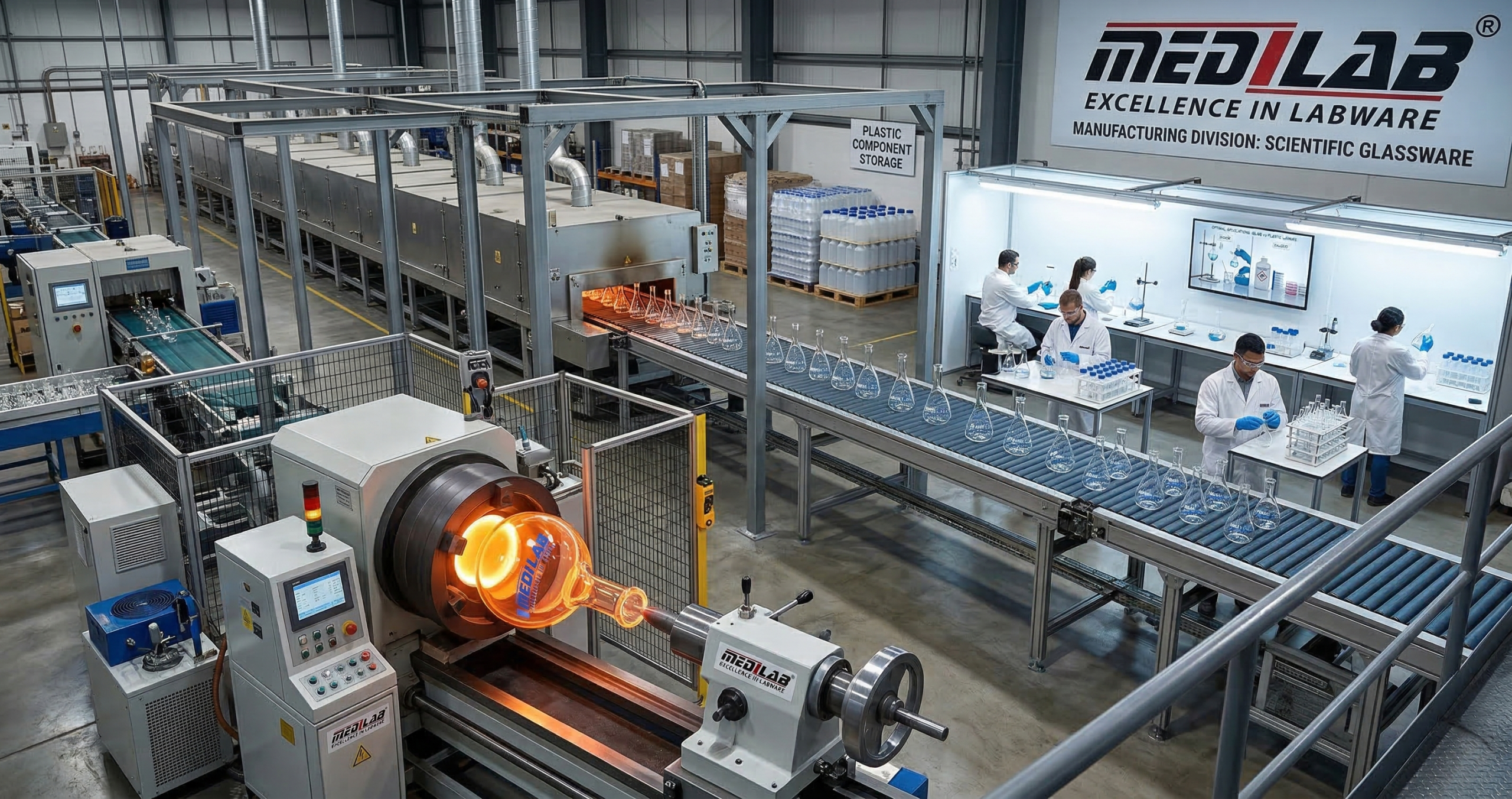
Medilab Exports Consortium operates a direct laboratory glassware manufacturing facility supplying ISO-certified borosilicate labware to distributors and institutions in over 40 countries. Our production process follows ISO and ASTM standards at every stage, from the batch composition of borosilicate 3.3 glass through gravimetric calibration verification and export packaging.
What Makes Laboratory Glass Different from Ordinary Glass?
The most important distinction in laboratory glassware manufacturing begins with the raw material itself. Ordinary glass – used in windows, bottles, and tableware – is soda-lime glass, composed primarily of silica (SiO2), sodium oxide (Na2O), and calcium oxide (CaO). This formulation is inexpensive and easy to work with, but it has a high thermal expansion coefficient (approximately 9 x 10 to the power of -6 per K), leaches alkali ions into acidic and neutral solutions, and cannot withstand significant temperature cycling without cracking.
Laboratory glassware is manufactured from borosilicate glass 3.3, which replaces a significant portion of the sodium oxide with boron trioxide (B2O3), typically 12 to 13 percent by weight. This substitution produces a glass with a thermal expansion coefficient of 3.3 x 10 to the power of -6 per K – approximately three times lower than soda-lime glass – and Hydrolytic Class 1 chemical resistance per ISO 719. The material specification for borosilicate 3.3 glass used in laboratory glassware manufacturing is formally defined in ISO 3585, which specifies minimum boron trioxide content, maximum expansion coefficient, and hydrolytic resistance class.
Understanding this material distinction explains why certified laboratory glassware manufacturing cannot simply use cheaper glass from alternate sources without compromising the performance properties that define the product. Every stage of the production process described below assumes a borosilicate 3.3 starting material, and the calibration data produced at the end of the process is only valid for that specific glass composition.
Step 1: Raw Material Selection and Batch Preparation
The first stage of laboratory glassware manufacturing is the preparation of the glass batch – the carefully weighed mixture of mineral raw materials that will be fused into glass. The primary constituents are high-purity silica sand (SiO2), boric acid or borax (B2O3 source), soda ash (Na2O source), and alumina (Al2O3). These are sourced from certified mineral suppliers and tested upon receipt to verify chemical purity and particle size distribution, both of which affect melting behavior and final glass homogeneity.
Batch formulation in precision laboratory glassware manufacturing is tightly controlled, as even minor variations in the oxide ratios shift the thermal expansion coefficient and chemical resistance class of the finished glass. The target composition for borosilicate 3.3 glass is approximately 80.6% SiO2, 13.0% B2O3, 4.0% Na2O/K2O, and 2.3% Al2O3.
Cullet – cleaned, pre-melted borosilicate glass from previous production runs – is typically added to the batch to improve melting efficiency and reduce energy consumption. Cullet must be free from contamination with soda-lime glass or other glass types, as even small quantities of incompatible glass can cause streaking, devitrification, or expansion mismatches in the final product.
Step 2: Glass Melting and Homogenization
The prepared batch is fed into a continuous tank furnace operating at temperatures between 1,450 and 1,600 degrees C. At these temperatures, the solid mineral components react and dissolve into a homogeneous molten glass. The melting process in laboratory glassware manufacturing must be carefully managed to eliminate bubbles (seeds and blisters), stones (unmelted refractory inclusions), and cords (streaks of compositionally different glass) – all of which constitute critical defects in the finished product.
Homogenization is achieved through a combination of thermal convection, mechanical stirring in some furnace designs, and a controlled residence time in the refining zone of the furnace, where the temperature is slightly lower and bubbles have time to rise out of the melt. The molten glass exits the furnace at a working temperature of approximately 1,100 to 1,200 degrees C, where its viscosity is appropriate for the forming operations that follow. Consistent melt temperature and composition are the foundation of consistent dimensional properties in laboratory glassware manufacturing.
Step 3: Forming – Blowing, Pressing, and Tubing
The third stage of laboratory glassware manufacturing converts molten glass into the shapes of specific labware items through one of three primary forming methods. Blowing – either mouth blowing for bespoke items or machine blowing for standard shapes – uses air pressure to expand a molten glass gather into a mold cavity. This method is used for flasks, beakers, and round-bottom flasks where a hollow spherical or cylindrical body is required.
Pressing involves forcing molten glass into a mold using a plunger, and is typically used for thicker items such as Petri dish bases and watch glasses where wall thickness uniformity and flatness are the primary requirements.
Tubing is the third and most important forming method for volumetric glassware. Glass tubes for graduated cylinders, burettes, and pipettes are produced by the Danner or Vello process, in which a continuous ribbon of molten glass is drawn over a rotating mandrel and pulled to the target diameter and wall thickness. The dimensional precision of this tubing drawing process has a direct impact on the volumetric accuracy of the finished laboratory glassware manufacturing output, since the internal diameter of the tube determines the relationship between meniscus height and contained volume.
Step 4: Annealing and Stress Relief
Annealing is the most critical structural step in laboratory glassware manufacturing and the one most often compromised by manufacturers prioritizing throughput over quality. When a glass item is formed at high temperature and cooled rapidly, the surface layers solidify and contract before the interior, creating permanent internal tensile stresses. These stresses are invisible and undetectable without polarized light inspection, but they dramatically reduce the mechanical strength of the item and can cause spontaneous fracture during use, particularly under thermal or mechanical load.
In controlled laboratory glassware manufacturing, formed items are immediately transferred into an annealing lehr – a tunnel oven that moves the glass slowly through a precisely programmed temperature gradient. The glass is reheated to just below its strain point (approximately 515 degrees C for borosilicate 3.3), held there to allow internal stresses to relax through viscous flow, then cooled at a carefully controlled rate – typically 2 to 5 degrees C per minute – to room temperature.
The total annealing cycle for heavy-walled items may take several hours. Properly annealed borosilicate glass can withstand temperature differentials of 140 degrees C or more without thermal shock fracture, a performance level specified in the relevant ISO standards for laboratory glassware manufacturing.
Step 5: Inspection and Defect Removal
After annealing, every item in the laboratory glassware manufacturing process undergoes visual and dimensional inspection. Trained inspectors examine each piece under bright transmitted light for seeds (small bubbles), stones (crystalline inclusions), cords (compositional streaks), checks (surface cracks), and chips. For volumetric items, dimensional inspection includes neck diameter, body geometry, and stopper joint tolerances. Items failing any criterion are rejected and returned to cullet rather than being released for calibration.
For critical items in precision laboratory glassware manufacturing, residual stress inspection is performed using polarized light stress viewers. An item that appears visually perfect may still contain dangerously high internal stress from inadequate annealing, and only polarized light reveals the birefringence patterns that indicate stress concentration. This stage of inspection is what separates a manufacturer that genuinely controls their process from one that relies on downstream calibration to define product quality.
Step 6: Calibration Marking and Graduation
Calibration marking is the stage of laboratory glassware manufacturing that transforms a formed glass vessel into a measuring instrument. For volumetric flasks, a single circumferential graduation line is applied at the neck at the position corresponding to the nominal volume at 20 degrees C. For graduated cylinders and burettes, a complete scale of graduation lines is applied at calculated intervals. For pipettes, one or more delivery marks are applied to define the calibrated delivery volume.
Graduation marks in premium laboratory glassware manufacturing are applied by one of two methods: ceramic enamel screen printing, which fuses the mark permanently into the glass surface during a subsequent firing step, or laser etching, which ablates the glass surface to create a permanent mechanical mark. Both methods must produce graduation lines of the correct width (typically 0.2 to 0.4 mm for Class A items), color contrast, and positional accuracy. The position of each graduation line is determined by calculations that account for the actual internal geometry of the glass tube, not a theoretical ideal geometry, which is why tube diameter consistency from Step 3 directly affects graduation accuracy in this step.
Step 7: Volumetric Verification and Certification
Volumetric verification is the metrological core of laboratory glassware manufacturing. This stage determines whether the calibration marks applied in Step 6 correspond to the actual physical volumes they represent, within the tolerances specified by the applicable ISO or ASTM standard.
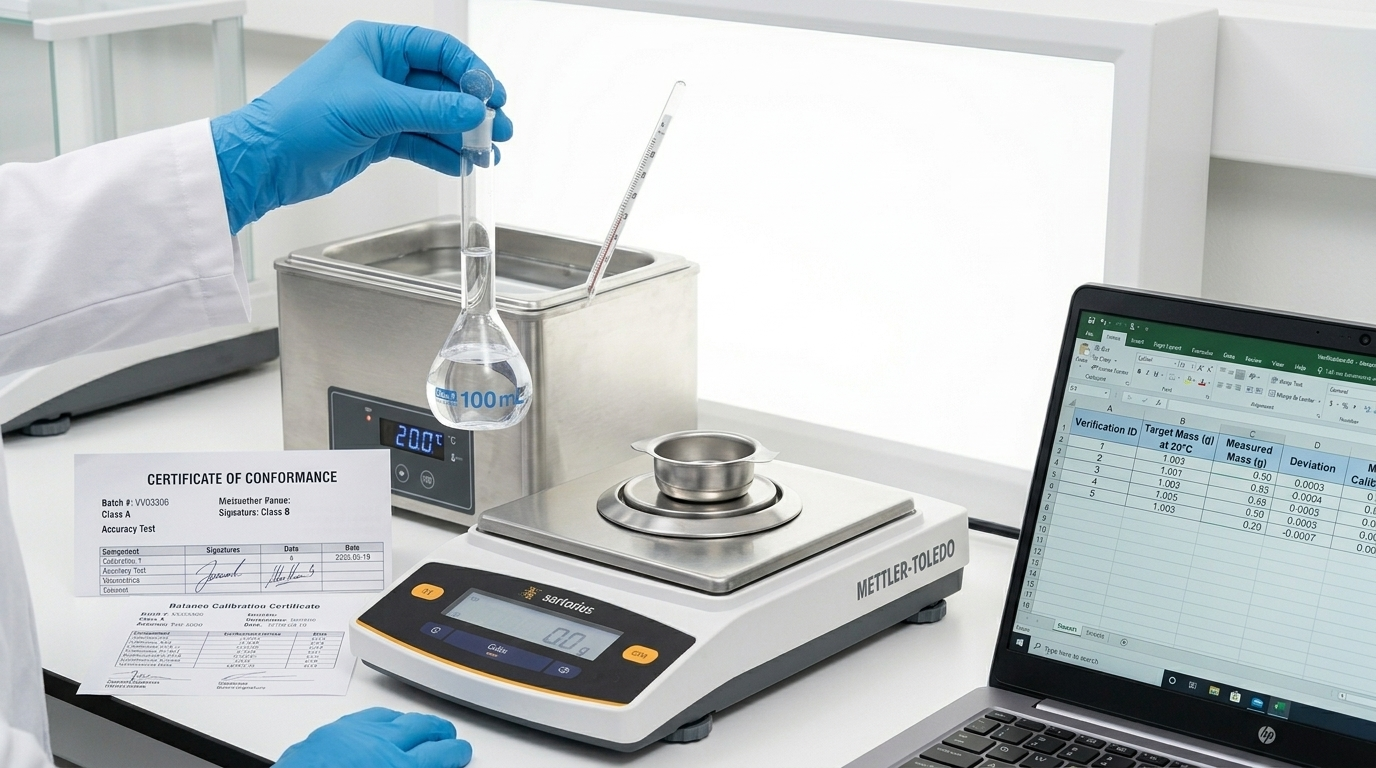
The verification method is gravimetric, as defined in ISO 4787: the vessel is filled with distilled water at exactly 20 degrees C to the calibration mark, and the mass of water is measured on a calibrated analytical balance. The actual volume is calculated from the mass using the known density of water at 20 degrees C (0.99820 g/mL).
For Class A certification of volumetric flasks per ISO 1042, every item in the batch must fall within the specified tolerance. The balance used for gravimetric verification must itself be calibrated with traceability to national measurement institutes such as NIST or NPL, creating the metrological chain that gives the batch certificate its regulatory value. The output of this stage is the batch certificate of conformance – the document that a purchasing laboratory will request when qualifying a laboratory glassware manufacturing supplier for regulated use.
Step 8: Packaging and Quality Release
The final stage of laboratory glassware manufacturing before shipment is packaging and quality release. Packaging for laboratory glassware must protect fragile borosilicate items through the mechanical stresses of international freight – vibration, impact, compression, and temperature cycling. Standard packaging uses individual polyethylene foam sleeves or cells, packed into partitioned cardboard cartons with additional cushioning material. For export shipments, outer cartons are typically placed in wooden crates for sea freight or reinforced for air freight.
Quality release involves a final check that the product in each carton matches the batch certificate documentation: product code, nominal volume, tolerance class, standard citation, and quantity. For OEM private-label shipments in laboratory glassware manufacturing, this stage also involves application of the customer’s branded labels and inclusion of the co-branded documentation pack.
No carton leaves the production facility without a completed quality release sign-off linking the physical product to its production and calibration records. This documentation trail is what allows a laboratory to respond to an auditor’s question about any piece of glassware with a complete, traceable answer. For guidance on evaluating these capabilities in a supplier, see our guide on how to choose a laboratory glassware manufacturer.
What to Look for in a Laboratory Glassware Manufacturer
Now that you understand the 8 stages of laboratory glassware manufacturing, you can ask more targeted questions when evaluating suppliers. First: does the manufacturer melt their own glass, or do they purchase pre-made glass tubes and simply graduate them? A manufacturer that controls the melting stage controls the starting material quality and can provide verifiable composition data. A manufacturer that only graduates purchased tubing cannot guarantee the glass composition of their finished product.
Second: is annealing performed in a controlled lehr with a documented temperature profile, or by batch oven? Continuous lehr annealing produces more consistent stress relief across an entire production run than batch processes.
Third: is gravimetric verification performed on every batch with balance calibration records available? A claim of ISO 1042 Class A compliance without supporting gravimetric data and a balance calibration certificate is an unverifiable marketing statement. For a complete supplier evaluation framework, see our guide on how to choose a laboratory glassware manufacturer and our overview of why precision scientific glassware matters. Explore the full Medilab Exports laboratory glassware catalog to see the range of certified items available for your laboratory.
Frequently Asked Questions
Premium laboratory glassware manufacturing uses borosilicate glass 3.3 as the standard material. This composition – approximately 80.6% SiO2 and 13% B2O3 – provides a thermal expansion coefficient of 3.3 x 10 to the power of -6 per K and Hydrolytic Class 1 chemical resistance per ISO 719. The material specification is formally defined in ISO 3585. Soda-lime glass is sometimes used for non-critical or decorative items but is unsuitable for precision laboratory use due to its high thermal expansion, chemical reactivity, and lower mechanical strength.
Annealing is the stress-relief stage of laboratory glassware manufacturing that determines the mechanical safety of the finished product. Glass that cools too quickly after forming contains internal tensile stresses that are invisible under normal lighting but cause unpredictable fracture during use – particularly when the glassware is subjected to heating, mechanical pressure, or centrifugation. A properly annealed borosilicate piece can withstand temperature differentials of 140 degrees C or more. Improperly annealed glass may fracture at temperature changes of only 20 to 40 degrees C, creating a significant safety hazard in the laboratory.
Volumetric accuracy in laboratory glassware manufacturing is verified by the gravimetric method described in ISO 4787. The flask is filled with distilled water at exactly 20 degrees C to the graduation mark and weighed on a calibrated precision balance. The actual volume is calculated from the measured mass using the known density of water (0.99820 g/mL at 20 degrees C). The result is compared to the nominal volume and the deviation must fall within the Class A or Class B tolerance specified in ISO 1042. The balance used must be calibrated with traceability to a national measurement institute, creating a fully documented metrological chain.
In laboratory glassware manufacturing, Class A and Class B designate two levels of volumetric accuracy, each defined by specific tolerance values in the applicable ISO or ASTM standard. Class A has approximately half the tolerance of Class B for the same nominal volume. For example, a 100 mL Class A volumetric flask must fall within plus or minus 0.10 mL of the nominal volume, while a Class B flask of the same size must fall within plus or minus 0.20 mL. Class A is required for regulated analytical work, pharmacopoeial assays, and any procedure where measurement uncertainty must be demonstrably minimized. Class B is appropriate for general laboratory work, teaching, and reagent preparation where the highest precision is not required.
Yes. Medilab Exports Consortium operates a direct laboratory glassware manufacturing facility producing the complete range of borosilicate 3.3 labware from raw batch materials through calibrated, certified finished goods. Our production process covers all 8 stages described in this guide – from batch preparation and melting through gravimetric verification, batch certification, and export packaging. We supply ISO-certified Class A and Class B volumetric glassware to distributors and laboratories in over 40 countries. Contact us to discuss your requirements or request a production facility audit for supplier qualification purposes.
Source From a Direct Laboratory Glassware Manufacturer
Medilab Exports Consortium controls every stage of laboratory glassware manufacturing – from borosilicate batch preparation through gravimetric verification and export packaging. ISO-certified Class A and Class B labware for distributors and institutions worldwide.
