

Laboratory glassware breakage is one of the most frequent – and most preventable – sources of waste, safety incidents, and experimental disruption in research and teaching laboratories. A broken volumetric flask or shattered Erlenmeyer flask means discarded reagents, contaminated workspaces, sharps injuries, and invalidated experiments. For high-value contents such as primary standard solutions, cell culture media, biological samples, or pharmaceutical reagents, laboratory glassware breakage represents both a safety event and a direct research cost that compounds with every incident.
The root causes of laboratory glassware breakage are well understood and largely preventable with proper handling protocols, storage practices, and glassware selection. Yet breakage continues at high rates in many laboratories because prevention knowledge is rarely formalized into SOPs and is seldom transferred systematically to new laboratory personnel. This guide identifies 9 common causes of laboratory glassware breakage and provides specific, actionable prevention strategies for each.
Medilab Exports Consortium manufactures and exports ISO-certified borosilicate 3.3 laboratory glassware to research institutions, pharmaceutical companies, and laboratory equipment distributors in over 40 countries. Understanding the causes of laboratory glassware breakage and designing glassware that minimizes it is central to our manufacturing and quality philosophy. The prevention strategies in this guide apply to all borosilicate laboratory glassware regardless of manufacturer and are consistent with ISO and ASTM guidelines for laboratory glassware use and maintenance.
Why Laboratory Glassware Breakage Costs More Than Replacement
The visible cost of laboratory glassware breakage is the replacement purchase. The true cost is substantially higher. A broken Erlenmeyer flask containing 500 mL of freshly prepared culture media represents the cost of the media ingredients, the preparation time, the potential contamination of nearby surfaces and equipment, and – if the breakage was caused by a thermal or mechanical hazard – the risk of personnel injury from borosilicate glass shards and chemical exposure.
For volumetric glassware, the hidden cost of laboratory glassware breakage is even greater. A Class A volumetric flask that is replaced with an uncertified substitute invalidates every experiment that relies on it for primary standard preparation. A cracked graduated cylinder that is not immediately taken out of service introduces uncorrected volume errors into every measurement made with it. These downstream data quality costs are invisible in procurement records but directly affect the scientific validity of laboratory output.
In most laboratories, laboratory glassware breakage follows systematic patterns. The same causes account for the majority of incidents: thermal shock, impact, and continued use of pre-damaged items collectively represent well over half of all glassware breakage events. A structured prevention program targeting these systematic causes reduces total breakage rates substantially – typically by 60-80% compared to laboratories with no formal glassware handling protocols.
Cause 1: Thermal Shock
Thermal shock is the single most common cause of laboratory glassware breakage. It occurs when glass is exposed to a sudden, large temperature differential – the coefficient of thermal expansion causes different sections of the same piece of glass to expand or contract at different rates, generating internal stress that exceeds the tensile strength of the glass and causes fracture. Common thermal shock scenarios include: placing cold glassware directly on a hot plate, submerging hot glassware in cold water or a cold sink, pouring hot liquid into a cold flask, or removing glassware from an autoclave before adequate cooling.
Prevention strategies for thermal shock:
- Pre-warm glassware to near working temperature before adding hot contents or placing on a heat source
- Allow hot glassware to cool gradually on a wooden block, cork ring, or insulating mat – never place hot glass directly on a cold bench surface or in a cold water bath
- Never quench hot glassware with cold water to speed cooling
- Allow autoclave loads to cool for a minimum of 20 minutes inside the chamber before removing
- Use borosilicate 3.3 glass for all heating applications – its low coefficient of thermal expansion (3.3 x 10⁻⁶ K⁻¹) provides substantially greater thermal shock resistance than soda-lime glass
Borosilicate 3.3 glass is significantly more resistant to thermal shock than soda-lime glass, but it is not immune to it. Even high-quality borosilicate glassware will fracture under sufficient thermal stress. The prevention strategies above apply equally to all glass types.
Cause 2: Chemical Incompatibility
Certain chemical reagents attack borosilicate glass and can cause laboratory glassware breakage either immediately or through progressive weakening of the glass network over repeated exposure. Hydrofluoric acid (HF) is the most hazardous example: even dilute HF solutions etch borosilicate glass rapidly, thinning the walls, destroying volumetric calibration markings, and creating stress concentration points that lead to sudden fracture – often while a chemist is handling the item. HF work must never be performed in glass containers.
Concentrated strong alkalis – sodium hydroxide, potassium hydroxide, and concentrated ammonium hydroxide – attack the silicate network of borosilicate glass when used at elevated temperatures or in prolonged contact. This form of chemical attack is slower but cumulative. Glassware used repeatedly for strong alkali digestions should be replaced on a defined schedule and inspected regularly for surface crazing or etching.
Prevention strategies for chemical incompatibility:
- Use PTFE, polyethylene, or platinum labware for any work involving hydrofluoric acid or HF mixtures – never glass
- For strong alkali digestions and extractions, limit contact time at elevated temperatures and inspect glassware before each use
- Consult chemical compatibility charts before selecting glassware for a new reagent or solvent – particularly for concentrated mineral acids, concentrated alkalis, and fluoride-containing compounds
- Replace etched or hazed glassware immediately – surface etching is a sign of chemical attack and a precursor to laboratory glassware breakage
Cause 3: Mechanical Impact and Improper Handling
Dropping, bumping, or striking glassware against hard bench surfaces, sinks, or other glass items is a major and consistent cause of laboratory glassware breakage. Many impacts do not cause immediate breakage – they create microscopic surface cracks that weaken the glass and cause delayed fracture under subsequent thermal or mechanical stress. This delayed failure pattern is particularly hazardous because the connection between the impact event and the eventual breakage is not obvious.
Prevention strategies for mechanical impact:
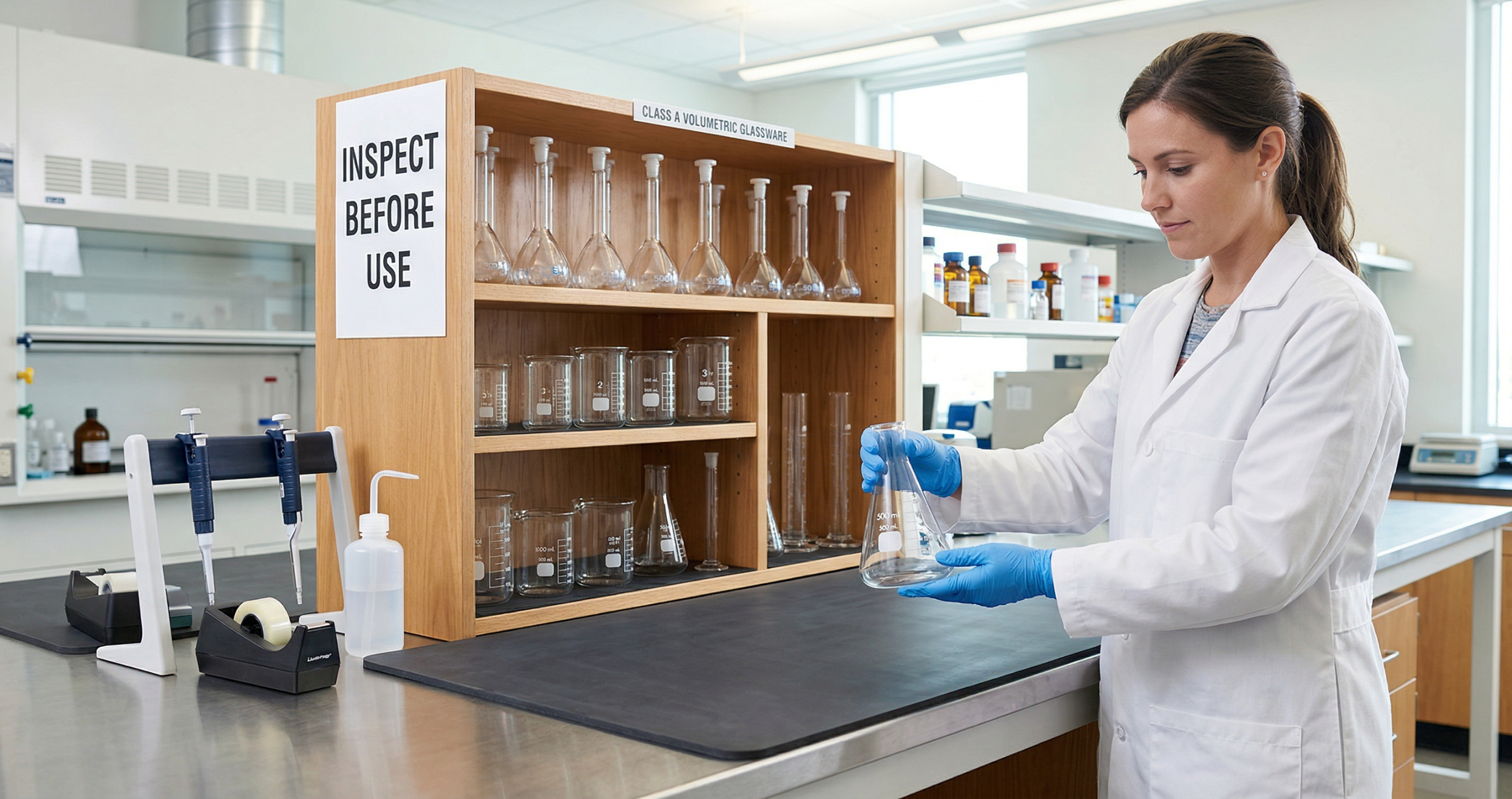
- Work over rubber bench mats in areas where glassware is regularly handled – they cushion impacts and significantly reduce breakage from minor drops
- Use both hands when carrying large volumetric flasks, media bottles, and reagent bottles – one hand on the body, one supporting the base
- Never carry multiple pieces of glassware stacked, nested, or balanced insecurely – carry one item at a time for large or heavy pieces
- Do not bang glassware against the interior of sinks or set it down hard on metal or ceramic surfaces
- Keep glassware away from the edges of benches and shelves where it can be swept off by passing movement or a swinging door
Cause 4: Continuing to Use Cracked or Chipped Glassware
Using glassware with pre-existing chips, stars, rim cracks, or surface abrasions is one of the most preventable causes of serious laboratory glassware breakage incidents. Damage to the glass surface dramatically reduces tensile strength – even a small chip at the rim of a beaker or a star crack on the base of a volumetric flask can reduce the burst pressure or thermal shock resistance of the item by 50-80%. Glassware that has been visibly damaged should be treated as already broken – not as serviceable equipment.
Prevention strategies for pre-damaged glassware:
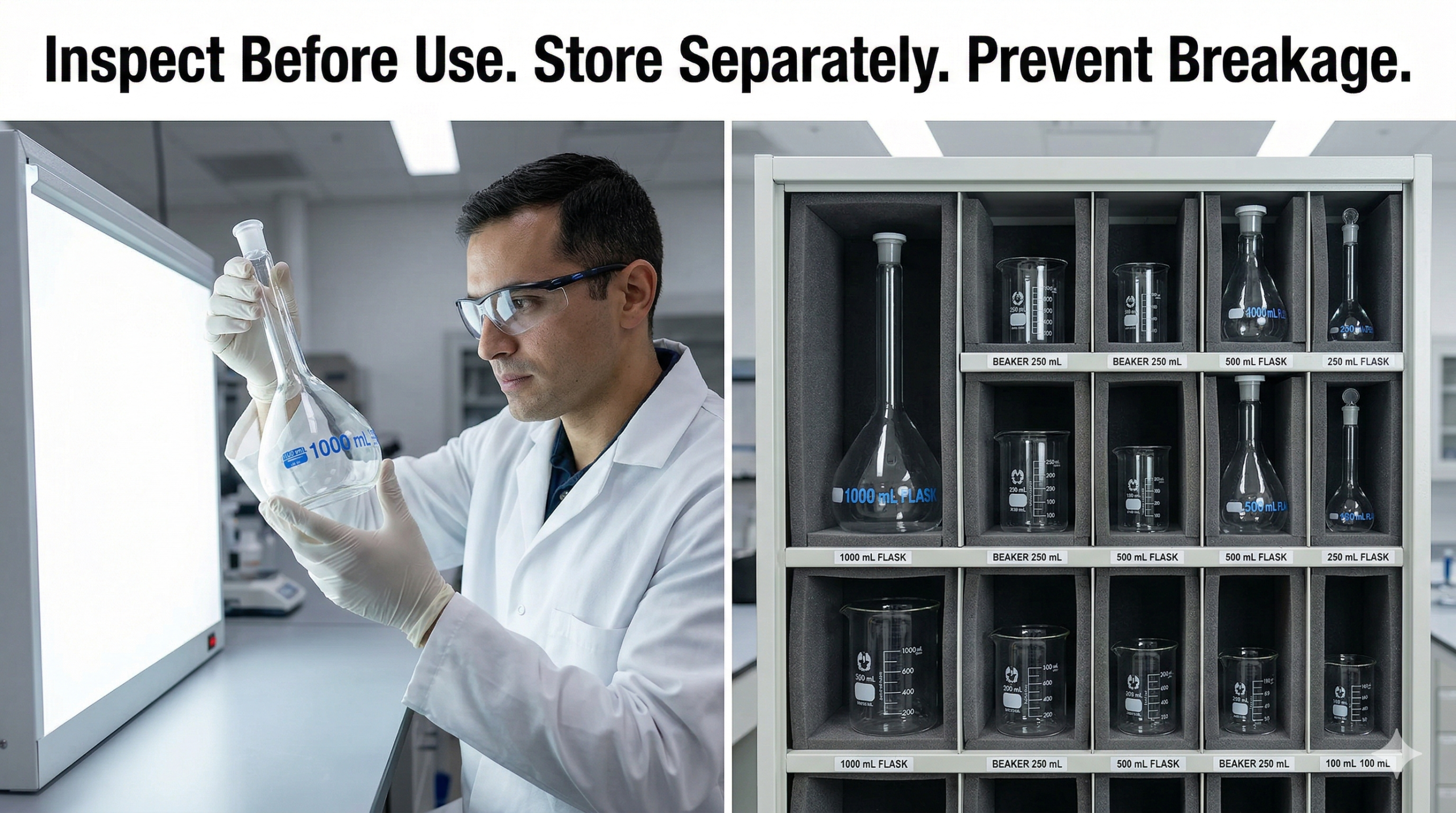
- Inspect every piece of glassware against a light source before each use – look for chips at the rim, star cracks or spirals on the base, and linear cracks or abrasion marks on the body
- Discard any item with chips, cracks, or significant scratching immediately – mark it with a colored label or tape before placing it in a sharps/glass disposal container
- Never attempt to “repair” cracked glassware with tape, sealant, or adhesive for continued laboratory use – it is not structurally safe under heating, pressure, or chemical stress
- Establish a routine inspection schedule for permanent glassware stock, especially older items that have accumulated surface wear
Cause 5: Improper Washing Technique
Incorrect washing procedures cause laboratory glassware breakage through two mechanisms: physical abrasion that creates micro-cracks in the glass surface, and thermal shock from washing hot glassware under cold water or vice versa. Both damage modes accumulate over repeated washing cycles, progressively weakening the glassware until fracture occurs under routine use conditions.
Prevention strategies for improper washing:
- Use only soft nylon-bristled brushes sized to fit the glassware without forcing – a brush that is too large applies damaging lateral pressure on the glass walls
- Never use abrasive steel wool, metal pot scrubbers, or abrasive powders on laboratory glassware – these scratch the surface and initiate the crack network that causes eventual laboratory glassware breakage
- Allow glassware to cool to near room temperature before washing – sudden immersion of hot glassware in cooler water is a thermal shock event
- If using ultrasonic baths for cleaning, limit cycle times for precision volumetric glassware – prolonged ultrasonic cleaning can loosen calibration markings and stress ground glass joints
- Rinse with water of appropriate quality: ISO 3696 Type 2 or 3 water for general labware, Type 1 for analytical glassware
Cause 6: Incorrect Autoclaving Procedure
Autoclaving subjects glassware to both thermal stress (from rapid pressurization and depressurization) and mechanical stress (from the weight of contents and contact with other items in the chamber). Incorrect autoclaving is a significant cause of laboratory glassware breakage, particularly for Erlenmeyer flasks, media bottles, and other glass containers used for liquid sterilization. The most dangerous failure mode is delayed breakage: a flask weakened by autoclave stress may survive the cycle itself but fracture during subsequent handling when the internal pressure differential or residual thermal stress is released.
Prevention strategies for autoclave-related breakage:
- Never fill glass containers more than two-thirds of their total volume with liquid for autoclaving – underfilled containers allow thermal expansion without pressure buildup
- Use a slow-exhaust or liquid cycle setting for liquid-filled glassware – rapid pressure release generates flash evaporation that can fracture glass from sudden internal pressure change
- Do not allow glass items to press against each other in the autoclave chamber – use padded racks, wire baskets lined with autoclave-safe padding, or autoclave bags to separate items
- Allow glassware to cool inside the autoclave for at least 20-30 minutes before removal, and then on an insulating surface before handling
- Check all glassware for cracks after each autoclave cycle, particularly flasks and bottles used repeatedly – autoclave stress is cumulative
Cause 7: Improper Storage
Improper storage practices cause a significant proportion of laboratory glassware breakage incidents that occur not during active use but during retrieval, stacking reorganization, or vibration-induced movement on overcrowded shelves. The most common storage errors are nesting conical flasks inside each other (which creates concentrated point load stress at the rim contact), glass-on-glass contact without cushioning, and overloading shelves so that items in the back must be forcibly extracted past items in the front.
Prevention strategies for storage:
- Never nest glassware – each Erlenmeyer flask, beaker, or conical flask should be stored individually upright, not stacked rim-to-base
- Use dedicated glassware storage racks that separate and support individual items with rubber or foam inserts – these are among the highest-return investments in preventing laboratory glassware breakage
- Store heavier or larger items on lower shelves; lighter and more fragile items (burettes, pipettes, volumetric flasks) at eye level or on dedicated holders away from general traffic areas
- Do not allow glassware to project beyond the shelf edge where it can be displaced by a swinging elbow or a closing drawer
- Cap or plug open-ended glassware in storage to prevent debris accumulation and provide a handling point that does not require gripping the glass body directly
Cause 8: Overtightening Clamps and Misaligned Connections
Clamp-related laboratory glassware breakage is common in distillation, reflux, and filtration setups where glass components are held in stands or connected via ground glass joints. A clamp applied without rubber or cork padding creates a hard metal-on-glass contact point that concentrates mechanical stress. Overtightening the clamp applies continuous compressive load on the glass body. Misaligned connections in ground glass joint assemblies create lateral bending stress that can fracture glassware when the assembly is heated or when a component is adjusted.
Prevention strategies for clamps and connections:
- Always use rubber-padded or cork-lined clamps – never allow bare metal to contact glassware directly in a clamp
- Tighten clamps only enough to hold the glassware securely – they should not compress the glass; excessive tightening causes point-load fracture
- Apply a thin layer of appropriate joint grease (silicone or hydrocarbon grease depending on the solvent) to ground glass joints before assembly – this reduces the torque required to seat the joint and prevents fused joints that cause breakage during disassembly
- Align glass tubing and apparatus connections so that no lateral bending force is required to make the connection – if the assembly requires force to connect, it will transmit that force as stress on the glass during use and heating
- Replace hardened or cracked rubber tubing immediately – aged rubber tubing exerts unpredictable pull and compression forces on glass connections
Cause 9: Wrong Glassware Type for the Application
Using glassware that is not specified for the conditions of the application is a systematic cause of laboratory glassware breakage that often goes unrecognized because the connection between the specification error and the breakage event is not obvious. The most common version of this error is using soda-lime glass (identifiable by its greenish tint and lower cost) for applications that require borosilicate glass – heating, autoclaving, chemical resistance, and precision volumetric work. Soda-lime glass has a coefficient of thermal expansion approximately three times higher than borosilicate 3.3 glass, making it far more susceptible to thermal shock breakage in laboratory conditions.
Prevention strategies for glassware type selection:
- Always confirm glass type before purchase – borosilicate 3.3 is the correct specification for all general laboratory glassware applications requiring heating, autoclaving, or chemical resistance
- Request glass type documentation from suppliers – reputable manufacturers provide material test reports confirming borosilicate classification and hydrolytic resistance per ISO 719
- Use appropriate support equipment for round-bottom flasks – a round-bottom flask without a cork ring, flask stand, or heating mantle support is a rolling and tipping hazard that causes laboratory glassware breakage
- Match volumetric glassware class to application requirements – Class A for quantitative analytical work, Class B for routine preparation
- Use boiling chips or magnetic stirring in flasks heated directly – localized superheating without nucleation points creates thermal stress that causes sudden breakage from the base
Laboratory Glassware Breakage: Causes and Prevention at a Glance
The table below summarizes the 9 common causes of laboratory glassware breakage covered in this guide, with the primary prevention action, risk level, and the glassware types most commonly affected by each cause.
| Cause | Primary Prevention Action | Risk Level | Most Affected Glassware |
|---|---|---|---|
| Thermal shock | Pre-warm glass; cool gradually; use borosilicate 3.3 | High | Beakers, round-bottom flasks, test tubes |
| Chemical incompatibility | Check compatibility; never use glass for HF work | High | Volumetric flasks, beakers, test tubes |
| Mechanical impact | Rubber bench mats; two-handed carrying; secure storage | High | All glassware; especially bulb and round-bottom items |
| Using pre-damaged glass | Inspect before each use; discard chipped or cracked items | High | All glassware |
| Improper washing | Soft nylon brushes; cool before washing; no abrasives | Medium | Volumetric flasks, burettes, pipettes |
| Incorrect autoclaving | Two-thirds fill rule; slow exhaust; padded racks; cool in chamber | High | Erlenmeyer flasks, media bottles, reagent bottles |
| Improper storage | No nesting; dedicated glass racks; heavy items on lower shelves | Medium | Erlenmeyer flasks, graduated cylinders, volumetric flasks |
| Overtightened clamps | Padded clamps; greased joints; aligned connections | Medium | Ground-joint glassware, glass tubing, condensers |
| Wrong glassware type | Confirm borosilicate 3.3; use appropriate support; correct class | Medium | Round-bottom flasks, soda-lime substitutes |
Building a Laboratory Glassware Breakage Prevention Program
Reducing laboratory glassware breakage to its minimum achievable level requires more than individual awareness. It requires a formal prevention program with written protocols, training requirements, incident tracking, and regular glassware stock audits. Laboratories that track breakage incidents systematically – recording the cause, the glassware type, and the activity context for each event – typically identify 2-3 dominant causes that account for 70-80% of their total breakage volume. Addressing those specific causes delivers the largest reduction in laboratory glassware breakage with the least resource investment.
A functional glassware breakage prevention program includes four elements. First, a written inspection protocol that specifies how and when glassware is inspected, what defects require immediate discard, and where damaged items are disposed of. Second, onboarding training for all new laboratory personnel covering the 9 causes of laboratory glassware breakage and the specific handling and storage protocols in force in that laboratory. Third, a breakage incident log that records each breakage event with cause, glassware type, and corrective action – reviewed monthly to identify patterns. Fourth, a periodic glassware stock audit that removes aged, worn, or borderline-conditioned items from service before they become safety incidents.
Procuring ISO-certified borosilicate 3.3 glassware from verified manufacturers is the foundational quality decision that underlies all prevention efforts. Glassware manufactured to ISO 4787 verification standards and ISO 1042 specifications enters the laboratory already meeting the dimensional, material, and calibration requirements that reduce the risk of manufacturing-related breakage. For a complete guide to the ISO certifications that define quality laboratory glassware, see Laboratory Glassware Quality Standards: 7 Essential ISO, ASTM & DIN Certifications. For understanding which glassware types are required for specific laboratory workflows, see 12 Common Laboratory Glassware and Their Uses. For the precision requirements that make correct glassware handling essential, see Precision Scientific Glassware: 7 Critical Reasons Why It Matters.
Frequently Asked Questions
Thermal shock is the single most common cause of laboratory glassware breakage in most laboratory settings. It occurs when glass is exposed to a sudden temperature differential – placing cold glass on a hot plate, submerging hot glass in cold water, or removing glassware from an autoclave before adequate cooling. Even high-quality borosilicate 3.3 glass, which has a low coefficient of thermal expansion (3.3 x 10⁻⁶ K⁻¹), will fracture under sufficient thermal stress. The prevention is straightforward: pre-warm glassware before heating, cool it gradually after heating, and never quench hot glass with cold water. After thermal shock, mechanical impact (dropping or striking glassware) and continued use of pre-damaged items are the next most frequent causes of laboratory glassware breakage.
Yes, borosilicate 3.3 glass is substantially more resistant to thermal-shock-induced laboratory glassware breakage than soda-lime glass. Borosilicate 3.3 has a coefficient of thermal expansion of 3.3 x 10⁻⁶ K⁻¹, compared to approximately 9 x 10⁻⁶ K⁻¹ for soda-lime glass – meaning borosilicate glass expands and contracts at roughly one-third the rate of soda-lime glass under the same temperature change. This makes borosilicate glass the correct specification for all laboratory applications involving heating, autoclaving, or significant temperature variation. Soda-lime glass is appropriate for cold storage containers, windows, and non-heating applications where cost is the priority, but it must never be substituted for borosilicate glass in applications involving heat or thermal cycling. Borosilicate glass also has superior chemical resistance (Hydrolytic Class 1 per ISO 719) that further reduces the risk of chemistry-related breakage.
The standard inspection method for laboratory glassware breakage prevention is visual examination against a light source – either a bright window, a light box, or a laboratory light bench. Hold the glassware up to the light and rotate it slowly, looking for: star-pattern cracks radiating from a single point (common on bases from impact), linear cracks running along the body or rim, chip marks on the rim or spout, and surface crazing (a network of fine cracks caused by chemical attack or thermal fatigue). For transparent glass, cracks are often easiest to detect when the light source is behind the glass and the crack appears as a bright line. Any item showing any of these defects should be immediately removed from service and placed in a sharps/glass disposal container. Rim chips in particular are a high-risk defect because they create stress concentration points directly where the glassware is most frequently handled and poured.
No. Chipped or cracked laboratory glassware cannot be safely repaired for continued laboratory use. Sealing a crack with tape, epoxy, or silicone sealant does not restore the mechanical strength of the glass and can create a false sense of security that leads to a more serious laboratory glassware breakage event during subsequent use – particularly if the item is heated, autoclaved, or filled with liquid. A crack in a glass body reduces the item’s resistance to thermal shock, mechanical stress, and internal pressure by as much as 50-80%. For precision volumetric glassware (volumetric flasks, burettes, pipettes), damage also invalidates the calibration. The correct response to any cracked or chipped laboratory glassware is immediate disposal in a dedicated glass/sharps waste container with appropriate labeling.
To prevent autoclave-related laboratory glassware breakage, follow these key protocols: fill liquid containers no more than two-thirds of their volume; select a slow-exhaust or liquid cycle setting (not gravity or pre-vacuum) for liquid-filled glassware; separate glass items in the chamber using padded racks, wire baskets with autoclave-safe liners, or autoclave bags so that items do not press against each other during pressurization; and allow the load to cool inside the chamber for at least 20-30 minutes before removal. After removal, place glassware on an insulating surface (cork ring, wooden block, or folded autoclave wrap) rather than directly on a cold bench. Inspect all glassware after each autoclave cycle for new cracks or changes to ground glass joints, as autoclave stress is cumulative across multiple cycles.
Correct storage is one of the highest-impact steps in preventing laboratory glassware breakage. The core rules are: store each piece individually upright in a dedicated glassware rack – never nest or stack glassware (nesting creates concentrated rim-to-base contact stress that can cause spontaneous breakage when the items are separated); use rubber or foam-lined storage racks or dividers that prevent glass-on-glass contact; store heavy or large items on lower shelves and delicate items (burettes, pipettes, Class A volumetric flasks) in dedicated holders away from general bench traffic; ensure glassware does not project beyond the shelf edge where it can be displaced; and cap or plug open-ended storage items to prevent debris accumulation and provide a safe handling point. A well-organized glassware storage system also makes pre-use inspection faster and more consistent.
Laboratory glassware breakage prevention requires knowing when to retire glassware before a breakage event occurs, not just after. Replace glassware immediately if: there is any visible chip, crack, star fracture, or rim damage; there is surface crazing or haziness that indicates chemical attack; calibration markings have become illegible or have been compromised by abrasion; ground glass joints no longer seat smoothly or have become fused and require force to open; or the item has undergone 5 or more years of regular autoclave cycling (cumulative thermal fatigue is not visible but is real). For precision volumetric glassware, the replacement threshold should be more conservative – any item with visible surface wear, cleaning abrasion, or marking damage should be replaced to maintain calibration integrity. The cost of replacing worn glassware on a defined schedule is small compared to the cost of a breakage incident or an experiment invalidated by uncorrected volumetric error.
Source ISO-Certified Borosilicate 3.3 Glassware Built to Minimize Breakage Risk
Medilab Exports Consortium manufactures Class A and Class B borosilicate 3.3 laboratory glassware to ISO 4787 and ISO 1042 standards. Every batch ships with material test reports confirming Hydrolytic Class 1 glass classification – the foundation of laboratory glassware breakage prevention starts with correctly specified material.
