
Selecting the right laboratory equipment for biology labs is one of the most consequential decisions a laboratory director, procurement manager, or research institution can make. The wrong equipment introduces workflow bottlenecks, compromises experimental reproducibility, and creates compliance gaps that are costly to resolve after the fact. Yet many biology laboratories equip themselves reactively – purchasing instruments as immediate needs arise rather than building a coherent, future-proof equipment infrastructure from the start.
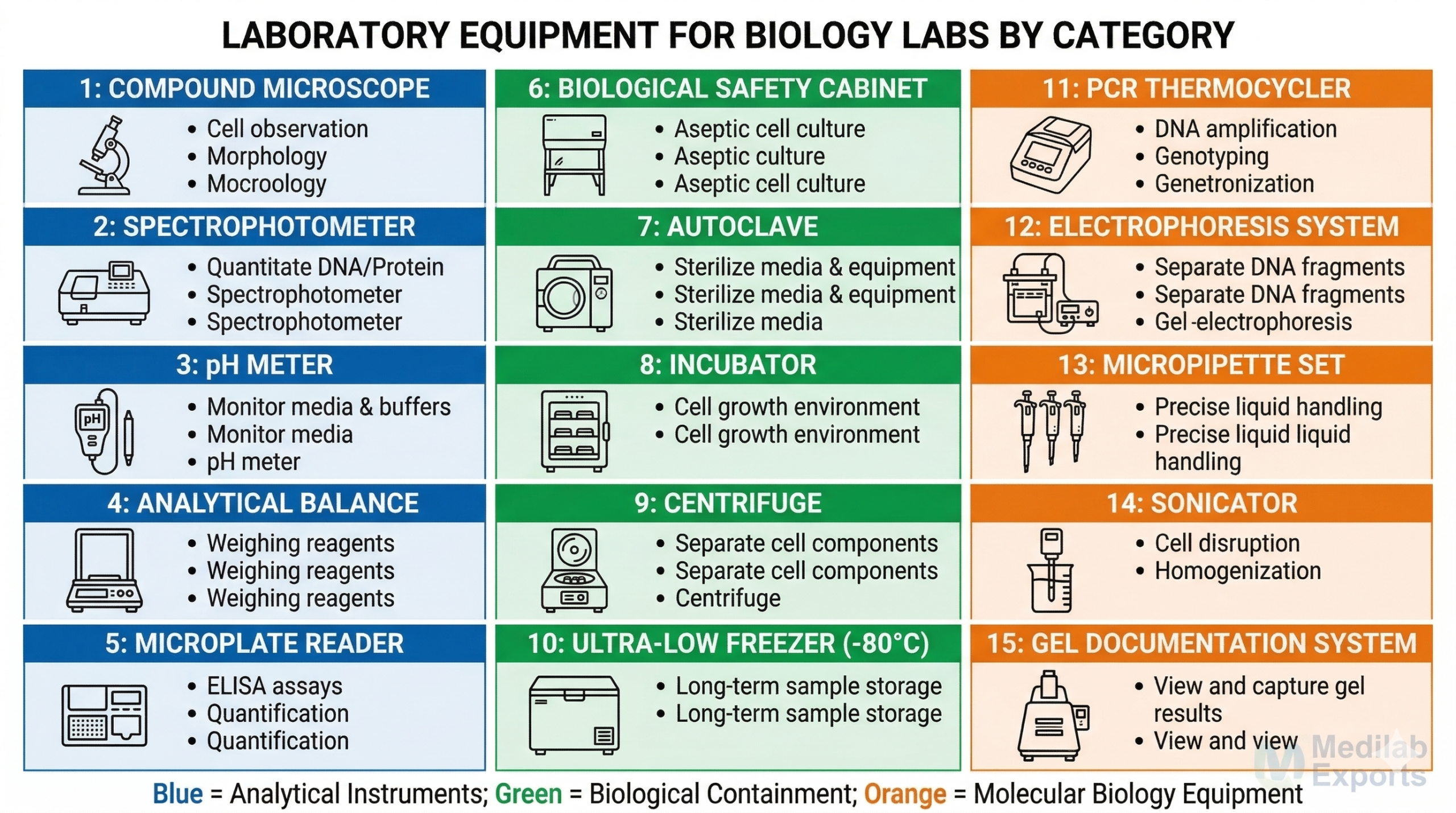
This guide covers 15 essential categories of laboratory equipment for biology labs, organized into 8 functional groups that reflect how modern biology research and teaching laboratories actually operate. Whether you are equipping a new microbiology department, upgrading an established cell biology facility, or building a clinical research unit from scratch, this framework will help you identify the right instruments, prioritize investment, and avoid the most common specification mistakes.
Medilab Exports Consortium supplies ISO-certified borosilicate laboratory glassware to biology laboratories and scientific equipment distributors in over 40 countries. Our perspective on laboratory equipment for biology labs is grounded in direct supply experience across university research departments, pharmaceutical biology units, environmental testing facilities, and hospital diagnostic laboratories – the four settings where equipment selection decisions have the most measurable impact on scientific output.
Why the Right Laboratory Equipment for Biology Labs Matters
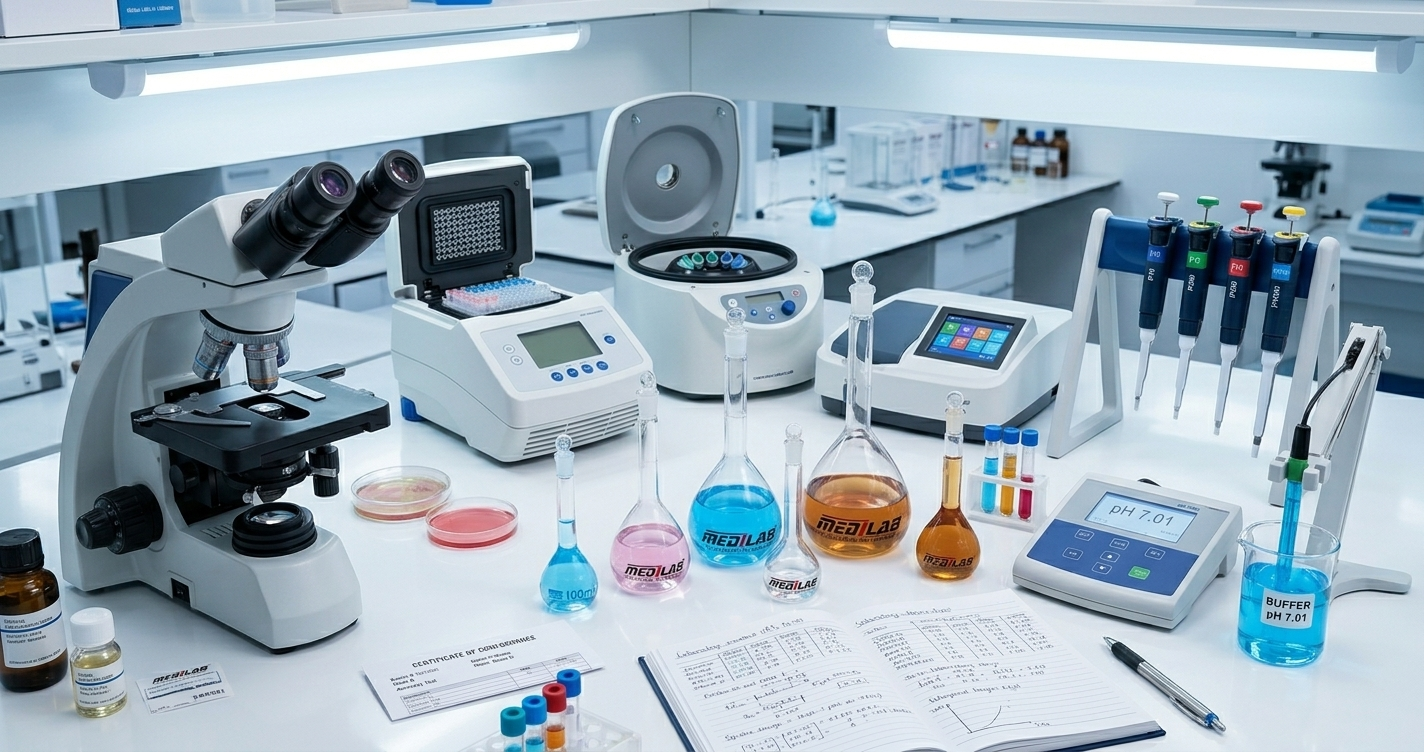
Biology is an inherently experimental discipline. Unlike computational or theoretical sciences, every hypothesis in biology must ultimately be tested against physical reality using instruments that can measure, separate, visualize, amplify, or culture biological material. The quality and completeness of a biology laboratory’s equipment directly determines which experiments are possible, how reproducible the results are, and how quickly the research cycle from hypothesis to validated data can be completed.
Poorly specified laboratory equipment for biology labs creates cascading problems. An incubator with poor temperature uniformity produces inconsistent cell growth, making every experiment that follows unreliable. A centrifuge without a refrigeration system degrades temperature-sensitive samples during long-spin protocols. A spectrophotometer without UV capability cannot perform DNA or protein quantification. Each equipment gap either blocks experiments entirely or introduces uncontrolled variables that contaminate the scientific record.
For teaching and training laboratories, the stakes are equally high. Students who learn on poorly maintained or incorrectly specified equipment develop incorrect technique habits that must be unlearned in professional settings. For diagnostic and clinical biology laboratories, equipment failures or specification gaps directly affect patient care decisions. In all these contexts, investing in correctly specified laboratory equipment for biology labs at the outset is substantially cheaper than correcting the downstream consequences of poor equipment selection.
1. Microscopy Equipment
The compound light microscope remains the single most universally essential piece of laboratory equipment for biology labs at every level, from secondary education through advanced research. A quality compound microscope provides magnification from 40x to 1000x (oil immersion), bright-field illumination for stained histological sections and fixed specimens, and – in research models – phase contrast or DIC (differential interference contrast) capability for live cell visualization without staining.
Key specification parameters when selecting compound microscopes as laboratory equipment for biology labs:
- Optical system: Plan achromat objectives are adequate for teaching; plan apochromat objectives are required for research-grade imaging and photomicrography
- Illumination: LED illumination is now standard – it is cooler, longer-lasting, and more consistent than halogen
- Condenser: An Abbe condenser (NA 1.25) with iris diaphragm is required for oil immersion work at 100x
- Camera port: Trinocular head with C-mount adapter is required if digital image capture is part of the workflow
The stereomicroscope (dissecting microscope) is a separate and complementary instrument providing lower magnification (6x to 45x) with a large working distance and three-dimensional viewing of intact specimens, dissections, plant material, and small organisms. Any biology laboratory conducting organism-level work needs both compound and stereo microscopes as core laboratory equipment for biology labs.
2. Sterilization and Containment Equipment
Autoclaves and biological safety cabinets (BSCs) are the two most critical safety and contamination control items in the laboratory equipment for biology labs category. Both are regulatory requirements in any laboratory working with live microorganisms, cell cultures, or biological materials classified at Biosafety Level 1 or above.
The autoclave sterilizes media, glassware, waste, and instruments using pressurized steam at 121 degrees C for a defined cycle time. Key selection parameters include chamber volume (20-50 L for small labs, 100-500 L for high-throughput facilities), cycle programmability, and printer or data logger capability for documentation. For pharmaceutical biology and regulated research, autoclave cycle validation documentation is a GMP requirement.
The biological safety cabinet provides a sterile working environment for cell culture and microbiology by passing room air through HEPA filters before it contacts the work surface. Class II Type A2 BSCs are the standard for most biology laboratory work involving BSL-1 and BSL-2 organisms. They protect both the product (preventing contamination) and the operator (containing aerosols). A laminar flow clean bench, by contrast, protects only the product and provides no operator protection – it is not a substitute for a BSC when working with biological agents.
3. Centrifugation Equipment
Centrifugation is one of the most frequently performed operations in biology laboratories, making the centrifuge one of the highest-priority items in any laboratory equipment for biology labs procurement list. The basic principle – separating components of different densities by applying centrifugal force – is used for cell pelleting, serum separation, density gradient fractionation, DNA isolation, protein precipitation, and dozens of other core biology protocols.
Most biology laboratories need at least two centrifuge types. A microcentrifuge (also called a microfuge or benchtop centrifuge) handles 1.5 mL and 2.0 mL microtubes at speeds up to 16,000 x g and is used for virtually every molecular biology protocol. A larger clinical or general-purpose centrifuge handles 15 mL and 50 mL Falcon tubes and larger sample volumes for cell culture work. Refrigerated models (4 degrees C or below during spinning) are essential when processing temperature-sensitive samples such as serum, plasma, or protein extracts.
For research-intensive biology laboratories, an ultracentrifuge (capable of 100,000-500,000 x g) is required for subcellular fractionation, virus pelleting, and lipoprotein isolation. Ultracentrifuges represent a significant capital investment and are typically shared resources rather than individual-laboratory equipment.
4. Molecular Biology Instruments
PCR (polymerase chain reaction) technology has become foundational laboratory equipment for biology labs at every level – from high school science through pharmaceutical genomics. The PCR thermocycler cycles a DNA sample through defined temperature stages (denaturation, annealing, extension) to amplify specific DNA sequences from nanogram quantities of starting material. Key selection parameters include block uniformity (temperature variation across the block affects amplification consistency), ramp rate (speed of temperature transitions), and well format (96-well is standard; 384-well for high-throughput work).
Gel electrophoresis systems are used after PCR and other molecular biology procedures to separate DNA or RNA fragments by size using an agarose gel matrix and electrical current. A basic horizontal gel electrophoresis system with power supply, gel casting trays, and a UV transilluminator for ethidium bromide visualization is standard laboratory equipment for biology labs conducting any nucleic acid work. For protein separation, vertical polyacrylamide gel electrophoresis (PAGE) systems including SDS-PAGE are required for Western blotting and protein characterization.
Real-time PCR (qPCR) systems add fluorescence detection to standard PCR, allowing quantitative measurement of gene expression or pathogen load during the amplification reaction itself. qPCR has become essential laboratory equipment for biology labs in diagnostic, research, and quality control settings where quantitative nucleic acid data is needed.
5. Analytical Measurement Instruments
Accurate measurement of biological molecules in solution is a daily requirement in biology laboratories, making analytical instruments central to the laboratory equipment for biology labs framework. The spectrophotometer measures light absorbance or transmittance through a solution at defined wavelengths, allowing quantification of nucleic acids (260 nm), proteins (280 nm or Bradford assay at 595 nm), and reaction products in colorimetric assays (400-700 nm visible range).
UV-Vis spectrophotometers covering 190-900 nm are the standard research instrument. Microvolume spectrophotometers (such as NanoDrop-type instruments) measure 1-2 microlitre samples directly on a pedestal, eliminating cuvettes and allowing rapid nucleic acid and protein quantification from precious or small-volume samples. Both types are important laboratory equipment for biology labs with nucleic acid work.
The pH meter is another non-negotiable item in the analytical laboratory equipment for biology labs category. Buffer preparation, cell culture media formulation, enzyme activity assays, and most microbiological growth studies require precise pH measurement and control. A research-grade pH meter with a combination electrode, automatic temperature compensation, and calibration memory (minimum 3-point calibration) is the correct specification for any biology laboratory. Colorimetric pH indicators and litmus paper are not acceptable substitutes for pH meter measurement in quantitative biology work.
6. Temperature and Growth Control Equipment
Biological processes are temperature-sensitive by nature. Controlling temperature – for growth, storage, enzymatic reactions, and sterilization – is one of the most fundamental requirements in the laboratory equipment for biology labs category.
The bacteriological or cell culture incubator maintains a defined temperature (typically 37 degrees C for mammalian cells, 25-30 degrees C for many microbial cultures) over extended periods. For mammalian cell culture, a CO2 incubator that maintains 5% CO2 alongside temperature control is required to buffer the bicarbonate-based pH of cell culture media. Incubator specification parameters include temperature uniformity (how tightly the temperature is controlled across the chamber), CO2 control accuracy, and contamination control features (copper interiors, UV decontamination cycles).
Water baths and heating blocks provide controlled temperature environments for enzymatic incubations, sample digestion, and reagent warming. A standard shaking water bath (25-100 degrees C with orbital or linear shaking) is versatile laboratory equipment for biology labs for aerobic bacterial culture in flasks, hybridization reactions, and digestion protocols.
Cryogenic and sub-ambient storage is essential for preserving biological samples and reagents. Most biology laboratories require: a standard laboratory refrigerator (4 degrees C) for short-term reagent storage, a -20 degrees C freezer for enzymes and DNA stocks, and a -80 degrees C ultra-low temperature (ULT) freezer for long-term cell and tissue storage. For long-term cell banking, liquid nitrogen storage tanks (at -196 degrees C) are the gold standard.
7. Liquid Handling and Dispensing Equipment
Accurate liquid measurement and transfer is performed hundreds of times per day in active biology laboratories, making liquid handling equipment some of the most frequently used laboratory equipment for biology labs in any facility. Pipetting errors – from using incorrectly calibrated pipettes or poor technique – are among the most common sources of irreproducibility in biological research.
Micropipettes (also called automatic pipettors or Gilson-type pipettes) are the primary liquid handling tool in modern biology laboratories. They are available in single-channel and multi-channel configurations covering volumes from 0.1 microlitre to 10 mL across different models. Key selection criteria include calibration accuracy and precision (traceable to ISO 8655), ergonomics (low actuation force reduces repetitive strain injury risk), and autoclavability for sterile work. Every micropipette in a biology laboratory should be on a regular calibration schedule.
Repeat dispensers and bottle-top dispensers are used for dispensing fixed volumes of frequently used reagents (buffers, media, staining solutions) directly from storage bottles. They reduce both the risk of contamination from repeated pipetting into stock bottles and the time spent on repetitive dispensing tasks.
8. Volumetric Glassware and Weighing Equipment
ISO-certified volumetric glassware is indispensable laboratory equipment for biology labs at every scale. Accurate preparation of buffers, culture media, standard solutions, and reagents requires volumetric flasks, graduated cylinders, beakers, and Erlenmeyer flasks manufactured from borosilicate glass 3.3 and calibrated to ISO standards.
For critical quantitative work – primary standard preparation, pharmacopoeial media formulation, and method validation experiments – Class A borosilicate glassware calibrated per ISO 4787 gravimetric verification methodology is the correct specification. Class A ISO 1042 volumetric flasks (tolerance +/- 0.40 mL at 1000 mL) ensure that primary stock solutions are prepared at the stated concentration. For routine media and buffer preparation in teaching or general research settings, Class B glassware is appropriate.
Borosilicate glass is the preferred material for biology laboratory glassware for three reasons: chemical inertness (Hydrolytic Class 1 per ISO 719, preventing alkali leaching into biological solutions), thermal resistance (withstands autoclaving, dry heat sterilization, and direct heating without dimensional change), and optical clarity (essential for visual inspection of cultures and solutions). Plastic volumetric ware, while adequate for non-critical applications, cannot match the calibration traceability or chemical inertness of certified borosilicate glassware for critical biology work.
The analytical balance is the partner instrument to volumetric glassware in all gravimetric preparation workflows. A two-decimal-place balance (resolution 0.01 g) is adequate for routine media preparation. A four-decimal-place analytical balance (resolution 0.1 mg) is required for primary standard preparation and any protocol where reagent mass must be determined with high accuracy.
Biology Lab Equipment: Priority Reference Table
The table below categorizes the 15 essential categories of laboratory equipment for biology labs by functional priority, typical biology application, and whether the item is required for all biology labs or specific to particular disciplines. Use this as a starting reference when building your equipment procurement plan.
| Equipment Category | Primary Biology Applications | Priority Level | All Labs or Specialist? |
|---|---|---|---|
| Compound light microscope | Cell morphology, histology, microbiology | Essential | All biology labs |
| Autoclave | Media/glassware sterilization, waste treatment | Essential | All biology labs |
| Biological safety cabinet | Cell culture, microbiology, BSL-1/2 work | Essential | All biology labs with live organisms |
| Microcentrifuge | DNA isolation, protein work, molecular biology | Essential | All biology labs |
| CO2 incubator | Mammalian cell culture | Essential | Cell biology, tissue culture labs |
| UV-Vis spectrophotometer | DNA/protein quantification, colorimetric assays | Essential | All biology labs |
| pH meter | Buffer prep, media formulation, enzyme assays | Essential | All biology labs |
| PCR thermocycler | DNA amplification, genotyping, diagnostics | Essential | Molecular biology, diagnostics labs |
| Gel electrophoresis system | DNA/RNA size separation, protein SDS-PAGE | Essential | Molecular biology labs |
| Micropipettes (set) | All liquid transfer operations | Essential | All biology labs |
| Volumetric glassware (Class A) | Standard preparation, media, buffer formulation | Essential | All biology labs |
| Analytical balance | Reagent weighing, gravimetric preparation | Essential | All biology labs |
| -80 degrees C ULT freezer | Long-term sample and cell bank storage | High priority | Research and cell culture labs |
| Water bath / heating block | Enzymatic incubations, hybridization | High priority | All biology labs |
| Stereomicroscope | Dissection, organism observation, embryology | Specialist | Zoology, botany, developmental biology |
How to Prioritize Laboratory Equipment for Biology Labs
Not all biology laboratories need all 15 categories simultaneously. The right approach to specifying laboratory equipment for biology labs starts with a clear understanding of the primary workflows the laboratory will support in its first two to three years of operation, then builds a phased equipment plan that prioritizes foundation instruments before specialist tools.
A newly established general biology laboratory should prioritize in this order: sterilization and containment first (autoclave and BSC – these are safety and regulatory requirements that cannot be deferred), then microscopy and liquid handling (compound microscope and micropipette set – required for virtually every biology protocol), then analytical measurement (spectrophotometer and pH meter – required for all quantitative work), then temperature control (incubator, refrigerator, -20 degrees C freezer – required for reagent storage and biological culture).
Molecular biology instruments (PCR, gel electrophoresis) should be added once the core analytical and containment infrastructure is in place, as these instruments generate data that is only reliable when prepared with accurately measured reagents and properly sterilized glassware. Investing in a PCR thermocycler before you have a reliable autoclave, calibrated glassware, and accurate pipettes is a sequencing error that compromises the validity of all molecular data generated.
For procurement of volumetric glassware as laboratory equipment for biology labs, see our complete guide to 12 Common Laboratory Glassware and Their Uses for a detailed breakdown of which glassware types are required for specific biology workflows. For understanding glassware certification requirements, see our guide to Laboratory Glassware Quality Standards: 7 Essential ISO, ASTM & DIN Certifications. For precision requirements in analytical biology procedures, see Precision Scientific Glassware: 7 Critical Reasons Why It Matters.
Medilab Exports Consortium supplies ISO-certified borosilicate laboratory glassware – one of the most foundational categories of laboratory equipment for biology labs – to distributors and institutions in over 40 countries. All Class A volumetric items ship with batch calibration certificates and ISO 9001-backed quality documentation.
Frequently Asked Questions
The most universally essential laboratory equipment for biology labs are the autoclave (sterilization), biological safety cabinet (containment), compound microscope (visualization), micropipette set (liquid handling), spectrophotometer (quantification), pH meter (solution control), and calibrated volumetric glassware (accurate preparation). These seven categories underpin virtually every biology protocol regardless of specialization. Molecular biology instruments like PCR thermocyclers and gel electrophoresis systems are essential for labs with nucleic acid workflows but are secondary to this foundational set. No biology laboratory can operate reliably without all seven foundational items functioning correctly and calibrated.
Biology laboratories use a wide range of borosilicate glass labware. The most common items include: Erlenmeyer flasks (for liquid culture of microorganisms and preparation of media), beakers (for mixing and weighing), volumetric flasks (for accurate preparation of standard solutions and buffers), graduated cylinders (for approximate volume measurement), reagent bottles (for reagent storage), Petri dishes (for solid media plating and cell culture), test tubes and culture tubes (for small-scale liquid culture), and glass slides and coverslips (for microscopy). ISO-certified Class A borosilicate glassware is required for any preparation where volumetric accuracy affects the validity of the biology experiment. For a complete guide to glassware types used in biology laboratories, see our article on 12 Common Laboratory Glassware and Their Uses.
This is one of the most important distinctions in laboratory equipment for biology labs safety. A biological safety cabinet (BSC) protects both the product and the operator: it filters incoming air through HEPA filters before it contacts the work surface, and exhausts air through HEPA filters before it leaves the cabinet, preventing aerosols from reaching the laboratory environment. A laminar flow hood (clean bench) protects only the product by blowing HEPA-filtered air across the work surface and toward the operator – it provides no operator protection and is not suitable for work with any biological agents, toxins, or volatile chemicals. Class II Type A2 BSCs are the standard for BSL-1 and BSL-2 biology laboratory work. Substituting a laminar flow hood for a BSC when working with live microorganisms or cell cultures is a serious biosafety error.
Calibrated borosilicate glassware is important as laboratory equipment for biology labs because virtually all quantitative biology begins with an accurately prepared solution. Buffer pH depends on the molar concentration of its components – which depends on accurately measured volumes. Cell culture media formulations have defined osmolarity requirements – which depend on accurate weighing and volumetric preparation. Drug dose-response experiments depend on accurately prepared serial dilutions. If the volumetric flask used to prepare the primary stock solution carries an uncertified volume error, every downstream experiment inherits that error. ISO Class A borosilicate volumetric flasks, calibrated to +/- 0.04% relative error at 1000 mL, ensure that the starting solution matches its stated concentration and that all experiments built on that solution are valid.
Yes, for many applications – but not for all. Plastic labware (polypropylene, polyethylene, polycarbonate) is appropriate for sample storage tubes, microplates for high-throughput assays, single-use serological pipettes, and cryogenic storage containers. However, glass is the preferred material for: volumetric measurement where calibrated accuracy is required (no ISO Class A standard exists for plastic volumetric ware), heating and sterilization applications above 135 degrees C (most plastics deform or leach), organic solvent procedures (most polymers are attacked by common organic solvents), and UV spectrophotometry where optical clarity and UV transmission are needed. Biology laboratories that replace all glass with plastic compromise precision, contamination control, and sterilization compatibility simultaneously. The correct approach is to use glass where its properties are required and plastic where convenience, disposability, or chemical compatibility with alkaline or HF solutions is the priority.
Source ISO-Certified Borosilicate Glassware for Your Biology Laboratory
Medilab Exports Consortium supplies ISO-certified borosilicate 3.3 laboratory glassware – one of the most foundational categories of laboratory equipment for biology labs – to institutions and distributors in 40+ countries. Class A and Class B available with full ISO 4787 batch documentation.
