
Over the past decade, Indian lab equipment manufacturers have shifted from being a low-cost alternative to becoming the preferred strategic sourcing partner for scientific equipment distributors across North America, Europe, the Middle East, Southeast Asia, and Sub-Saharan Africa. What began as a cost-driven procurement experiment has become a deliberate supply chain decision grounded in measurable advantages: ISO-certified quality infrastructure, deep borosilicate 3.3 glass manufacturing expertise, flexible production capacity, and a government-supported export ecosystem that no other manufacturing geography currently replicates in full.
This guide examines 7 evidence-based reasons why experienced laboratory equipment distributors are consolidating procurement with Indian lab equipment manufacturers rather than splitting orders across multiple countries or maintaining legacy supplier relationships in higher-cost manufacturing regions. Each reason is grounded in the commercial and operational realities of contemporary laboratory supply chains – not in national brand perception or trade promotion narrative.
Medilab Exports Consortium has supplied ISO-certified borosilicate 3.3 laboratory glassware to distributors and institutions in over 40 countries. Our direct export relationships span university procurement departments, pharmaceutical research facilities, clinical diagnostic laboratories, and regional laboratory equipment distributors across four continents. The perspective we bring to why global distributors prefer Indian lab equipment manufacturers is grounded in direct commercial experience with procurement professionals in Germany, the United States, the UAE, South Korea, and Brazil.
The Rise of Indian Lab Equipment Manufacturers in Global Supply Chains
India’s laboratory equipment manufacturing sector has expanded substantially over the past 15 years, driven by three convergent forces. First, a rapidly growing domestic pharmaceutical, biotechnology, and academic research sector has generated sustained domestic demand that has forced Indian manufacturers to build production and quality systems at international scale. Second, the Indian government’s active investment in science infrastructure and manufacturing export competitiveness has created a supportive regulatory and financial environment for laboratory equipment producers. Third, global distributor communities actively searching for supply chain alternatives after quality and reliability concerns with lower-cost regions have discovered that Indian lab equipment manufacturers offer a genuinely differentiated value proposition.
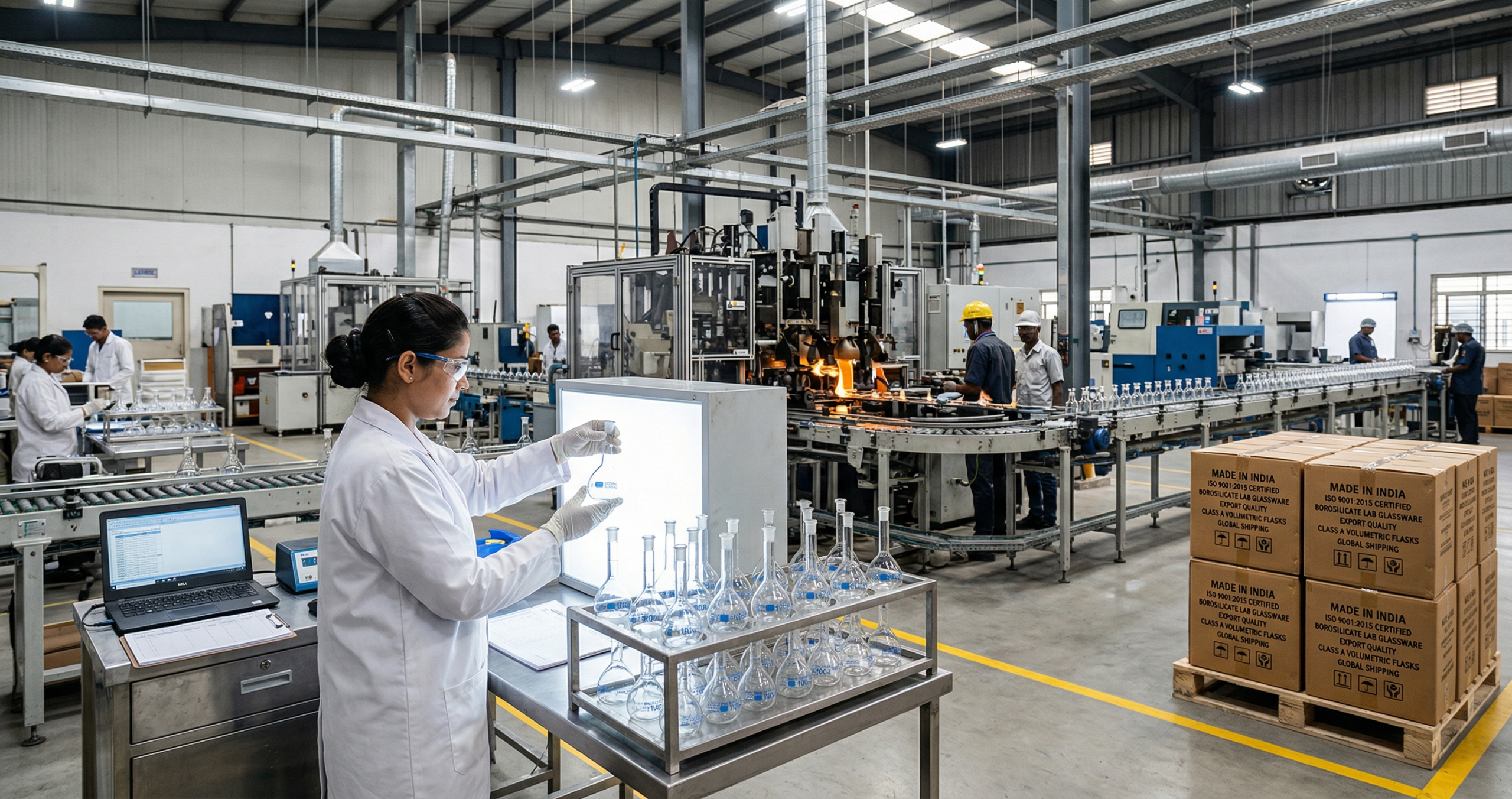
Today, Indian lab equipment manufacturers supply a broad range of scientific products to global markets: borosilicate laboratory glassware (Boro 3.3 and Boro 5.1), diagnostic equipment, analytical balances, centrifuges, microscopes, filtration apparatus, and laboratory chemicals. The borosilicate glassware segment – where India has the deepest manufacturing heritage and the most developed ISO certification infrastructure – is particularly strong. Manufacturers in the Ambala, Vadodara, Mumbai, and Pune manufacturing clusters have built export-focused production facilities that serve Fortune 500 pharmaceutical companies, accredited testing laboratories, and independent laboratory equipment distributors worldwide.
The shift in global distributor preference toward Indian lab equipment manufacturers is not a temporary trend. It reflects structural advantages that have deepened over time and are increasingly difficult for competing manufacturing regions to replicate simultaneously on cost, quality, and service. The following seven reasons explain why this preference has become a durable feature of global laboratory supply chain strategy.
Reason 1: Price Competitiveness Without Compromising ISO Certification
The most consistently cited reason why distributors choose Indian lab equipment manufacturers is the price-to-quality ratio. Indian manufacturers typically offer ex-factory pricing 30-60% below equivalent ISO-certified products from German or US manufacturers, and 15-25% below Chinese manufacturers for products that require verifiable ISO certification documentation.
This pricing advantage is not achieved by cutting quality corners. It results from three structural cost factors specific to the Indian manufacturing environment: lower manufacturing labor costs relative to Western economies while maintaining qualified technical and quality assurance staff, lower energy and overhead costs in Indian manufacturing clusters, and a mature domestic raw materials supply chain for borosilicate glass, laboratory plastics, and metal components that reduces import dependency and currency exposure.
For distributors who need to offer competitive catalogue pricing to end customers while maintaining acceptable margins, Indian lab equipment manufacturers represent the only current sourcing option that combines ISO certification, competitive pricing, and reliable supply continuity at scale. German and US manufacturers command a quality premium that many end customer markets will not absorb. Chinese manufacturers at comparable price points frequently lack verifiable ISO documentation. Indian lab equipment manufacturers fill this gap precisely, and experienced distributors recognize it as a sustainable competitive position.
Reason 2: ISO, WHO-GMP, and CE Certifications Matched to Global Market Requirements
Certification compliance is a non-negotiable requirement for laboratory equipment distributors operating in regulated markets. Indian lab equipment manufacturers serving export markets have invested heavily in the certification infrastructure that global distributors require. This includes ISO 9001 quality management systems, ISO 17025 laboratory accreditation for calibration and testing, WHO-GMP certification for pharmaceutical-grade products, CE marking for European market access, and product-specific standards such as ISO 4787 for volumetric glassware verification and ISO 1042 for volumetric flasks.
This certification portfolio makes Indian lab equipment manufacturers directly comparable to European and North American suppliers in terms of documented quality compliance. Distributors serving pharmaceutical, clinical diagnostics, food safety, and environmental testing markets can source from Indian manufacturers without compromising the compliance documentation they must provide to end customers. For regulated-market distributors, this was historically the decisive barrier to Indian sourcing – it is no longer a barrier for manufacturers with genuine certification programs.
The critical due diligence step is verifying that certifications are current and supported by active quality management infrastructure, not just certificates on file. Reputable Indian lab equipment manufacturers maintain documented quality systems with regular third-party audits, batch-level calibration records, and ISO-traceable measurement systems. This verification process is straightforward for manufacturers with genuine programs and immediately reveals those with paper-only compliance. Distributors should always request the certifying body name and certificate number, then verify directly with the issuing body.
Reason 3: Deep Expertise in Borosilicate 3.3 Glass Manufacturing
India’s borosilicate laboratory glassware manufacturing sector has roots going back over 60 years. This heritage has created a concentration of specialized expertise in borosilicate 3.3 glass – the material that defines high-performance laboratory glassware – that is difficult to replicate in newer manufacturing economies without equivalent institutional knowledge.
Experienced Indian lab equipment manufacturers command deep competency in the properties and processing requirements of borosilicate 3.3: the precise thermal expansion coefficient (3.3 x 10⁻⁶ K⁻¹), the forming temperature range (820-860°C), the annealing requirements for complete residual stress relief, and the material testing protocols for hydrolytic resistance (Hydrolytic Class 1 per ISO 719), thermal shock resistance, and optical clarity that separate laboratory-grade borosilicate from industrial grades.
This materials expertise translates directly into product quality. Borosilicate glassware from experienced Indian lab equipment manufacturers exhibits the chemical inertness, thermal stability, and dimensional calibration accuracy required by ISO and pharmacopoeial standards. For distributors supplying pharmaceutical, clinical, and research markets where material traceability and glass classification documentation are required, this depth of manufacturing heritage in the Indian sector is a decisive sourcing advantage over newer manufacturing geographies that have not yet built equivalent expertise.
Reason 4: Production Capacity, MOQ Flexibility, and Lead Time Reliability
Global distributors manage varying and sometimes unpredictable demand profiles. A distributor serving hospital procurement departments needs to respond to sudden bulk orders on short lead times. A distributor building out a new product catalogue needs to trial small quantities across multiple SKUs before committing to volume. Both scenarios require a manufacturing partner with genuine flexibility across minimum order quantities and production timelines.
Indian lab equipment manufacturers in the mid-to-large tier consistently offer this flexibility. Minimum order quantities for laboratory glassware typically range from 50-200 units per SKU for standard catalogue items, allowing distributors to trial new products without excessive inventory risk. Production lead times for standard items are typically 3-6 weeks ex-works, with air freight options available for urgent orders. Custom items – modified volumes, private label printing, non-standard dimensions – are accommodated by most established manufacturers with lead times of 6-10 weeks.
At the upper end, established Indian lab equipment manufacturers with dedicated export production lines handle container-scale orders (20-foot and 40-foot FCL) on predictable schedules. This allows distributors to plan quarterly stock replenishment with reliable landed cost visibility. The combination of trial-quantity flexibility and container-scale capacity makes Indian lab equipment manufacturers suitable as both new product development partners and core, high-volume supply chain suppliers – a versatility that is harder to find in higher-cost manufacturing regions where MOQ minimums force distributor commitment before product validation.
Reason 5: English-Language Business Culture and Export Documentation
Operational friction in cross-border supply chains is consistently underestimated until it is experienced firsthand. Language barriers, documentation errors, unclear specifications, and communication delays represent significant hidden costs in international sourcing relationships. Indian lab equipment manufacturers eliminate most of these friction points through English as the default business language and decades of experience with international export documentation requirements.
All standard export documentation is produced in English by experienced Indian lab equipment manufacturers: proforma invoices, commercial invoices, packing lists, certificates of origin, test certificates, calibration records, material safety data sheets (MSDS), and compliance declarations including CE conformity statements. Technical specifications, product catalogues, and quality documentation are likewise available in English, making it straightforward for distributor procurement teams to integrate Indian supply chain documentation into their internal systems without translation costs or specification interpretation errors.
Beyond documentation, the engineering and commercial teams at experienced Indian lab equipment manufacturers engage substantively in English on product specifications, compliance requirements, and custom configurations. This capability – taken for granted with European suppliers but not reliably available from all manufacturing geographies – significantly reduces the effort required to manage supplier relationships and resolve technical queries. For distributors who have experienced the communication challenges of sourcing from non-English-primary manufacturing regions, this is consistently cited as one of the most practically valuable advantages of working with Indian lab equipment manufacturers.
Reason 6: Make in India and Government Export Support
The Government of India has made manufacturing export competitiveness a strategic national priority through the Make in India initiative and a range of supporting programs that directly benefit Indian lab equipment manufacturers and create favorable commercial conditions for their global distributor partners.
Export support measures available to Indian laboratory equipment manufacturers include duty drawback schemes that reduce the effective export cost of finished goods, the Remission of Duties and Taxes on Exported Products (RoDTEP) scheme that compensates manufacturers for embedded taxes in exported goods, and participation in government-backed international trade missions and exhibitions that give distributors direct access to verified manufacturers at Ministry of Commerce-endorsed events. The Quality Council of India also supports manufacturers in achieving and maintaining ISO accreditation through subsidized certification programs.
These structural supports mean that Indian lab equipment manufacturers operate in a commercial environment that actively facilitates export competitiveness. They are not simply competing on their own resources but are supported by a national manufacturing export strategy with substantial government investment behind it. Distributors who establish supply relationships with Indian lab equipment manufacturers benefit from this ecosystem through more competitive pricing, better certification infrastructure, greater supply chain stability, and ongoing investment in manufacturing capability by their supplier partners.
Reason 7: Direct Factory-to-Distributor Supply Chain Traceability
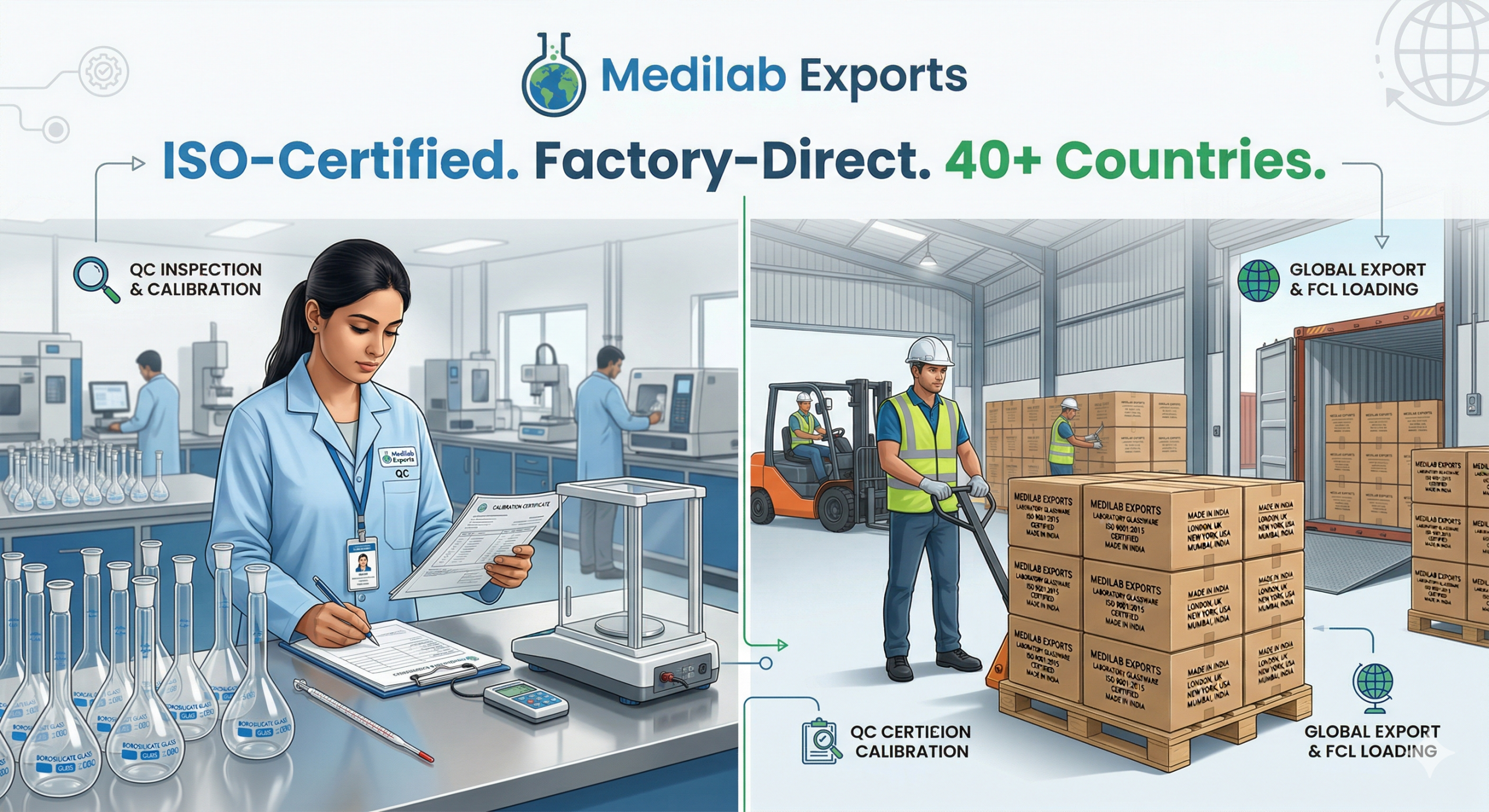
One of the most operationally important advantages of sourcing directly from Indian lab equipment manufacturers – as opposed to through trading companies, regional intermediaries, or multi-tier distribution chains – is complete supply chain traceability. When a distributor establishes a direct relationship with an ISO-certified Indian manufacturer, the chain of custody for every shipment is clear and documented: from factory quality control through batch certification to the distributor’s warehouse.
This traceability matters increasingly as distributors’ end customers operate in regulated environments requiring documented supply chain provenance. Pharmaceutical laboratories, clinical diagnostic facilities, and ISO 17025-accredited testing laboratories require supplier documentation that traces product quality directly to the manufacturing batch. Trading company intermediaries typically cannot provide this level of documentation because they lack visibility into the manufacturer’s production and quality records.
Reputable Indian lab equipment manufacturers supply batch-level quality documentation as standard with each shipment: material test reports confirming borosilicate glass classification, calibration certificates referencing ISO 4787 or product-specific standards, QA release records, and traceability statements linking shipped goods to specific production batches. This factory-direct traceability model is one of the strongest operational arguments for building direct distributor-manufacturer relationships with established Indian lab equipment manufacturers rather than sourcing through intermediaries.
India vs Other Lab Equipment Manufacturing Hubs: A Comparison
The table below compares the key sourcing parameters of Indian lab equipment manufacturers against other major manufacturing geographies that global distributors typically consider. Use this as a reference framework when evaluating your current supply chain structure or initiating a new sourcing evaluation.
| Manufacturing Hub | Price vs German Baseline | ISO / WHO-GMP Certifications | English Communication | MOQ Flexibility | Standard Lead Time | Borosilicate 3.3 Expertise |
|---|---|---|---|---|---|---|
| India | 40-60% lower | ISO 9001, WHO-GMP, CE, ISO 4787, ISO 1042 | High | High (50-200 units/SKU) | 3-6 weeks EXW | Deep (60+ year heritage) |
| China | 50-70% lower | Variable – independent verification required | Medium | High (100+ units) | 4-8 weeks EXW | Moderate |
| Germany | Baseline (100%) | ISO 9001, EN standards, ISO 4787 | High | Low (high MOQ, long commitment) | 6-12 weeks EXW | Very deep |
| United States | 10-30% above Germany | FDA, ISO 9001, ASTM | High | Medium | 4-8 weeks EXW | Moderate |
| Eastern Europe | 20-40% lower | ISO 9001, CE | Medium-High | Medium | 4-8 weeks EXW | Moderate |
How to Evaluate and Qualify Indian Lab Equipment Manufacturers
Not all Indian lab equipment manufacturers deliver the same quality, certification rigor, or supply chain reliability. Distributors approaching the Indian market for the first time – or reviewing existing supplier relationships – should follow a structured evaluation process that goes beyond reviewing a digital catalogue and quoted prices.
The first step is certificate verification. Request the ISO 9001 certificate with the issuing certification body name and certificate number, then verify the certificate’s current status directly with the certifying body’s online registry. For WHO-GMP and CE claims, request the underlying documentation rather than a summary statement. Reputable Indian lab equipment manufacturers will provide this documentation promptly. Manufacturers who deflect, delay, or provide certificates without verifiable certifying body information should be disqualified at this stage.
The second step is requesting a sample quality documentation package for a recent production batch. This should include the batch production record, material test report confirming borosilicate glass classification and hydrolytic resistance, calibration certificate referencing the applicable ISO standard (ISO 4787, ISO 1042, or similar), and the QA release authorization. This documentation package reveals the maturity and rigor of the manufacturer’s quality management system far more accurately than the ISO certificate itself.
The third step is a trial order before volume commitment. Source a representative range of SKUs in modest quantities, verify the goods on arrival against specifications and documentation, and assess the manufacturer’s handling of any discrepancies. How an Indian lab equipment manufacturer responds to a quality claim or specification query during a trial order tells you everything about how they will behave as a long-term supply chain partner.
For a comprehensive understanding of the quality standards and certifications that define credible laboratory glassware, see our guide to Laboratory Glassware Quality Standards: 7 Essential ISO, ASTM & DIN Certifications. For understanding the precision requirements your end customers will apply to glassware from Indian lab equipment manufacturers, see Precision Scientific Glassware: 7 Critical Reasons Why It Matters. For a complete breakdown of glassware types used across laboratory settings, see 12 Common Laboratory Glassware and Their Uses.
Frequently Asked Questions
The price advantage of Indian lab equipment manufacturers is structural, not a result of cutting quality corners. Three factors drive it: lower manufacturing labor costs relative to Western economies (while maintaining qualified engineering and QA staff), lower energy and overhead costs in India’s manufacturing clusters, and a mature domestic supply chain for raw materials including borosilicate glass that reduces import dependency. These structural cost advantages allow Indian lab equipment manufacturers to price 30-60% below German or US equivalent products while investing in ISO certification infrastructure, calibrated testing equipment, and quality assurance staff that fully support international compliance requirements. The result is a price-to-quality ratio that no other manufacturing region currently matches for ISO-certified laboratory glassware and equipment.
The minimum certification baseline for serious Indian lab equipment manufacturers in the export segment is ISO 9001 quality management system certification from an internationally recognized accreditation body (such as Bureau Veritas, SGS, TUV, DNV, or NABCB-accredited bodies). For laboratory glassware specifically, look for compliance with ISO 4787 (volumetric glassware verification), ISO 1042 (volumetric flasks), ISO 385 (burettes), and ISO 648 (one-mark pipettes). For manufacturers supplying pharmaceutical markets, WHO-GMP certification is required. For European market access, CE marking with supporting technical documentation is required. Always verify certificates directly with the issuing certification body rather than accepting a certificate PDF alone. Reputable Indian lab equipment manufacturers welcome this verification request.
Yes, established Indian lab equipment manufacturers specializing in laboratory glassware produce items from borosilicate glass 3.3, which is verified by material testing against ISO 719 (hydrolytic resistance) and confirmed thermal expansion coefficient (3.3 x 10⁻⁶ K⁻¹). India has over 60 years of borosilicate glassware manufacturing heritage, and the leading export-focused manufacturers use verified borosilicate 3.3 raw glass from accredited domestic and international suppliers. When in doubt, request the material test report confirming hydrolytic classification and glass composition from any Indian lab equipment manufacturer you are evaluating. A Hydrolytic Class 1 result per ISO 719 confirms genuine borosilicate 3.3 material. Any manufacturer that cannot or will not provide this documentation should not be considered a credible source for laboratory glassware.
Minimum order quantities from Indian lab equipment manufacturers for standard catalogue laboratory glassware typically range from 50-200 units per SKU, depending on the manufacturer, product type, and whether custom labeling or private branding is required. For commodity items like beakers, flasks, and graduated cylinders in standard volumes, some manufacturers accept MOQs as low as 24-50 units for trial purposes. For custom items – non-standard volumes, private label printing, bespoke packaging – MOQs are typically higher at 200-500 units. Container-scale FCL orders (1,000+ units per SKU) attract the best pricing and can be built as mixed-SKU containers to meet the FCL weight and volume minimums without concentrating risk in a single product line. Most experienced Indian lab equipment manufacturers are accustomed to working with distributors on mixed-container orders that combine multiple product categories.
The key difference between Indian lab equipment manufacturers and Chinese manufacturers for laboratory glassware lies in certification verifiability and materials expertise. Both geographies offer competitive pricing below German and US manufacturers. However, Indian lab equipment manufacturers in the export-focused segment have invested more consistently in internationally verifiable ISO certification infrastructure, and India’s 60+ year borosilicate glassware manufacturing heritage provides deeper materials expertise than is available in most Chinese glassware producers. Chinese manufacturers are highly capable in high-volume commodity production, and some maintain genuine international certifications. But for distributors who need verifiable ISO 4787 compliance documentation, Hydrolytic Class 1 material test reports, and direct calibration traceability for regulated-market customers, Indian lab equipment manufacturers consistently provide more complete and independently verifiable documentation packages.
Experienced Indian lab equipment manufacturers supplying export markets provide a complete documentation package with each shipment. Standard commercial documentation includes: commercial invoice, packing list, certificate of origin (from an authorized issuing body), and bill of lading or airway bill. Quality documentation includes: batch calibration certificate referencing the applicable ISO standard, material test report confirming borosilicate glass classification, QA release certificate, and – for regulated markets – a Certificate of Conformance stating compliance with applicable product standards. For pharmaceutical market customers, WHO-GMP status documentation and product-specific analytical data may also be provided. This documentation level is fully comparable to what European manufacturers provide and is sufficient for regulated-market distributor requirements. Distributors should specify documentation requirements explicitly in the purchase order to ensure all needed certificates are prepared in advance of shipment.
The recommended approach for distributors new to Indian lab equipment manufacturers is a structured three-step process. First, identify manufacturers through verified directories such as the Federation of Indian Export Organisations (FIEO), government-recognized export promotion councils, or attendance at international laboratory trade exhibitions where Indian manufacturers exhibit under Ministry of Commerce accreditation. Second, conduct certificate verification and request a sample quality documentation package before placing any order, as described in our evaluation guide above. Third, place a trial order covering your priority SKUs in modest quantities, verify the goods thoroughly on arrival, and assess how the manufacturer handles any queries or discrepancies before committing to volume. Medilab Exports Consortium welcomes distributor inquiries from all markets and is prepared to provide full certification documentation, sample shipments, and reference contacts from existing distributor partners as part of a structured onboarding process.
Partner With an ISO-Certified Indian Lab Equipment Manufacturer
Medilab Exports Consortium is an ISO-certified manufacturer and exporter of borosilicate 3.3 laboratory glassware supplying distributors in 40+ countries. We supply Class A and Class B volumetric glassware with full ISO 4787 batch documentation, WHO-GMP compliance records, and CE conformity statements – everything your regulated-market customers require.
