

The debate between glassware vs plasticware in laboratories is one of the most consequential procurement decisions a lab manager can make. The wrong choice introduces chemical contamination, measurement error, failed sterilization cycles, or unnecessary cost – each of which can compromise scientific credibility, regulatory compliance, or operational efficiency. Yet many laboratories make this decision by habit or historical precedent rather than by evaluating the actual technical requirements of their workflows.
This guide compares glassware vs plasticware across 8 critical differences that matter most in professional laboratory settings: chemical resistance, precision, temperature tolerance, sterilization compatibility, cost dynamics, environmental impact, optical clarity, and application-specific suitability. By the end of this guide, you will have a clear framework for making the right material choice for every application in your laboratory, rather than defaulting to one material for everything.
Medilab Exports Consortium manufactures ISO-certified borosilicate laboratory glassware for institutions and distributors in over 40 countries. Our perspective on the glassware vs plasticware question is grounded in decades of supply experience across pharmaceutical QC, academic research, environmental testing, and industrial analytical chemistry – the four laboratory types where this choice has the most significant consequences.
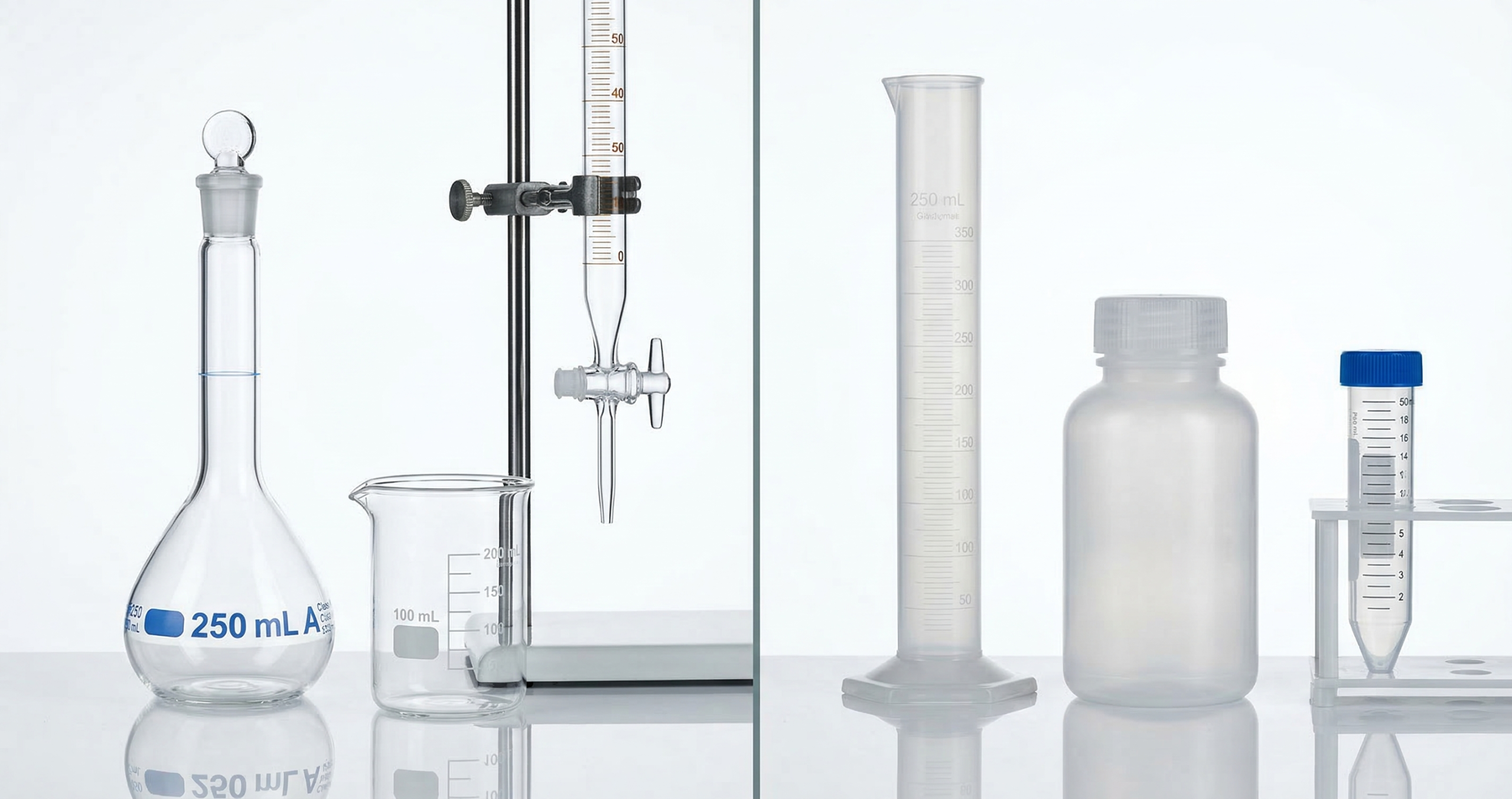
Why the Glassware vs Plasticware Decision Matters
The choice between glassware vs plasticware is not purely a matter of tradition or preference – it is a scientific and operational decision with measurable consequences. Laboratory vessels come into direct contact with samples, reagents, standards, and biological materials. The material of the vessel determines what contaminants it may introduce, how accurately it measures volume, which sterilization protocols it can survive, and how it behaves under the thermal and chemical conditions of the procedure being performed.
Neither glass nor plastic is universally superior. Borosilicate glass excels in chemical inertness, thermal resistance, volumetric precision, and optical clarity. Plastic materials excel in impact resistance, weight, cost for single-use applications, and compatibility with hydrofluoric acid and strongly alkaline solutions that attack glass. A laboratory that understands the glassware vs plasticware distinction at a technical level will use both materials, each in the contexts where it outperforms the alternative.
1. Chemical Resistance and Compatibility
Chemical resistance is the first and most critical factor in the glassware vs plasticware decision. Borosilicate glass 3.3, the industry standard for laboratory glassware, is classified as Hydrolytic Class 1 (HGB 1) per ISO 719. This means it releases an extremely small quantity of alkali ions into solutions even under prolonged contact, making it chemically inert for the vast majority of laboratory applications including trace metal analysis, enzyme assays, and pharmaceutical formulation work.
Common laboratory plastics – polypropylene (PP), high-density polyethylene (HDPE), polycarbonate (PC), and polytetrafluoroethylene (PTFE) – each have distinct chemical resistance profiles. PP and HDPE resist most acids and bases well but are attacked by many organic solvents including hexane, acetone, and toluene. Polycarbonate is chemically fragile and should never be used with organic solvents, strong acids, or bases. PTFE is essentially chemically universal but expensive and not transparent. In the glassware vs plasticware comparison, glass wins for organic solvent applications, while specific plastics win for hydrofluoric acid and prolonged alkaline storage where glass would dissolve or leach silica.
Plastic vessels also carry a contamination risk that glass does not: plasticizers, antioxidants, and slip agents incorporated during manufacturing can leach into solutions over time, particularly in the presence of organic solvents or elevated temperatures. This leaching is a significant concern in trace analysis and biological work where even parts-per-billion contamination levels affect results. In the glassware vs plasticware debate for high-sensitivity analytical chemistry, glass is the safer default material.
2. Precision and Volumetric Accuracy
For quantitative analytical work, the glassware vs plasticware comparison is decisive in favor of glass. Precision volumetric glassware – Class A volumetric flasks, burettes, pipettes, and graduated cylinders – is calibrated to internationally defined tolerances specified in ISO 1042, ISO 385, and ISO 648. These calibrations are performed gravimetrically at 20 degrees C and are traceable to national measurement institutes.
Plastic volumetric vessels exist but carry inherent disadvantages. The thermal expansion coefficient of most polymers is 5 to 10 times higher than that of borosilicate glass, meaning that plastic cylinders and flasks change their internal volume more significantly with temperature fluctuations. Many plastic surfaces also exhibit different wetting behavior than glass, affecting meniscus formation and therefore the reproducibility of volume readings. For routine volume measurement and transfer in general laboratory work, plastic graduated cylinders and bottles are adequate. For all critical quantitative analysis, the glassware vs plasticware choice is unambiguous: use calibrated glass.
3. Temperature Resistance and Heat Applications
Borosilicate glass 3.3 has a maximum working temperature of approximately 500 degrees C and a softening point of 820 degrees C. It withstands direct flame, Bunsen burner heating, hot plates, oven sterilization, and autoclaving without structural change or dimensional deformation. Its low thermal expansion coefficient (3.3 x 10 to the power of -6 per K) means it resists thermal shock better than soda-lime glass, though rapid quenching from high temperatures should always be avoided.
Most laboratory plastics begin to deform at temperatures well below those commonly encountered in chemical synthesis or sterilization. Polypropylene has a maximum working temperature of approximately 135 degrees C – adequate for autoclave sterilization at 121 degrees C but not for direct heat applications. Polycarbonate is rated to approximately 120 degrees C but becomes brittle after repeated autoclave cycles. PTFE can withstand temperatures up to 260 degrees C but is rarely used as primary labware due to cost. In the glassware vs plasticware comparison for any heat application beyond standard autoclave temperatures, glass is the only viable option.
4. Sterilization Methods and Compatibility
The glassware vs plasticware comparison in sterilization reveals important differences that affect workflow design in biological laboratories. Borosilicate glass is compatible with all four common sterilization methods: autoclaving (121 degrees C / 15 psi steam), dry heat oven (160 to 180 degrees C), UV irradiation, and chemical disinfection. This universal compatibility makes glass the most flexible choice for laboratories that switch between sterilization methods depending on the application.
Most plastics are limited to autoclave sterilization, chemical disinfection, or gamma irradiation for single-use items. Dry heat sterilization above 150 degrees C is incompatible with all common laboratory polymers. Repeated autoclave cycles degrade many plastic materials over time – polycarbonate becomes brittle and cloudy, while polypropylene may warp with prolonged or repeated high-pressure steam exposure. For cell culture and microbiology applications where sterility is critical and glassware must survive many sterilization cycles, glass provides long-term reliability that plastic cannot match. Single-use plastic items avoid degradation concerns entirely but generate significant waste volumes.
5. Cost: Upfront Investment vs Long-Term Value
The glassware vs plasticware cost comparison requires a longer time horizon than most procurement decisions. Individual glass items cost more than their plastic equivalents at point of purchase. A 250 mL borosilicate beaker costs more than a polypropylene beaker of the same nominal size. However, glass beakers cleaned, inspected, and handled correctly last for years or decades. Plastic beakers used for organic solvents, strong acids, or repeated heat cycles degrade and must be replaced significantly more frequently.
The true glassware vs plasticware cost calculation must include: purchase price, replacement frequency, cleaning and sterilization cost per cycle, waste disposal cost (plastic laboratory waste often requires special handling), and regulatory documentation cost for consumable plastic items used in regulated workflows. For routine general-purpose laboratory use with no chemical compatibility concerns, plastic is cost-effective. For high-temperature, organic solvent, or regulated analytical applications, glass provides substantially better long-term value despite higher initial cost.
6. Environmental Impact and Sustainability
Environmental sustainability is an increasingly important factor in the glassware vs plasticware decision as laboratories worldwide pursue Green Lab certifications and reduce their plastic waste footprint. The volume of single-use plastic labware consumed by the global scientific research sector is substantial – estimates published by Nature suggest that laboratories generate millions of tonnes of plastic waste annually, much of it from single-use pipette tips, tubes, and containers that cannot be recycled through standard municipal streams.
Borosilicate glass is made from natural raw materials (silica, boron, sodium, aluminum oxides), has a long service life, and can be recycled into new glass products at end of life. A glass beaker used for 10 years generates a fraction of the waste footprint of the equivalent number of single-use plastic beakers. For laboratories seeking to demonstrate environmental responsibility, the glassware vs plasticware choice consistently favors glass for reusable applications. The My Green Lab certification framework specifically rewards laboratories that reduce single-use plastic consumption through strategic equipment choices.
7. Optical Clarity and Visual Inspection
In the glassware vs plasticware comparison for visual applications, glass is the clear winner. Borosilicate glass transmits visible and UV light uniformly, maintains clarity across its service life, and does not develop the haziness or yellowing that affects plastic labware after repeated use, UV exposure, or chemical contact. This optical property matters practically in several contexts: reading meniscus levels accurately for volume measurement, visually inspecting solutions for clarity or precipitation, and using vessels directly as cuvettes in UV-Vis spectrophotometry.
Many plastics that appear optically clear initially develop surface hazing after chemical exposure or autoclaving. Polycarbonate is particularly prone to this effect. Polypropylene and polyethylene are inherently translucent rather than transparent, making precise meniscus reading difficult even on new items. For colorimetric reaction monitoring, crystallization observation, or any application where visual inspection of solution clarity is important, glass provides a substantially superior viewing environment than any common laboratory plastic.
8. Application-Specific Suitability
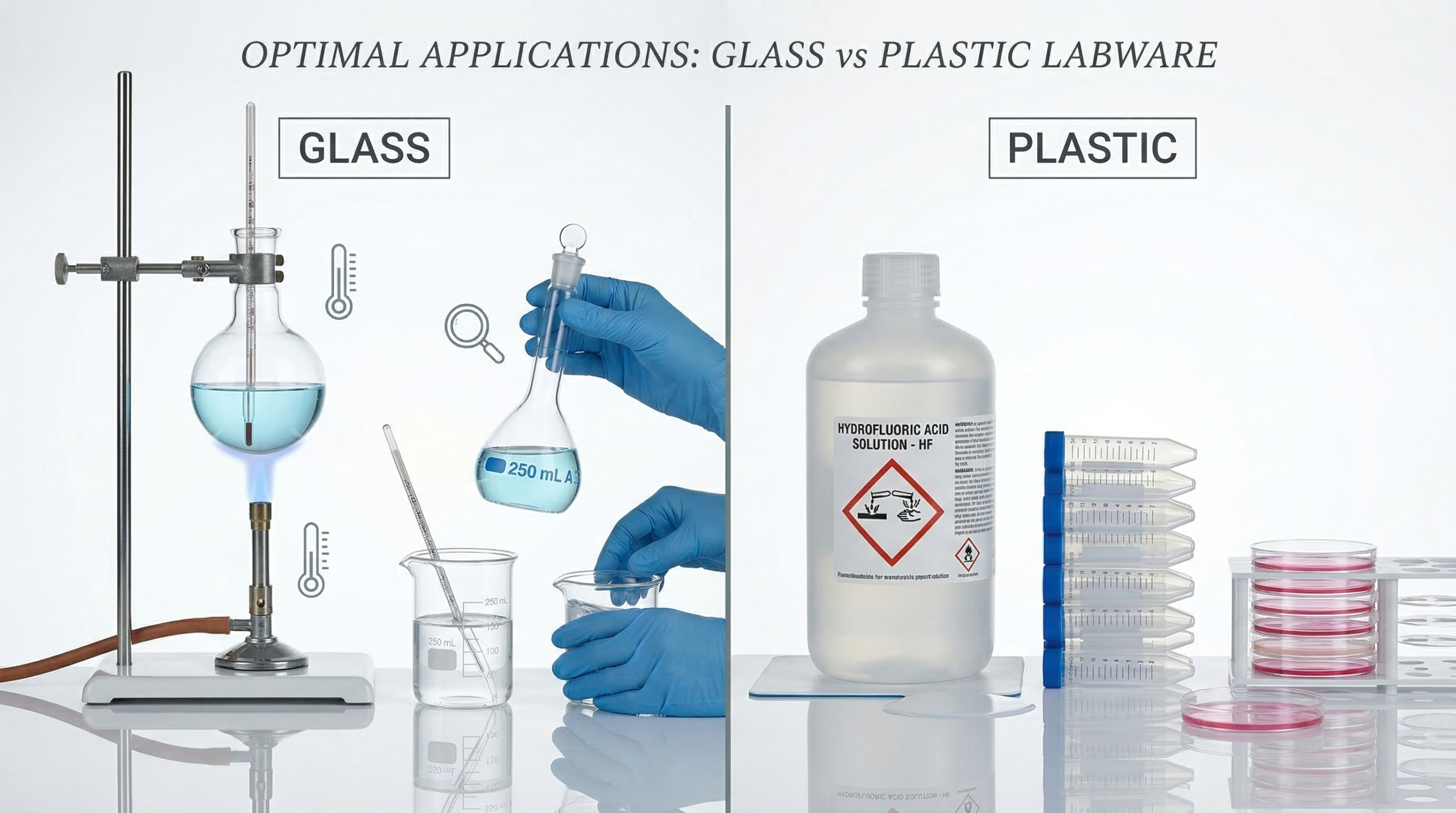
The most nuanced aspect of the glassware vs plasticware decision is matching material properties to specific laboratory applications. Some applications strongly favor glass: preparation of standard solutions for quantitative analysis (precision, inertness), organic synthesis and reflux reactions (heat resistance), distillation and solvent work (chemical inertness, thermal resistance), and any procedure requiring UV spectrophotometry with the vessel itself as a cuvette (optical clarity).
Other applications strongly favor specific plastics: storage of hydrofluoric acid or strongly alkaline solutions (glass dissolves), low-temperature storage below -20 degrees C where glass breakage risk is high (polypropylene cryo-tubes), high-throughput biological screening where breakage risk and cost of disposables is prioritized over environmental concerns (polypropylene microplates and tubes), and field sampling where portability and breakage resistance matter more than chemical precision (HDPE sample bottles). A laboratory that has resolved the glassware vs plasticware question intelligently uses a planned combination of both materials rather than defaulting to one across all applications.
Quick Reference: Glassware vs Plasticware Comparison Table
The table below summarizes the glassware vs plasticware comparison across all 8 critical factors. Use this reference when evaluating material choices for specific applications in your laboratory. For a detailed guide to the glassware types referenced, see our complete guide to common laboratory glassware and their uses.
| Factor | Borosilicate Glass | Common Plastics (PP, HDPE, PC) | Winner |
|---|---|---|---|
| Chemical Resistance (general) | Excellent – inert to most acids, bases, solvents | Variable – PP/HDPE good for acids; attacked by many organics | Glass |
| Volumetric Precision (Class A) | ISO-certified tolerances, gravimetrically verified | No ISO Class A standard; high thermal expansion | Glass |
| Maximum Working Temperature | Up to 500 degrees C | PP: 135 degrees C; PC: 120 degrees C; PTFE: 260 degrees C | Glass |
| Sterilization Compatibility | All methods: autoclave, dry heat, UV, chemical | Autoclave (PP) and chemical only; dry heat incompatible | Glass |
| Upfront Cost | Higher per item | Lower per item | Plastic |
| Long-Term Cost | Lower – decades of service life | Higher – replacement, waste disposal | Glass |
| Environmental Impact | Lower – reusable, recyclable, natural materials | Higher for single-use; non-recyclable lab plastics | Glass |
| Optical Clarity | Excellent – UV and visible transparent, stable | Variable – PP/HDPE translucent; PC hazes with use | Glass |
| Impact Resistance | Lower – brittle, breaks on dropping | Higher – resistant to impact and dropping | Plastic |
| HF / Strong Alkali Storage | Not compatible – glass dissolves | Compatible (PP, HDPE, PTFE) | Plastic |
When to Choose Glass and When to Choose Plastic
Based on the 8 critical differences covered in this glassware vs plasticware guide, the practical decision rules are straightforward. Choose borosilicate glass when: precision volumetric measurement is required, the procedure involves organic solvents or reagents that attack polymer surfaces, direct heating or high-temperature sterilization is part of the workflow, optical clarity for visual inspection or spectrophotometry is required, or the application is regulated and requires traceable calibration documentation. For detailed guidance on maintaining glass equipment in these applications, see our guide on laboratory glassware maintenance and cleaning tips.
Choose plastic when: the reagent stored is hydrofluoric acid or a strongly alkaline solution that attacks glass, breakage risk in the specific environment is high (field work, educational settings, high-throughput automation), single-use disposability is required for biological containment, the application is cryogenic storage at temperatures below -40 degrees C, or the procedure involves extremely light-sensitive reagents where amber PP or HDPE containers provide superior protection. For high-volume single-use applications, also factor in your laboratory’s waste reduction targets when making the final glassware vs plasticware decision.
Contact the Medilab Exports team to discuss your specific laboratory application requirements and receive a recommendation for the right glassware specification to support your work. Explore our full laboratory glassware catalog to find the certified borosilicate items that match your workflow.
Frequently Asked Questions
Neither is universally better in the glassware vs plasticware comparison – each material excels in different applications. Borosilicate glass is superior for precision volumetric work, organic solvent procedures, high-temperature applications, sterilization compatibility, optical clarity, and long-term cost efficiency. Plastic is superior for impact resistance, hydrofluoric acid and strong alkali storage, single-use biological containment, and cryogenic applications. Professional laboratories use both materials, matching each to the specific technical requirements of the workflow.
No. The glassware vs plasticware comparison for quantitative analytical work strongly favors glass. ISO-certified Class A glass volumetric flasks, burettes, and pipettes are calibrated to tight tolerances per ISO 1042, ISO 385, and ISO 648, with gravimetric verification traceable to national measurement institutes. No equivalent ISO certification exists for plastic volumetric ware, and the higher thermal expansion coefficient of polymers makes their calibrated volumes less stable across the temperature range of a working laboratory. Pharmacopoeias including USP, EP, and BP explicitly require Class A glass volumetric ware for official test procedures.
In the glassware vs plasticware comparison for chemical resistance, PTFE (polytetrafluoroethylene) is the most chemically resistant plastic available for laboratory use, withstanding virtually all acids, bases, and organic solvents at temperatures up to 260 degrees C. For general-purpose use, polypropylene (PP) offers excellent resistance to most aqueous acids, bases, and polar solvents, though it is attacked by many organic solvents including chlorinated solvents and aromatics. HDPE offers similar resistance to PP with better impact strength. Polycarbonate is the least chemically resistant common lab plastic and should be avoided for reagent storage.
In the glassware vs plasticware comparison for organic solvents, glass is strongly preferred because most laboratory polymers are partially soluble in or absorb common organic solvents. Polypropylene swells and softens in chlorinated solvents. Polycarbonate is attacked by acetone, ethanol, and most organic reagents. Even PP and HDPE absorb non-polar solvents like hexane over time, leaching plasticizer compounds into the sample. Borosilicate glass is chemically inert to virtually all organic solvents used in laboratory practice, making it the only reliable choice for solvent storage, extraction work, and organic synthesis procedures.
Yes, in most cases. The glassware vs plasticware environmental comparison favors glass for reusable laboratory applications. A single glass beaker used and cleaned for 10 years generates far less waste than the equivalent number of single-use plastic beakers. Laboratory plastic waste is largely non-recyclable through standard municipal streams and often requires special disposal as chemical-contaminated waste, adding cost and environmental impact. The My Green Lab certification framework and similar programs actively encourage laboratories to reduce single-use plastic consumption by substituting reusable glass where technically appropriate. For biological containment applications where single-use plastics are required for safety, this recommendation does not apply.
Source ISO-Certified Borosilicate Laboratory Glassware
When your application calls for glass in the glassware vs plasticware decision, Medilab Exports Consortium supplies ISO-certified borosilicate 3.3 laboratory glassware to institutions and distributors in 40+ countries. Class A and Class B available with full batch documentation.
