Navigating the complex world of scientific research requires more than just specialized knowledge; it requires the right foundation of Essential Chemistry Lab Equipment. Whether you are establishing a new decentralized testing facility, a university educational laboratory, or a high-throughput pharmaceutical R&D center, the quality and selection of your core tools will dictate the accuracy of your results and the safety of your personnel. In this comprehensive guide, we explore the definitive list of scientific tools that serves as the backbone of modern chemical analysis.
At Medilab Exports Consortium, we understand that “good enough” is never sufficient in a laboratory setting. Our commitment to manufacturing premium Borosilicate 3.3 laboratory glassware ensures that every piece of labware we produce meets the most stringent international standards. From the thermal shock resistance of our beakers to the metrological precision of our Class A volumetric flasks, we provide the tools that turn observations into breakthrough data.
Why Borosilicate 3.3 is the Foundation of Professional Lab Supplies
Before diving into individual items, it is critical to address the material science that makes professional chemistry lab supplies possible. Not all glass is suitable for chemical work. Standard soda-lime glass, while ubiquitous in windows and consumer bottles, fails in the lab because of its high coefficient of thermal expansion and lower chemical durability.
Borosilicate glass 3.3 is the international gold standard. It contains a high concentration of boric oxide, which allows it to withstand rapid temperature changes (thermal shock) without fracturing. Furthermore, it is classified as Hydrolytic Class 1 (HGB 1) glass, meaning it leaches virtually no alkali ions into your samples. This inertness is why Borosilicate 3.3 is the only acceptable material for scientific glassware used in trace analysis and pharmaceutical quality control.
1. Beakers: The Versatile Vessel in Your Professional Lab Kit
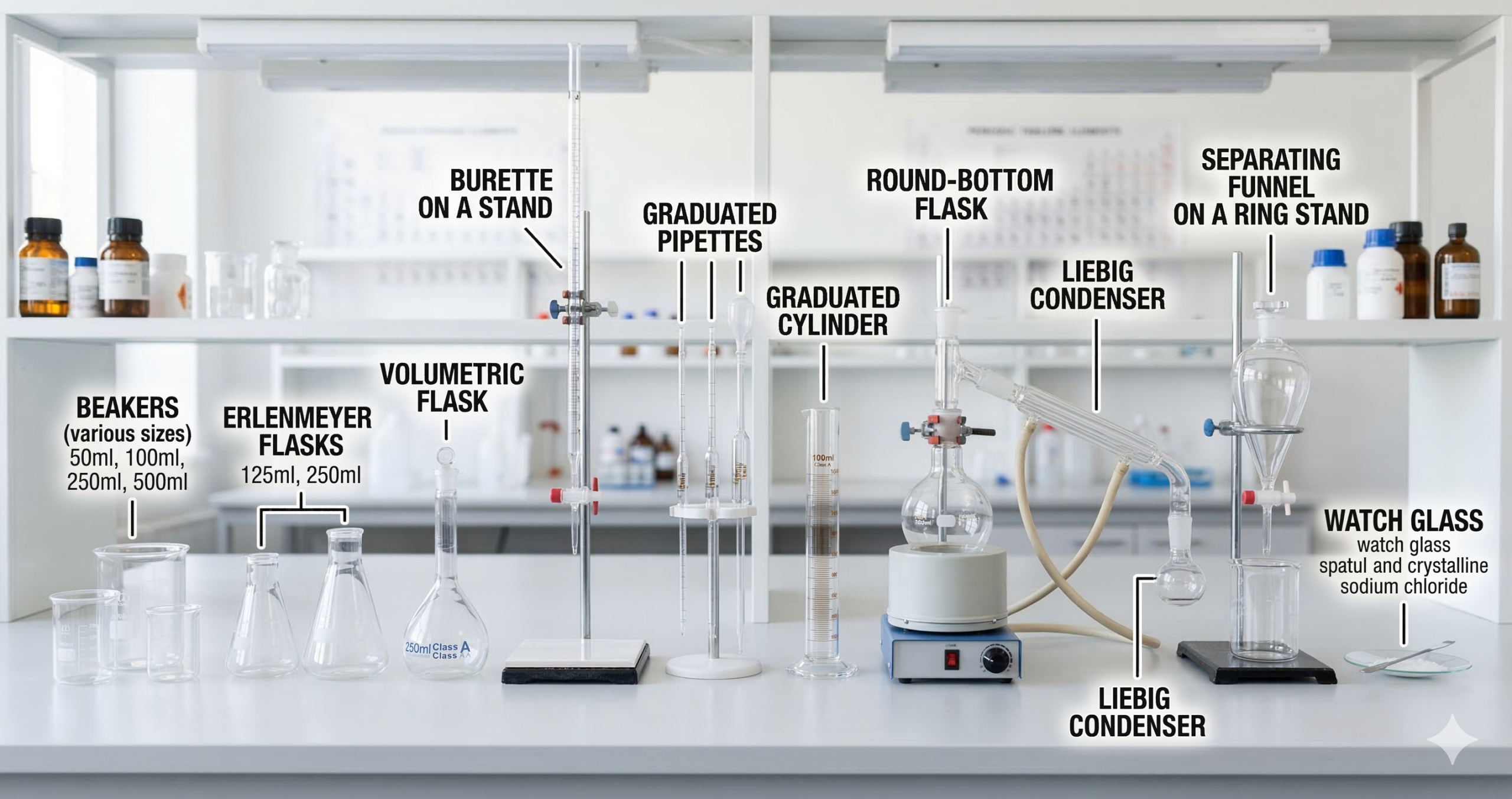
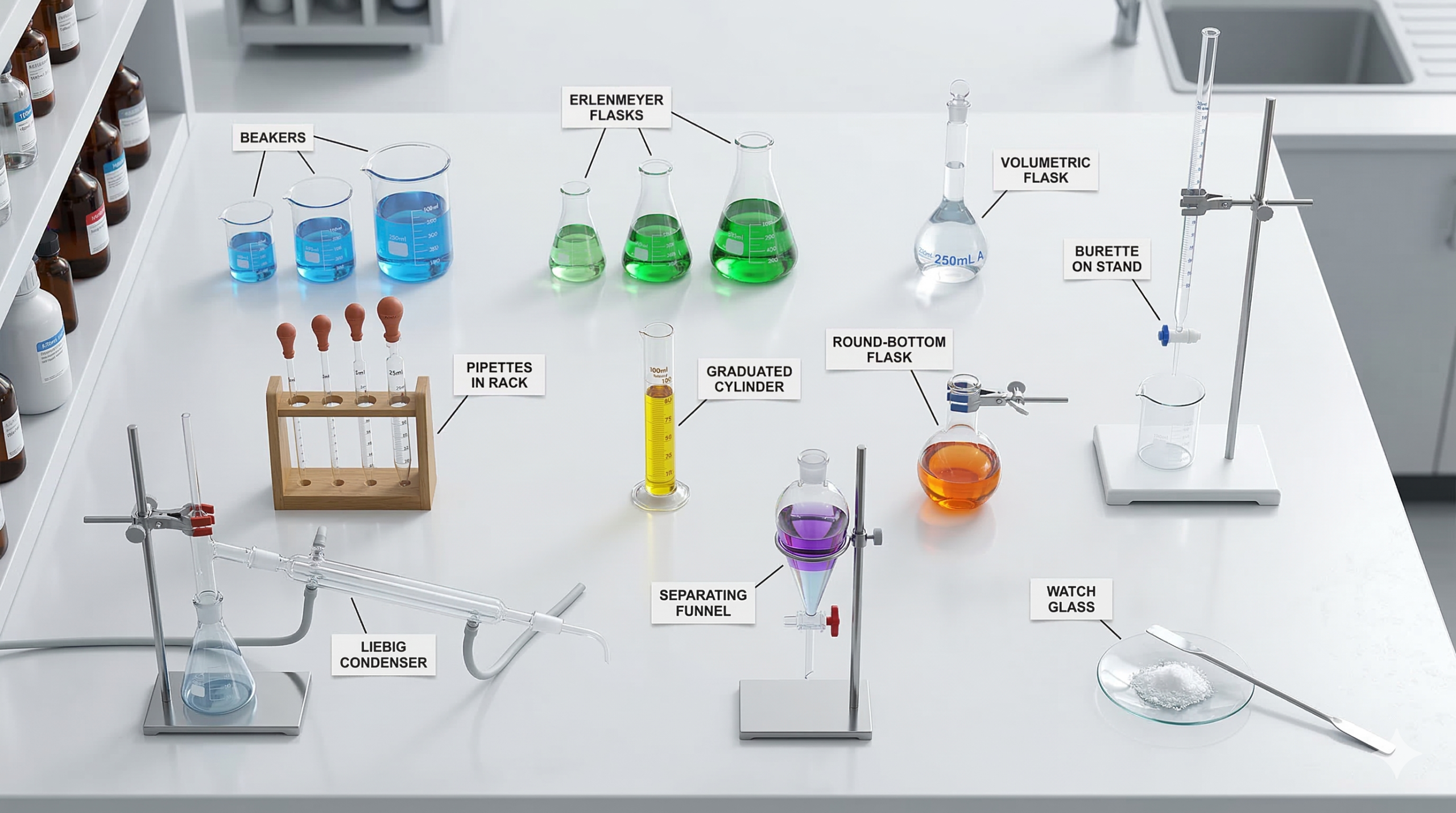
No list of Essential Chemistry Lab Equipment is complete without the beaker. These cylindrical, flat-bottomed vessels are the “workhorses” of the lab. Their primary functions include mixing liquids, dissolving solids, heating solutions, and serving as a temporary holding vessel during experimental transitions.
While beakers feature graduation marks, it is a common pitfall for new researchers to use them for precise measurement. Beaker markings are generally accurate only to within ±5%. For professional laboratory glassware usage, beakers should be used for qualitative work, while volumetric tasks are reserved for more calibrated instruments. Our beakers at Medilab Exports feature reinforced rims and uniform wall thickness to ensure longevity under direct flame usage.
2. Erlenmeyer Flasks: Stability and Agitation
The Erlenmeyer flask, with its distinctive conical body and narrow neck, is another critical piece of scientific tools. Its design allows for the vigorous swirling of liquids—essential during titrations—without the risk of spilling that a beaker would present. The narrow neck also facilitates the use of stoppers for temporary storage or for creating a closed environment for microbiological cultures.
In high-end glassware catalogs, you will find Erlenmeyer flasks with ground-glass joints. These allow the flask to be integrated directly into reaction setups like reflux or distillation, ensuring a leak-proof and pressure-stable connection. For bio-analytical applications, we offer “baffled” flasks that increase surface area and oxygen transfer, further expanding the utility of this labware staple.
3. Volumetric Flasks: Essential Chemistry Lab Equipment for Accuracy
When the experiment requires a solution of an exact, known concentration, the volumetric flask becomes the most important piece of analytical instruments. Calibrated “TC” (to contain) at a specific temperature (usually 20°C), these pear-shaped flasks have a long, thin neck with a single graduation line etched into the glass.
For any analytical laboratory, Class A volumetric flasks are Essential Chemistry Lab Equipment that must be present in every size from 5 mL to 2 L. The tight tolerances (as low as ±0.02 mL for a 10 mL flask) ensure that standard solutions for HPLC, titration, and spectroscopy are prepared with absolute accuracy. At Medilab Exports, our volumetric glassware is individually calibrated and can be supplied with a factory batch certificate of conformity.
4. Burettes: Mastering Titration
Titration is perhaps the most fundamental quantitative technique in chemistry, and the burette is the specialized tool that makes it possible. A burette is a long, graduated glass tube with a precision stopcock (valve) at the bottom. This allows the researcher to dispense accurately measured volumes of a liquid reagent (the titrant) with incredible control.
Modern scientific standards demand burettes with PTFE (Teflon) stopcocks. Unlike traditional glass stopcocks that require grease (which can contaminate samples or become stuck), PTFE valves operate smoothly without lubrication. Whether you are conducting acid-base titrations or complexometric assays, having a Class A certified burette is non-negotiable for professional-grade laboratory inventories.
5. Pipettes: Precise Liquid Transfer
While burettes dispense liquid from a fixed point, pipettes are Essential Chemistry Lab Equipment designed to transfer highly accurate volumes from one vessel to another. There are two primary categories of glass pipettes in our catalog lineup: volumetric (one-mark) and graduated (multiple marks).
Volumetric pipettes offer the highest precision and are used for transferring a single, fixed volume. Graduated pipettes provide more flexibility for varying volumes but with slightly wider tolerances. For biological work, serological pipettes (graduated to the tip) are common tools used for media transfer and serial dilutions. All our pipettes conform to ASTM and ISO specifications, ensuring your liquid-handling remains flawless.
6. Graduated Cylinders: Reliable Foundation
For day-to-day measurements where the extreme precision of a volumetric flask isn’t required but better accuracy than a beaker is needed, Essential Chemistry Lab Equipment like graduated cylinders are the ideal choice. These tall, narrow vessels provide a clear view of the liquid meniscus against a graduated scale.
A key aspect of using this labware correctly is understanding the “meniscus.” Always read the bottom of the curve at eye level to avoid parallax error. Medilab’s inventory range features hexagonal bases to prevent tipping on the lab bench—a small but critical safety feature for any professional workspace.
7. Condensers: Essential Chemistry Lab Equipment for Phase Changes
In organic chemistry and distillation, the condenser is the specialized Essential Chemistry Lab Equipment that enables the recovery of liquids from vapors. By circulating cooling water through an outer jacket, the condenser pulls heat away from the vapor in the inner tube, cause it to condense.
From simple Liebig condensers to high-efficiency Graham (spiral) or Allihn (bulb) models, these are core items that define a reaction setup. Because they are often subjected to significant thermal gradients, the use of Borosilicate 3.3 in these glass components is mandatory to avoid catastrophic failure during heating. We manufacture our condensers with precision-ground joints (14/23, 19/26, 24/29) for seamless integration with other specialized scientific tools.
8. Round-Bottom Flasks: The Reaction Hub
When chemicals need to be heated, evaporated, or reacted under reflux, the round-bottom flask (RBF) is the Essential Chemistry Lab Equipment most commonly used. Its spherical shape distributes heat and stress far more evenly than a flat-bottomed vessel, making it safe for use in heating mantles or oil baths. This item is a key part of any professional inventory for synthesis and distillation.
Our RBF models come in multiple configurations, including two-neck and three-neck designs. This allows for the simultaneous introduction of thermometers, addition funnels, and condensers, enabling complex chemical pathways to be executed safely within a single reaction environment.
9. Separating Funnels: Essential Chemistry Lab Equipment for Extraction
Extraction is a primary method of purification, and the separating funnel is the Essential Chemistry Lab Equipment engineered for this task. These pear-shaped or cylindrical vessels allow a researcher to mix two immiscible liquids, let them settle into distinct layers, and then drain the lower layer with precision via a stopcock.
In the context of scientific instruments, durability of the stopcock is paramount. A leaking separating funnel is not just a waste of sample; it’s a significant safety hazard when dealing with volatile organic solvents. Medilab’s labware ensures a perfect glass-to-glass or glass-to-PTFE seal, providing the reliability required for hundreds of extractions.
10. Watch Glasses, Crucibles, and Support Instruments
Finally, no lab is functional without the smaller auxiliary scientific items. Watch glasses serve as covers for beakers and as basic weighing surfaces. Crucibles, often made from porcelain or silica, are standard tools used for high-temperature gravimetric analysis in muffle furnaces where glass would soften.
These components, while simple, are just as critical as a complex distillation apparatus. They provide the necessary support for samples at every stage of the analytical process. When sourcing your Essential Chemistry Lab Equipment, ensuring that these accessories match the quality of your primary glassware is a mark of professional lab management.
Maintenance and Sterilization of Your Labware
Acquiring Essential Chemistry Lab Equipment is only the first step; maintaining it is equally critical. For high-quality glassware, consistent Essential Chemistry Lab Equipment maintenance involves using specialized low-residue detergents and ensuring a final rinse with deionized water. This prevents the buildup of mineral deposits that can interfere with sensitive assays.
Sterilization is often a regulatory requirement in microbiology and pharmaceutical labs using scientific glassware. Borosilicate 3.3 is perfectly suited for autoclaving at 121°C, provided that caps are kept loose to prevent pressure buildup. Following the CDC sterilization guidelines is a key part of the Essential Chemistry Lab Equipment lifecycle. At Medilab Exports, we also recommend regular visual inspections for “stars” or micro-cracks—a mandatory safety check for any glassware used under vacuum or high heat.
Why Choose Medilab Exports for Your Laboratory Requirements?
Sourcing Essential Chemistry Lab Equipment from a reliable manufacturer is a commitment to the quality of your science. Medilab Exports Consortium stands at the intersection of traditional craftsmanship and modern precision engineering. We export our Essential Chemistry Lab Equipment to over 40 countries, serving as a trusted partner for educational institutions, industrial plants, and healthcare facilities worldwide.
Our product range is not just glass; it is a promise of performance. Every piece is subjected to multiple points of quality control—from the raw borosilicate tubing inspection to the final annealing and metrological verification. When you choose Medilab for your Essential Chemistry Lab Equipment, you are choosing a legacy of export excellence.
Essential Chemistry Lab Equipment: Frequently Asked Questions
Class A Essential Chemistry Lab Equipment is manufactured to the highest precision standards, usually with tolerances half those of Class B. It is mandatory for analytical labs and quantitative analysis. Class B is suitable for general educational purposes or reagent preparation where extreme precision is less critical.
Yes, Borosilicate 3.3 is designed for direct heating. However, ensure that the vessel (like a beaker or Erlenmeyer flask) is flat-bottomed for stable heat transfer. Round-bottom flasks must be used with a specialized heating mantle. Always avoid “dry heating”—ensure some liquid is present to absorb the energy.
Look for the “3.3” or “Type I” designation and ISO/ASTM certification marks on the glass. Professional Essential Chemistry Lab Equipment will have clear, high-contrast permanent graduations. You can also perform a simple gravimetric density test to verify the volumetric accuracy of your flasks and pipettes.
Absolutely. We specialize in supplying Essential Chemistry Lab Equipment to distributors and institutions at competitive export pricing. Contact our sales team for standardized catalogs and customized volume quotes for your specific laboratory project.
Build a World-Class Laboratory with Medilab
Don’t compromise your research with sub-standard tools. Secure your supply of ISO-certified **Essential Chemistry Lab Equipment** today. Precision-manufactured, globally delivered.