

Common laboratory glassware forms the foundation of every scientific workflow – from teaching labs and university research departments to pharmaceutical quality control facilities and industrial analytical labs. Knowing the correct name, function, and application of each piece of glassware is essential for accurate experimentation, safe handling, and informed procurement decisions.
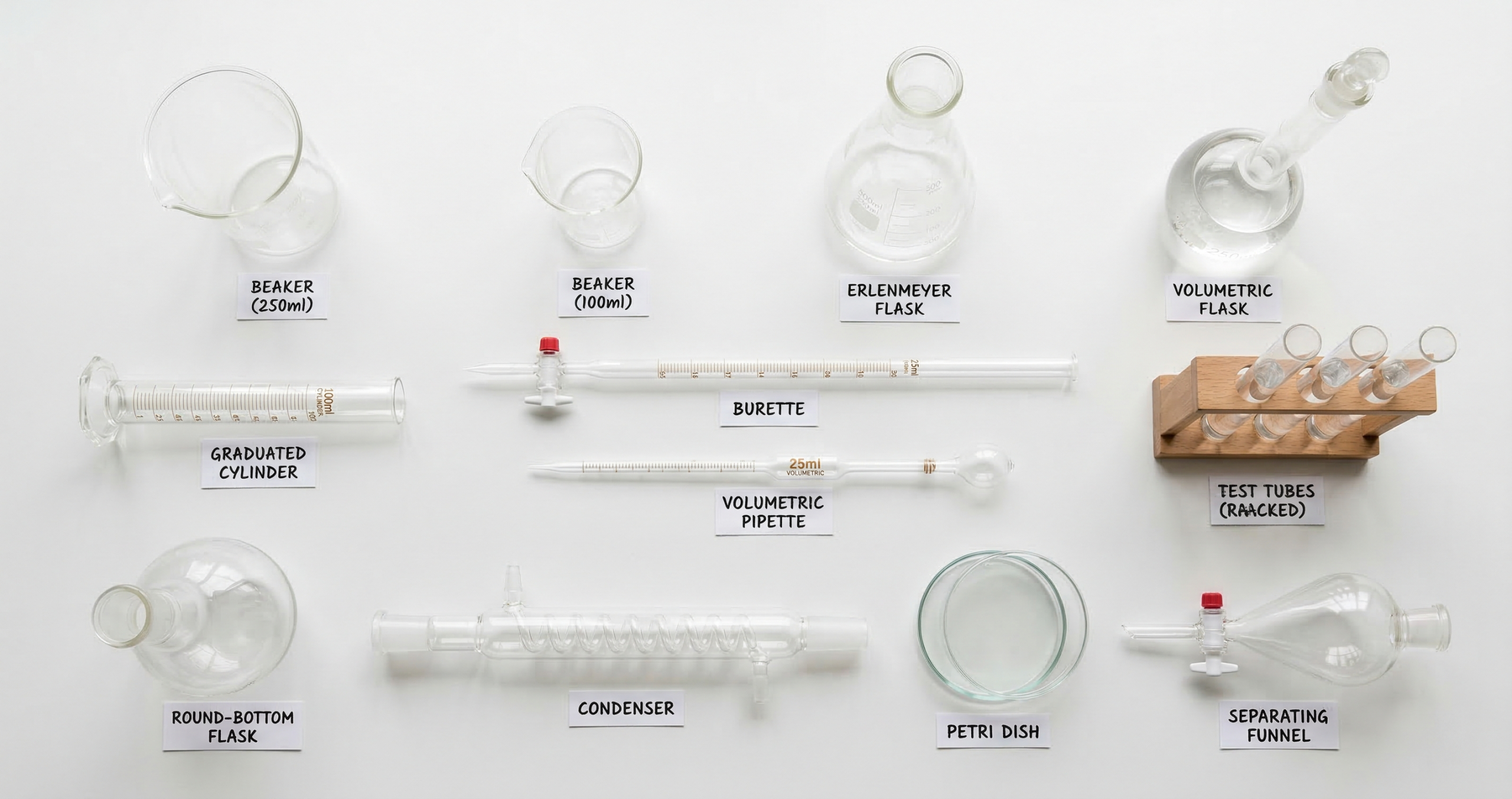
This complete visual guide covers the 12 most essential types of common laboratory glassware, explaining what each item does, when to use it, what sizes it comes in, and how to choose between options. Whether you are a new lab technician learning the equipment, a procurement officer sourcing labware for your facility, or a researcher comparing standard glassware categories, this guide gives you everything you need in one place.
Medilab Exports Consortium manufactures and exports the full range of common laboratory glassware to distributors and institutions in over 40 countries. Our comprehensive guide draws on decades of production expertise and direct experience with laboratory professionals worldwide – from pharmaceutical QC labs to university teaching departments.
What Is Laboratory Glassware?
Laboratory glassware refers to precision instruments and vessels made from specialized glass – primarily borosilicate glass 3.3 – used in scientific experiments, analysis, measurement, and chemical handling. Unlike ordinary glass, laboratory-grade glassware is designed to withstand chemical exposure, thermal stress, and sterilization processes while maintaining dimensional accuracy. It is governed by ISO and ASTM international standards that specify tolerances, material requirements, and calibration procedures.
Understanding common laboratory glassware is the first step toward equipping any scientific workspace intelligently. Each piece serves a specific function, and using the wrong glassware for a task introduces measurement error, contamination risk, or safety hazards. The guide below covers the 12 most widely used types in detail.
1. Beakers
Beakers are the most recognizable piece of common laboratory glassware. They are cylindrical vessels with a flat bottom, a wide opening, and a small pouring spout. Beakers are used for mixing, stirring, heating, and rough volume measurement. They are not precision volumetric instruments – their graduation markings are approximate, typically within ±5% of the stated volume.
Available in sizes from 5 mL to 5,000 mL, borosilicate beakers are compatible with Bunsen burners, hot plates, and magnetic stirrers. They are found in virtually every laboratory on earth. Beakers are classified using Griffin (low-form) and Berzelius (tall-form) designations. For common laboratory glassware procurement, beakers represent the highest unit count in most facility inventories.
2. Erlenmeyer Flasks (Conical Flasks)
The Erlenmeyer flask features a wide, flat bottom that tapers into a narrow cylindrical neck. This unique shape minimizes evaporation and prevents splashing during titration or swirling. It is one of the most versatile pieces of common laboratory glassware, used in titrations, microbial culture, chemical synthesis, and media preparation.
Erlenmeyer flasks are available in standard and baffled versions. Baffled flasks promote superior oxygen transfer in cell culture applications. Sizes range from 25 mL to 5,000 mL. Like beakers, Erlenmeyer flasks are general-purpose items not calibrated for precision measurement. They are manufactured from borosilicate 3.3 glass and can be autoclaved for sterile applications.
3. Volumetric Flasks
Volumetric flasks are precision instruments used for preparing solutions of exact concentration. They feature a pear-shaped body, a long narrow neck with a single calibration mark, and a stopper. The calibration mark defines the exact volume the flask holds at 20°C. Volumetric flasks are critical common laboratory glassware for all quantitative analytical chemistry.
They are available in Class A and Class B accuracy grades. Class A volumetric flasks meet the tightest tolerances defined in ISO 1042 and ASTM E288, making them the standard for pharmaceutical assays, HPLC mobile phase preparation, and calibration standard preparation. For a full comparison, see our detailed guide on Class A vs Class B laboratory glassware.
4. Graduated Cylinders
Graduated cylinders are tall, narrow cylindrical containers with graduated scale markings used to measure liquid volumes. They offer better volume accuracy than beakers but are not as precise as volumetric flasks. They are one of the most commonly used pieces of common laboratory glassware for general volume measurement across a wide range in a single vessel.
Graduated cylinders are available in Class A and Class B grades per ISO 4788. Sizes typically range from 5 mL to 2,000 mL. They are used to measure liquids, transfer volumes, and approximate dilutions. They should never be heated directly, as thermal expansion permanently alters their calibrated volume markings.
5. Burettes
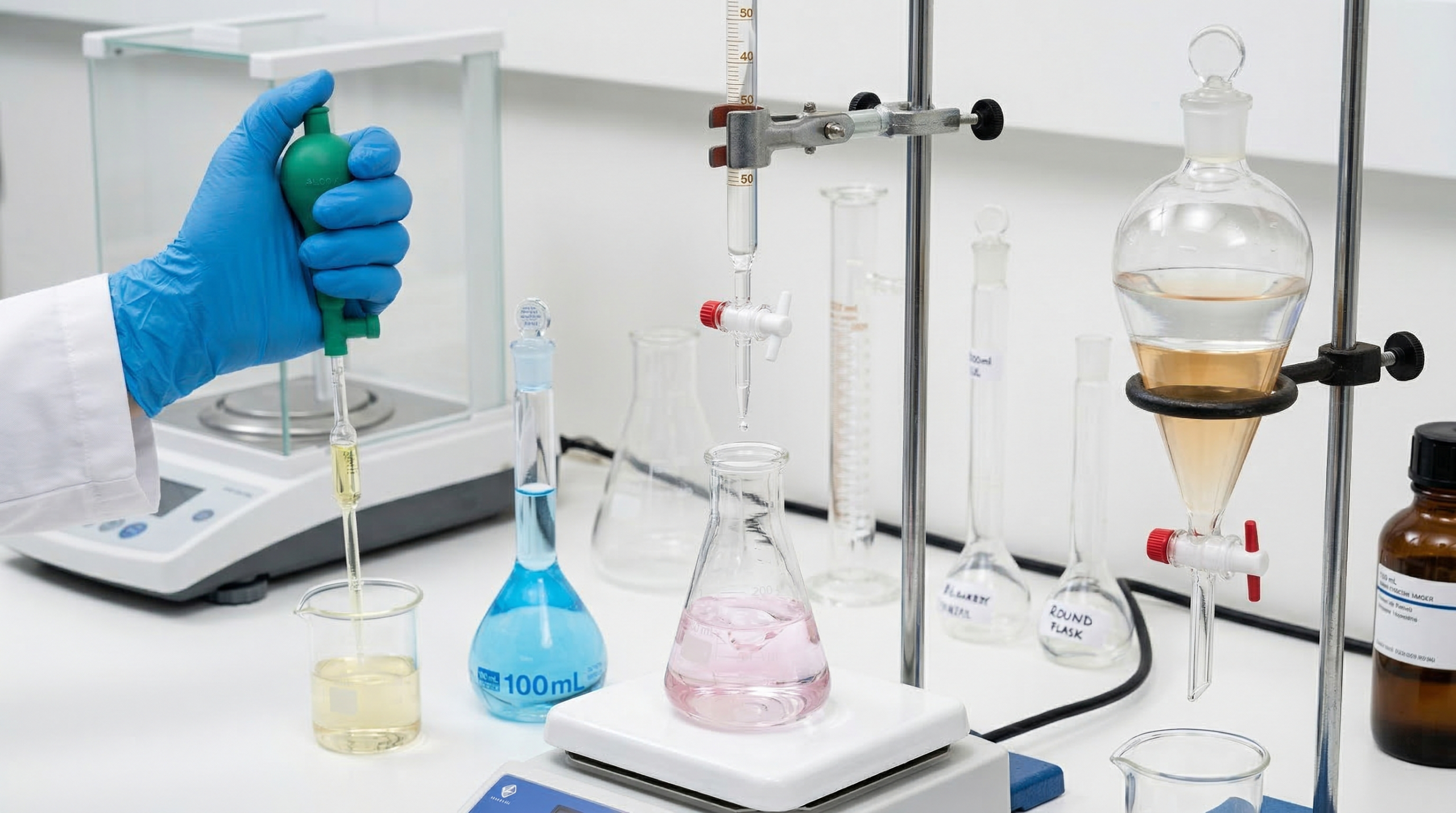
Burettes are long, precisely graduated glass tubes fitted with a stopcock at the bottom, used to dispense measured volumes of liquid with high precision. They are essential common laboratory glassware for all titration procedures – acid-base, redox, complexometric, and precipitation titrations alike. Class A burettes are calibrated to ISO 385 and deliver volumes with tolerances as tight as ±0.05 mL for a 50 mL burette.
Standard burettes hold 10, 25, or 50 mL. The traditional glass stopcock has been widely replaced by PTFE stopcocks in modern laboratories, which offer superior chemical resistance and reduced sticking. Proper burette maintenance – including vertical storage and cleaning with appropriate lab detergents – extends service life significantly.
6. Pipettes (Volumetric and Graduated)
Pipettes are glass tubes used to transfer precise, defined volumes of liquid between containers. They are a critical category of common laboratory glassware for analytical chemistry. One-mark (volumetric) pipettes deliver a single fixed volume with Class A accuracy per ISO 648. Graduated (Mohr and Serological) pipettes allow delivery of variable volumes.
Volumetric pipettes are the most accurate type, with tolerances of ±0.020 mL for a 10 mL Class A item. They are calibrated to deliver (TD) at 20°C – meaning the calibration accounts for the thin film of liquid remaining on the inner glass surface after draining. Pipette filler bulbs protect users from mouth-pipetting, a practice now prohibited in all regulated laboratories.
7. Test Tubes
Test tubes are small, cylindrical glass tubes closed at one end, used for holding, mixing, and heating small volumes of liquid or solid reagents. They are among the most fundamental pieces of common laboratory glassware, found in chemistry, biology, and microbiology labs worldwide. Standard borosilicate test tubes can be heated directly over a flame and are autoclavable for sterile applications.
Sizes are expressed as diameter × length (e.g., 16×150 mm, 18×180 mm). Culture tubes include rimmed and rimless variants. Centrifuge tubes feature a conical bottom designed to collect precipitates under centrifugal force. Test tube racks and holders are essential safety accessories used alongside this glassware type.
8. Round-Bottom Flasks
Round-bottom flasks have a spherical body that distributes heat evenly, making them the preferred choice for distillation, reflux, and rotary evaporation. Their geometry prevents localized overheating that could crack flat-bottomed vessels under direct flame. They are specialized common laboratory glassware for organic and inorganic synthesis applications.
Available in single-neck and multi-neck configurations, round-bottom flasks are supplied in sizes from 25 mL to 20,000 mL. Standard joint sizes (14/23, 19/26, 24/29, 29/32) allow integration with condensers, adapters, and distillation assemblies using interchangeable glassware systems. Always support round-bottom flasks with a clamp and stand during use – they cannot stand independently on a bench.
9. Condensers
Condensers are glass apparatus designed to cool and condense vapors back into liquid during distillation and reflux procedures. They are specialized but essential common laboratory glassware for any synthetic chemistry or separation workflow. The three main types are Liebig (straight tube, simplest design), Graham (spiral tube for longer contact time), and Allihn (bulb-type for reflux applications).
Condensers are connected to the water supply via inlet and outlet hose connections. Cold water flows through the outer jacket to cool the inner tube where vapor travels. Sizes are specified by effective condensing length (200–600 mm) and standard joint size at each end. Proper water flow rate is essential for efficient condensation and safe operation during prolonged distillations.
10. Petri Dishes
Petri dishes are shallow, flat-bottomed cylindrical glass dishes with a loose-fitting lid, used primarily in microbiology for culturing cells, bacteria, and fungi on agar media. They are also used in chemistry for crystallization, evaporation, and sample examination under a microscope. Petri dishes are fundamental common laboratory glassware in any biology or microbiology setting.
Standard sizes include 60 mm, 90 mm, and 150 mm diameter dishes. Borosilicate Petri dishes can be sterilized by autoclaving (121°C / 15 psi) or dry-heat oven treatment. Disposable plastic Petri dishes have replaced glass in many high-throughput settings, but glass remains the standard where reuse, solvent compatibility, or optical clarity under microscopy is required.
11. Watch Glasses
Watch glasses are concave, circular glass discs used as vessel covers, evaporation surfaces, and for weighing small quantities of solid reagents on an analytical balance. They are simple but indispensable common laboratory glassware items found in every chemistry laboratory. As a beaker cover, a watch glass reduces evaporation while still allowing gas to escape safely.
Available in diameters from 40 mm to 150 mm, watch glasses are generally manufactured from borosilicate glass. When used on a ring stand over a steam bath, they facilitate slow evaporative crystallization – a technique for growing well-formed crystals for X-ray diffraction studies or visual inspection of purified compounds.
12. Separating Funnels
Separating funnels, also called separatory funnels, are pear-shaped or cylindrical glass vessels fitted with a PTFE stopcock, used to separate immiscible liquid phases based on density differences. They are essential common laboratory glassware for liquid-liquid extraction, one of the most widely used purification techniques in organic chemistry and pharmaceutical synthesis.
After adding the mixture and extraction solvent, the user inverts and vents the funnel repeatedly before allowing the phases to separate. The denser phase settles to the bottom and is drained through the stopcock. Sizes range from 50 mL to 2,000 mL. Borosilicate separating funnels are compatible with most organic solvents, acids, and aqueous solutions used in extraction procedures.
Quick Reference: Common Laboratory Glassware Comparison Table
The following table summarizes the 12 most common types of common laboratory glassware, their primary use, typical size range, and accuracy class. Use this reference when planning your lab inventory or evaluating supplier catalogs. For volumetric items, see our guide on complete guide to laboratory glassware and the Medilab Exports glassware catalog.
| Glassware Item | Primary Use | Size Range | Accuracy Class |
|---|---|---|---|
| Beaker | Mixing, heating, rough measurement | 5 mL – 5,000 mL | N/A (approximate) |
| Erlenmeyer Flask | Titration, culture, synthesis | 25 mL – 5,000 mL | N/A |
| Volumetric Flask | Exact solution preparation | 5 mL – 2,000 mL | Class A / Class B |
| Graduated Cylinder | Volume measurement | 5 mL – 2,000 mL | Class A / Class B |
| Burette | Titration dispensing | 10 mL – 100 mL | Class A / Class B |
| Pipette (Volumetric) | Precise liquid transfer | 1 mL – 100 mL | Class A / Class B |
| Test Tube | Small-scale reactions, culture | 10×75 mm – 25×200 mm | N/A |
| Round-Bottom Flask | Distillation, reflux, synthesis | 25 mL – 20,000 mL | N/A |
| Condenser | Vapor cooling, distillation | 200 mm – 600 mm | N/A |
| Petri Dish | Microbial culture, evaporation | 60 mm – 150 mm | N/A |
| Watch Glass | Cover, evaporation, weighing | 40 mm – 150 mm | N/A |
| Separating Funnel | Liquid-liquid extraction | 50 mL – 2,000 mL | N/A |
Frequently Asked Questions
The beaker is arguably the most commonly used piece of common laboratory glassware. It is found in virtually every laboratory type – from teaching labs to pharmaceutical QC facilities – and is used daily for mixing, heating, and rough measurement. Erlenmeyer flasks and test tubes are close behind in terms of daily usage frequency across all lab disciplines.
A volumetric flask has a single calibration mark and is designed to contain one precise fixed volume at the highest accuracy (Class A tolerance per ISO 1042). A graduated cylinder has multiple markings along its length, allowing measurement of a range of volumes at lower precision. For preparing exact-concentration solutions, always use a volumetric flask. For rough volume measurement or approximate dilutions, a graduated cylinder is the appropriate choice. Both are essential pieces of common laboratory glassware serving different accuracy levels.
Premium common laboratory glassware is manufactured from borosilicate glass 3.3 – a formulation with a low thermal expansion coefficient (3.3 × 10⁻⁶/K) and the highest hydrolytic resistance (Type I, Hydrolytic Class 1 per ISO 719). This glass withstands temperature changes, chemical exposure, and repeated autoclaving without cracking or leaching contaminants into samples. Lower-cost soda-lime glass is occasionally used for disposable or non-critical items but is unsuitable for precision analytical work.
Volumetric glassware – including volumetric flasks, burettes, graduated cylinders, and volumetric pipettes – should never be heated. Heat changes the physical dimensions of the glass and permanently alters the calibrated volume, rendering the glassware inaccurate and unsuitable for precision work. Non-volumetric common laboratory glassware such as beakers, Erlenmeyer flasks, test tubes, and round-bottom flasks can be heated, with appropriate precautions taken to prevent thermal shock.
Yes. Medilab Exports Consortium manufactures and exports the complete range of common laboratory glassware – including beakers, Erlenmeyer flasks, volumetric flasks, graduated cylinders, burettes, pipettes, test tubes, round-bottom flasks, condensers, and more. All glassware is manufactured from borosilicate 3.3 glass with ISO certification available for Class A volumetric items. Contact us for pricing, specifications, and bulk supply arrangements for your laboratory or distribution business.
Source the Complete Range of Common Laboratory Glassware
Medilab Exports Consortium manufactures ISO-certified borosilicate common laboratory glassware for global distributors. Full product catalog available. MOQ available for all standard items. Serving distributors in 40+ countries.
