

Laboratory glassware manufacturer selection is the most critical starting point for any procurement professional. The quality, traceability, and consistency of the glassware your facility uses directly determines the reliability of every measurement, assay, and analytical result your team produces. Choosing the right source means securing precision that stays within tolerance, documentation that survives audits, and material strength that ensures safety. In a high-stakes scientific environment, the vessel is not just a container; it is a calibrated instrument that must perform predictably under extreme thermal and chemical stress.
This comprehensive guide explores the essential criteria for evaluating a laboratory glassware manufacturer — from international certifications and borosilicate material specifications to supply chain reliability and technical support availability. Whether you are equipping a new pharmaceutical quality control lab, sourcing equipment for an environmental testing facility, or managing a university research department, these criteria provide a defensible framework for a professional sourcing decision. We will delve into the technical nuances of glass composition, the metrology of calibration, and the logistics of global laboratory supply chains.
Medilab Exports Consortium has supplied premium borosilicate 3.3 labware to distributors and institutions in more than 40 countries. Our insights reflect over twenty years of experience in scientific glass manufacturing and the rigorous quality expectations of international regulated markets. We understand that in the world of research, “close enough” is never sufficient, and the manufacturer you choose is your first line of defense against measurement uncertainty and experimental failure.
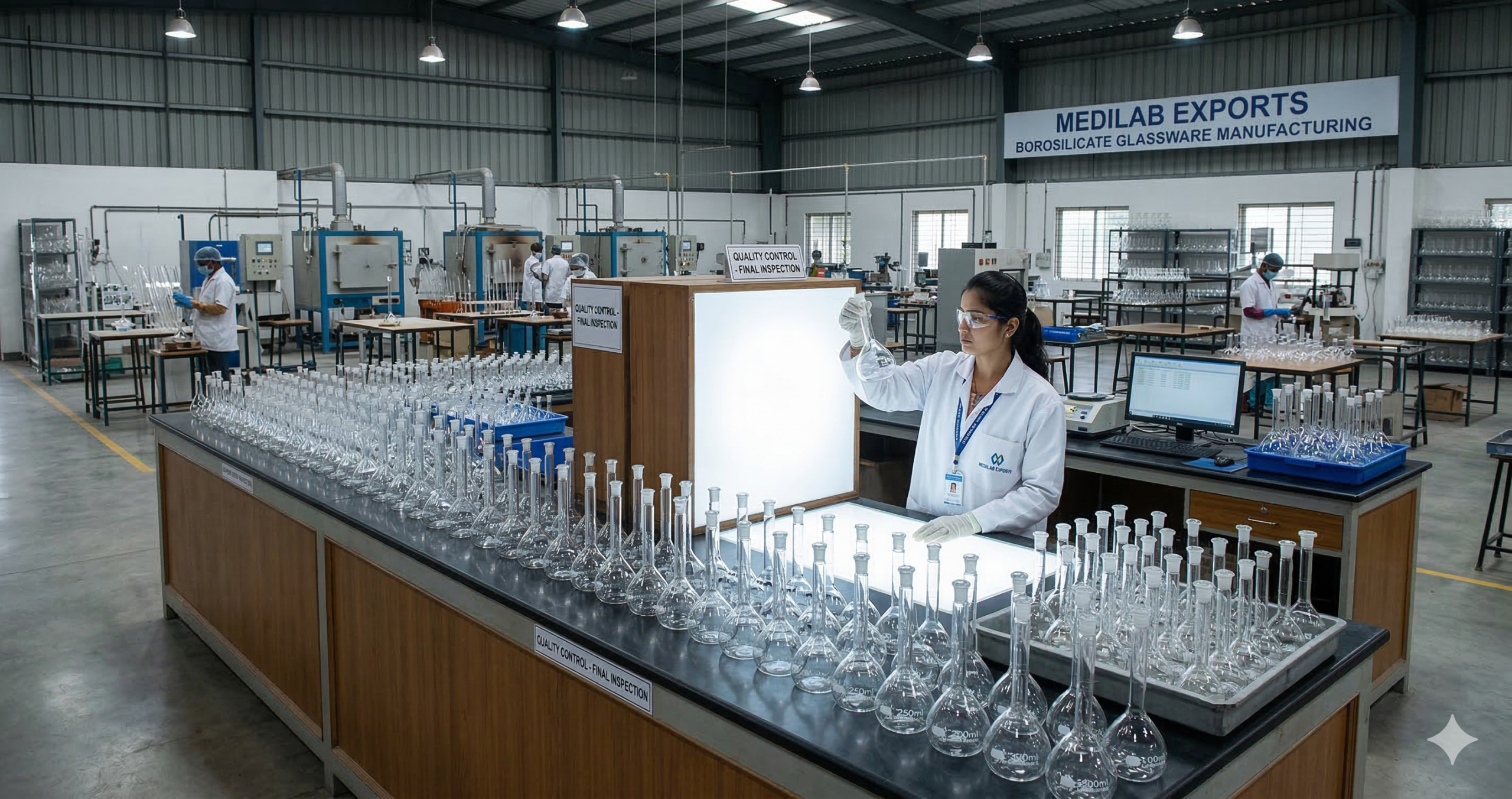
Why Choosing the Right Source Matters More Than the Glass Itself
When procurement decisions ignore the reputation of the manufacturer, labs often discover hidden costs after an audit failure or a failed titration. The production facility behind your equipment determines if the nominal volume on the label corresponds to the physical volume in the vessel, and if the borosilicate composition meets the hydrolytic resistance standards required for non-reactive analytical work. A low-quality vessel may look identical on the shelf, but its performance under vacuum or at high temperatures will quickly reveal its true nature.
A piece of labware that looks identical to a certified item but is made from cheaper soda-lime glass can silently introduce bias into every workflow. Pharmaceutical firms operating under FDA 21 CFR Part 211, environmental labs accredited to ISO/IEC 17025, and research institutions publishing peer-reviewed data all share a common need: their glass MUST come from a provider whose quality system is documented and auditable. Without this traceability, every result generated by the lab is potentially subject to challenge by regulatory bodies or peer reviewers.
Furthermore, the manufacturing process itself—specifically the annealing phase—is critical. Glass that has not been properly annealed contains internal stresses that can cause it to shatter unexpectedly. A reputable source invests in precise temperature control and long cooling cycles to ensure every beaker and flask is structurally sound. When you choose a partner, you are not just buying glass; you are buying the assurance that your staff is safe from preventable accidents and your data is safe from systematic errors.
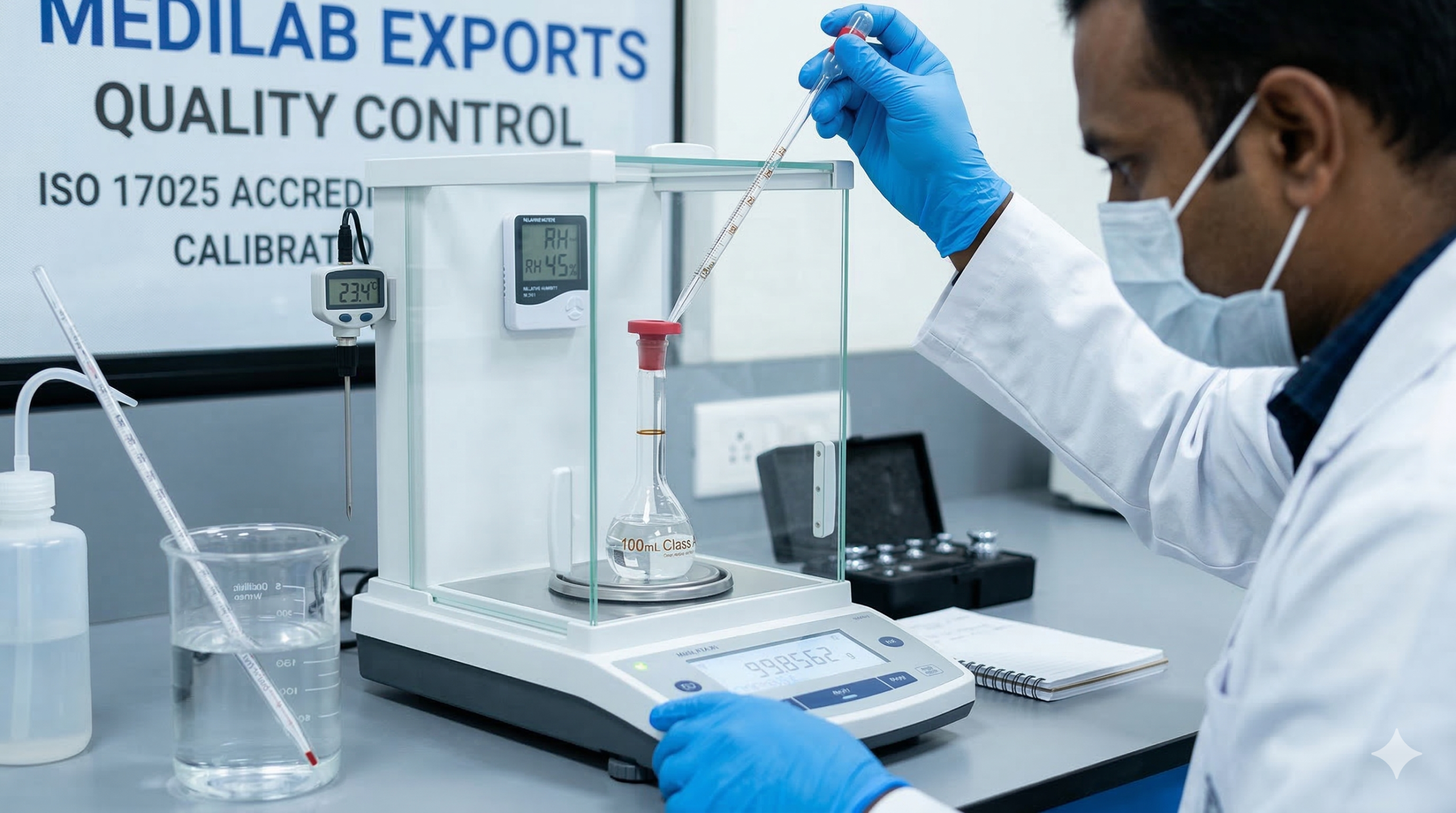
1. Certification and International Standards Compliance
The primary criterion for any professional source is compliance with international standards. These documents define the tolerance values, graduation markings, and material properties that separate precision instruments from decorative glass. For volumetric items, look for ISO 1042 (flasks), ISO 385 (burettes), ISO 648 (pipettes), and ISO 4788 (cylinders). In North America, ASTM E288 is the primary reference for flask accuracy. These standards are the “language” of precision, and any manufacturer unable to speak this language is unsuitable for professional use.
A qualified producer will cite the specific standard applied to each product. If a supplier uses vague terms like “high quality” without a standard number, they likely haven’t performed the necessary testing to verify their claims. In pharmaceutical settings, ensure the manufacturer’s Class A items meet USP/EP requirements for solution preparation. This level of rigor is essential for ensuring that the 0.1 mL tolerance on your 100 mL flask is a reality, not just a marketing claim. The difference between a compliant and non-compliant vessel might be only a few microliters, but in analytical chemistry, those microliters are the difference between a pass and a fail.
Moreover, standards compliance extends to the markings on the glass. The graduation lines must be durable enough to withstand hundreds of wash cycles without fading. They must be thin enough to allow for precise meniscus reading, and they must be positioned with metrological accuracy. A manufacturer that shortcuts the printing or etching process is shortcutting your science. Always verify that the markings follow the color-coding and placement rules defined by ISO or ASTM guidelines.
2. Material Quality: Why Borosilicate 3.3 is the Gold Standard
A professional laboratory glassware manufacturer uses borosilicate glass 3.3 as their primary raw material. This formulation (min 80% SiO2, 13% B2O3) provides a low coefficient of thermal expansion and Type I hydrolytic resistance. Soda-lime glass, while cheaper, has high thermal expansion and leaches alkali ions, which can contaminate trace metal analysis and biological assays. The unique chemistry of borosilicate 3.3 allows it to expand and contract uniformly, preventing the mechanical failure known as thermal shock.
Always request a material data sheet from your supplier. Important parameters include the expansion coefficient (≤3.3 × 10⁻⁶ K⁻¹), resistance class (HGB 1), and density (~2.23 g/cm³). Using inferior glass leads to “stars,” stress cracks, and contamination bias—risks that far outweigh any minor cost savings from non-certified sources. In high-temperature applications, such as distillation or reflux, the purity of the glass is paramount. Impurities in the glass can act as nucleation sites for cracks or can react with sensitive reagents, leading to anomalous experimental results.
Additionally, the hydrolytic resistance of Type I glass ensures that the pH of your samples remains stable. This is particularly critical in life sciences and biochemistry, where even a slight shift in pH can deactivate enzymes or alter cellular behavior. When you source your supplies, you are essentially selecting the “chemical environment” in which your reactions occur. Choosing borosilicate 3.3 ensures that this environment is as inert and predictable as modern material science allows.
3. Tolerance Accuracy and Calibration Traceability
Volumetric accuracy is non-negotiable in analytical chemistry. A reliable source produces Class A items that meet ISO/ASTM tolerances across their entire size range. Most Class A items are supplied with batch certificates, but metrology-grade work may require individual certificates recording the specific volume of that unique piece. This data allows you to account for individual instrument bias, pushing your measurement precision to the absolute theoretical limit.
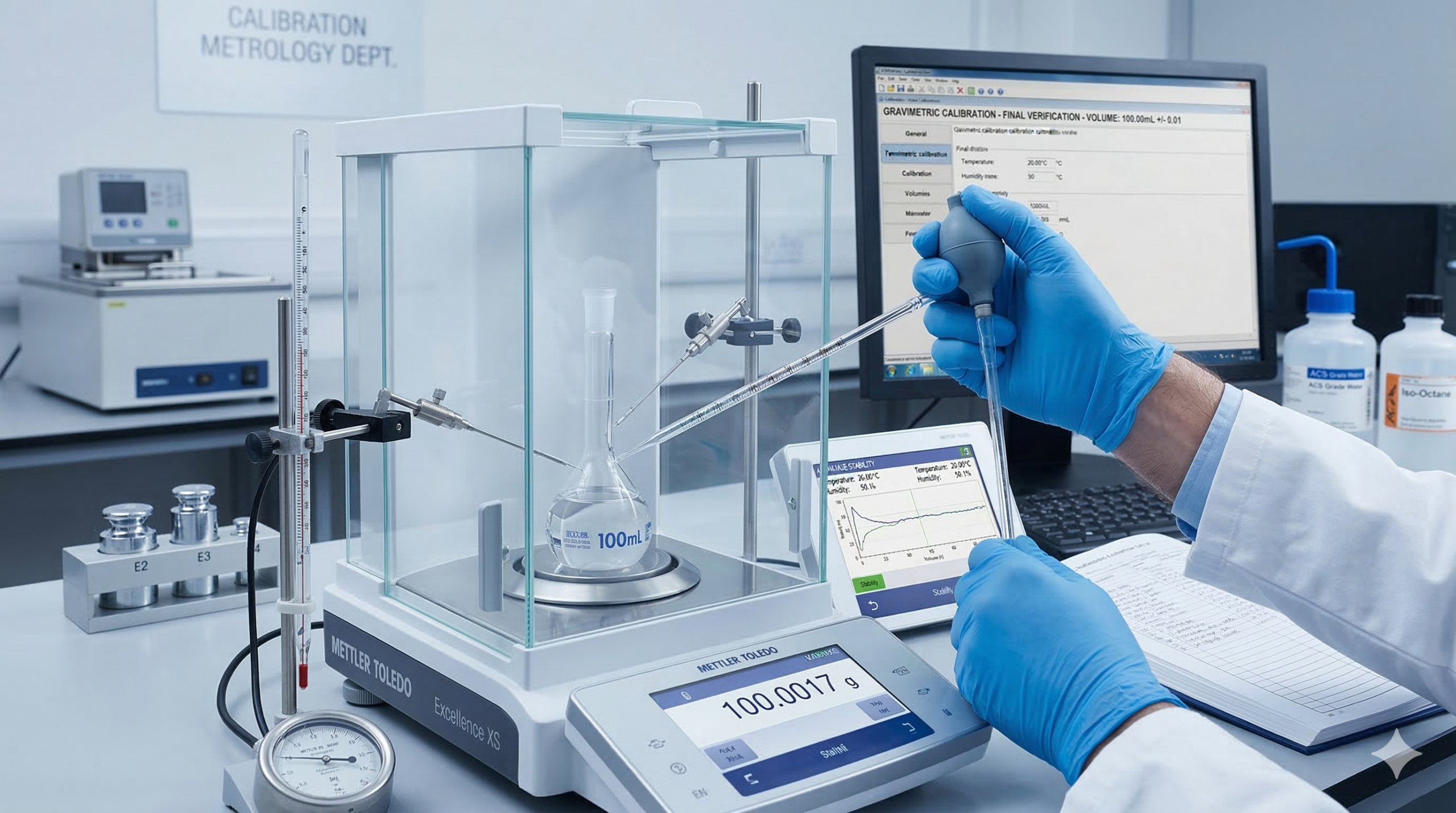
Verify that your supplier’s calibration equipment is traceable to national institutes like NIST (USA) or NPL (UK). The industry standard for verification is gravimetric: filling the vessel with 20°C distilled water and measuring the mass on a precision balance. This procedure ensures your data remains certain and your results remain reproducible across different laboratories. Without a clear chain of traceability, your laboratory certificates have no regulatory weight during an audit. The calibration laboratory at your chosen manufacturer should be a temple of precision, with temperature and humidity controls that rival those of the finest research facilities.
Furthermore, the “TD” (To Deliver) versus “TC” (To Contain) markings must be accurate. A pipette that is supposed to deliver 10 mL must account for the infinitesimal volume of liquid that remains on the glass wall after draining. A manufacturer that handles these subtle calibrations correctly demonstrates a deep understanding of fluid dynamics and surface tension—expertise that directly translates to the accuracy of your titrations and dilutions.
4. Product Range and Custom Fabrication Capability
A leading laboratory glassware manufacturer should be a “one-stop shop” for standard needs: volumetric flasks, PTFE burettes, cylinders, and flasks. However, many breakthroughs happen with non-standard setups. Assess your provider’s ability to create custom joint sizes, bespoke reactor geometries, or specialized glassware for automated liquid handlers. The ability to solve unique engineering challenges with glass is the hallmark of a true scientific partner.
Custom work requires skilled scientific glassblowers and specialized annealing ovens. If a provider only sells “off-the-shelf” items, they may lack the deep technical expertise needed to support complex research projects. Review the full Medilab Exports catalog to see the breadth of both standard and specialized options available for global export. Having a manufacturer that can fabricate a specific condenser or a multi-neck flask to your exact specifications allows you to design your experiments around your science, not around the limitations of your catalog.
Moreover, the availability of specialized coatings—such as amber glass for light-sensitive reagents or plastic-coated glass for added safety—is a sign of a mature product range. These “value-add” options demonstrate that the manufacturer understands the practical challenges of the laboratory bench, where light degradation and accidental breakages are constant threats to productivity.
5. Supply Chain Reliability and Global Shipping
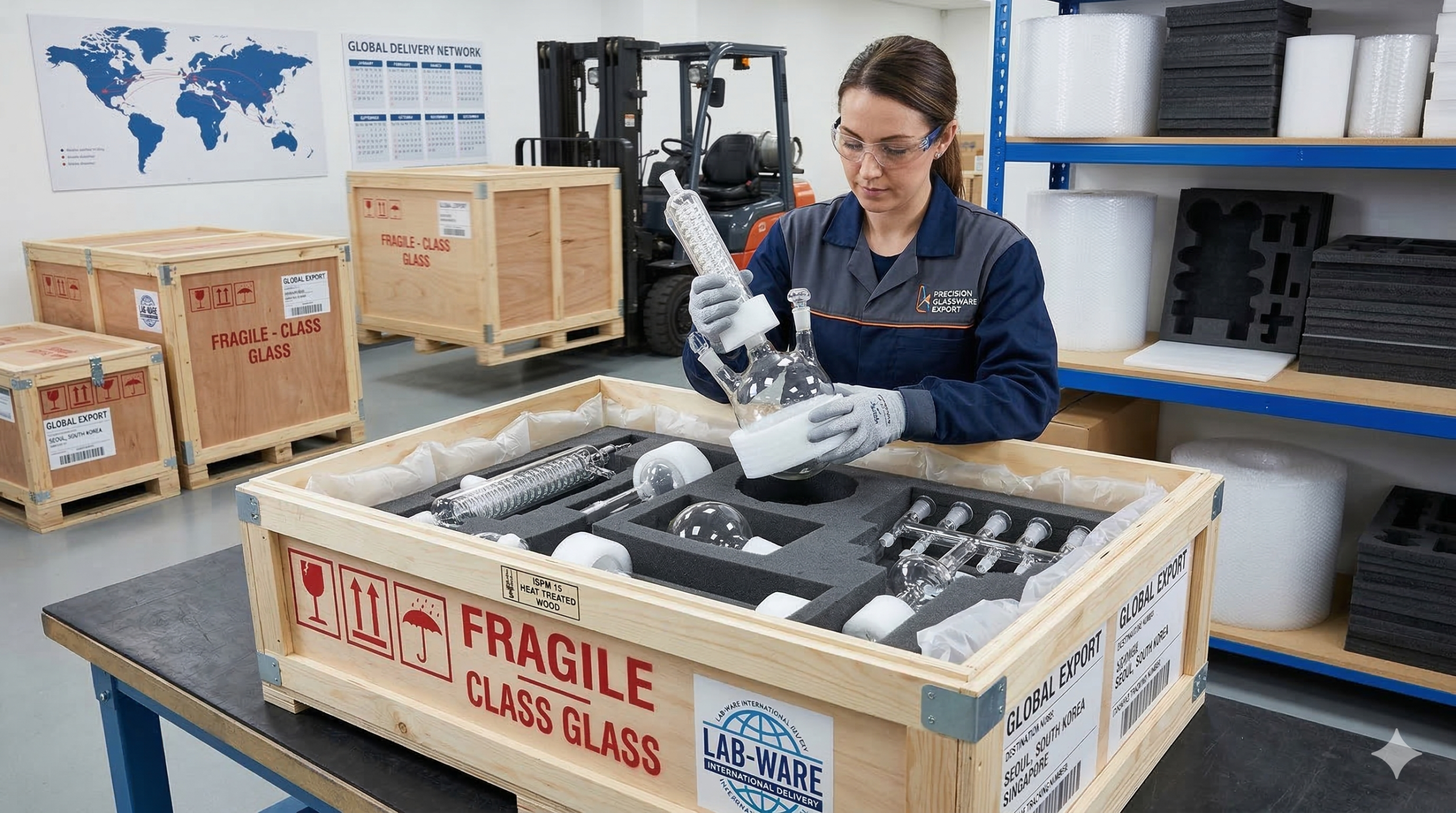
Even the best glass is useless if it arrives broken or late. Supply chain reliability is critical. Ask about committed lead times versus estimates, and verify their packaging standards. International shipping requires multi-layer cushioned protection to keep breakage rates near zero. Check if they maintain stock of “fast-moving” items like beakers and flasks to avoid production delays. A manufacturer that controls its own logistics chain is often more reliable than one that relies entirely on third-party aggregators.
Experienced exporters like Medilab Exports handle all regulatory documentation—HS codes, certificates of origin, and conformity documents—to ensure smooth customs clearance in markets from the EU to Southeast Asia. This administrative maturity is just as important as the physical quality of the glass when managing large-scale laboratory inventories. Delays at the border can be as damaging as defects on the production line, so choose a partner with a proven track record of international compliance.
Additionally, consider the manufacturer’s environmental impact. A reliable laboratory glassware manufacturer will use sustainable packaging materials where possible and optimize their shipping routes to minimize their carbon footprint. As laboratories worldwide move toward “Green Lab” certifications, the environmental practices of your suppliers become an extension of your own institution’s sustainability goals.
6. Technical Documentation and After-Sales Support
The relationship with a professional provider should continue long after the sale. In regulated labs, you will need support for vendor audit questionnaires and regulatory inspections. A quality provider has technical staff (not just sales reps) who can answer questions about chemical resistance, thermal limits, and metrological uncertainty. They should be able to provide detailed guidance on the compatibility of their glass with specific aggressive chemicals or extreme cryogenic temperatures.
Ensure your supplier maintains permanent technical files for their products. When an auditor asks for the spec of the 100 mL flask used in a drug stability study, you need that document instantly. Proactive support includes providing MSDS, chemical tables, and application notes that help your team work safer and more accurately every day. After-sales support also includes a clear and fair returns policy for any defective items, as well as a willingness to provide technical training for your staff on the proper care and maintenance of specialized glass apparatus.
Finally, look for a laboratory glassware manufacturer that actively participates in the scientific community. Manufacturers who attend major conferences, contribute to the development of international standards, and publish their own technical research demonstrate a commitment to the field that goes beyond simple commerce. This expertise is a resource you can tap into when designing new laboratory workflows or troubleshooting anomalous analytical results.
Red Flags to Avoid When Sourcing Glassware
Avoid any source that hides behind vague quality claims or “lowest in market” pricing. “Equivalent to Class A” is not Class A. Unusually cheap glass often uses inferior raw materials that weaken after just a few autoclave cycles. Evasive customer service is another major warning sign—if they won’t answer technical questions now, they won’t help you during a regulatory audit or a quality investigation. A lack of transparent documentation is perhaps the biggest red flag of all; in science, if it isn’t documented, it didn’t happen.
Manufacturer Evaluation Checklist for Professional Labs
| Criterion | Required Standard | Rationale | Priority |
|---|---|---|---|
| Compliance | ISO 1042 / ASTM E288 / ISO 385 | Ensures global accuracy and audit traceability | Critical |
| Material | Borosilicate 3.3 (HGB 1) | Ensures thermal safety and chemical inertness | Critical |
| Calibration | Traceable Gravimetric Data | Foundation of analytical measurement certainty | Critical |
| Certification | Batch or Individual Certificates | Required for regulatory (GMP/ISO) compliance | High |
| Support | 24-48h Technical Response | Essential for troubleshooting and audits | High |
| Logistics | Certified Export Packaging | Minimizes operational breakage and delays | Medium |
Frequently Asked Questions
A batch certificate of conformance for Class A items is essential. It proves the glass was tested against international standards and found to be within the specified volumetric tolerance. It should include the standard number, the tolerance class, and the manufacturer’s quality stamp.
Its extremely low thermal expansion coefficient prevents breakage during heating, cooling, or sterilization. Furthermore, its high chemical resistance ensures that your samples and reagents aren’t contaminated by alkali ions leaching from the glass surface, which is a common issue with cheaper soda-lime glass.
Class B is suitable for general laboratory work, teaching, and reagent preparation where the highest precision isn’t required. However, for quantitative analysis, HPLC mobile phase preparation, and regulatory assays, Class A is mandatory due to its tighter tolerances (usually half those of Class B).
Source Professional Glassware from a Global Manufacturer
Medilab Exports Consortium is a direct laboratory glassware manufacturer and global exporter of ISO-certified borosilicate 3.3 laboratory equipment. We provide full documentation, expert technical support, and robust logistics for labs and distributors worldwide. Ensure your research is built on a foundation of precision.
